
Hansei: looking back with a lesson in mind
The two kanji are 反 (han), to turn back, and 省 (sei), to examine oneself, the same character as in the literary verb kaerimiru, to look back on oneself. Put together, hansei is turning back to examine what you did. The word nearly always assumes there is something to improve: a mistake, a weak point, a part of the plan that did not work.
That is the main difference from English reflection, which can be neutral or even happy, as in reflecting on a wonderful year. Hansei leans towards self-criticism, but it is meant to be constructive. A good hansei ends with a clear idea of what to do differently.
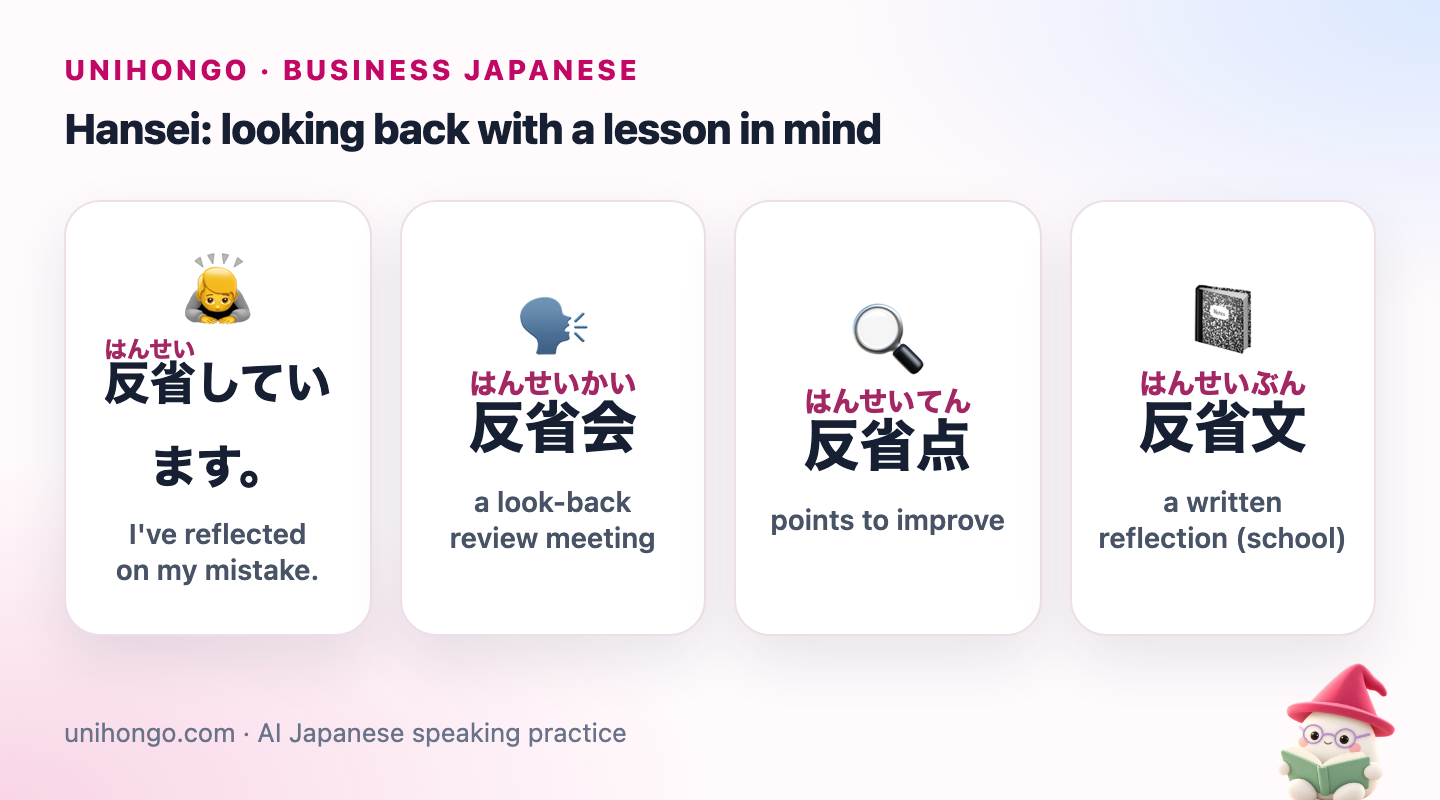
| Japanese | Romaji | Meaning |
|---|---|---|
| 反省しています。 | Hansei shite imasu. | I've reflected on my mistake. |
| 反省会 | hanseikai | a look-back review meeting |
| 反省点 | hanseiten | points to improve |
| 反省文 | hanseibun | a written reflection (school) |
Owning a mistake: apology, hansei and a fix
In many Japanese workplaces, a good response to a mistake has three parts. First comes a clear apology. Second comes hansei: what the cause was, stated briefly and without excuses. Third comes the countermeasure, taisaku, or a promise to prevent it happening again, saihatsu bōshi. Leaving out the third part can make the apology sound empty, and leaving out the second can sound as if you are blaming circumstances.
The humble form hansei shite orimasu, or the stronger fukaku hansei shite orimasu, I deeply regret it and have reflected on it, is common in emails and formal apologies. In conversation with your team, hansei shite imasu or simply a plain description of the cause is enough. Keep the cause short and factual, such as I did not double-check the address, rather than a long account of why you were busy.
| Japanese | Romaji | Meaning |
|---|---|---|
| ご迷惑をおかけして申し訳ございませんでした。 | Gomeiwaku o okake shite mōshiwake gozaimasen deshita. | I'm very sorry for the trouble I caused. (formal) |
| 確認が不十分でした。深く反省しております。 | Kakunin ga fujūbun deshita. Fukaku hansei shite orimasu. | My checking was not thorough. I have reflected on it deeply. |
| 今後は送信前に必ずダブルチェックします。 | Kongo wa sōshin mae ni kanarazu daburu chekku shimasu. | From now on I'll always double-check before sending. |
| 二度とこのようなことがないよう気をつけます。 | Nido to kono yō na koto ga nai yō ki o tsukemasu. | I'll take care that this never happens again. |
Hanseikai and furikaeri: review meetings at work
A hanseikai is held after a project, an event, a sports match or a school festival. People go through what happened and list good points and points to improve. It often happens even when everything went well, because the purpose is to make the next one better. Among friends and coworkers, the word is also used with a wink for the drinks after an event: the official hanseikai turns into a party.
Many companies now prefer the softer word furikaeri (振り返り), looking back, especially for regular team retrospectives. Furikaeri sounds neutral and forward-looking, while hansei can sound like the focus is on what went wrong. You will often hear both in the same office. Common structures are yokatta ten, good points, and kaizen ten or kadai, things to improve or issues.
| Japanese | Romaji | Meaning |
|---|---|---|
| 来週、プロジェクトの反省会をしましょう。 | Raishū, purojekuto no hanseikai o shimashō. | Let's hold a review of the project next week. |
| まず、よかった点から挙げていきましょう。 | Mazu, yokatta ten kara agete ikimashō. | Let's start by listing what went well. |
| 改善点は何でしょうか。 | Kaizen ten wa nan deshō ka. | What should we improve? |
| 今回の反省を次に活かしたいです。 | Konkai no hansei o tsugi ni ikashitai desu. | I want to use this time's lessons next time. |
| 今月の振り返りをしましょう。 | Kongetsu no furikaeri o shimashō. | Let's do this month's retrospective. |
Hansei is not neutral reflection or regret
English speakers often reach for hansei when they want to say reflect, and the result can sound odd. If you say kyonen o hansei shimashita about a happy year, it sounds as if the year was full of mistakes. For neutral looking back, Japanese uses furikaeru, to look back on, or omoikaesu, to recall. For simply thinking something over, kangaenaosu, to reconsider, works well.
Hansei is also different from kōkai (後悔), regret. Kōkai is the painful feeling of wishing you had done otherwise; it looks backwards. Hansei looks back in order to move forward. You can feel kōkai without any hansei, and a calm hansei does not need much kōkai at all.
| Japanese | Romaji | Meaning |
|---|---|---|
| この一年を振り返ってみましょう。 | Kono ichinen o furikaette mimashō. | Let's look back on this year. |
| あのとき言えばよかったと後悔しています。 | Ano toki ieba yokatta to kōkai shite imasu. | I regret not saying it at the time. |
| もう一度考え直します。 | Mō ichido kangaenaoshimasu. | I'll think it over again. |
| Word | What it does | Example situation |
|---|---|---|
| hansei | Looks back to find and fix a fault | A late report, a lost match |
| furikaeru | Looks back neutrally | Reviewing a year or a trip |
| omoikaesu | Recalls a memory | Thinking back to childhood |
| kōkai | Regrets, wishes it were different | Not saying goodbye to someone |
| kangaenaosu | Thinks again, reconsiders | Changing a decision |
Hansei at school, at home and in the news
Outside work, the word turns up in three common places. At school, a student who breaks a rule may be asked to write a hanseibun, a written reflection explaining what they did and how they will change. Parents tell children hansei shinasai, think about what you did, and sports coaches use it after a lost match.
In news reports, commentators often judge whether a person shows hansei. The phrase hansei no iro ga nai, literally no colour of hansei, means showing no remorse, and it is a serious criticism. In daily life, people also use the word lightly about themselves: after eating too much cake, tabesugita, hansei, I ate too much, lesson learned.
| Japanese | Romaji | Meaning |
|---|---|---|
| 何が悪かったか、よく反省しなさい。 | Nani ga warukatta ka, yoku hansei shinasai. | Think carefully about what you did wrong. (parent to child) |
| 反省の色が見られない。 | Hansei no iro ga mirarenai. | He shows no sign of remorse. (news, critical) |
| 昨日は飲みすぎた。反省。 | Kinō wa nomisugita. Hansei. | I drank too much yesterday. Lesson learned. (casual, joking) |
Mini dialogue: the review after a product launch
Two weeks after a product launch, a small team holds a hanseikai. The launch was a success, but the online shop crashed for an hour on the first day. Daniel, who managed the launch schedule, speaks first. Notice how the manager keeps the tone constructive.

| Japanese | Romaji | Meaning |
|---|---|---|
| では、反省会を始めましょう。まず、よかった点は? | Dewa, hanseikai o hajimemashō. Mazu, yokatta ten wa? | Manager: Let's start the review. First, what went well? |
| 予約数は目標を超えました。 | Yoyakusū wa mokuhyō o koemashita. | Daniel: Pre-orders beat our target. |
| 反省点としては、初日のアクセス集中を予想できませんでした。 | Hanseiten to shite wa, shonichi no akusesu shūchū o yosō dekimasen deshita. | Daniel: As a point to improve, I didn't foresee the first-day traffic spike. |
| 次回は事前に負荷テストをしましょう。 | Jikai wa jizen ni fuka tesuto o shimashō. | Daniel: Next time, let's run a load test beforehand. |
| いいですね。それを次に活かしましょう。 | Ii desu ne. Sore o tsugi ni ikashimashō. | Manager: Good. Let's put that to use next time. |
When hansei sounds too strong
Because hansei implies fault, using it about other people needs care. Asking a colleague hansei shite kudasai sounds like a scolding, and using it upwards is almost never appropriate. If you need to point out a problem, frame it as something for the team: tsugi wa kō shite mimasen ka, shall we try it this way next time?
The opposite problem also exists. Some learners, keen to fit in, attach hansei to every small slip. In a casual chat, a plain sumimasen, ki o tsukemasu, sorry, I'll be careful, is often more natural than a formal statement of reflection, which can sound heavier than the situation needs.
| Japanese | Romaji | Meaning |
|---|---|---|
| 次はこうしてみませんか。 | Tsugi wa kō shite mimasen ka. | Shall we try it this way next time? |
| すみません、気をつけます。 | Sumimasen, ki o tsukemasu. | Sorry, I'll be careful. (light, everyday) |
| みんなで改善していきましょう。 | Minna de kaizen shite ikimashō. | Let's improve it together as a team. |
Turn a real slip into practice with Mocchi
Think of a small mistake from your own week, such as a late reply or a missed meeting, and write a three-line apology email in Japanese. Paste it into Mocchi with /correct. Mocchi checks the keigo, points out where an excuse crept in, and suggests a cleaner hansei phrase and a concrete fix. It also keeps a note of the keigo forms you got wrong, so a later /review brings them back.
Then take the polished version to AI Sensei. Choose Yamada-sensei and ask him to play your manager in a performance review; say your apology aloud, answer his follow-up questions, and read the corrections in the session report afterwards.
Common learner mistakes
- Using hansei for happy reflection. For looking back on a great trip, use furikaeru.
- Apologising with hansei but no fix. Add a concrete next step, such as kongo wa zenjitsu ni kakunin shimasu, from now on I will check the day before.
- Telling others to do hansei. It is a rebuke; suggest improvements as a team instead.
- Over-explaining the cause. A long story about why you were busy sounds like an excuse, iiwake.
- Assuming every company runs hanseikai. Many teams use furikaeri or simply a short chat; follow what your own team does.