
Why rhythm is the highest-value fix
Several of the errors that most damage a learner's intelligibility are the same error wearing different clothes. Shortened long vowels, vanished small tsu, a swallowed moraic n and compressed unstressed syllables are all failures to give a mora its beat.
That means rhythm work is unusually efficient. Fixing the timing addresses all of them at once, where working through them individually treats each symptom separately.
It is also the difference most audible to a listener. A learner with a strong accent and accurate timing is easy to follow; a learner with good individual sounds and English rhythm is not, because the word boundaries and the word lengths are both wrong.
What counts as a beat
Before drilling, the count has to be right, and this is where learners most often go wrong. Several things that do not look like beats are beats, and they are exactly the ones that get dropped.
Count in moras, not in syllables. A syllable can contain two moras, and treating it as one is the compression you are trying to remove.
| Item | Beats | Example |
|---|---|---|
| A short vowel | 1 | か |
| A long vowel | 2 | かあ |
| The small tsu | 1, silent | かっ |
| The moraic n | 1 | かん |
| A ya, yu or yo combination | 1 | きゃ |
| A combination with a long vowel | 2 | きゅう |
The last two rows catch people out. A small ya, yu or yo joins the preceding kana into a single beat, while the same combination with a long vowel is two.
The routine
The routine is deliberately dull, which is a feature. It needs no material, no preparation and no decisions, so it survives on days when nothing else does.
The critical rule is that the metronome is never wrong. If a word does not fit the beats, the word is being compressed, and the answer is to slow down rather than to speed up the word.
- Set sixty beats per minute, one mora per beat.
- Say a word one mora per beat, including silent beats for the small tsu.
- Six words per session, the same six for a week.
- Ten minutes, daily; longer sessions produce fatigue rather than change.
- Only raise the tempo once every beat is landing without effort.
Words that expose the compression
Some words are much better drill material than others, because they contain the beats most likely to be swallowed. These six contain long vowels, small tsu and the moraic n between them.
Say each with a beat on every mora, including the silent one. The silent beat is the part learners skip, and it is a real beat.
| Japanese | Romaji | Meaning |
|---|---|---|
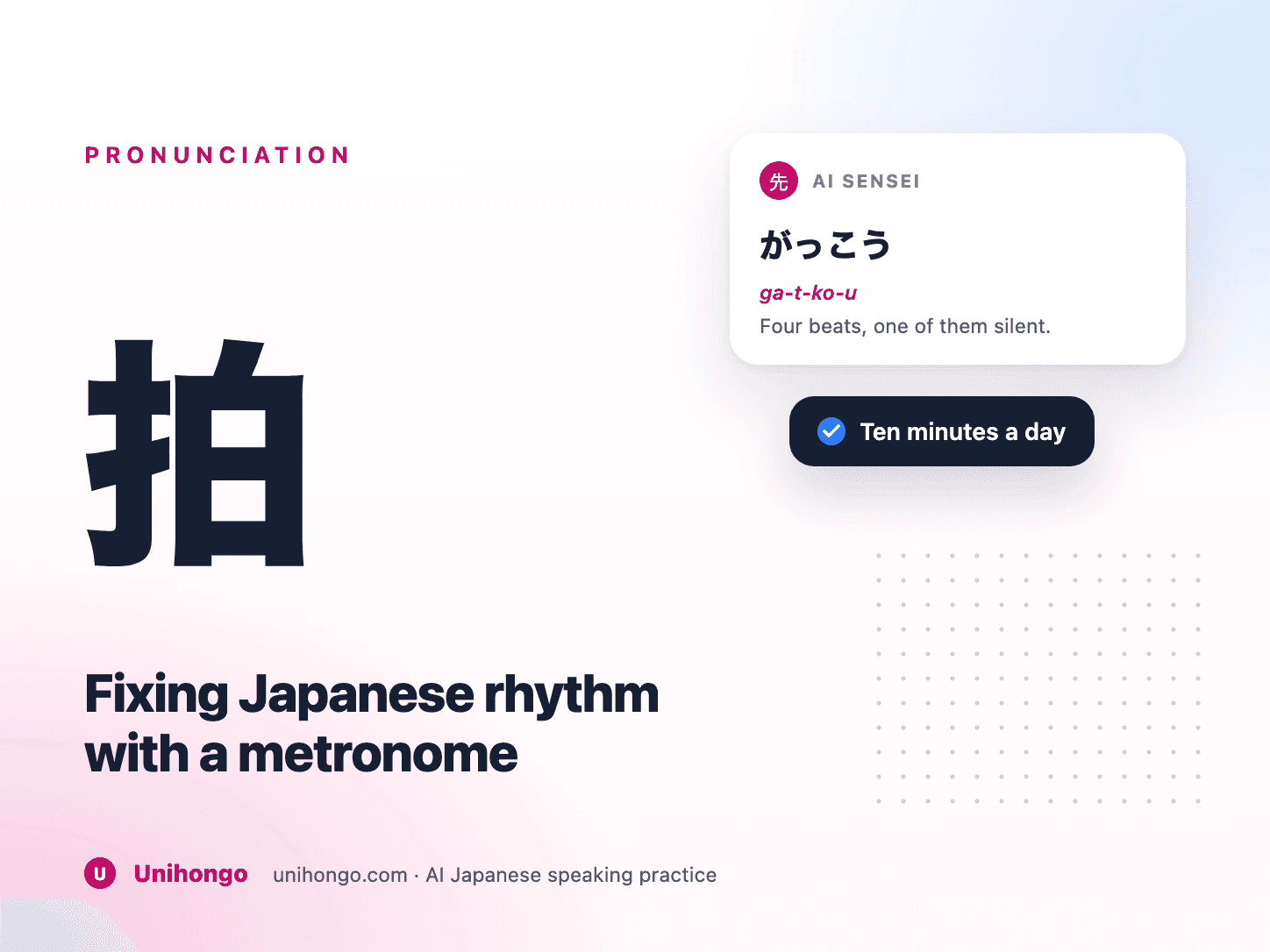
| がっこう | ga-t-ko-u | Four beats, one silent |
| きって | ki-t-te | Three beats, one silent |
| せんせい | se-n-se-i | Four beats |
| ちょっと | cho-t-to | Three beats |
| こうこう | ko-u-ko-u | Four beats |
| しんぶん | shi-n-bu-n | Four beats |
Adding speed last
The temptation is to speed up as soon as the slow version is comfortable, and this is where most rhythm work fails. At speed the old compression returns, and drilling at speed simply rehearses it.
Raise the tempo in small steps and drop back immediately whenever a beat starts to collapse. The goal is not to reach conversational speed in the drill; it is to build a rhythm that survives when you stop thinking about it.
- Move from sixty to seventy-two only after a week of clean beats.
- At each new tempo, expect the first day to be worse.
- Drop back a step whenever a long vowel starts shortening.
- Do not drill above conversational speed; there is no benefit.
- Finish every session with one slow repetition, to end on the correct pattern.
Checking it against something that is not you
A metronome fixes evenness, and evenness is not the whole target. It is possible to be perfectly even and still be wrong, most commonly by giving a long vowel one beat consistently rather than two.
That is why the drill needs an external check. Unihongo's pronunciation lab plays a native model line and scores your attempt, with focus modes for long vowels and the small tsu, which are exactly the beats a metronome cannot tell you are missing because it does not know what you meant to say.
The last step is conversation. Rhythm that is correct in a drill and compressed in speech is the normal intermediate state, and it resolves with spoken volume rather than more drilling; a session in the immersive 3D classroom, and the report afterwards, shows which words are still collapsing when your attention is elsewhere.
Two weeks of ten minutes a day is enough to hear a difference in a recording. Full transfer into unmonitored speech takes months, and it is worth every one of them.