
Shrine or temple: the difference you can see
A jinja is a Shinto shrine and an otera is a Buddhist temple, and as a visitor the difference shows before you read a single sign. A shrine usually announces itself with a torii, the two-post gate with no doors, and its main building is open at the front with a rope and a bell above the offering box. A temple usually has a roofed gate with heavy doors and guardian figures, a main hall with a Buddha statue inside, and often a large bell or a cemetery to one side. Names help too: jinja, jingū, and taisha are shrines, while ji, dera, and in are temples.
The two sit side by side in many neighbourhoods and share visitors without any tension, so you do not need to choose one. The practical reason to tell them apart is that the sequence at the offering box differs, and a couple of the words you use at the office differ. If you cannot tell, asking is completely normal, and the reply will be one word.
| Japanese | Romaji | Meaning |
|---|---|---|
| ここは神社ですか、お寺ですか。 | Koko wa jinja desu ka, otera desu ka? | Is this a shrine or a temple? |
| 鳥居があるので、神社ですね。 | Torii ga aru node, jinja desu ne. | There is a torii, so it must be a shrine. |
| お寺には仏像があります。 | Otera ni wa butsuzō ga arimasu. | Temples have Buddha statues. |
| 参拝してもいいですか。 | Sanpai shite mo ii desu ka? | May I pay my respects here? |
The gate and the path
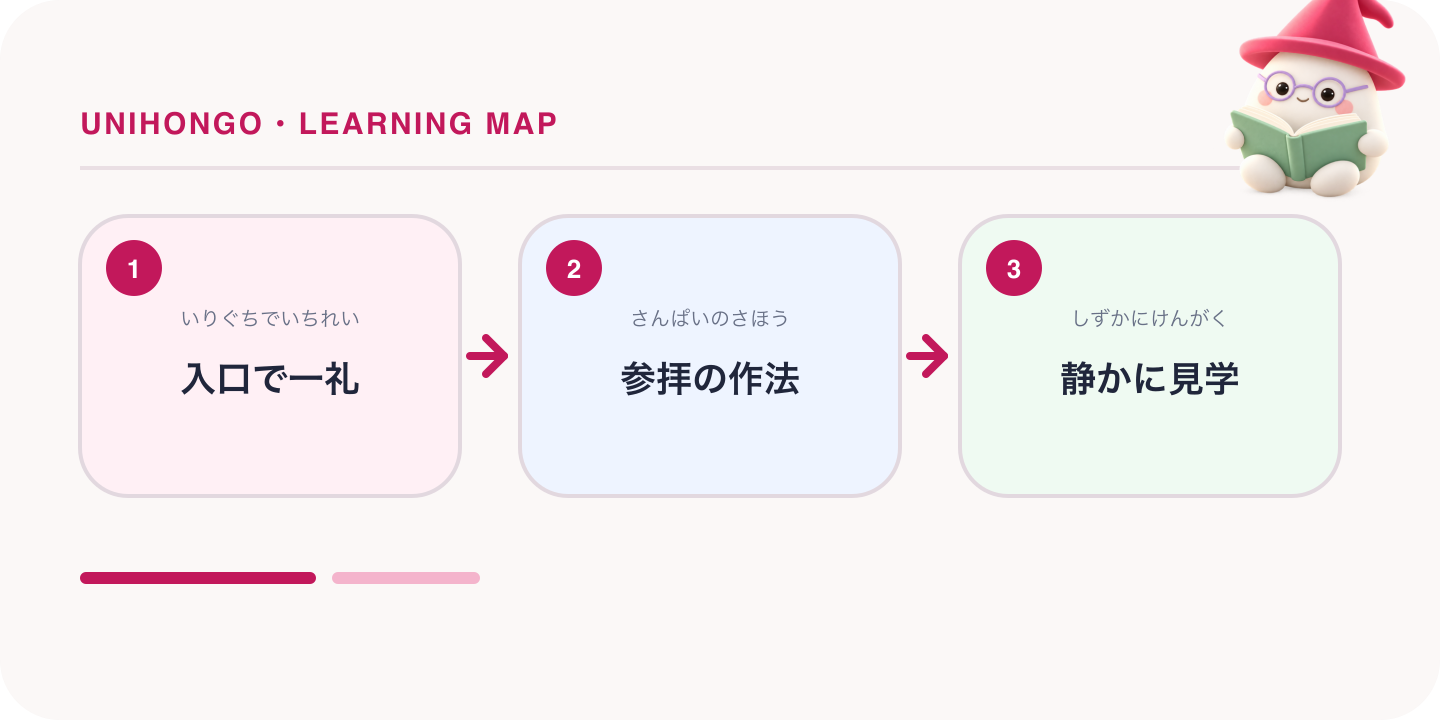
Many visitors pause and give a single bow before passing under a torii or a temple gate, and again on the way out, turning to face the buildings. It is a courtesy rather than a requirement, and you will see plenty of people walk straight through. On the approach path, the sandō, it is often said that the centre is kept for the deity, so people usually walk slightly to one side. Again, nobody will stop you if you forget, but it is an easy habit to copy.
Keep your voice down and put your phone on silent, especially near the halls, because the people around you may be there for a private reason. If you are with a group, this is the point to agree where to meet later, since the hall, the office, and the amulet counter are often in different corners of the grounds.
| Japanese | Romaji | Meaning |
|---|---|---|
| 鳥居の前で一礼します。 | Torii no mae de ichirei shimasu. | I bow once in front of the torii. |
| 真ん中は避けて歩きましょう。 | Mannaka wa sakete arukimashō. | Let's keep out of the centre as we walk. |
| 参道はこちらですか。 | Sandō wa kochira desu ka? | Is this the approach path? |
| お参りするところはどちらですか。 | Omairi suru tokoro wa dochira desu ka? | Where do I go to pay my respects? |
The water basin
Near the path there is usually a small roofed basin with ladles, called the temizuya or chōzuya, where visitors rinse their hands and mouth before approaching the hall. The whole sequence uses one scoop of water and takes about twenty seconds. In recent years some places have removed the ladles and run water through bamboo pipes instead, and some basins are dry or filled with flowers, so follow whatever is in front of you and whatever the people ahead of you do.
| Japanese | Romaji | Meaning |
|---|---|---|
| 手水舎はどこですか。 | Temizuya wa doko desu ka? | Where is the water basin? |
| 柄杓に口をつけません。 | Hishaku ni kuchi o tsukemasen. | You do not put your mouth to the ladle. |
| 先にどうぞ。 | Saki ni dōzo. | Please, go ahead. |
| 使い方を教えていただけますか。 | Tsukaikata o oshiete itadakemasu ka? | Could you show me how to use it? |
- Take the ladle in your right hand, scoop water, and pour some over your left hand.
- Switch the ladle to your left hand and pour some over your right hand.
- Switch back, pour a little water into your cupped left palm, rinse your mouth from your hand, and spit quietly into the drain beside the basin, never into the basin.
- Rinse your left hand once more.
- Tilt the ladle upright so the last of the water runs down the handle, then set it back face down.
The two things people notice are touching the ladle to your lips and drinking the water. Neither is dangerous, but both mark you as unsure. Keeping the ladle away from your mouth and using only a little water for each step solves both, and if the queue is long it is fine to rinse your hands only.
The offering box and the bow
At the hall of a shrine, the usual sequence is to place a coin gently into the wooden offering box, ring the bell if there is a rope, then bow deeply twice, clap twice, hold your hands together for a moment, and bow once more. Japanese people describe this as nirei nihakushu ichirei, two bows, two claps, one bow, and it is what most visitors do at most shrines. A few well-known shrines use a different number of claps, and where that is the case a sign by the box usually says so.
At a temple the sequence is quieter. Place your offering, put your palms together in front of your chest, bow once, and step aside. Clapping is not done at temples, and that is the mistake people notice most, because it carries the shrine habit into the wrong building. If there is an incense burner in front of the hall, many visitors light a stick or waft the smoke towards themselves, but it is optional.
The amount of the offering is your choice. Five-yen coins are popular because goen sounds like the word for a good connection, which is a widely repeated play on words rather than a rule. Do not throw the coin from a distance on an ordinary day; drop it in from close to the box.
| Japanese | Romaji | Meaning |
|---|---|---|
| お賽銭を入れます。 | Osaisen o iremasu. | I put in an offering. |
| 二礼二拍手一礼です。 | Nirei nihakushu ichirei desu. | Two bows, two claps, one bow. |
| お寺では拍手をしません。 | Otera de wa hakushu o shimasen. | At a temple you do not clap. |
| 静かに手を合わせます。 | Shizuka ni te o awasemasu. | I quietly put my palms together. |
| 鈴を鳴らしてもいいですか。 | Suzu o narashite mo ii desu ka? | May I ring the bell? |
| 五円玉がありますか。 | Goen-dama ga arimasu ka? | Do you have a five-yen coin? |
Amulets and fortunes
The counter selling amulets and fortunes is usually a window near the hall called the juyosho, and at a shrine the amount you pay is often called hatsuhoryō rather than a price, because it is framed as an offering. Amulets, omamori, are small cloth pouches each dedicated to one purpose, and the purpose is written on the front: traffic safety, health, study, safe childbirth, or finding a partner. You do not open them. Old ones are usually returned to a marked box at any shrine or temple rather than thrown away.
Fortunes, omikuji, are paper slips drawn from a box or by shaking a numbered stick out of a tube and taking the slip from the matching drawer. The overall grade is printed at the top in one or two kanji, followed by short lines about health, work, study, travel, and love. Learn the seven grade words and you can read the important part of any slip.
| Japanese | Romaji | Meaning |
|---|---|---|
| お守りをください。 | Omamori o kudasai. | An amulet, please. |
| 交通安全のお守りはありますか。 | Kōtsū anzen no omamori wa arimasu ka? | Do you have a traffic-safety amulet? |
| おみくじを一枚お願いします。 | Omikuji o ichimai onegai shimasu. | One fortune slip, please. |
| 大吉が出ました。 | Daikichi ga demashita. | I got a great blessing. |
| おみくじはここに結びますか。 | Omikuji wa koko ni musubimasu ka? | Do I tie the fortune here? |
| 古いお守りはどこに返しますか。 | Furui omamori wa doko ni kaeshimasu ka? | Where do I return an old amulet? |
| Grade | Reading | Meaning |
|---|---|---|
| 大吉 | daikichi | Great blessing, the best result |
| 中吉 | chūkichi | Middle blessing |
| 小吉 | shōkichi | Small blessing |
| 吉 | kichi | Blessing |
| 末吉 | suekichi | Blessing still to come |
| 凶 | kyō | Misfortune |
| 大凶 | daikyō | Great misfortune, the rarest result |
The exact ranking of kichi against chūkichi and shōkichi varies from place to place, so treat the middle of the scale loosely. Bad fortunes are usually tied to a rack or wire near the counter, and many people keep good ones. Ask where to tie it if you cannot see the spot.
The goshuin stamp book
A goshuin is a page of brush calligraphy and red seals that a shrine or temple writes into a dedicated book, the goshuinchō, as a record of your visit. The books are sold at most larger places, and any book works anywhere, though some people keep separate books for shrines and temples. The office is the shamusho at a shrine and often the nōkyōsho at a temple, and the fee is usually a fixed small amount paid in coins.
The etiquette that matters is order and patience. Pay your respects at the hall first, then go to the office, hand over the book open at the next blank page, and wait quietly while it is written; it is not a souvenir counter, and the person writing may be a priest. At busy times, or where nobody is available to write, you may be handed a pre-written sheet, called kakioki, to paste in later, and it is polite to accept that without complaint.
| Japanese | Romaji | Meaning |
|---|---|---|
| 御朱印をお願いします。 | Goshuin o onegai shimasu. | A goshuin, please. |
| 御朱印帳はありますか。 | Goshuinchō wa arimasu ka? | Do you sell stamp books? |
| 御朱印はどこでいただけますか。 | Goshuin wa doko de itadakemasu ka? | Where can I receive a goshuin? |
| 先にお参りしてきました。 | Saki ni omairi shite kimashita. | I have already paid my respects. |
| 書き置きでも大丈夫です。 | Kakioki demo daijōbu desu. | A pre-written sheet is fine too. |
| 初穂料はいくらですか。 | Hatsuhoryō wa ikura desu ka? | How much is the offering fee? |
Photography, shoes, and quiet zones
Photography on the grounds is generally fine, and photography inside halls is often not, so the safe habit is to look for the sign and ask if there is none. The inside of a hall may hold statues or paintings that are not to be photographed, or a ceremony may be in progress. Shoes come off at the entrance to many temple halls, where a sign says dosoku kinshi and a rack or a plastic bag is provided, and it is normal to carry your shoes with you along a marked route through the building.
| Japanese | Romaji | Meaning |
|---|---|---|
| 写真を撮ってもいいですか。 | Shashin o totte mo ii desu ka? | May I take photos? |
| 中は撮影禁止ですか。 | Naka wa satsuei kinshi desu ka? | Is photography banned inside? |
| 靴を脱ぎますか。 | Kutsu o nugimasu ka? | Do I take my shoes off? |
| ここに入ってもいいですか。 | Koko ni haitte mo ii desu ka? | May I go in here? |
| 外からならどうぞ。 | Soto kara nara dōzo. | From outside is fine. |
| 本堂の中はご遠慮ください。 | Hondō no naka wa goenryo kudasai. | Please refrain inside the main hall. |
The replies tend to be short and kind. Soto kara nara dōzo means you may shoot from outside, and goenryo kudasai is the polite way of saying no. Both are worth recognising instantly so you do not have to ask twice, and a small bow with hai, wakarimashita closes the exchange.
Festival days and the New Year
On festival days and during hatsumōde, the first shrine visit of the year, the same grounds fill with food stalls, queues, and loudspeaker announcements, and the quiet etiquette relaxes. Queue for the hall, follow the ropes and the staff directing traffic, and expect the offering box to be replaced by a long cloth so that hundreds of people can toss coins at once, which is the one time throwing is normal. Stalls usually take cash, and asking for the end of the queue is the most useful sentence of the day.
| Japanese | Romaji | Meaning |
|---|---|---|
| 今日はお祭りですか。 | Kyō wa omatsuri desu ka? | Is there a festival today? |
| 初詣に来ました。 | Hatsumōde ni kimashita. | I came for the first shrine visit of the year. |
| 屋台はどこですか。 | Yatai wa doko desu ka? | Where are the food stalls? |
| 列の最後尾はどこですか。 | Retsu no saikōbi wa doko desu ka? | Where is the end of the queue? |
| 何時まで開いていますか。 | Nanji made aite imasu ka? | Until what time is it open? |
Words you will read on signs
The signs use a small set of words, most of them kanji compounds that repeat across the country. Read them once here and you will recognise them on site, which matters because the most important ones are the ones telling you where not to go.
| Sign or word | Reading | Meaning |
|---|---|---|
| 神社 | jinja | Shinto shrine |
| お寺 | otera | Buddhist temple |
| 鳥居 | torii | Shrine gate |
| 山門 | sanmon | Temple gate |
| 参道 | sandō | Approach path |
| 手水舎 | temizuya or chōzuya | Water basin pavilion |
| 拝殿 | haiden | Shrine worship hall, where visitors stand |
| 本堂 | hondō | Temple main hall |
| 賽銭箱 | saisenbako | Offering box |
| 社務所 | shamusho | Shrine office |
| 授与所 | juyosho | Amulet and fortune counter |
| 納経所 | nōkyōsho | Temple goshuin office |
| 御朱印 | goshuin | Visiting stamp |
| 絵馬 | ema | Wooden wish plaque |
| 古札納所 | kosatsu nōsho | Box for returning old amulets |
| 撮影禁止 | satsuei kinshi | No photography |
| 立入禁止 | tachiiri kinshi | No entry |
| 土足禁止 | dosoku kinshi | Remove your shoes |
| 順路 | junro | Follow this route |
| 拝観料 | haikanryō | Admission fee for viewing |
| 静粛に | seishuku ni | Quiet, please |
Asking staff a question
Staff at the office and the counter are used to visitors, and they answer simple questions with simple Japanese. The pattern that covers almost everything is a noun plus wa arimasu ka for whether something exists, wa doko desu ka for where it is, and wa ikura desu ka for how much it costs. Open with sumimasen, ask one thing at a time, and close with arigatō gozaimashita. The broader set of question words is covered in the question words guide; here you only need these three frames and the nouns from the table above.
| Japanese | Romaji | Meaning |
|---|---|---|
| すみません、ちょっとお聞きしてもいいですか。 | Sumimasen, chotto okiki shite mo ii desu ka? | Excuse me, may I ask you something? |
| 拝観料はいくらですか。 | Haikanryō wa ikura desu ka? | How much is admission? |
| 英語のパンフレットはありますか。 | Eigo no panfuretto wa arimasu ka? | Do you have an English pamphlet? |
| お手洗いはどこですか。 | Otearai wa doko desu ka? | Where is the toilet? |
| この神社は何の神様ですか。 | Kono jinja wa nan no kamisama desu ka? | Which deity is enshrined here? |
| ありがとうございました。お参りできてよかったです。 | Arigatō gozaimashita. Omairi dekite yokatta desu. | Thank you. I am glad I could visit. |