

The question and why it is left unfinished
The full polite form is o-shigoto wa nan desu ka. It is correct and you can use it, but listen to Japanese speakers and you will hear it cut short: o-shigoto wa, with the voice rising at the end. Ending on wa turns the question into an invitation. The other person can answer with a category, a workplace or a vague ma, iroiro, oh, this and that, and no one has been put on the spot.
The o- in front of shigoto is not optional here. Shigoto wa, without it, is what you say to a friend; with a stranger or anyone senior, it sounds abrupt. A second question, nani o shite imasu ka or its casual version nani shiteru no, asks what someone does in a broader sense and is common between younger people, where the answer may be study or a part-time job.
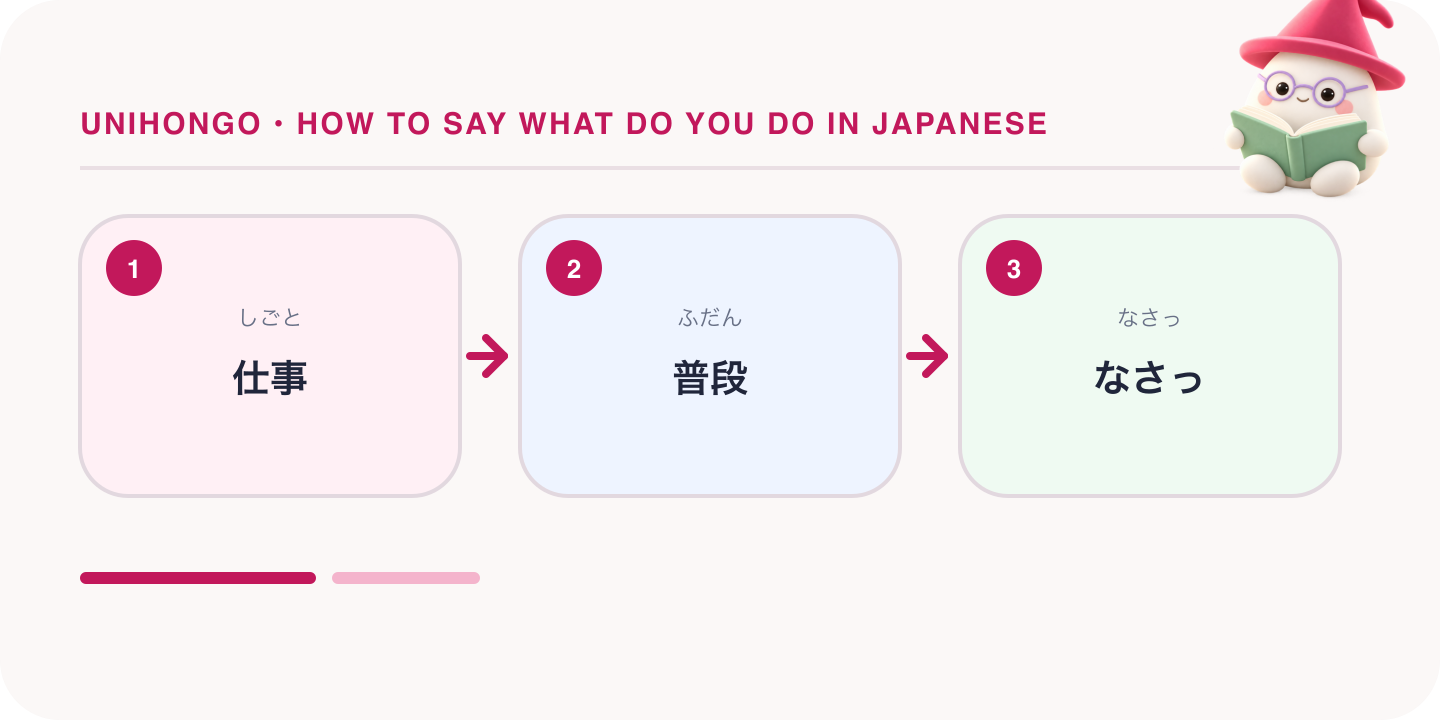
There is also a fully formal version for business settings: o-shigoto wa nani o nasatte imasu ka, using the honorific nasaru. You will hear it from hotel staff or at a formal dinner. Learners do not need to produce it, but recognising it means you will not be caught out.
| Japanese | Romaji | Meaning |
|---|---|---|
| お仕事は何ですか。 | O-shigoto wa nan desu ka. | What is your job? |
| お仕事は? | O-shigoto wa? | And your work? (softer, unfinished) |
| 普段は何をしていますか。 | Fudan wa nani o shite imasu ka. | What do you usually do? |
| 仕事、何してるの? | Shigoto, nani shiteru no? | What do you do for work? (casual) |
| お仕事は何をなさっていますか。 | O-shigoto wa nani o nasatte imasu ka. | What work do you do? (formal) |
| 失礼ですが、お仕事は? | Shitsurei desu ga, o-shigoto wa? | Excuse me for asking, but what do you do? |
Short answers that sound natural
Japanese answers to this question are shorter than English ones. The first reply names a category, and only if the other person asks again do you add what you actually do. Kaishain desu, I'm a company employee, is the classic and still the most common. Kōmuin desu, I'm a public servant, and jieigyō desu, I'm self-employed, fill the same slot.
The second pattern gives a place: X de hataraite imasu, I work at X, where X is a type of place or a company name. Ginkō de hataraite imasu, I work at a bank; IT no kaisha de hataraite imasu, I work at an IT company. This is the pattern to use when your role is hard to translate, because the workplace does the explaining.
The third pattern is a profession with desu: kyōshi desu, I'm a teacher; kangoshi desu, I'm a nurse; enjinia desu, I'm an engineer. Use it when the profession is a recognised word. When it is not, describe the work with o shite imasu: honyaku o shite imasu, I do translation.
| Japanese | Romaji | Meaning |
|---|---|---|
| 会社員です。 | Kaishain desu. | I'm a company employee. |
| 銀行で働いています。 | Ginkō de hataraite imasu. | I work at a bank. |
| ITの会社で働いています。 | Ai-tī no kaisha de hataraite imasu. | I work at an IT company. |
| 英語の教師をしています。 | Eigo no kyōshi o shite imasu. | I work as an English teacher. |
| 翻訳の仕事をしています。 | Hon'yaku no shigoto o shite imasu. | I do translation work. |
| 自営業です。 | Jieigyō desu. | I'm self-employed. |
Students, part-timers, freelancers and retirees
Not everyone answers with a job, and Japanese has ready phrases for each case. Students say gakusei desu, or name the level: daigakusei desu, I'm a university student, and add the subject with o benkyō shite imasu if asked. Someone working part-time says arubaito o shite imasu, and it is common to add where: kafe de arubaito o shite imasu.
Freelancers say furī de shigoto o shite imasu or furīransu desu, and then name the field. Someone between jobs says ima wa shigoto o sagashite imasu, I'm looking for work now, which is honest and closes the topic gently. Homemakers say shufu desu, or shufu o shite imasu, and men in the same role say shufu with the kanji for husband, read the same way.
Retirees say mō taishoku shimashita, I've already retired, and often add what they do now: ima wa nōgyō o yatte imasu, now I do farming. The phrase teinen taishoku, retirement at the mandatory age, is also common. Asking a retiree what they used to do is fine; asking why they retired is not.
| Japanese | Romaji | Meaning |
|---|---|---|
| 大学生です。経済を勉強しています。 | Daigakusei desu. Keizai o benkyō shite imasu. | I'm a university student. I study economics. |
| カフェでアルバイトをしています。 | Kafe de arubaito o shite imasu. | I work part-time at a café. |
| フリーで仕事をしています。 | Furī de shigoto o shite imasu. | I work freelance. |
| 今は仕事を探しています。 | Ima wa shigoto o sagashite imasu. | I'm looking for work at the moment. |
| もう退職しました。 | Mō taishoku shimashita. | I've already retired. |
| 主婦をしています。 | Shufu o shite imasu. | I'm a homemaker. |
Follow-up questions that are welcome
After a short first answer, the conversation continues with one of a small set of follow-ups. Dō iu o-shigoto desu ka, what kind of work is that, is the most useful, because it works after any first answer. Donna kaisha desu ka, what kind of company, follows kaishain desu. Nagai n desu ka, have you been doing it long, and taihen desu ka, is it hard, are friendly and low pressure.
Asking where someone works, dochira de hataraite irun desu ka, is fine; it asks for a place or a type of place, and the other person can answer as vaguely as they like. Asking about the job itself, shigoto wa tanoshii desu ka, is it enjoyable, is warm and usual. Each of these signals interest without demanding detail, which is the balance the Japanese conversation is aiming for.
| Japanese | Romaji | Meaning |
|---|---|---|
| どういうお仕事ですか。 | Dō iu o-shigoto desu ka. | What kind of work is it? |
| どんな会社ですか。 | Donna kaisha desu ka. | What kind of company is it? |
| どちらで働いているんですか。 | Dochira de hataraite irun desu ka. | Where do you work? |
| 長いんですか。 | Nagai n desu ka. | Have you been doing it long? |
| お仕事、楽しいですか。 | O-shigoto, tanoshii desu ka. | Do you enjoy the work? |
| 忙しい時期ですか。 | Isogashii jiki desu ka. | Is it a busy period? |
Questions that cross the line
Some questions that are casual in other countries are considered nosy in Japan, especially at a first meeting. Salary is the clearest: kyūryō wa ikura desu ka is not asked by anyone who wants to be invited back. Rank and company size are close behind; dono kaisha, which company exactly, and yakushoku wa, what's your position, sound like you are sizing the person up.
Asking why someone does not have a job, or when they will get one, is intrusive, and so is asking a homemaker whether they used to work. Age comes into this too: asking how long until retirement is a way of asking someone's age. The table below sets the safe versions against the ones to avoid.
| You want to know | Ask this | Reading | Not this |
|---|---|---|---|
| Their job | お仕事は? | o-shigoto wa | 何の仕事? to a stranger |
| What kind of work | どういうお仕事ですか | dō iu o-shigoto desu ka | 具体的に何をするんですか |
| Where they work | どちらで働いているんですか | dochira de hataraite irun desu ka | どの会社ですか |
| Whether it is enjoyable | お仕事、楽しいですか | o-shigoto, tanoshii desu ka | 給料はいいですか |
| How long they have done it | 長いんですか | nagai n desu ka | 何歳から働いていますか |
| A student's field | 何を勉強しているんですか | nani o benkyō shite irun desu ka | 卒業したらどうするんですか |
| A retiree's past work | 以前はどんなお仕事を? | izen wa donna o-shigoto o | どうして辞めたんですか |
| Their position | leave it unasked | let them volunteer it | 役職は何ですか |
| Their income | leave it unasked | never on a first meeting | 給料はいくらですか |
If someone asks you one of the right-hand questions, you are not obliged to answer. Ma, iroiro to, oh, various things, followed by a question of your own, is a polite way to redirect.
Turning the question around
After you answer, ask back. The simplest way is to echo the question with the person's name or with sochira wa: Tanaka-san wa, and you, or sochira wa o-shigoto wa, what about your work. Asking back is expected; answering and then going quiet can feel as though you were not interested.
A complete opening exchange between two adults who have just met is short. Here is one built from the phrases above.
- A: Shitsurei desu ga, o-shigoto wa?
- B: Kaishain desu. Ginkō de hataraite imasu. Tanaka-san wa?
- A: Watashi wa eigo no kyōshi o shite imasu.
- B: Sō nan desu ka. Dochira de oshiete irun desu ka?
- A: Kōkō de oshiete imasu. O-shigoto, isogashii desu ka?
- B: Ima wa chotto isogashii desu ne.
Notice that neither speaker gives a job title, and both ask a follow-up. That is the rhythm to copy: category, place, question back.
Mistakes that make the question sound blunt
The most common error is dropping the o- and asking shigoto wa nan desu ka to a stranger; it is grammatical but sounds like a form being filled in. A close second is translating what do you do word for word as nani o shimasu ka, which asks what someone will do, not what they do for a living. Use nani o shite imasu ka, with the -te imasu form, or stick to o-shigoto wa.
On the answering side, learners often give too much: the company name, the department, the title and the project, all in one breath. Japanese conversation prefers that you give one piece and wait to be asked for the next. Answer in one sentence, then ask back.
- Shigoto wa nan desu ka without the o- to someone you have just met
- Nani o shimasu ka, which asks about future plans, not work
- Answering with a full job title and department in one breath
- Asking dono kaisha or yakushoku wa on a first meeting
- Forgetting to ask back after you answer
- Assuming someone does not work, such as a parent at a school event
If you slip, a light shitsurei shimashita and a softer rephrasing puts things right. Japanese speakers correct their own register constantly, and the effort itself is read as good manners.