

Daijōbu: the all-purpose it's fine
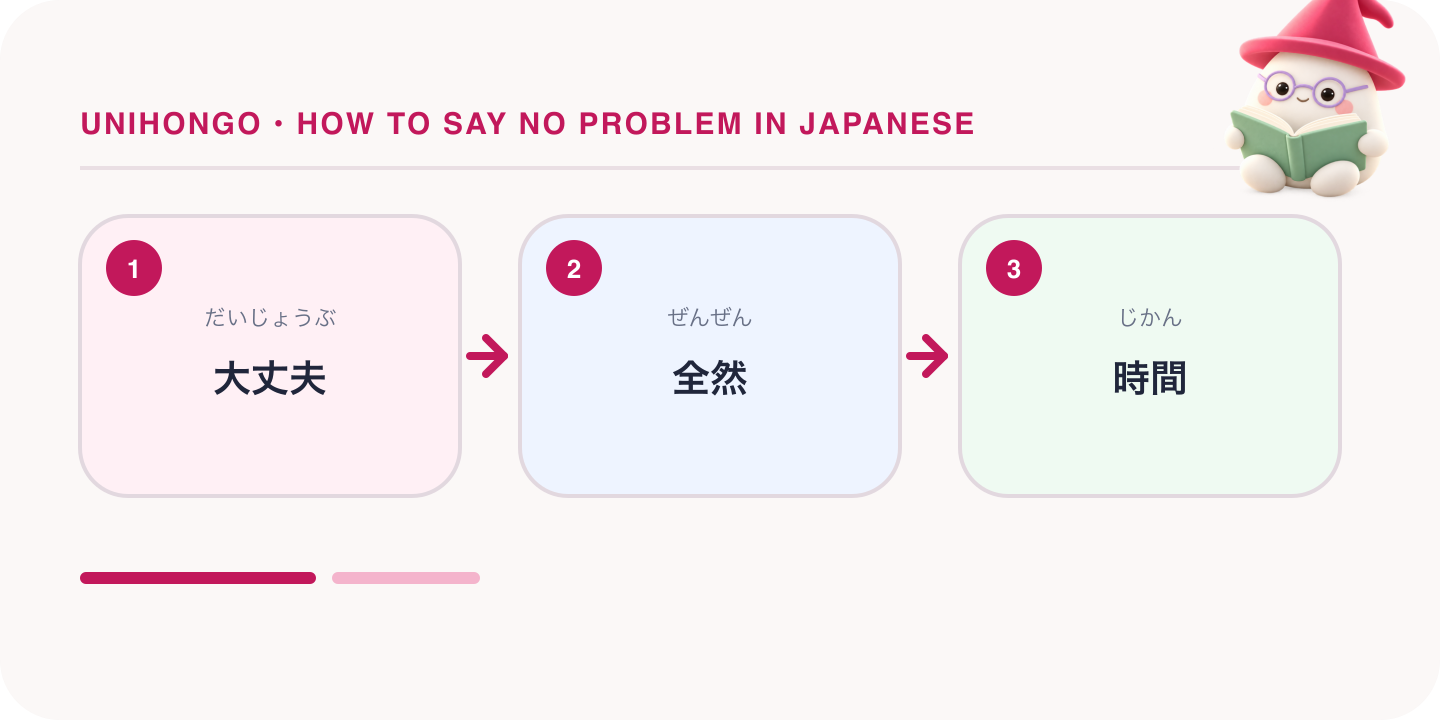
大丈夫 (daijōbu) means fine, all right, or safe. It is the most versatile answer when someone checks on you, apologises, or asks whether something works. Daijōbu? with a rising tone asks "are you OK?", and daijōbu with a falling tone answers "I'm fine" or "it's fine".
In polite speech, say daijōbu desu. To sound warmer, add a softener: daijōbu desu yo, "it's really fine", reassures someone who looks worried. Zenzen daijōbu, completely fine, is common in casual speech.
| Japanese | Romaji | Meaning |
|---|---|---|
| 大丈夫? | Daijōbu? | Are you OK? |
| 大丈夫。 | Daijōbu. | I'm fine. / It's fine. |
| 大丈夫ですよ。 | Daijōbu desu yo. | It's really fine. (reassuring) |
| 全然大丈夫! | Zenzen daijōbu! | Totally fine! |
| 時間は大丈夫ですか。 | Jikan wa daijōbu desu ka. | Are you OK for time? |
| 三時で大丈夫です。 | Sanji de daijōbu desu. | Three o'clock is fine. |
Daijōbu desu as no, thank you
The most confusing use of daijōbu for learners is as a refusal. When a shop assistant asks fukuro wa go-riyō desu ka, would you like a bag, and you say daijōbu desu, it means you do not need one. The same applies when a host offers more food or someone offers to help carry something.
Tone and gesture make the meaning clear. A refusal usually comes with a small smile and a light wave of the open hand in front of the face or chest. To be explicit, say daijōbu desu, arigatō gozaimasu, or use kekkō desu, which is a clearer, slightly firmer no thank you.
| Japanese | Romaji | Meaning |
|---|---|---|
| 袋は大丈夫です。 | Fukuro wa daijōbu desu. | I don't need a bag. |
| 大丈夫です、ありがとうございます。 | Daijōbu desu, arigatō gozaimasu. | I'm fine, thank you. |
| 結構です。 | Kekkō desu. | No, thank you. (firmer) |
| もうお腹いっぱいなので、大丈夫です。 | Mō onaka ippai na node, daijōbu desu. | I'm full, so I'm fine. |
Mondai nai and mondai arimasen: literally no problem
問題ない (mondai nai) is the literal "no problem". It sounds matter-of-fact and slightly confident, and is best for confirming that a plan, schedule or request causes no difficulty. With friends, mondai nai or mondai nashi is fine; with colleagues, use mondai arimasen; with clients, mondai gozaimasen is the most formal.
Mondai nai is not used to reply to thanks, and it can sound a little cool as a reply to an apology, since it focuses on the facts rather than feelings. For apologies, daijōbu or ki ni shinaide is warmer.
| Japanese | Romaji | Meaning |
|---|---|---|
| 問題ないよ。 | Mondai nai yo. | No problem. (casual) |
| 問題ありません。 | Mondai arimasen. | No problem. (polite) |
| 特に問題ございません。 | Toku ni mondai gozaimasen. | There is no particular problem. (formal) |
| 日程の変更は問題ありません。 | Nittei no henkō wa mondai arimasen. | Changing the schedule is no problem. |
| 何か問題ありますか。 | Nanika mondai arimasu ka. | Is there any problem? |
Ii yo, kamaimasen and dōzo: sure, go ahead
When someone asks a favour or permission, the natural no problem is a yes. With friends, いいよ (ii yo), "sure", is the everyday answer, often doubled: ii yo, ii yo. In polite speech, いいですよ (ii desu yo) or 構いません (kamaimasen), "I don't mind", work well.
どうぞ (dōzo), "please, go ahead", is the reply when someone asks to use, take or do something, like sitting in the seat next to you or passing through. With a small open-hand gesture towards the seat or doorway, it needs no other words.
| Japanese | Romaji | Meaning |
|---|---|---|
| いいよ。 | Ii yo. | Sure. / No problem. |
| いいですよ。 | Ii desu yo. | Sure, that's fine. (polite) |
| 構いませんよ。 | Kamaimasen yo. | I don't mind at all. |
| どうぞ。 | Dōzo. | Go ahead. |
| もちろんです。 | Mochiron desu. | Of course. |
| 全然いいよ。 | Zenzen ii yo. | Totally fine. (casual) |
Responding to apologies
When a friend says gomen, the most natural replies are ii yo, daijōbu or 気にしないで (ki ni shinaide), "don't worry about it". Politely, say daijōbu desu yo or 気にしないでください (ki ni shinaide kudasai). To someone senior or a customer, お気になさらないでください (o-ki ni nasaranaide kudasai) is the respectful form.
In business, a client apologising for a delay may get a gracious iie, tondemo gozaimasen or a reassuring dō ka o-ki ni nasaranaide kudasai. Showing you are not upset matters more than the exact words, so smile and keep your tone light.
| Japanese | Romaji | Meaning |
|---|---|---|
| 気にしないで。 | Ki ni shinaide. | Don't worry about it. |
| いいよ、いいよ。 | Ii yo, ii yo. | It's fine, it's fine. |
| 大丈夫ですよ、気にしないでください。 | Daijōbu desu yo, ki ni shinaide kudasai. | It's fine, please don't worry. |
| どうぞお気になさらないでください。 | Dōzo o-ki ni nasaranaide kudasai. | Please don't concern yourself. (respectful) |
| お互い様ですよ。 | O-tagaisama desu yo. | We're in the same boat. / It happens to all of us. |
O-tagaisama is a lovely reply when someone apologises for a small inconvenience, such as a child making noise on a train. It means "we all need understanding sometimes". For more on apology language, see our guide to sumimasen and gomennasai.
Responding to thanks
English speakers often say no problem when thanked, but mondai nai sounds strange in reply to arigatō. Japanese replies play down the favour instead. いいえ (iie), "no", said once or twice, is the most common, and どういたしまして (dō itashimashite), "you're welcome", is correct but can sound slightly textbook in casual settings.
とんでもないです (tondemonai desu), "not at all", is humble and good for colleagues and people above you. Among friends, ii yo, ii yo or zenzen with a wave of the hand is natural. In business, kochira koso, "likewise", turns thanks back towards the other person.
| They say | Natural reply | Situation |
|---|---|---|
| ありがとう | いいよ、いいよ | Friends |
| ありがとうございます | いいえ | Everyday polite |
| 助かりました | とんでもないです | Colleague, senior |
| ありがとうございました | こちらこそ | Business, mutual help |
| すみません、わざわざ | いえいえ、大丈夫です | Someone who feels they troubled you |
Tone, gestures and reading the reply
The hand wave matters. Waving the open hand side to side in front of your face means "no, no, not at all" and often goes with iie, iie or tondemonai. It is used both to refuse an offer and to wave away thanks. A small nod with ii desu yo signals permission.
Be careful with your own tone. A flat, clipped daijōbu can sound as if you are upset and pretending not to be. A slightly higher, lighter daijōbu daijōbu with a smile sounds sincere. Likewise, if a Japanese speaker says daijōbu desu with hesitation, a pause or a strained smile, they may be being polite; it can be worth asking again gently: hontō ni daijōbu desu ka?
- Open hand waving in front of the face: no, not at all.
- Small bow with iie: modest reply to thanks.
- Open palm towards a seat or doorway with dōzo: please go ahead.
- Hesitant daijōbu with a pause: possibly not fine; check kindly.
Common mistakes
- Saying mondai nai in reply to thanks. Use iie, dō itashimashite or tondemonai desu.
- Answering an offer with daijōbu desu when you mean yes. Say onegai shimasu.
- Using ii yo or mondai nai with a client or manager. Use kamaimasen, mondai arimasen or kashikomarimashita.
- Replying to a heartfelt apology with just mondai arimasen. Add warmth with daijōbu desu yo or ki ni shinaide kudasai.
- Assuming daijōbu always means yes. Check the context: it is often a polite no.