
The four words that structure the whole purchase
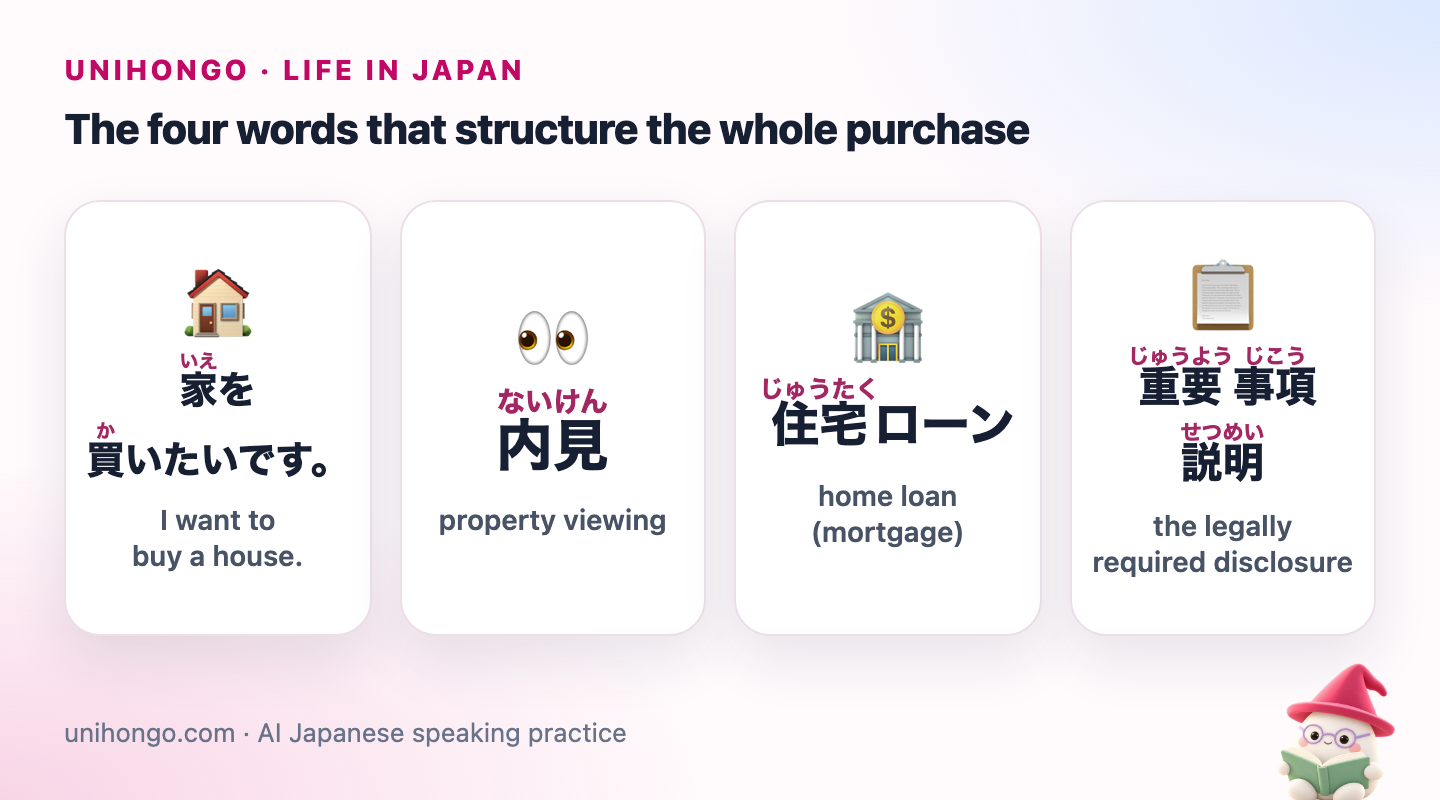
Buying a home in Japan is a chain of appointments, and four words mark the stages. Naiken (内見) is a viewing. Jūtaku rōn (住宅ローン) is the home loan, and the bank will talk about a pre-check before you make any offer. Jūyō jikō setsumei (重要事項説明) is the disclosure session that the law requires before a contract. Then comes baibai keiyaku (売買契約), the purchase contract, and finally hikiwatashi (引き渡し), the handover of keys and ownership.
If you can say these five words clearly, agents will understand immediately which stage you are asking about, and every other phrase in this guide hangs on one of them.
| Japanese | Romaji | Meaning |
|---|---|---|
| 家を買いたいです。 | Ie o kaitai desu. | I want to buy a house. |
| 内見 | naiken | property viewing |
| 住宅ローン | jūtaku rōn | home loan (mortgage) |
| 重要事項説明 | jūyō jikō setsumei | the legally required disclosure |
| 売買契約 | baibai keiyaku | purchase contract |
| 引き渡し | hikiwatashi | handover of the keys |
Finding an agent and asking for a viewing
Most buyers start on a property portal and then contact the fudōsan gaisha (不動産会社), the estate agency, listed for a property. Say what you are looking for in one sentence: chūko (中古) is pre-owned, shinchiku (新築) is newly built, manshon (マンション) is a flat in a concrete building, and ikkodate (一戸建て) is a detached house. State your budget early; agents in Japan expect it and will not take offence.
For a flat, two monthly costs sit on top of the loan: the kanrihi (管理費), the management fee, and the shūzen tsumitatekin (修繕積立金), the reserve fund for large repairs. Ask about both at the first contact. The agent's own fee, the chūkai tesūryō (仲介手数料), is capped by law and usually quoted as a formula based on the price; ask for the actual figure for the property you like.
| Japanese | Romaji | Meaning |
|---|---|---|
| 中古マンションを探しています。 | Chūko manshon o sagashite imasu. | I'm looking for a pre-owned flat. |
| 予算を先にお伝えします。 | Yosan o saki ni otsutae shimasu. | Let me tell you my budget first. |
| この物件を内見できますか。 | Kono bukken o naiken dekimasu ka. | Can I view this property? |
| 築年数は何年ですか。 | Chikunensū wa nannen desu ka. | How old is the building? |
| 管理費と修繕積立金はいくらですか。 | Kanrihi to shūzen tsumitatekin wa ikura desu ka. | How much are the management fee and repair reserve? |
| 仲介手数料はいくらですか。 | Chūkai tesūryō wa ikura desu ka. | How much is the brokerage fee? |
| Word | Reading | What it means for you |
|---|---|---|
| 新築 | shinchiku | Newly built; often sold by the developer with a model room |
| 中古 | chūko | Pre-owned; condition and renovation history matter |
| マンション | manshon | A flat in a concrete building, with management fees |
| 一戸建て | ikkodate | A detached house; you maintain it yourself |
| 土地 | tochi | Land; building on it is a separate project |
At the viewing: the questions that matter
A viewing is usually led by the agent, and you are welcome to open cupboards, run taps and ask about the neighbours. Japanese buyers care a great deal about hiatari (日当たり), the amount of sunlight, and about which direction the balcony faces. For older buildings, ask about the taishin kijun (耐震基準), the earthquake-resistance standard: the national standard was tightened in 1981, so agents describe buildings as built to the old or the new standard. Mizumawari (水回り) means the wet areas, the kitchen, bath and toilet, which are the expensive parts to renovate.
You are not expected to decide on the spot. Sukoshi kangaesasete kudasai is a normal, polite way to leave without committing.
| Japanese | Romaji | Meaning |
|---|---|---|
| 日当たりはどうですか。 | Hiatari wa dō desu ka. | How is the sunlight? |
| 周りは静かですか。 | Mawari wa shizuka desu ka. | Is the area quiet? |
| 耐震基準は新しいですか。 | Taishin kijun wa atarashii desu ka. | Is it built to the current earthquake standard? |
| 水回りを見せてください。 | Mizumawari o misete kudasai. | Please show me the kitchen and bathrooms. |
| リフォームは必要ですか。 | Rifōmu wa hitsuyō desu ka. | Does it need renovation? |
| 少し考えさせてください。 | Sukoshi kangaesasete kudasai. | Let me think about it a little. |
The loan: talking to the bank
Before you make an offer, the agent will usually ask you to apply for a jizen shinsa (事前審査), the bank's preliminary check. The full approval, honshinsa (本審査), comes after the contract is signed. Banks ask about your residence status, employment, income and existing debts, and many have conditions on permanent residency or a long-term visa. Conditions differ a lot between lenders, so ask several and do not take the first refusal as final.
Two words come up in every loan conversation: hendō kinri (変動金利), a variable rate, and kotei kinri (固定金利), a fixed rate. Atamakin (頭金) is the down payment, and hensai kikan (返済期間) is the repayment term. If you want the staff to slow down, the phrase from the disclosure section below works in a bank too.
| Japanese | Romaji | Meaning |
|---|---|---|
| 住宅ローンの事前審査を申し込みたいです。 | Jūtaku rōn no jizen shinsa o mōshikomitai desu. | I'd like to apply for loan pre-approval. |
| 永住権はまだありません。 | Eijūken wa mada arimasen. | I don't have permanent residency yet. |
| 変動金利と固定金利、どちらがいいですか。 | Hendō kinri to kotei kinri, dochira ga ii desu ka. | Variable or fixed rate, which is better? |
| 頭金はいくら必要ですか。 | Atamakin wa ikura hitsuyō desu ka. | How much deposit do I need? |
| 返済期間は何年まで選べますか。 | Hensai kikan wa nannen made erabemasu ka. | Up to how many years can I repay over? |
| 月々の返済額を教えてください。 | Tsukizuki no hensaigaku o oshiete kudasai. | Please tell me the monthly repayment. |
Bank staff will also mention danshin, group credit life insurance that pays off the loan if the borrower dies, which most lenders require. Ask what it covers rather than nodding through it.
Jūyō jikō setsumei: the disclosure you must sit through
Before you sign, a licensed takuchi tatemono torihikishi (宅地建物取引士) must read you the important matters: the property's registered details, legal restrictions on the land, utilities, fees for a flat, and the conditions of the contract, including what happens if the loan is refused. It can take an hour or more, and it is often read quickly in formal Japanese. You have every right to slow it down, to ask what a term means, and to receive the documents in advance so you can read them with a dictionary or a bilingual friend.
The dialogue below is the one every foreign buyer should rehearse. Nobody will think less of you for asking; the specialist is legally responsible for making sure you understood.
| Japanese | Romaji | Meaning |
|---|---|---|
| 重要事項説明を始めます。 | Jūyō jikō setsumei o hajimemasu. | Agent: I'll begin the disclosure. |
| もう一度ゆっくり説明してください。 | Mō ichido yukkuri setsumei shite kudasai. | You: Please explain that again, slowly. |
| この部分の意味がわかりません。 | Kono bubun no imi ga wakarimasen. | You: I don't understand this part. |
| 事前に書類をもらえますか。 | Jizen ni shorui o moraemasu ka. | You: Can I have the documents in advance? |
| 後で質問してもいいですか。 | Ato de shitsumon shite mo ii desu ka. | You: May I ask questions afterwards? |
| 納得してから署名します。 | Nattoku shite kara shomei shimasu. | You: I'll sign once I'm satisfied. |
Contract day and the handover
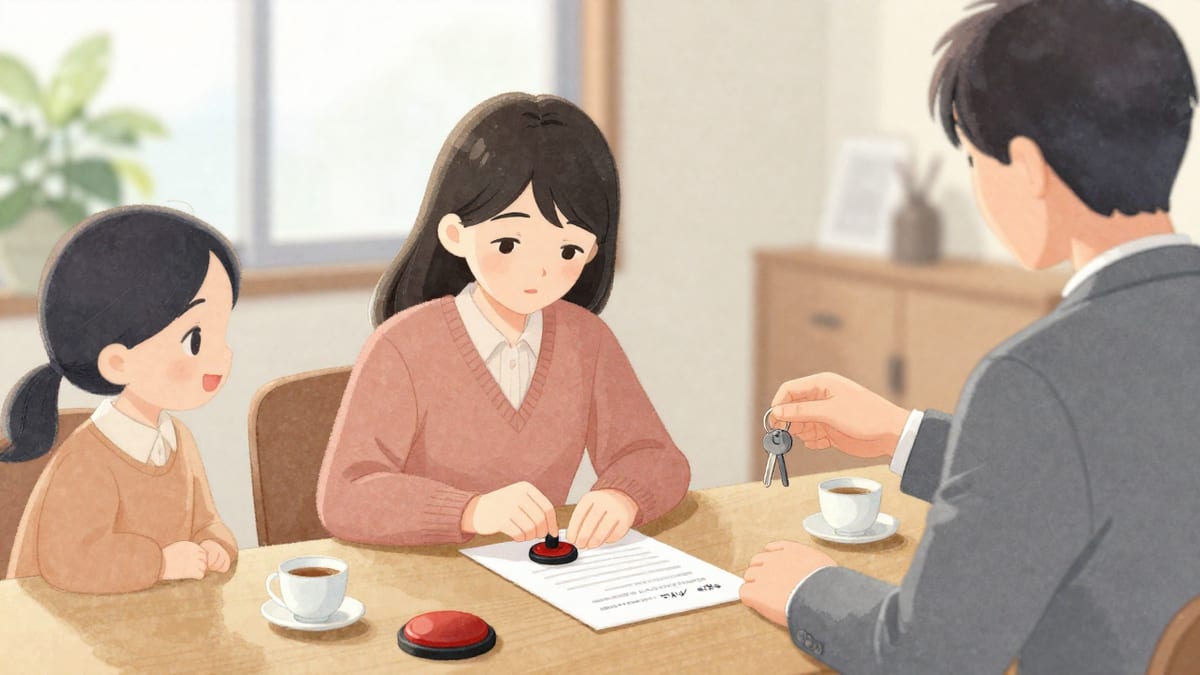
On contract day you sign the baibai keiyaku, stamp it with your jitsuin (実印), the seal registered at your city office, and show the inkan shōmeisho (印鑑証明書), the certificate that proves the seal is yours. You pay the tetsukekin (手付金), the deposit, which is commonly a percentage of the price agreed in advance. Weeks later, at the kessai (決済) and hikiwatashi, the loan is paid out, a shihō shoshi (司法書士), a judicial scrivener, handles the ownership registration (登記, tōki), and you receive the keys.
Bring everything the agent listed, arrive early, and keep this short set of lines ready. Ōin (押印) is the formal word for stamping with a seal.
| Japanese | Romaji | Meaning |
|---|---|---|
| 実印と印鑑証明書を持ってきました。 | Jitsuin to inkan shōmeisho o motte kimashita. | I've brought my registered seal and certificate. |
| 手付金はいつ払いますか。 | Tetsukekin wa itsu haraimasu ka. | When do I pay the deposit? |
| ここに署名と押印をお願いします。 | Koko ni shomei to ōin o onegai shimasu. | Agent: Please sign and stamp here. |
| 引き渡しはいつですか。 | Hikiwatashi wa itsu desu ka. | When is the handover? |
| 鍵は何本ありますか。 | Kagi wa nanbon arimasu ka. | How many keys are there? |
| 本日はありがとうございました。 | Honjitsu wa arigatō gozaimashita. | Thank you for today. |
After the purchase you will receive notices about the kotei shisanzei (固定資産税), the annual property tax, and possibly a one-time acquisition tax. Amounts depend on the municipality and the property, so ask your agent what to expect and read the official notices when they arrive.
Greeting the neighbours
In many neighbourhoods, new residents visit the houses on either side and opposite within the first days, often with a small gift. In a large apartment building the custom is weaker, but a greeting in the corridor is always welcome. Keep it short: say you have moved in, give your name, and finish with yoroshiku onegai shimasu. Two practical questions make a good first conversation: when rubbish is collected, and whether there is a jichikai (自治会), a residents' association, which may handle festivals, cleaning days and emergency planning.
| Japanese | Romaji | Meaning |
|---|---|---|
| 隣に引っ越してきました。 | Tonari ni hikkoshite kimashita. | We've just moved in next door. |
| リーと申します。 | Rī to mōshimasu. | My name is Lee. |
| これからお世話になります。 | Korekara osewa ni narimasu. | We look forward to being neighbours. |
| ゴミの日はいつですか。 | Gomi no hi wa itsu desu ka. | Which days is rubbish collected? |
| 自治会はありますか。 | Jichikai wa arimasu ka. | Is there a residents' association? |
| よろしくお願いします。 | Yoroshiku onegai shimasu. | Please treat us kindly. |
Common mistakes and how to avoid them
- Nodding through the disclosure. If you did not understand a clause, say so; the phrases above are standard and the specialist expects them.
- Confusing naiken (viewing a property) with kengaku (visiting a school or facility). Agents say naiken.
- Saying ie for a flat. Ie is fine in general talk, but when describing what you want, say manshon or ikkodate so the agent searches correctly.
- Forgetting the monthly fees. For a flat, always ask about kanrihi and shūzen tsumitatekin together, since both are paid every month on top of the loan.
- Treating the pre-check as approval. Jizen shinsa is only a preliminary check; the contract will normally contain a clause that releases you if the full loan is refused. Ask the agent to point to it.