
The three ways people usually send
Most international transfers from Japan go through one of three channels, and each needs slightly different Japanese. The words overlap, but the conversation happens in different places.
| Channel | Where the conversation happens | Japanese you mostly need |
|---|---|---|
| Bank counter | Face to face with a clerk, using a form | Form words, purpose questions and ID |
| Money transfer shop | At a counter, often with multilingual staff | Recipient details, rate and fee questions |
| Transfer app | On screens and by message or phone support | Reading form fields and support phrases |
Registration usually takes the longest the first time, whichever channel you choose. After that, repeat transfers are much quicker.
Words on the form
Transfer forms and app screens use the same core vocabulary. Knowing these words lets you fill in a form without guessing and catch a clerk's question the first time.
| Japanese | Romaji | Meaning |
|---|---|---|
| 海外送金 | kaigai sōkin | International money transfer |
| 受取人 | uketorinin | Recipient |
| 送金目的 | sōkin mokuteki | Purpose of the transfer |
| 口座番号 | kōza bangō | Account number |
| 受取銀行 | uketori ginkō | Receiving bank |
| 手数料 | tesūryō | Fee |
| 為替レート | kawase rēto | Exchange rate |
| 本人確認 | honnin kakunin | Identity verification |
The purpose and relationship questions
Expect to be asked why you are sending the money and who the recipient is to you. These are routine checks, and the clerk is looking for a short, clear answer rather than a story.
Give the category first. If they need more detail, they will ask a follow-up question.
| Japanese | Romaji | Meaning |
|---|---|---|
| 送金の目的は何ですか。 | Sōkin no mokuteki wa nan desu ka. | What is the purpose of the transfer? |
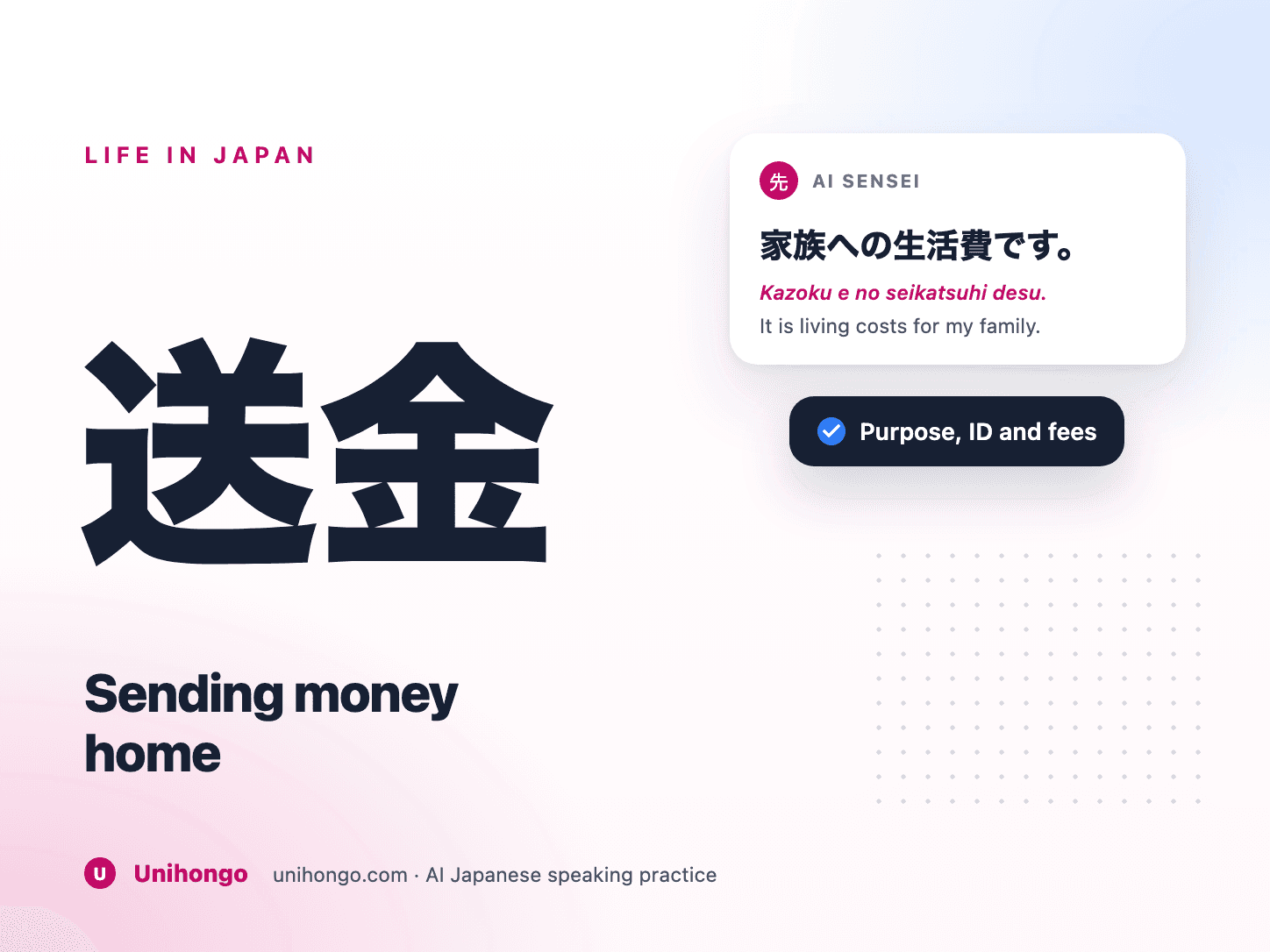
| 家族への生活費です。 | Kazoku e no seikatsuhi desu. | It is living costs for my family. |
| 学費の支払いです。 | Gakuhi no shiharai desu. | It is a payment for tuition fees. |
| 受取人とのご関係は。 | Uketorinin to no go-kankei wa. | What is your relationship to the recipient? |
| 母です。 | Haha desu. | She is my mother. |
| 自分の口座に送ります。 | Jibun no kōza ni okurimasu. | I am sending it to my own account. |
ID checks and My Number
Identity checks are normal for international transfers, and you may be asked for your residence card and, in many cases, your My Number. New registrations can also involve confirming your address.
If the list of required documents is unclear, ask before you visit. It saves a wasted trip.
| Japanese | Romaji | Meaning |
|---|---|---|
| 本人確認書類をお願いします。 | Honnin kakunin shorui o onegai shimasu. | Your identity document, please. |
| 在留カードでいいですか。 | Zairyū kādo de ii desu ka. | Is my residence card all right? |
| マイナンバーの確認が必要です。 | Mai nanbā no kakunin ga hitsuyō desu. | We need to confirm your My Number. |
| 何を持っていけばいいですか。 | Nani o motte ikeba ii desu ka. | What should I bring? |
| 住所が変わりました。 | Jūsho ga kawarimashita. | My address has changed. |
Asking about rates, fees and timing
The rate and the fee are two different costs, and comparing providers only makes sense when you ask about both. It is also worth asking how long the money takes to arrive, since that varies by destination and method.
Ask for the total the recipient will receive when you can. That single number is easier to compare than a rate and a fee on their own.
| Japanese | Romaji | Meaning |
|---|---|---|
| 今日のレートはいくらですか。 | Kyō no rēto wa ikura desu ka. | What is today's exchange rate? |
| 手数料はいくらかかりますか。 | Tesūryō wa ikura kakarimasu ka. | How much is the fee? |
| 相手はいくら受け取れますか。 | Aite wa ikura uketoremasu ka. | How much will the recipient receive? |
| 着金までどのくらいかかりますか。 | Chakkin made dono kurai kakarimasu ka. | How long until the money arrives? |
| 受け取り側でも手数料がかかりますか。 | Uketori-gawa demo tesūryō ga kakarimasu ka. | Is there a fee on the receiving side as well? |
When a transfer is delayed or returned
Most transfers arrive without trouble, but a wrong account number or a name mismatch can delay or return one. When that happens, have the date, the amount and any reference number ready before you call or visit.
Explain the problem in one sentence, then give the details they ask for. Support staff can only check once they have identified the transfer.
| Japanese | Romaji | Meaning |
|---|---|---|
| まだ届いていないそうです。 | Mada todoite inai sō desu. | I hear it has not arrived yet. |
| 送金の状況を確認してもらえますか。 | Sōkin no jōkyō o kakunin shite moraemasu ka. | Could you check the status of the transfer? |
| 名前のつづりが違っていました。 | Namae no tsuzuri ga chigatte imashita. | The spelling of the name was wrong. |
| 送金は先週の金曜日にしました。 | Sōkin wa senshū no kin'yōbi ni shimashita. | I made the transfer last Friday. |
| お金は戻ってきますか。 | O-kane wa modotte kimasu ka. | Will the money come back to me? |
Making the next transfer easier
The first transfer is the hard one. After that, keep the recipient details, your answers and the provider's support number together so repeat transfers become a two-minute errand.
If a phone call to support is the part you dread, rehearse it. The Reserve a Restaurant by Phone mission in Unihongo trains the same skills of catching numbers and confirming details on a call, and the corrections in the session report show where your phrasing needs tightening.
- Save the recipient's details exactly as the bank lists them.
- Keep a note of your purpose and relationship answers.
- Record the date, amount and reference number of each transfer.
- Note the provider's support number and hours.