
The vocabulary of translation work
Before any phrases, you need the words that appear in every job request and every query. Many are shared with publishing and software localisation, and agencies use them constantly in emails and instructions.
Note that Japanese volume is usually counted in characters, mojisū, while English is counted in words, gosū. Being clear about which one a job uses avoids misunderstandings about scope.
| Japanese | Romaji | Meaning |
|---|---|---|
| 翻訳者 | hon'yakusha | Translator |
| 翻訳会社 | hon'yaku-gaisha | Translation agency |
| 原文 | genbun | Source text |
| 訳文 | yakubun | Translated text |
| 和訳・英訳 | wayaku / eiyaku | Translation into Japanese / into English |
| 納期 | nōki | Delivery date, deadline |
| 文字数・ワード数 | mojisū / wādosū | Character count / word count |
| 用語集 | yōgoshū | Glossary, termbase |
| 翻訳メモリ | hon'yaku memori | Translation memory |
| 校正 | kōsei | Proofreading, checking |
| トライアル | toraiaru | Test translation for a new agency |
Accepting jobs, volume and deadlines
Job offers usually arrive as a short email or a message in an agency's system, listing the content, volume, deadline and tools. Your reply should either accept clearly, ask a specific question, or decline politely with a reason and ideally an alternative date. Keeping it short and concrete is itself a form of politeness.
When you need more time, ask early and give a concrete proposal. Vague lines such as it might be difficult leave the project manager to guess.
| Japanese | Romaji | Meaning |
|---|---|---|
| ご依頼ありがとうございます。ぜひお引き受けいたします。 | Go-irai arigatō gozaimasu. Zehi o-hikiuke itashimasu. | Thank you for the request. I would be glad to take it on. |
| 納期は〇日〇時で承知いたしました。 | Nōki wa (maru)-nichi (maru)-ji de shōchi itashimashita. | Understood, delivery by (date and time). |
| ファイル形式と使用ツールをご教示いただけますでしょうか。 | Fairu keishiki to shiyō tsūru o go-kyōji itadakemasu deshō ka. | Could you tell me the file format and the tools to be used? |
| 大変恐縮ですが、納期を〇日までご調整いただくことは可能でしょうか。 | Taihen kyōshuku desu ga, nōki o (maru)-nichi made go-chōsei itadaku koto wa kanō deshō ka. | I'm very sorry to ask, but would it be possible to move the deadline to (date)? |
| あいにく今回はスケジュールの都合でお受けできかねます。 | Ainiku konkai wa sukejūru no tsugō de o-uke dekikanemasu. | Unfortunately I am unable to accept this time due to my schedule. |
| 〇日以降でしたら対応可能です。 | (Maru)-nichi ikō deshitara taiō kanō desu. | I could handle it from (date) onwards. |
Asking terminology questions
Terminology queries are where translators most often look unprofessional, usually by asking too broadly or sending questions one at a time. A good query identifies the exact location, quotes the source, states your understanding and proposes a rendering. Many agencies prefer queries collected in a query sheet, a shitsumon-hyō or Q&A shīto, rather than scattered emails.
The key sentence pattern is to iu rikai de yoroshii deshō ka, would it be correct to understand it as, which shows you have already thought about the problem.
| Japanese | Romaji | Meaning |
|---|---|---|
| 〇ページ〇行目の「〇〇」について質問がございます。 | (Maru) pēji (maru) gyōme no (marumaru) ni tsuite shitsumon ga gozaimasu. | I have a question about the term on page (x), line (y). |
| こちらは「〇〇」という意味という理解でよろしいでしょうか。 | Kochira wa (marumaru) to iu imi to iu rikai de yoroshii deshō ka. | Am I right in understanding this to mean (x)? |
| 訳語は「〇〇」を想定しておりますが、ご指定の訳語はございますか。 | Yakugo wa (marumaru) o sōtei shite orimasu ga, go-shitei no yakugo wa gozaimasu ka. | I am planning to use (x). Is there a preferred translation? |
| 用語集と過去の訳文で訳語が異なっております。 | Yōgoshū to kako no yakubun de yakugo ga kotonatte orimasu. | The glossary and previous translations use different terms. |
| どちらに統一すればよろしいでしょうか。 | Dochira ni tōitsu sureba yoroshii deshō ka. | Which one should I standardise on? |
| ご回答いただくまでは仮訳で進めます。 | Go-kaitō itadaku made wa kariyaku de susumemasu. | Until I hear back, I will proceed with a provisional translation. |
The last line is useful for keeping work moving. Mark provisional renderings clearly in your file so they can be updated once the client answers.
Register and style choices
When translating into Japanese, the first style decision is the sentence ending. Desu-masu tai, keitai, is polite and addresses the reader; de-aru tai, jōtai, is neutral and used in reports, academic writing and many technical documents. Mixing them in one document is a classic error that reviewers mark immediately.
Other decisions include how much keigo to use towards the reader, whether to write numbers in half-width or full-width characters, how to render katakana loanwords, and whether to keep product names in English. These belong in a style guide, and if there is none, it is worth proposing your choices and getting agreement at the start.
| Japanese | Romaji | Meaning |
|---|---|---|
| 文体は「です・ます調」と「である調」のどちらがよろしいでしょうか。 | Buntai wa desu-masu chō to de aru chō no dochira ga yoroshii deshō ka. | Should the style be desu-masu or de-aru? |
| スタイルガイドがございましたら、ご共有いただけますか。 | Sutairu gaido ga gozaimashitara, go-kyōyū itadakemasu ka. | If there is a style guide, could you share it? |
| 数字は半角で統一いたします。 | Sūji wa hankaku de tōitsu itashimasu. | I will use half-width numerals throughout. |
| 製品名は英語表記のままでよろしいでしょうか。 | Seihinmei wa eigo hyōki no mama de yoroshii deshō ka. | Is it all right to leave product names in English? |
| Text type | Usual Japanese style | Question to confirm |
|---|---|---|
| Website and marketing | Desu-masu, warm and direct | How much keigo towards customers? |
| User interface strings | Short, often noun endings or desu-masu | Character limits and button style |
| Manuals and specifications | De-aru or clipped forms | Imperative or polite instructions? |
| Business letters and emails | Desu-masu with keigo | Level of formality towards the recipient |
| Reports and papers | De-aru | Terminology and citation conventions |
Flagging problems in the source text
Source texts contain typos, inconsistent numbers, unclear references and sometimes outright errors. Pointing them out is part of the job, but the phrasing matters: you are raising a possibility, not correcting the client. Words like to omowareru, what appears to be, and nen no tame, just to be sure, keep the tone respectful.
Always say what you did about the problem in the translation, so the client knows whether to expect a follow-up.
| Japanese | Romaji | Meaning |
|---|---|---|
| 原文に誤記と思われる箇所がございました。 | Genbun ni goki to omowareru kasho ga gozaimashita. | I found what appears to be a typo in the source text. |
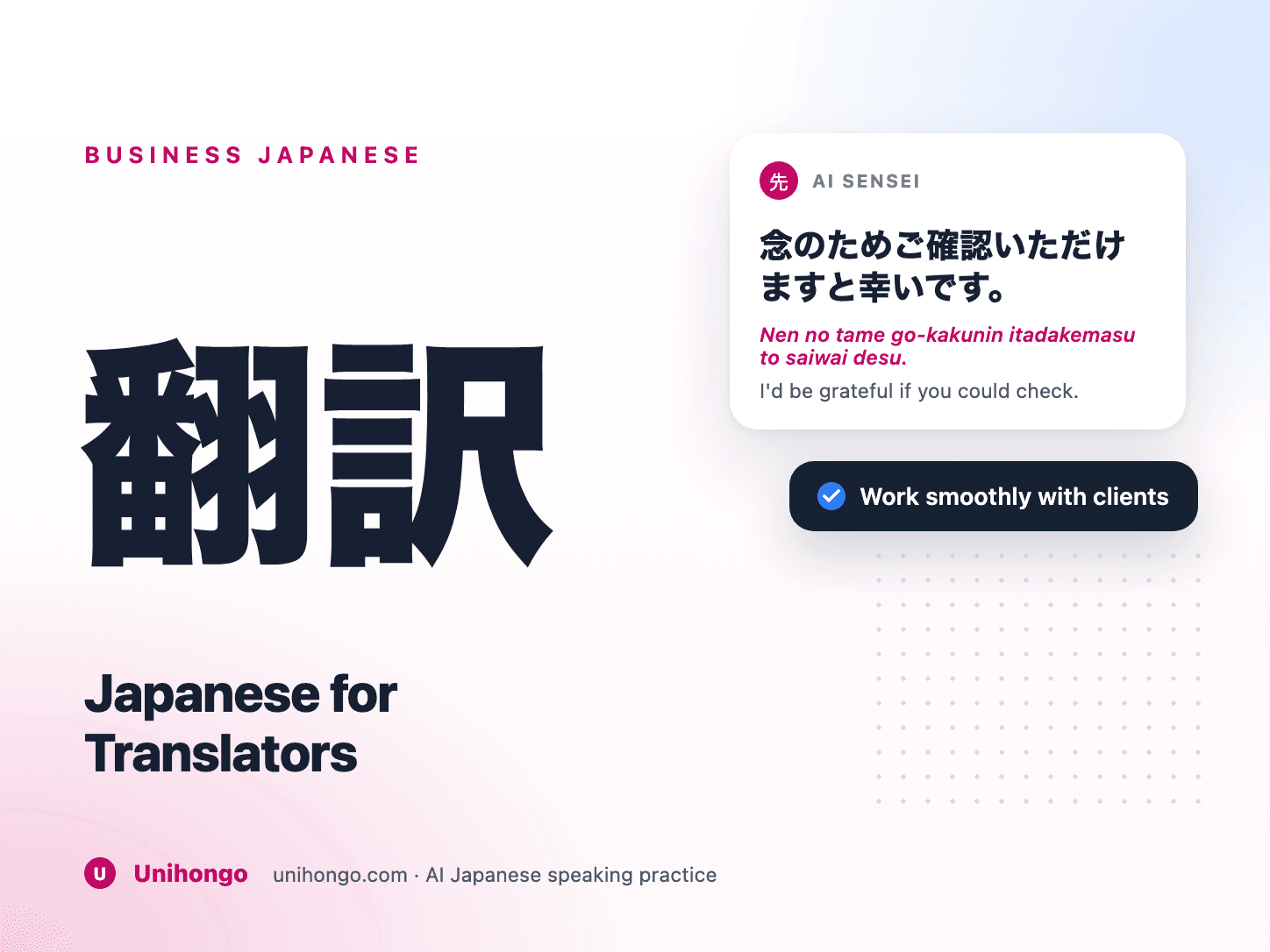
| 念のためご確認いただけますと幸いです。 | Nen no tame go-kakunin itadakemasu to saiwai desu. | I would be grateful if you could check, just to be sure. |
| 表の数値と本文の数値が一致しておりません。 | Hyō no sūchi to honbun no sūchi ga itchi shite orimasen. | The figures in the table and the text do not match. |
| 訳文では原文どおりに訳し、コメントを付けております。 | Yakubun de wa genbun dōri ni yakushi, komento o tsukete orimasu. | I have translated it as written and added a comment. |
| 主語が不明確なため、文脈から判断して訳しました。 | Shugo ga fumeikaku na tame, bunmyaku kara handan shite yakushimashita. | The subject was unclear, so I translated based on context. |
Delivery and responding to review
At delivery, a short note listing what you are sending, any open queries and anything the reviewer should know saves everyone time. Many translators also run their own checks before delivery: terminology consistency, numbers, omissions and style. The post on checking your own Japanese writing covers similar self-review habits for general writing.
Reviewer feedback, called feedback or shiteki, should be handled calmly. Thank the reviewer, accept the valid points and, where you disagree, explain with a reason and a source rather than simply defending your choice.
| Japanese | Romaji | Meaning |
|---|---|---|
| 訳文を納品いたします。ご査収のほどよろしくお願いいたします。 | Yakubun o nōhin itashimasu. Go-sashū no hodo yoroshiku onegai itashimasu. | I am delivering the translation. Please find it attached. |
| 未解決の質問が二点ございます。 | Mikaiketsu no shitsumon ga niten gozaimasu. | There are two open questions. |
| ご指摘ありがとうございます。修正いたしました。 | Go-shiteki arigatō gozaimasu. Shūsei itashimashita. | Thank you for pointing that out. I have corrected it. |
| この訳語は用語集に基づいておりますが、変更いたしましょうか。 | Kono yakugo wa yōgoshū ni motozuite orimasu ga, henkō itashimashō ka. | This term follows the glossary. Shall I change it? |
| 今後の案件でも同様に対応いたします。 | Kongo no anken demo dōyō ni taiō itashimasu. | I will handle it the same way in future projects. |
Phone and video calls with clients
Not everything happens in writing. Onboarding calls, kick-off meetings for large projects and quick clarifications are often done by video. Spoken business Japanese is a little less formal than email, but still uses keigo, and it helps to have ready-made lines for confirming and summarising.
Summarising at the end of a call is especially valuable for translators, because it turns a conversation into agreed instructions. Follow up with a short email confirming the same points, a habit covered more broadly in the post on business email phrases.
| Japanese | Romaji | Meaning |
|---|---|---|
| 本日はお時間をいただき、ありがとうございます。 | Honjitsu wa o-jikan o itadaki, arigatō gozaimasu. | Thank you for your time today. |
| 対象読者はどなたを想定されていますか。 | Taishō dokusha wa donata o sōtei sarete imasu ka. | Who is the intended readership? |
| 確認ですが、〇〇ということでよろしいでしょうか。 | Kakunin desu ga, (marumaru) to iu koto de yoroshii deshō ka. | Just to confirm, is it (x)? |
| 本日の内容は、後ほどメールでまとめてお送りいたします。 | Honjitsu no naiyō wa, nochihodo mēru de matomete o-okuri itashimasu. | I will send a summary of today's discussion by email later. |