

What every first language struggles with
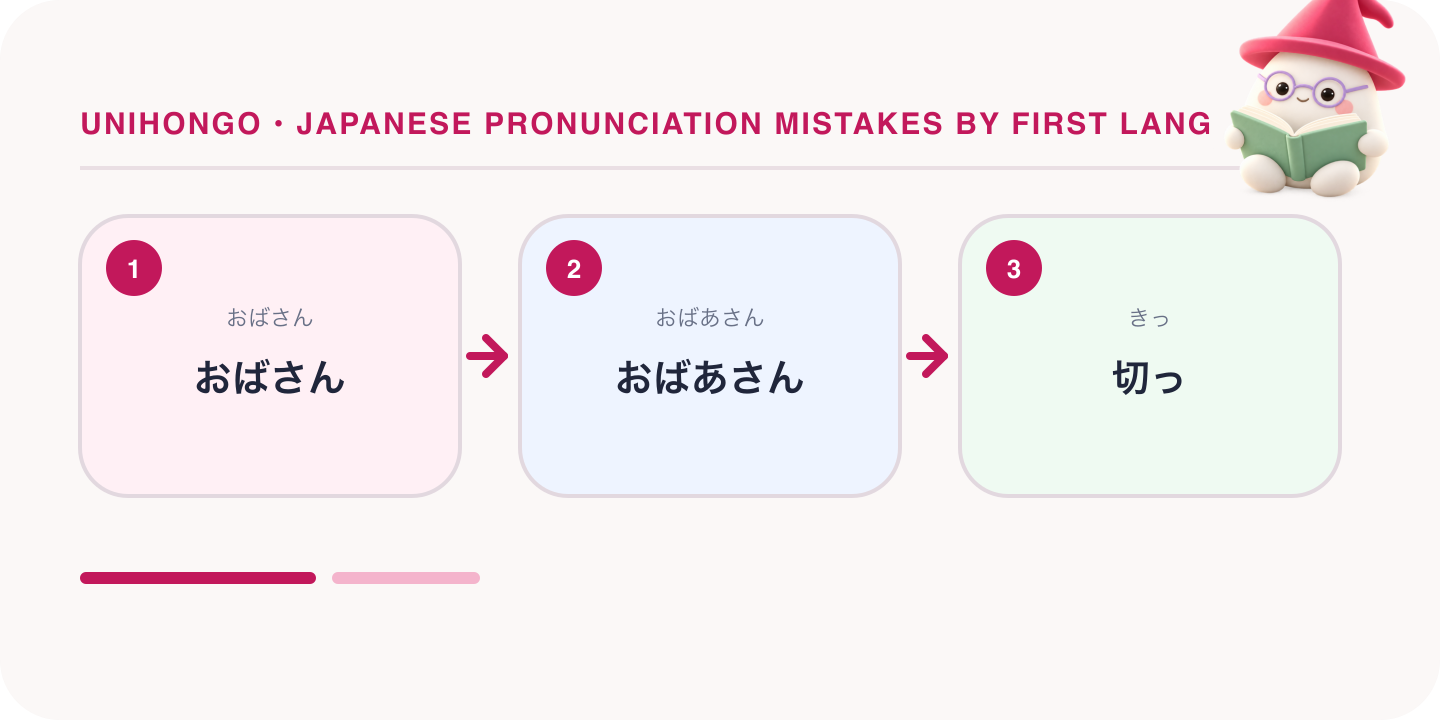
Before the language-specific lists, three problems are almost universal. The first is mora timing: every Japanese mora takes about the same time, including a lone n and the silent beat of a doubled consonant, so speakers of every stress-timed or tone language squeeze some morae and stretch others. The second is vowel length: obasan and obāsan, aunt and grandmother, or kite and kitte, come and stamp, differ only in length, and almost no first language treats length as carefully as Japanese does. The third is pitch accent, unfamiliar to almost everyone.
Because these problems are shared, the drills are the same for everyone: tap once per mora as you speak, and say each pair below in both orders until you can hear the difference.
| Japanese | Romaji | Meaning |
|---|---|---|
| おばさんとおばあさん。 | Obasan to obāsan. | Aunt and grandmother. |
| 来てと切って。 | Kite to kitte. | Come and cut. |
| ここと高校。 | Koko to kōkō. | Here and high school. |
| 雪と勇気。 | Yuki to yūki. | Snow and courage. |
| 音と夫。 | Oto to otto. | Sound and husband. |
English speakers
English speakers make four characteristic errors. Stress is the largest: one syllable per word is louder, longer and higher, which creates false long vowels and moves the accent. Diphthongs are the second: the English vowel in go or say glides, so Japanese o and e become ou and ei, and Tokyo comes out as Toh-kee-oh instead of Tōkyō with two long, steady vowels. The r is third: the English r curls the tongue back and never touches the roof of the mouth, while Japanese r is a single tap of the tongue tip against the ridge behind the teeth, closer to the tt in the American pronunciation of butter. The u is fourth: English u rounds the lips; Japanese u keeps them flat.
For stress, use the pause-and-particle toolkit from the guide on Japanese emphasis. For diphthongs, hold the vowel with a still jaw. For r, say a quick d and let it soften. For u, say ee and move only the tongue back, not the lips.
| Japanese | Romaji | Meaning |
|---|---|---|
| 東京へ行きます。 | Tōkyō e ikimasu. | I'm going to Tokyo. |
| ありがとうございます。 | Arigatō gozaimasu. | Thank you. |
| 寒いですね。 | Samui desu ne. | It's cold, isn't it. |
| これはいくらですか。 | Kore wa ikura desu ka. | How much is this? |
| 料理が好きです。 | Ryōri ga suki desu. | I like cooking. |
| すみません、遅れました。 | Sumimasen, okuremashita. | Sorry, I'm late. |
Chinese speakers
Mandarin and Japanese share thousands of kanji words, which helps vocabulary and hurts pronunciation, because the Chinese reading tends to surface. The most audible errors are the retroflex consonants: Mandarin sh, ch and r are made with the tongue curled back, and carrying them into shi, chi and ri makes the sounds dark and heavy. Japanese wants the flat, forward tongue of Mandarin x and q instead. The Japanese r is a tap, and speakers who merge n and l should watch ni against ri.
Vowels cause trouble too. The Japanese u is unrounded, unlike Mandarin u; the Japanese e is a pure mid vowel, not the Mandarin e of hé or the ei glide. Tone habits impose a contour on each word, which fights Japanese pitch accent.
The fix for retroflexes is to keep the tongue tip down behind the bottom teeth for shi, chi and ji. For u, smile slightly. For tones, say a whole phrase on one level pitch and then add only the accent drop.
| Japanese | Romaji | Meaning |
|---|---|---|
| 失礼します。 | Shitsurei shimasu. | Excuse me. |
| 料理と旅行。 | Ryōri to ryokō. | Cooking and travel. |
| うちに帰ります。 | Uchi ni kaerimasu. | I'm going home. |
| 駅の前で会いましょう。 | Eki no mae de aimashō. | Let's meet in front of the station. |
| 日本の人。 | Nihon no hito. | A Japanese person. |
| 二人と二里。 | Futari to ni-ri. | Two people and two ri (a distance). |
Korean speakers
Korean learners progress fast and then plateau on a few sounds. Voicing is the big one: Korean has no voiced versus voiceless contrast at the start of a word, so ka and ga, ta and da, pa and ba, and sa and za merge. Since kin and gin, gold and silver, are different words, this is a real comprehension problem. The fix is to hum before the voiced consonant: put a finger on your throat, feel the vibration on ga, and make sure it starts before the consonant releases.
Aspiration is the second: Korean voiceless stops release a strong puff of air, which in Japanese sounds forceful or angry. Reduce the puff so that a hand in front of your mouth barely feels it. Third, tsu often becomes chu or su because Korean lacks the tsu sound; practise it as a t released straight into su.
| Japanese | Romaji | Meaning |
|---|---|---|
| 金と銀。 | Kin to gin. | Gold and silver. |
| 柿と鍵。 | Kaki to kagi. | Persimmon and key. |
| 机の上です。 | Tsukue no ue desu. | It's on the desk. |
| 月曜日に出発します。 | Getsuyōbi ni shuppatsu shimasu. | We depart on Monday. |
| 電話をください。 | Denwa o kudasai. | Please phone me. |
Vietnamese speakers
Vietnamese speakers usually have excellent Japanese vowels and no trouble with the flat u. Their difficulties are at the ends of syllables. Vietnamese final consonants are unreleased and very short, so the Japanese final n in san, hon and en tends to vanish or turn into a nasalised vowel. The doubled consonants are worse: kitte, ippun and zasshi need a full silent beat, and Vietnamese has nothing like it, so the beat is dropped and the word becomes kite, ipun or zashi.
Tone is the other source of errors. Vietnamese words carry six tones, and speakers tend to give each Japanese word a rising or falling contour, which is heard as odd emphasis or as a question.
For final n, finish with the tongue on the ridge behind the teeth and hold it a full beat. For doubled consonants, close the mouth and count one before releasing. For tone, say short phrases on a monotone and add only the accent fall.
| Japanese | Romaji | Meaning |
|---|---|---|
| 三人です。 | San-nin desu. | There are three of us. |
| 切手を三枚ください。 | Kitte o san-mai kudasai. | Three stamps, please. |
| 雑誌を買いました。 | Zasshi o kaimashita. | I bought a magazine. |
| 一分待ってください。 | Ippun matte kudasai. | Please wait one minute. |
| 全然わかりません。 | Zenzen wakarimasen. | I don't understand at all. |
Spanish and Hindi speakers
Spanish speakers have the easiest start: the five vowels are almost identical, the rhythm is syllable-timed and the r tap already exists. Spanish has no sh, so shi drifts to si and sha to sa; it has no voiced z, so zu becomes su and zenzen becomes senzen; and it has no ts, so tsu becomes su or tu. Long vowels get shortened, because Spanish never lengthens vowels for meaning. The fix for sh is to raise the tongue blade towards the palate while saying s; for z, hum through the s; for tsu, say a t and release straight into su; for length, count two beats.
Hindi and Urdu speakers have a rich consonant inventory, which produces the opposite problem: too much distinction. Aspirated stops such as kh and th leak into Japanese ka and ta, and Japanese listeners hear the puff as force. Retroflex t and d, made with the tongue curled back, replace the Japanese dental t and d, which are made with the tongue tip on the back of the teeth. The Japanese u also tends to be rounded. Fixes: put the tongue tip on the back of the upper teeth for t and d, cut aspiration to nearly nothing, and unround the lips on u.
| Japanese | Romaji | Meaning |
|---|---|---|
| 塩と潮。 | Shio to shio. | Salt and tide (same sound, different kanji). |
| 全然大丈夫です。 | Zenzen daijōbu desu. | It's completely fine. |
| 机と靴。 | Tsukue to kutsu. | Desk and shoes. |
| お手洗いはどこですか。 | O-tearai wa doko desu ka. | Where is the toilet? |
| 手紙を出します。 | Tegami o dashimasu. | I'll post a letter. |
Fixes at a glance
The table condenses each language's most damaging errors and the adjustment that repairs each. Start with your own rows, then borrow from the others.
| Language and error | Reading | Targeted fix |
|---|---|---|
| English: stress on one syllable (東京) | Tōkyō | Pause before the key word instead; keep morae equal |
| English: glide on o and e (誠) | makoto | Hold the vowel with a still jaw |
| English: curled r (料理) | ryōri | Single tap of the tongue tip, like a quick d |
| Chinese: retroflex sh, ch (失礼) | shitsurei | Tongue tip down, blade forward |
| Chinese: tone contour on words (日本) | Nihon | Level pitch, then one accent drop |
| Korean: no voicing at word start (銀) | gin | Hum before the consonant releases |
| Korean: heavy aspiration (高い) | takai | Reduce the puff of air |
| Vietnamese: lost final n (三) | san | Tongue on the ridge, hold one beat |
| Vietnamese: dropped doubled consonant (切手) | kitte | Close, count one, release |
| Spanish: shi becomes si (塩) | shio | Raise the tongue blade while saying s |
| Spanish: zu becomes su (全然) | zenzen | Voice the s with a finger on the throat |
| Hindi: retroflex t and d (手) | te | Tongue tip on the back of the teeth |
If your language is not here, look for the nearest relative. Portuguese and Italian pattern with Spanish, Thai with Vietnamese for tones and final sounds, Cantonese with Mandarin for retroflexes and vowels, and Bengali and Punjabi with Hindi.
A self-check routine with the AI Sensei
The routine is the same whichever row is yours. It takes ten minutes and works best three times a week.
| Japanese | Romaji | Meaning |
|---|---|---|
| 私の母語は英語です。 | Watashi no bogo wa eigo desu. | My first language is English. |
| この二つの違いが聞こえますか。 | Kono futatsu no chigai ga kikoemasu ka. | Can you hear the difference between these two? |
| どちらに聞こえましたか。 | Dochira ni kikoemashita ka. | Which one did that sound like? |
| 長い音になっていますか。 | Nagai oto ni natte imasu ka. | Is that coming out as a long sound? |
| もう一度直してみます。 | Mō ichido naoshite mimasu. | I'll try correcting it once more. |
- Say the five universal pairs from the first section, recording yourself, and check that length is audible in each pair.
- Say your language's six drill sentences slowly, then at conversational speed, and listen for the specific error named in your row.
- Ask the AI Sensei to say your language's minimal pairs in random order and repeat each one back; have it tell you which word it heard.
- Run a role-play that makes you speak for several minutes, such as Describe Symptoms at a Clinic or View an Apartment, without thinking about pronunciation.
- Read the corrections afterwards and note any word the Sensei heard as a different word; those are your length and voicing errors.
- Pick one mechanical fix from the table and apply it for the whole next session; do not try to fix two things at once.
If your recordings sound right to you but the Sensei still hears the wrong word, trust the Sensei. Your ear is filtered by your first language, which is exactly why these errors persist.