
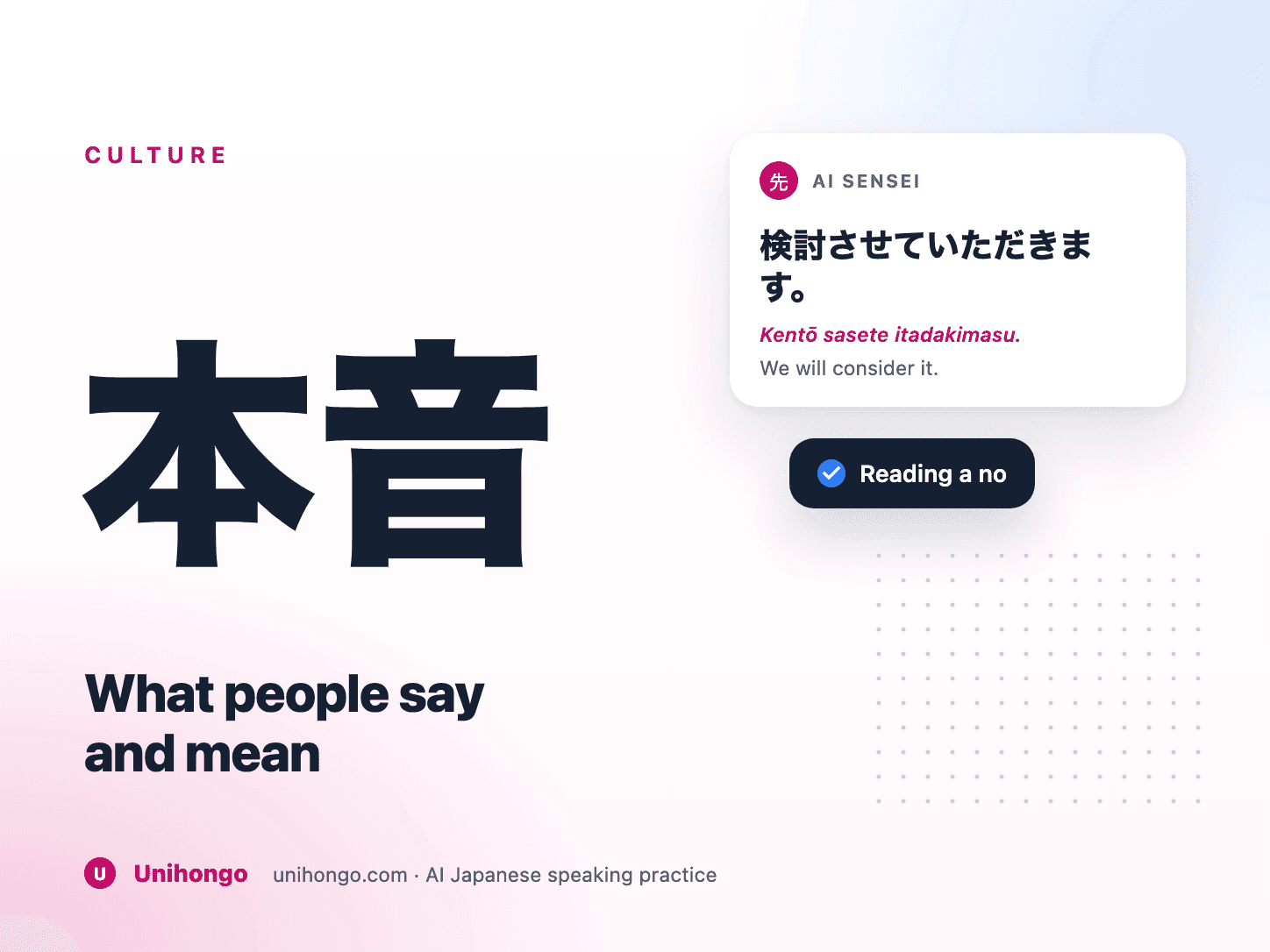
What the distinction is for
Tatemae is the position a person presents in a setting; honne is what they privately think. The gap between them is not a moral failure but a mechanism that allows people to disagree, decline and coexist without open conflict.
Every culture has some version of this, and the common foreign reaction of calling it dishonest usually reflects a culture where the same work is done by other means rather than one where it is not done at all.
The useful framing is that tatemae is what the situation requires and honne is what the person holds. Both are real.
The signals
Reading this is not about detecting sincerity, which is unreliable. It is about noticing specific markers, which are consistent and learnable.
The strongest single signal is the absence of a concrete next step. A genuine yes comes with specifics; a tatemae yes does not.
| Signal | Usually indicates | What to do |
|---|---|---|
| No concrete next step | A polite no | Do not chase |
| Deferred to later | Uncommitted | Offer an alternative once |
| Vague agreement | A public position | Look for specifics |
| Specific date offered | Genuine | Proceed |
| Question about detail | Genuine interest | Answer thoroughly |
| Group setting | Tatemae likely | Ask privately later |
The last row is the most useful. The same person will often give a different answer privately, and that is expected rather than duplicitous.
The phrases that carry it
A set of conventional expressions do this work, and they are used often enough that recognising them resolves most of the ambiguity.
Learners frequently take these literally and spend weeks pursuing something that was declined in the first meeting.
| Japanese | Romaji | Meaning |
|---|---|---|
| 検討させていただきます。 | Kentō sasete itadakimasu. | We will consider it. (usually no) |
| 前向きに考えます。 | Maemuki ni kangaemasu. | We will think positively about it. (uncommitted) |
| また今度。 | Mata kondo. | Another time. (usually never) |
| 難しいですね。 | Muzukashii desu ne. | That is difficult. (no) |
| 社内で相談してみます。 | Shanai de sōdan shite mimasu. | I will discuss it internally. (may be genuine) |
| 具体的にはいつ頃でしょうか。 | Gutaiteki ni wa itsu goro deshō ka. | Around when specifically? (a genuine question) |
Where honne appears
Private settings, informal ones and time all shift the balance. A colleague who gave a public position in a meeting may be entirely direct in a corridor afterwards, and drinking settings are conventionally treated as a space where more can be said.
This is not a trick to be exploited. It is a set of contexts in which people are permitted to speak more freely, and the permission is mutual.
- One to one rather than in a group.
- Informal settings, including after work.
- After a relationship has had time to develop.
- When you have signalled that a direct answer is welcome.
- Never by pressing in the setting where the public position was given.
Using it yourself
You will be read as though you are operating the same convention, which means a blunt private opinion stated where a public position is expected is heard as considerably stronger than you intended.
The practical version for a learner is not elaborate: soften, avoid flat refusals in public settings, and save direct disagreement for private ones.
| Japanese | Romaji | Meaning |
|---|---|---|
| 少し考えさせてください。 | Sukoshi kangaesasete kudasai. | Let me think about it a little. |
| 難しいかもしれません。 | Muzukashii kamo shiremasen. | It might be difficult. |
| そういう見方もありますね。 | Sō iu mikata mo arimasu ne. | That is one way of looking at it. |
| 個人的には、少し違う意見です。 | Kojinteki ni wa, sukoshi chigau iken desu. | Personally, I see it slightly differently. |
| あとで個別にご相談しても? | Ato de kobetsu ni gosōdan shite mo? | May I discuss it with you separately later? |
| 正直に申し上げますと、 | Shōjiki ni mōshiagemasu to, | To speak frankly, |
The fifth phrase is the most useful move available: it moves a disagreement from a group setting to a private one, which is where it can actually be resolved.
Not a reason to distrust people
The common trajectory for a foreign resident is to discover the concept, conclude that nothing anyone says can be relied on, and become suspicious of ordinary interactions. That reading is both unpleasant to live with and inaccurate.
Most of what is said in Japan is straightforward. The convention operates in specific settings, mainly where disagreement or refusal is involved, and the signals for those are learnable.
The practical skill is narrow: notice when a response has no specifics attached, and treat that as the answer rather than as an opening.
If a response contains a date, a number or a question about detail, take it at face value. If it contains none of those, it has probably already told you the answer.