
Four lines for a school festival visit
These four lines cover most of a visit: the question that starts a conversation at any stall, the name of the event, the attraction everyone queues for, and the compliment you leave with. They are all in polite form, which is the natural register for an adult visitor talking to students.
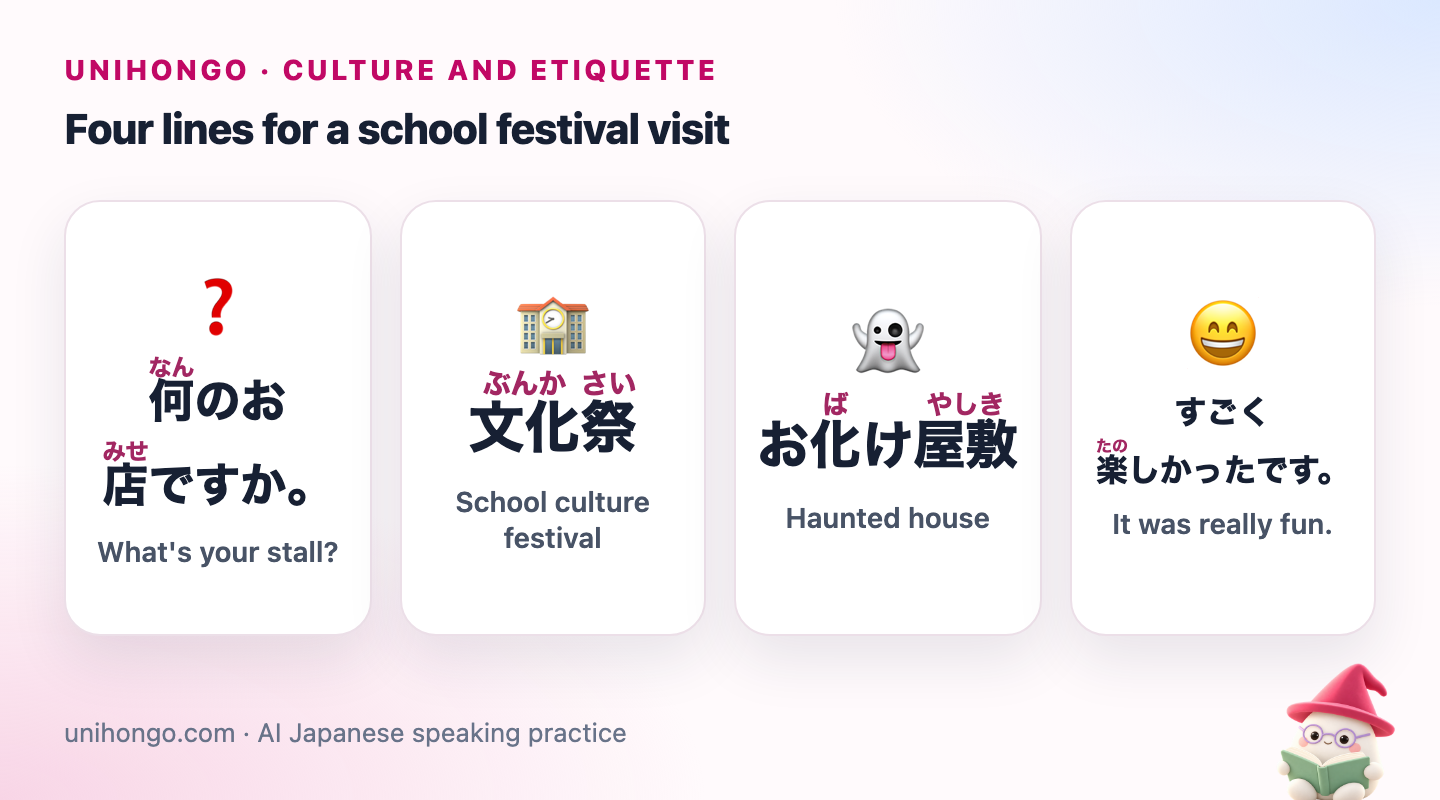
| Japanese | Romaji | Meaning |
|---|---|---|
| 何のお店ですか。 | Nan no omise desu ka. | What's your stall? |
| 文化祭 | bunkasai | School culture festival |
| お化け屋敷 | obake yashiki | Haunted house |
| すごく楽しかったです。 | Sugoku tanoshikatta desu. | It was really fun. |
Omise, with the polite o, is how students and visitors refer to a class stall, even when it is a few desks pushed together. Nan no omise desu ka is short and friendly, and it works for a café, a game booth or a classroom you cannot quite identify from the doorway.
How a bunkasai works
Each class and each club prepares something, often for weeks. A class might run a café, a food stall, a game room, a haunted house or an exhibit about a topic it has researched. Clubs perform on the gym stage: the brass band, the dance club, the light-music club with its electric guitars, the drama club. Art and calligraphy clubs show their work in classrooms. Students wear matching class T-shirts, called kurasu T (クラスT), which they designed themselves.
There is usually a reception desk, uketsuke (受付), at the entrance, a printed programme or map, and a questionnaire, ankēto (アンケート), that visitors can fill in. Some schools give prizes for the best class, so a kind word on the questionnaire is appreciated.
Most schools hold their festival in autumn, often over two days, though some hold it in early summer. A common pattern is one day for students only and one day open to visitors, usually a weekend so that families can come. When the gates close, students often have a closing event of their own, sometimes called kōyasai (後夜祭), the after-night festival, with music, awards and a lot of emotion. Visitors do not usually attend it, but you may hear students talking about it all day.
| Word | Meaning | What you will find |
|---|---|---|
| 模擬店 mogiten | Class stall | Food, drinks, simple games |
| 展示 tenji | Exhibit | Research posters, art, models |
| ステージ発表 sutēji happyō | Stage show | Dance, bands, plays in the gym |
| お化け屋敷 obake yashiki | Haunted house | A darkened classroom and screaming |
| 受付 uketsuke | Reception | Maps, tickets, slippers |
Before you go: entry and manners
School festivals are not theme parks, and rules vary. Some schools welcome anyone on the public day, ippan kōkai (一般公開). Others admit only families of students, people with a ticket from a student, or visitors who register online in advance. Photography of students is often restricted. Check the school's website, and if you are unsure, ask at reception in polite Japanese.
| Japanese | Romaji | Meaning |
|---|---|---|
| 一般の人も入れますか。 | Ippan no hito mo hairemasu ka. | Can members of the public enter? |
| 予約が必要ですか。 | Yoyaku ga hitsuyō desu ka. | Do I need to register in advance? |
| 写真を撮ってもいいですか。 | Shashin o totte mo ii desu ka. | May I take photos? |
| パンフレットを一部ください。 | Panfuretto o ichibu kudasai. | One programme, please. |
Even when photos are allowed, ask before photographing a student directly, and do not post faces online. Schools take this seriously, and parents will thank you for it.
At a class stall or café
Students call out to passers-by with shop phrases they have practised: irasshaimase, welcome, and dōzo yotte itte kudasai, please drop in. Ordering is the same as at any small café, but slower and friendlier. Some schools sell food tickets, shokken (食券), at a central desk, so if a stall will not take cash, that is the reason.
| Japanese | Romaji | Meaning |
|---|---|---|
| 焼きそばを一つください。 | Yakisoba o hitotsu kudasai. | One yakisoba, please. |
| おすすめは何ですか。 | Osusume wa nan desu ka. | What do you recommend? |
| 食券はどこで買えますか。 | Shokken wa doko de kaemasu ka. | Where can I buy food tickets? |
| クラスで作ったんですか。 | Kurasu de tsukutta n desu ka. | Did your class make this? |
| かわいい飾りですね。 | Kawaii kazari desu ne. | Lovely decorations. |
| おいしかったです。ごちそうさまでした。 | Oishikatta desu. Gochisōsama deshita. | That was delicious. Thank you. |
Mini dialogue: chatting with students at their café
The best part of a bunkasai is the conversation. In this exchange you are a parent's friend visiting a class café, and two students are serving. Your questions move from the menu to the project to the students themselves, which is exactly what makes them light up.
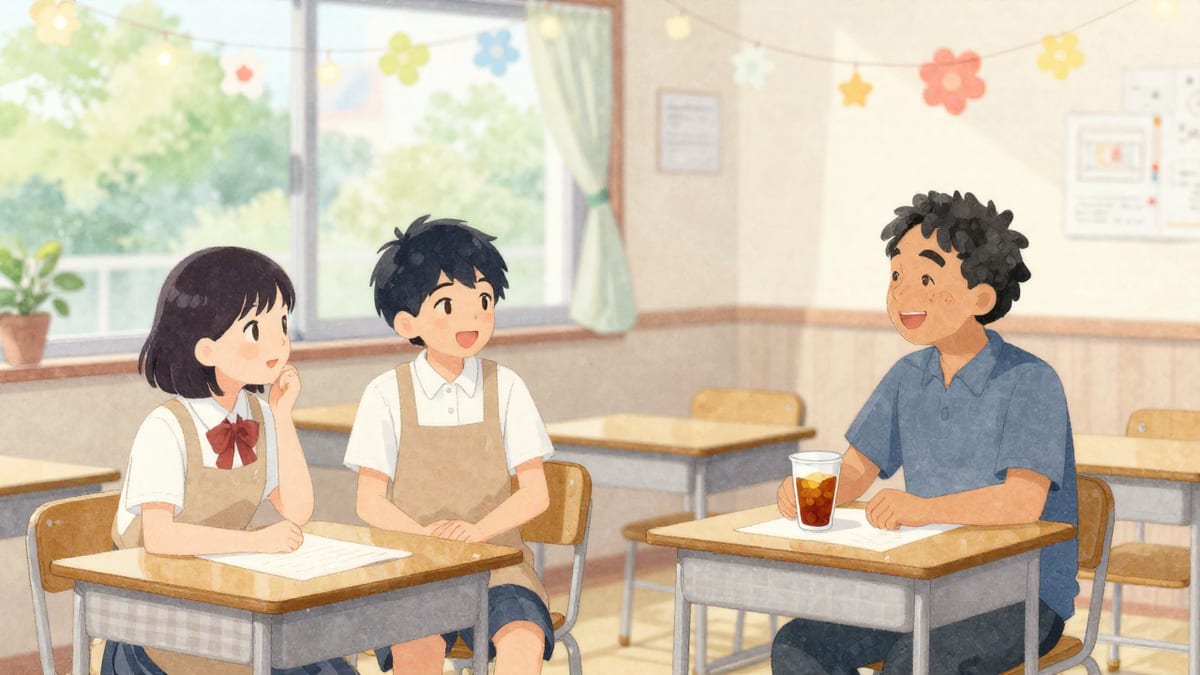
| Japanese | Romaji | Meaning |
|---|---|---|
| いらっしゃいませ!何にしますか。 | Irasshaimase! Nani ni shimasu ka. | Student: Welcome! What would you like? |
| アイスティーをください。この飾り、みんなで作ったんですか。 | Aisu tī o kudasai. Kono kazari, minna de tsukutta n desu ka. | You: An iced tea, please. Did you all make these decorations? |
| はい、一か月ぐらいかかりました。 | Hai, ikkagetsu gurai kakarimashita. | Student: Yes, it took about a month. |
| すごいですね。準備、大変でしたか。 | Sugoi desu ne. Junbi, taihen deshita ka. | You: Amazing. Was the preparation hard? |
| 大変でしたけど、楽しかったです! | Taihen deshita kedo, tanoshikatta desu! | Student: It was hard, but fun! |
| 何年生ですか。 | Nannensei desu ka. | You: What year are you in? |
| 二年生です。 | Ninensei desu. | Student: Second year. |
Junbi, taihen deshita ka is the key question: it recognises the work, not just the result. In Japanese schools, nensei counts years within the school, so a ninensei at a high school is in the second of three years.
Haunted houses, shows and reactions
The obake yashiki is often the longest queue. A classroom is blacked out and divided into a maze, and students in costume jump out from behind curtains. You will hear kowai! (scary!) and kyā! (a scream) from inside. Afterwards, the students at the exit will want to know how scary it was, so tell them. At stage shows, clap generously and say what you liked.
| Japanese | Romaji | Meaning |
|---|---|---|
| 何分ぐらい待ちますか。 | Nanpun gurai machimasu ka. | About how long is the wait? |
| めちゃくちゃ怖かったです! | Mechakucha kowakatta desu! | It was terrifying! |
| 演奏、かっこよかったです。 | Ensō, kakkoyokatta desu. | Your performance was so cool. |
| ダンス、すごく上手でしたね。 | Dansu, sugoku jōzu deshita ne. | The dance was really good. |
Mechakucha is casual, but mixed with desu it sounds friendly rather than rude, and students use it all the time. With teachers or other parents, totemo kowakatta desu is the safer choice.
Common mistakes, and university festivals
University festivals are called gakuensai (学園祭) or daigakusai (大学祭), and are usually open to everyone, bigger, and run by student clubs rather than classes. Some feature talks or concerts by well-known guests. The vocabulary in this guide works there too, with slightly more casual students.
For parents of a student, the bunkasai is also a social event. You will meet other parents and teachers in the corridors, and a few set phrases carry these short, polite exchanges. Introduce yourself as your child's parent, and use the classic line osewa ni natte imasu, which thanks someone for their help and goodwill in general.
| Japanese | Romaji | Meaning |
|---|---|---|
| ミアの母です。 | Mia no haha desu. | Parent: I'm Mia's mother. |
| いつもお世話になっています。 | Itsumo osewa ni natte imasu. | Thank you for all your kindness. |
| 素敵な文化祭ですね。 | Suteki na bunkasai desu ne. | What a lovely festival. |
- Talking to students in very casual Japanese from the start. As an adult stranger, begin with desu and masu.
- Photographing students without asking. Many schools ban it outright.
- Calling a class stall a mise without the o. It is not wrong, but omise sounds friendlier and is what everyone says.
- Leaving without a word. A short sugoku tanoshikatta desu at the exit means a lot to students who prepared for weeks.