

What the Japanese r really is
Before you can palatalise the r, you need the plain one. The Japanese r is an alveolar tap: the tip of the tongue flicks up, touches the ridge just behind the upper front teeth for a fraction of a second, and drops away. There is no curling back as in English red, no held contact as in English light, and no trill. The nearest sound most English speakers already make is the quick t in the American pronunciation of butter.
Because the contact is so short, the vowel after it does most of the work, and the tap borrows its colour from that vowel. Ra opens wide, ru is rounded, ri is tight with the tongue high at the front. That last point is the key to the whole series. When you say ri, the front of your tongue is already close to the hard palate, which is exactly where the y glide of rya, ryu and ryo lives. Palatalised r is simply the ri position released into a different vowel.
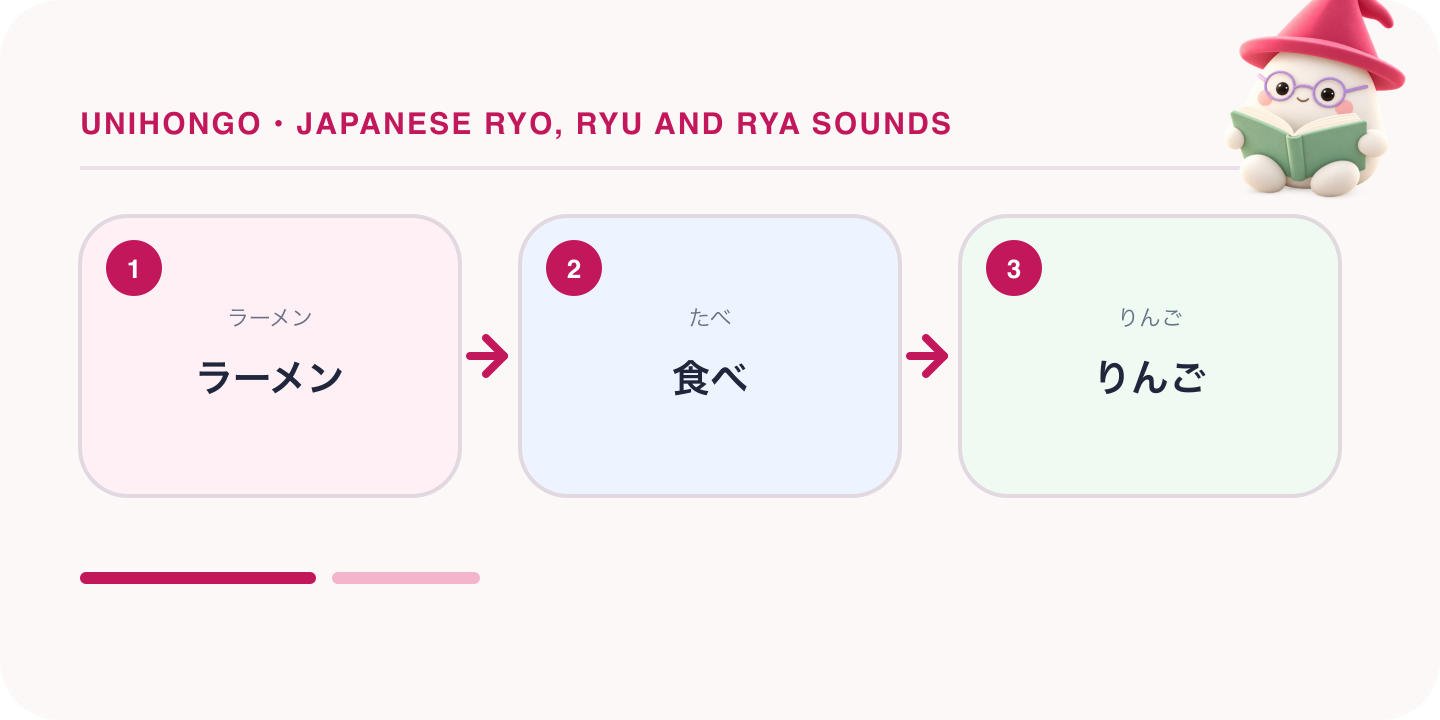
| Japanese | Romaji | Meaning |
|---|---|---|
| ラーメンを食べました。 | Rāmen o tabemashita. | I ate ramen. |
| りんごをください。 | Ringo o kudasai. | An apple, please. |
| 来週は忙しいです。 | Raishū wa isogashii desu. | Next week is busy. |
| 留守番電話にメッセージを残しました。 | Rusuban denwa ni messēji o nokoshimashita. | I left a message on the answering machine. |
Folding the y glide into one mora
Written Japanese shows the mechanism clearly. Rya is り plus a small ゃ, ryu is り plus a small ゅ, and ryo is り plus a small ょ. The small kana tells you that the i of ri does not get its own beat; it becomes a glide that slides straight into the next vowel. The whole combination, tap plus glide plus vowel, occupies one mora, exactly the same length as ro or ra.
Try it as a ladder. Say ri slowly. Now say ri-yo with two clear beats. Now speed it up until the i shrinks and the two beats become one: ryo. Do the same for ryu and rya. Then alternate ro and ryo, listening for the small lift of the tongue that separates them. The lift should be audible but quick; if it is heavy, you are back to two beats.
Length is the second half of the job. Many of the most common words carry a long vowel after the palatalised r: ryōri, ryōshin, ryūgaku, ryōhō. That long vowel is a full extra mora, so ryōri is three beats, ryo-o-ri, not two. Learners who get the tongue right often still say ryori and are misheard, because ryo with a short vowel is a different set of words.
| Japanese | Romaji | Meaning |
|---|---|---|
| 旅行が好きです。 | Ryokō ga suki desu. | I like travelling. |
| 料理を作ります。 | Ryōri o tsukurimasu. | I cook. |
| 留学したいです。 | Ryūgaku shitai desu. | I want to study abroad. |
| 両親は元気です。 | Ryōshin wa genki desu. | My parents are well. |
| 領収書をお願いします。 | Ryōshūsho o onegai shimasu. | A receipt, please. |
| 両方ください。 | Ryōhō kudasai. | Both, please. |
Minimal pairs to train your ear
You cannot fix a sound you cannot hear, so spend time on pairs that differ only in the glide or in the mora count. The pairs below are real words, and mishearing them changes the meaning. Say each pair aloud, then have someone, or the AI Sensei, say one of the two at random while you identify it.
The first group contrasts palatalised and plain r: ryaku, abbreviation, against raku, easy; ryōka, both families, against rōka, corridor. The second group contrasts one mora against two: ryū against riyū, ryō against riyō. The third group contrasts palatalised r with the palatalised n that learners often substitute: ryō, amount, against nyō, urine, a substitution you very much want to avoid at a clinic.
| Japanese | Romaji | Meaning |
|---|---|---|
| 略して言ってください。 | Ryaku shite itte kudasai. | Please say it in abbreviated form. |
| 楽な仕事ですね。 | Raku na shigoto desu ne. | That's an easy job, isn't it? |
| 廊下を走らないでください。 | Rōka o hashiranaide kudasai. | Please don't run in the corridor. |
| 理由を教えてください。 | Riyū o oshiete kudasai. | Please tell me the reason. |
| 利用できますか。 | Riyō dekimasu ka. | Can I use it? |
| 量が多いですね。 | Ryō ga ōi desu ne. | That's a large amount, isn't it? |
Everyday words with rya, ryu and ryo
The words below appear constantly in shops, classrooms, stations and small talk. Read each one aloud three times, counting the moras, and check the long vowels in the reading column. Notice how many are two-kanji compounds where the first kanji is 旅, 料, 両, 領, 流 or 留: once you can hear those kanji as ryo, ryō and ryū, a lot of vocabulary opens up at once.
| Word | Reading | Meaning and moras |
|---|---|---|
| 旅行 | ryokō | travel, trip (3 moras) |
| 旅館 | ryokan | traditional inn (3 moras) |
| 料理 | ryōri | cooking, a dish (3 moras) |
| 両親 | ryōshin | parents (4 moras) |
| 両方 | ryōhō | both (4 moras) |
| 両替 | ryōgae | currency exchange (4 moras) |
| 領収書 | ryōshūsho | receipt (6 moras) |
| 留学 | ryūgaku | studying abroad (4 moras) |
| 流行 | ryūkō | a trend, fashion (4 moras) |
| 緑茶 | ryokucha | green tea (4 moras) |
| 寮 | ryō | dormitory (2 moras) |
| 略 | ryaku | abbreviation (2 moras) |
A useful pattern: 旅 is ryo with a short vowel, 料, 両 and 領 are ryō with a long one, and 留 and 流 are ryū. Keeping those three groups apart in your head prevents most of the length errors in this family of words.
Drilling from ri to ryo in real sentences
Isolated drills build the muscle memory, but the sound has to survive inside a sentence at normal speed, next to other consonants and with the pitch moving. Work through the sentences below at three speeds: slow and exaggerated, natural, then slightly faster than comfortable. At the fast speed, listen for the two failure modes, ryo becoming ro and ryo becoming ri-yo, and slow down again if either appears.
In ryōri ga jōzu desu, the second r in ryōri needs its own clean tap. Learners often make the first r well and then rush the second.
| Japanese | Romaji | Meaning |
|---|---|---|
| 来月、京都に旅行に行きます。 | Raigetsu, Kyōto ni ryokō ni ikimasu. | Next month I'm going on a trip to Kyoto. |
| 母は料理が上手です。 | Haha wa ryōri ga jōzu desu. | My mother is a good cook. |
| 去年、日本に留学しました。 | Kyonen, Nihon ni ryūgaku shimashita. | Last year I studied abroad in Japan. |
| 空港で両替しました。 | Kūkō de ryōgae shimashita. | I exchanged money at the airport. |
| 緑茶と紅茶、両方あります。 | Ryokucha to kōcha, ryōhō arimasu. | We have both green tea and black tea. |
| 寮に住んでいます。 | Ryō ni sunde imasu. | I live in a dormitory. |
Common mistakes by first language
The same target sound goes wrong in predictable ways depending on what your mouth already knows. Recognising your own pattern saves weeks of vague practice. Each item below names the habit, what a Japanese listener hears, and the fix.
- English speakers: curling the tongue back for r, so ryo becomes a heavy English r plus yo that sounds like two syllables. Fix: replace the r with the tap from butter and keep the jaw still.
- English speakers: inserting a full vowel, saying ri-yo-ko-o for ryokō. Fix: tap the table once per mora and make ryo fit inside one tap.
- Spanish and Italian speakers: trilling or holding the r too long, which makes rya sound like rrya. Fix: allow only one contact, then release into the glide immediately.
- French and German speakers: producing the r at the back of the throat, which cannot carry a palatal glide. Fix: move the r to the tongue tip; think of a very light d.
- Korean speakers: turning ryo into yo at the start of a word, because r does not begin words in Korean. Fix: add a clear tap before the glide, starting from ri.
- Chinese speakers: substituting a retroflex r or l, giving lyo or a curled ryo. Fix: keep the tongue tip light and forward, and let the y glide come from the front of the tongue.
- Everyone: shortening long vowels, so ryōri becomes ryori and ryūgaku becomes ryugaku. Fix: hold the long vowel for a full extra beat and count it.
If you are not sure which pattern is yours, record yourself saying ryokō, ryōri and ryūgaku and compare it with a native recording.
A self-check routine with the AI Sensei
Because you are the least reliable judge of your own pronunciation, build a short routine that gives you outside feedback. In Unihongo's classroom, the AI Sensei listens to your voice and corrects you after the conversation, so use conversations that are dense with palatalised r sounds.
First, warm up with the ladder, ri to ryo, ryu and rya, five times each. Second, read the table of everyday words aloud with the moras counted. Third, hold a two-minute conversation with the Sensei about a trip you are planning, your parents, and what you like to cook, which forces ryokō, ryōshin and ryōri into natural sentences. Fourth, ask the Sensei to say five minimal pairs and to test you on which one you heard. Finally, read the feedback and repeat only the words that were flagged.
| Japanese | Romaji | Meaning |
|---|---|---|
| 発音を直してください。 | Hatsuon o naoshite kudasai. | Please correct my pronunciation. |
| もう一度ゆっくり言ってください。 | Mō ichido yukkuri itte kudasai. | Please say it once more, slowly. |
| 「りょ」と「ろ」の違いを聞かせてください。 | 'Ryo' to 'ro' no chigai o kikasete kudasai. | Please let me hear the difference between ryo and ro. |
| 今の発音は合っていましたか。 | Ima no hatsuon wa atte imashita ka. | Was my pronunciation just now correct? |
| 旅行の話をしましょう。 | Ryokō no hanashi o shimashō. | Let's talk about travel. |
When the sound still will not come
Some learners work through every drill and still feel stuck. Almost always the problem is one of three things. The plain r is not yet a tap, so there is nothing to palatalise; the glide is being made with the lips instead of the tongue, which gives a w-like sound; or the long vowel is being dropped, which makes the word wrong even when the consonant is right. Go back and test each one in isolation before repeating the whole word.
Aim for clarity over perfection, keep counting moras, and let the Sensei's feedback tell you when the sound is reliable enough to stop thinking about.
| Japanese | Romaji | Meaning |
|---|---|---|
| うまく言えません。 | Umaku iemasen. | I can't say it well. |
| 練習します。 | Renshū shimasu. | I'll practise. |
| だんだん上手になりました。 | Dandan jōzu ni narimashita. | I've gradually got better. |