

The evaluation cycle: jinji hyōka, mokuhyō settei and the mendan
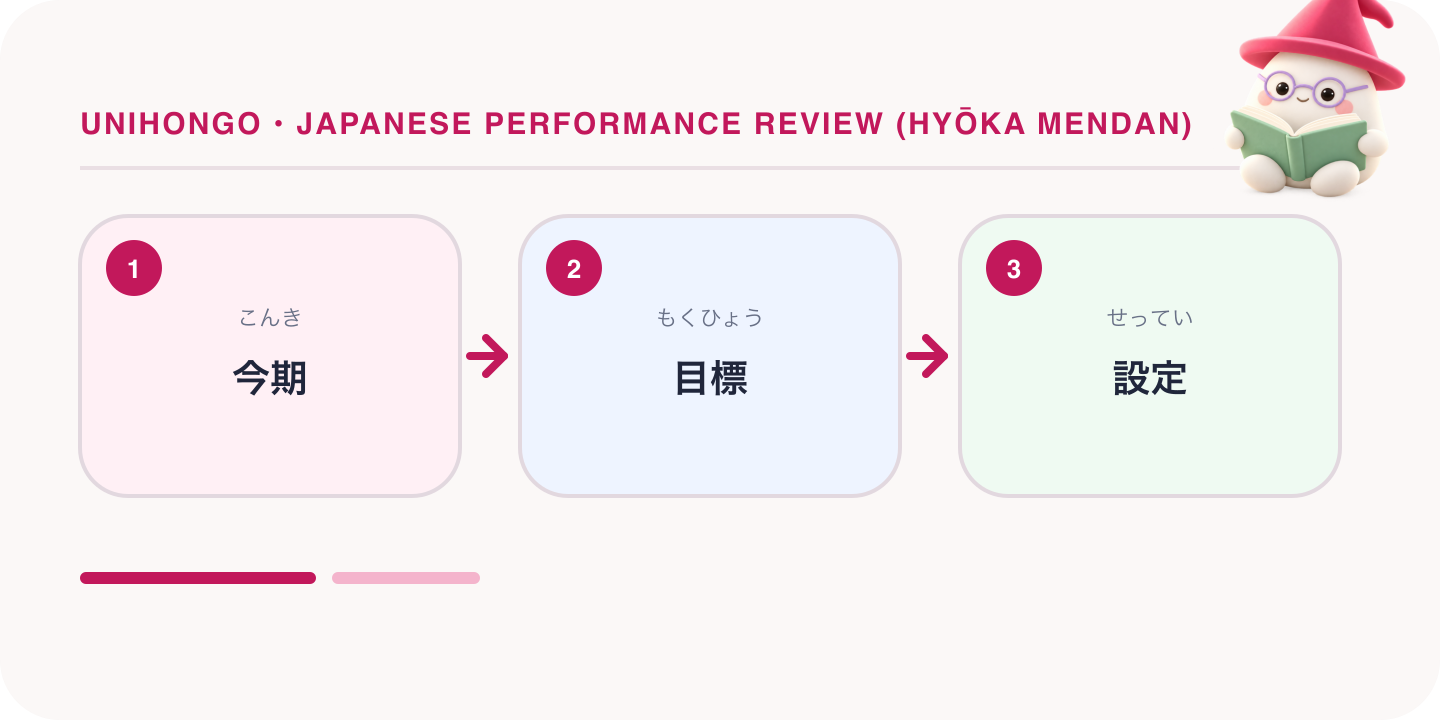
Jinji hyōka, personnel evaluation, is the system; the mendan is the meeting inside it. A typical cycle starts with mokuhyō settei, goal setting, where you agree three to five goals with your manager, each with a measure and a weight. At the end of the period you complete a jiko hyōka, a self-evaluation. Your manager writes their own assessment, the two are compared in the hyōka mendan, and a grade such as S, A, B or C is settled.
The grade scale, the weight given to results versus behaviour, and whether the review is tied to bonus or base pay all vary by company. Read your company's hyōka seido, evaluation guidelines, before the period starts; the words in the form, such as gyōseki, results, and kōdō, behaviour, tell you what the manager will look for.
| Japanese | Romaji | Meaning |
|---|---|---|
| 今期の目標設定について、ご相談したいのですが。 | Konki no mokuhyō settei ni tsuite, go-sōdan shitai no desu ga. | I'd like to discuss this period's goal setting. |
| 評価面談はいつ頃の予定でしょうか。 | Hyōka mendan wa itsu goro no yotei deshō ka. | Roughly when is the evaluation meeting planned? |
| 自己評価の提出期限は今週金曜日です。 | Jiko hyōka no teishutsu kigen wa konshū kin'yōbi desu. | The self-evaluation deadline is this Friday. |
| 評価基準を改めて確認させてください。 | Hyōka kijun o aratamete kakunin sasete kudasai. | Let me confirm the evaluation criteria again. |
Writing and saying your self-evaluation
A jiko hyōka is read by your manager before the meeting and often by their manager afterwards, so write it carefully. For each goal, write four things: what the goal was, what you achieved, the evidence, and what you would improve. The verbs are plain and factual: tassei shimashita, achieved; ichibu tassei, partly achieved; mi-tassei, not achieved. Numbers do the heavy lifting; a sentence with a number is worth three adjectives.
In the meeting you will usually be asked to summarise the form aloud, often with jibun de wa dō hyōka shite imasu ka, how do you rate yourself. Follow the same order but add the humble frame: results, then attribution to others, then reflection. Do not read the form word for word; pick the two or three points that matter most.
| Japanese | Romaji | Meaning |
|---|---|---|
| 今期の目標は、新規顧客を十社獲得することでした。 | Konki no mokuhyō wa, shinki kokyaku o jussha kakutoku suru koto deshita. | This period's goal was to win ten new clients. |
| 結果として、十二社を獲得し、目標を達成しました。 | Kekka to shite, jūnisha o kakutoku shi, mokuhyō o tassei shimashita. | As a result, I won twelve and achieved the goal. |
| 自己評価としては、Aに近いBだと考えています。 | Jiko hyōka to shite wa, A ni chikai B da to kangaete imasu. | As a self-rating, I consider it a B close to an A. |
| 二つ目の目標は、納期の遅れがあり、一部達成にとどまりました。 | Futatsume no mokuhyō wa, nōki no okure ga ari, ichibu tassei ni todomarimashita. | The second goal was only partly achieved because of a delivery delay. |
| 改善点としては、進捗の共有が遅れがちだった点です。 | Kaizen-ten to shite wa, shinchoku no kyōyū ga okure-gachi datta ten desu. | As a point to improve, I tended to be slow in sharing progress. |
Talking about achievements: clear numbers, humble frame
The balance learners struggle with is being specific without sounding like they are claiming credit. Japanese solves this with a two-part sentence: the fact, then a phrase that spreads the credit. Okage-sama de, thanks to everyone, and chīmu no kyōryoku mo ari, with the team's help too, do this job. The number does not get softer; the framing does.
The second tool is the verb ending. Instead of a bare tassei shimashita, close with to omotte imasu, I believe, or to ninshiki shite imasu, that is my understanding. This leaves room for the manager's view without retracting yours. Avoid the opposite extreme too: taishita koto wa arimasen, it was nothing, is self-defeating in a review, because the manager has to justify your grade upward with your words.
| Japanese | Romaji | Meaning |
|---|---|---|
| おかげさまで、売上は前年比二割増となりました。 | Okage-sama de, uriage wa zennen-hi niwari-zō to narimashita. | Thanks to everyone, sales rose twenty per cent on the previous year. |
| チームの協力もあり、予定より一か月早くリリースできました。 | Chīmu no kyōryoku mo ari, yotei yori ikkagetsu hayaku rirīsu dekimashita. | With the team's cooperation, we released a month ahead of schedule. |
| この案件では、主に顧客との調整を担当しました。 | Kono anken de wa, omo ni kokyaku to no chōsei o tantō shimashita. | On this project I was mainly responsible for coordinating with the client. |
| 私としては、一定の成果を出せたと考えています。 | Watashi to shite wa, ittei no seika o daseta to kangaete imasu. | For my part, I believe I produced solid results. |
Receiving feedback and handling a lower grade
Managers give feedback in a soft register, so listen for the shape rather than the volume. Mō sukoshi, a little more, and dekiru to ii ne, it would be good if you could, are criticisms. The expected response has three parts: thank them, acknowledge the point, and name one concrete action.
If the grade is lower than your self-rating, do not argue on the spot. Ask which point weighed most. If you believe a fact was missed, offer it as information with watashi no ninshiki de wa, as I understood it. Then accept the decision. Grades are rarely reversed in the room, but a calm response shapes the manager's view for the next cycle.
| Japanese | Romaji | Meaning |
|---|---|---|
| ご指摘ありがとうございます。おっしゃる通りだと思います。 | Go-shiteki arigatō gozaimasu. Ossharu tōri da to omoimasu. | Thank you for pointing that out. I think you are right. |
| 具体的には、どの点が評価に影響したのでしょうか。 | Gutai-teki ni wa, dono ten ga hyōka ni eikyō shita no deshō ka. | Specifically, which point affected the evaluation? |
| 私の認識では、その件は先方の都合で延期になったと理解しています。 | Watashi no ninshiki de wa, sono ken wa senpō no tsugō de enki ni natta to rikai shite imasu. | As I understood it, that matter was postponed for the client's reasons. |
| 今後は週次で進捗を報告するようにします。 | Kongo wa shūji de shinchoku o hōkoku suru yō ni shimasu. | From now on I will report progress weekly. |
| もう少し周りを巻き込めるといいね。 | Mō sukoshi mawari o makikomeru to ii ne. | It would be good if you could involve the people around you a bit more. (Manager, a gentle criticism.) |
Asking about promotion and pay politely
Shōshin, promotion, and shōkyū, a pay rise, are legitimate topics in a mendan, but the way to raise them is through the system, not through your wishes. Ask what the yōken, requirements, for the next grade are, what timing is realistic, and what the manager would need to see. In many companies pay is fixed by grade tables, so a manager can explain the path but cannot negotiate a number.
Avoid kyūryō o agete hoshii, I want my salary raised, which sounds like a demand and corners the manager. An outside offer is a different conversation, usually with HR. Inside the review, keep the frame on criteria and growth.
| Japanese | Romaji | Meaning |
|---|---|---|
| 昇進の要件について教えていただけますか。 | Shōshin no yōken ni tsuite oshiete itadakemasu ka. | Could you tell me about the requirements for promotion? |
| 次の等級に上がるには、何が必要でしょうか。 | Tsugi no tōkyū ni agaru ni wa, nani ga hitsuyō deshō ka. | What is needed to move up to the next grade? |
| 昇給の基準はどのように決まるのでしょうか。 | Shōkyū no kijun wa dono yō ni kimaru no deshō ka. | How are the criteria for pay rises decided? |
| 将来的にはリーダー職を目指したいと考えています。 | Shōrai-teki ni wa rīdā-shoku o mezashitai to kangaete imasu. | In the longer term I would like to aim for a leader position. |
| 今の評価ですと、昇格の時期はいつ頃が現実的でしょうか。 | Ima no hyōka desu to, shōkaku no jiki wa itsu goro ga genjitsu-teki deshō ka. | With my current evaluation, what timing for promotion would be realistic? |
Review vocabulary you will see on the form
Evaluation forms use a compact written vocabulary that rarely appears in conversation. The table gathers the words you will meet in the HR system and your manager's comments. Exact terms differ between companies.
| Word | Reading | Meaning |
|---|---|---|
| 人事評価 | jinji hyōka | Personnel evaluation, the system as a whole |
| 目標設定 | mokuhyō settei | Goal setting at the start of the period |
| 自己評価 | jiko hyōka | Self-evaluation |
| 上司評価 | jōshi hyōka | Manager's evaluation |
| 業績評価 | gyōseki hyōka | Results evaluation |
| 行動評価 | kōdō hyōka | Behaviour or competency evaluation |
| 達成度 | tasseido | Degree of achievement, often a percentage |
| 評価面談 | hyōka mendan | Evaluation meeting |
| フィードバック | fīdobakku | Feedback |
| 改善点 | kaizen-ten | Points to improve |
| 昇格 | shōkaku | Promotion in grade |
| 賞与 | shōyo | Bonus, often linked to the grade |
You may also see kitai yakuwari, the expected role for your grade, and konpitenshī, competencies, in behaviour sections. If a word on your form is not here, ask HR or a senpai before you write to it; definitions are often company-specific.
Setting goals for the next period
The last part of the mendan usually turns to raiki no mokuhyō, next period's goals. Good goals are specific, measurable and linked to the team's plan, and the manager will appreciate it if you arrive with a draft rather than waiting to be told.
- Reread the evaluation guidelines and the team's plan for the period
- Draft three to five goals, each with a number or a deliverable and a deadline
- Link at least one goal to the improvement point from your last review
- Include one goal on behaviour or teamwork if your form scores it
- Note what support you would need and be ready to say so
- Bring your draft to the meeting and ask for the manager's view
- Record the agreed goals in the HR system on the same day
- Set a mid-period reminder to check progress
When you present a draft goal, say kono yō na mokuhyō o kangaete imasu ga, ikaga deshō ka, I am thinking of a goal like this, what do you think. Managers adjust and approve more easily than they invent.
Mistakes to avoid
The first mistake is vagueness: ganbarimashita, I worked hard, is not an achievement. Every claim needs a number, a date or a deliverable. The second is the opposite: results with no humble frame, which reads as boasting even when true.
The third is arguing with feedback in the room. Ask, acknowledge, act; if there is a factual error, present the fact and let it go. The fourth is asking for money directly. The fifth is leaving without agreed goals, which means the next review starts from nothing.
| Japanese | Romaji | Meaning |
|---|---|---|
| 今期は頑張りました。 | Konki wa ganbarimashita. | I worked hard this period. (Too vague; add a result.) |
| 今期は目標の百二十パーセントを達成しました。 | Konki wa mokuhyō no hyaku-nijuppāsento o tassei shimashita. | This period I achieved 120 per cent of target. (Specific.) |
| その評価は納得できません。 | Sono hyōka wa nattoku dekimasen. | I can't accept that evaluation. (Too direct; avoid.) |
| 評価の理由をもう少し詳しく伺ってもよろしいでしょうか。 | Hyōka no riyū o mō sukoshi kuwashiku ukagatte mo yoroshii deshō ka. | May I ask a little more about the reasons for the evaluation? (The polite version.) |
| 給料を上げてほしいです。 | Kyūryō o agete hoshii desu. | I want my salary raised. (A demand; ask about criteria instead.) |