
What sayonara actually signals
Textbooks pair sayōnara with goodbye because both sit at the end of a conversation, but the two words cover different distances. English goodbye stretches from see you in ten minutes to farewell forever, and tone carries the difference. Sayōnara has no such range. It reads as a parting with a horizon on it, which is why it turns up when someone leaves the country, when a posting ends, or when a relationship closes. Said to a colleague on a Tuesday evening it lands strangely, as though you knew something they did not.
This is why fluent-sounding Japanese rarely contains the word at all. Instead of one general goodbye, speakers reach for a phrase that describes the situation: an apology for leaving first, a thank-you for the time given, a wish for a safe trip home, or a plain statement of when you will next meet. The greetings post covers the arrival half of this system; this one covers the exit.
| Japanese | Romaji | Meaning |
|---|---|---|
| さようなら。 | Sayōnara. | Goodbye, said when the parting will last. |
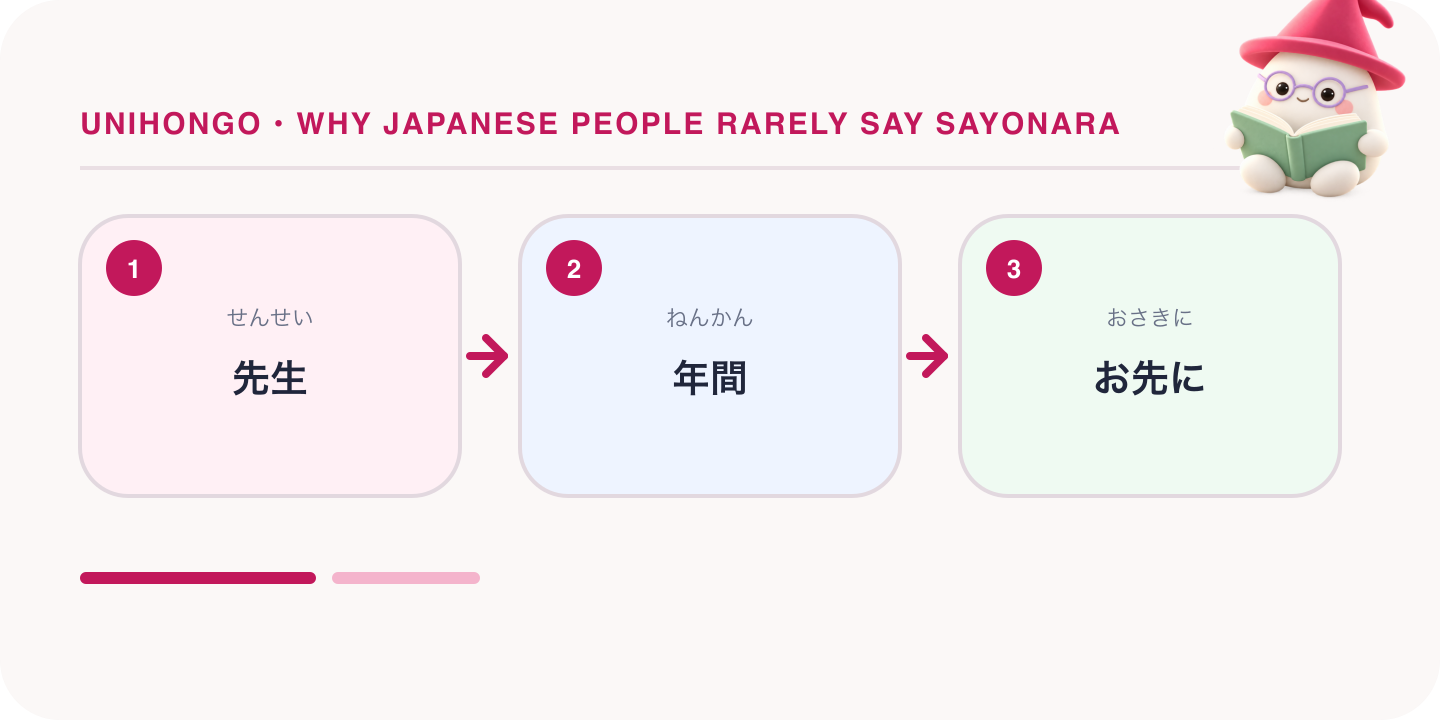
| 先生、さようなら。 | Sensei, sayōnara. | Goodbye, teacher. (school children at the end of the day) |
| 三年間、ありがとうございました。さようなら。 | San-nenkan, arigatō gozaimashita. Sayōnara. | Thank you for these three years. Goodbye. |
The exit line for each situation
| Situation | What you say | Register |
|---|---|---|
| Leaving work before others | お先に失礼します Osaki ni shitsurei shimasu | Polite, standard |
| Answering someone who leaves | お疲れさまです Otsukaresama desu | Polite, standard |
| Leaving work at the same time | お疲れさまでした Otsukaresama deshita | Polite, standard |
| Leaving a shop or office | 失礼します Shitsurei shimasu | Polite |
| Leaving a client meeting | 本日はありがとうございました Honjitsu wa arigatō gozaimashita | Formal |
| Leaving home | 行ってきます Itte kimasu | Household set phrase |
| Seeing someone out of the house | 行ってらっしゃい Itte rasshai | Household set phrase |
| Leaving a friend | じゃあね Jā ne / またね Mata ne | Casual |
| Naming the next meeting | また明日 Mata ashita | Casual to neutral |
| Seeing someone off at night | 気をつけて Ki o tsukete | Neutral, warm |
| Ending a phone call | 失礼します Shitsurei shimasu | Polite |
| Leaving someone's home | お邪魔しました O-jama shimashita | Polite |
| A genuinely long parting | お元気で O-genki de | Warm, final |
Read the table as a set of reflexes rather than vocabulary. Each line is welded to a place: the office door, the shop entrance, the genkan of a house, the ticket gate. Learners who memorise them as a list still freeze at the moment of leaving, because the cue is physical. Say each phrase while imagining the doorway it belongs to and it will arrive on time.
Leaving work: an apology, not a goodbye
Japanese office partings are built on the idea that you are going while others are still working, so the leaving line is shaped like an apology. Osaki ni shitsurei shimasu literally offers a discourtesy for going ahead, and nobody hears it as real regret; it is simply the correct sound for that moment. Those remaining answer otsukaresama desu, acknowledging the day's effort. If the whole team leaves together, both sides say otsukaresama deshita and the exchange is complete.
Register shifts with who is present. With a senior manager or a visiting client, osaki ni shitsurei itashimasu is the humble form and sounds careful rather than stiff. Among close colleagues on a quiet evening, a short otsukaresama with a nod is enough. What does not work is silence: leaving without a word reads as sulking, and it is the single most common mistake foreign staff make in their first month.
| Japanese | Romaji | Meaning |
|---|---|---|
| お先に失礼します。 | Osaki ni shitsurei shimasu. | Excuse me for leaving ahead of you. |
| お先に失礼いたします。 | Osaki ni shitsurei itashimasu. | Excuse me for leaving first. (humble, to a superior) |
| お疲れさまです。 | Otsukaresama desu. | Thanks for your work. (reply to someone leaving) |
| お疲れさまでした。 | Otsukaresama deshita. | Thank you for your work today. |
| そろそろ失礼します。 | Sorosoro shitsurei shimasu. | I should be getting going. |
| 今日はこれで失礼します。 | Kyō wa kore de shitsurei shimasu. | I will leave it there for today. |
| お先です。 | Osaki desu. | Off before you. (clipped, between close colleagues) |
| また明日よろしくお願いします。 | Mata ashita yoroshiku onegai shimasu. | See you tomorrow, and thank you in advance. |
Leaving a shop, an office, or a client
Shitsurei shimasu is the general-purpose polite exit. It works when you step out of a room, leave a company reception, finish at a bank counter, or hang up a call. The literal sense is I am about to be discourteous, and it covers both entering and leaving someone else's space. Past tense shitsurei shimashita marks the moment you are already on your way out, which is why you often hear it as the door closes.
In a shop, the customer often says nothing at all, or a simple arigatō gozaimasu, while staff say arigatō gozaimashita to your back. After a meeting, close with honjitsu wa arigatō gozaimashita before shitsurei shimasu, and add yoroshiku onegai shimasu if there is follow-up work. That three-part close sounds thoroughly professional and needs no goodbye in it.
| Japanese | Romaji | Meaning |
|---|---|---|
| 失礼します。 | Shitsurei shimasu. | Excuse me, I will be going. |
| 失礼しました。 | Shitsurei shimashita. | Excuse me for the intrusion. (on the way out) |
| それでは失礼いたします。 | Sore dewa shitsurei itashimasu. | Well then, I will take my leave. (formal) |
| 本日はありがとうございました。 | Honjitsu wa arigatō gozaimashita. | Thank you very much for today. |
| お忙しいところ、ありがとうございました。 | O-isogashii tokoro, arigatō gozaimashita. | Thank you for your time despite being busy. |
| 引き続きよろしくお願いします。 | Hikitsuzuki yoroshiku onegai shimasu. | I look forward to continuing to work with you. |
| また来ます。 | Mata kimasu. | I will come again. (staff hear this warmly) |
| お邪魔しました。 | O-jama shimashita. | Sorry to have taken up your space. (leaving a home or office) |
| ごちそうさまでした。 | Gochisōsama deshita. | Thank you for the meal. (leaving a restaurant or a host's table) |
Leaving friends: name the next meeting
Casual Japanese partings almost always point forward. Rather than closing the door with a goodbye, you say when the next meeting is, even vaguely. Mata ne means see you again, mata ashita is see you tomorrow, and mata kondo is see you next time with no date attached. Jā ne is the lightest of all and works with anyone you are on plain-form terms with. All of these are casual, so keep them for friends, classmates and colleagues you know well.
Bai bai is genuine spoken Japanese, not a foreigner's shortcut, though it skews young and slightly soft. Mixing two of these is normal and sounds natural: jā, mata ne is extremely common. A neutral middle option for colleagues you are not close to is dewa, mata, which is polite enough for most offices without being formal.
| Japanese | Romaji | Meaning |
|---|---|---|
| じゃあね。 | Jā ne. | See you. (casual) |
| じゃ、また。 | Ja, mata. | See you then. (casual) |
| またね。 | Mata ne. | See you again. (casual) |
| また明日。 | Mata ashita. | See you tomorrow. |
| また来週。 | Mata raishū. | See you next week. |
| またあとでね。 | Mata ato de ne. | See you later today. (casual) |
| また今度。 | Mata kondo. | See you next time. (casual) |
| バイバイ。 | Bai bai. | Bye bye. (casual, light) |
| では、また。 | Dewa, mata. | Until next time. (neutral, safe at work) |
| じゃ、行くね。 | Ja, iku ne. | Right, I'm off. (casual) |
| 今日は楽しかった。ありがとう。 | Kyō wa tanoshikatta. Arigatō. | Today was fun. Thanks. (casual) |
Leaving home and coming back
The household set has no goodbye in it either. Going out you say itte kimasu, literally I will go and come back, and the person staying answers itte rasshai. Coming home you say tadaima and hear okaeri or okaerinasai. These four lines are fixed, said quickly, and used far beyond the home: staff leaving the office on an errand say itte kimasu, and colleagues answer itte rasshai.
Because the pattern promises a return, learners sometimes worry about using it before a long trip. It is still correct; itte kimasu is about coming back to this door eventually, not about the length of the trip. What you add around it changes with the occasion, such as ki o tsukete ne from the person staying behind.
| Japanese | Romaji | Meaning |
|---|---|---|
| 行ってきます。 | Itte kimasu. | I'm off, and I'll be back. |
| 行ってらっしゃい。 | Itte rasshai. | Off you go, see you later. |
| 気をつけて行ってらっしゃい。 | Ki o tsukete itte rasshai. | Take care on your way out. |
| ただいま。 | Tadaima. | I'm home. |
| お帰りなさい。 | Okaerinasai. | Welcome back. |
| おやすみなさい。 | Oyasuminasai. | Good night. |
| また明日ね。おやすみ。 | Mata ashita ne. Oyasumi. | See you tomorrow. Night. (casual) |
Seeing someone off
When you are the one staying, the parting line is a wish for the other person's safety rather than a farewell. Ki o tsukete covers everything from a walk home to a flight, and o-ki o tsukete is its polite form for guests, clients and older people. At night, ki o tsukete kaette ne to a friend is the warm, ordinary thing to say. For a guest leaving your office or home, ki o tsukete o-kaeri kudasai is the careful version.
This is also where you place the thank-you for the visit. Kyō wa arigatō gozaimashita followed by ki o tsukete makes a complete send-off, and the guest answers with o-jama shimashita or arigatō gozaimashita. Notice again that nobody needs a word meaning goodbye for the exchange to feel finished.
| Japanese | Romaji | Meaning |
|---|---|---|
| 気をつけて。 | Ki o tsukete. | Take care on the way. |
| お気をつけて。 | O-ki o tsukete. | Please take care. (polite) |
| 気をつけて帰ってね。 | Ki o tsukete kaette ne. | Get home safely. (casual) |
| 気をつけてお帰りください。 | Ki o tsukete o-kaeri kudasai. | Please get home safely. (formal) |
| 今日はありがとうございました。 | Kyō wa arigatō gozaimashita. | Thank you for today. |
| また遊びに来てください。 | Mata asobi ni kite kudasai. | Please come and visit again. |
| 行ってらっしゃい、楽しんできてね。 | Itte rasshai, tanoshinde kite ne. | Off you go, enjoy yourself. (casual) |
| 寒いので、気をつけてくださいね。 | Samui node, ki o tsukete kudasai ne. | It is cold, so please take care. |
Ending calls and messages
A phone call closes with a thank-you and then shitsurei shimasu, said as you are already lowering the handset. In business, the caller normally hangs up second and waits a beat after the other person's line. If there is anything outstanding, yoroshiku onegai shimasu goes just before the exit, and it does a lot of quiet work: it means please handle this, thank you in advance, and I will speak to you again, all at once.
Written messages follow the same logic. A work email or chat ends with yoroshiku onegai shimasu or shitsurei shimasu rather than a goodbye, and a casual message ends with a forward-looking line such as mata ne or renraku suru ne. Writing sayōnara at the bottom of a message to a colleague reads as though you are resigning, so avoid it unless you mean it.
| Japanese | Romaji | Meaning |
|---|---|---|
| では、よろしくお願いします。失礼します。 | Dewa, yoroshiku onegai shimasu. Shitsurei shimasu. | Well then, thank you in advance. Goodbye. (phone) |
| お電話ありがとうございました。失礼します。 | O-denwa arigatō gozaimashita. Shitsurei shimasu. | Thank you for calling. Goodbye. |
| また改めてご連絡します。 | Mata aratamete go-renraku shimasu. | I will contact you again separately. |
| 長くなってすみません。それでは。 | Nagaku natte sumimasen. Sore dewa. | Sorry for keeping you. Right then. |
| 取り急ぎ、よろしくお願いいたします。 | Toriisogi, yoroshiku onegai itashimasu. | In haste, thank you for your help. (message closing) |
| また連絡するね。 | Mata renraku suru ne. | I'll be in touch. (casual message) |
| 返事ありがとう。またね。 | Henji arigatō. Mata ne. | Thanks for replying. See you. (casual message) |
When the parting really is a long one
There is a place for a proper farewell, and it is not sayōnara alone. When someone leaves a job, moves abroad, or finishes a long stay, the warm thing to say is o-sewa ni narimashita, which thanks the person for everything they did for you. O-genki de wishes them well over a long absence, and karada ni ki o tsukete asks them to look after their health. Together these carry far more feeling than the word learners were taught.
You can end such a farewell with mata aimashō or mata itsuka, keeping a door open. Many people do add sayōnara here, and it is fully natural, because the length of the parting matches the word. On a last day at work, the usual shape is a thank-you, a wish, and a hope of meeting again, said in that order.
| Japanese | Romaji | Meaning |
|---|---|---|
| お世話になりました。 | O-sewa ni narimashita. | Thank you for everything you have done for me. |
| 今までありがとうございました。 | Ima made arigatō gozaimashita. | Thank you for all this time. |
| お元気で。 | O-genki de. | Keep well. |
| 体に気をつけてください。 | Karada ni ki o tsukete kudasai. | Please look after your health. |
| また会いましょう。 | Mata aimashō. | Let us meet again. |
| またいつか、どこかで。 | Mata itsuka, dokoka de. | Again someday, somewhere. |
| 新しい職場でも頑張ってください。 | Atarashii shokuba demo ganbatte kudasai. | All the best at your new workplace. |
| 落ち着いたら連絡します。 | Ochitsuitara renraku shimasu. | I will get in touch once I have settled in. |
| また日本に来てくださいね。 | Mata Nihon ni kite kudasai ne. | Please come back to Japan. |
| 元気でね。連絡してね。 | Genki de ne. Renraku shite ne. | Take care. Keep in touch. (casual) |
Mistakes that mark you as a beginner
- Saying sayōnara to a colleague at six in the evening, which sounds like you are quitting.
- Leaving the office silently because you are not sure of the phrase; a plain otsukaresama desu is always better than nothing.
- Using otsukaresama with shop staff or a taxi driver, where arigatō gozaimasu is the right word.
- Answering osaki ni shitsurei shimasu with the same phrase; the person staying says otsukaresama desu instead.
- Using ki o tsukete to someone who is not going anywhere, when you meant ganbatte.
- Ending a business call with bai bai, which is fine with friends and jarring with clients.
- Adding sayōnara at the bottom of a work email instead of yoroshiku onegai shimasu.
A five-minute drill for exits
- Stand up and walk to a door for each line; partings are physical habits, not vocabulary.
- Say the leaving line and the reply as one unit, switching roles each time.
- Record yourself ending a call three ways: with a client, a colleague, and a friend.
- Rewrite one recent English farewell message into Japanese, then read it aloud.
- Keep a note of any parting you hear in the wild and copy it exactly the next day.