

The direct sentence: shitsumon ga arimasu
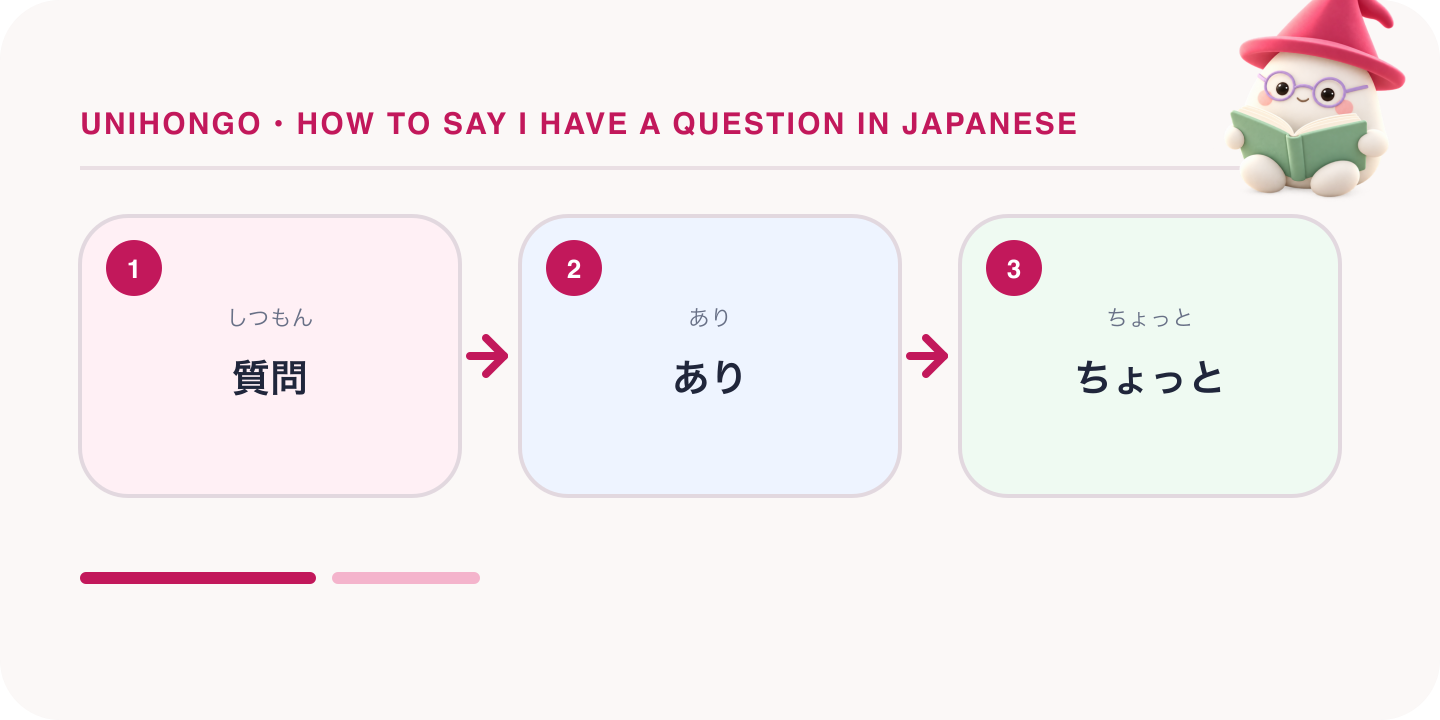
Shitsumon means a question, and shitsumon ga arimasu says one exists, which is the Japanese way of saying I have a question. It is grammatical, polite and clear, and in a classroom, a lecture, a training session or a meeting with a set question time, it is exactly right. The person leading the room expects questions, and announcing one is the normal move.
The reason to learn other options is that shitsumon ga arimasu is a statement rather than a request. In a one-to-one situation it can sound as if you are opening a formal Q and A. Two small changes fix this. First, turn it into a request for permission: shitsumon shite mo ii desu ka, may I ask a question. Second, add chotto, a little, and the softening n desu ga: chotto shitsumon ga aru n desu ga, which trails off and invites the other person to say hai, dōzo, yes, go ahead.
You will also see shitsumon as a verb, shitsumon suru, to ask a question, and in written contexts such as forms and emails as go-shitsumon, with an honorific prefix, meaning your question.
| Japanese | Romaji | Meaning |
|---|---|---|
| 質問があります。 | Shitsumon ga arimasu. | I have a question. |
| 質問してもいいですか。 | Shitsumon shite mo ii desu ka. | May I ask a question? |
| ちょっと質問があるんですが。 | Chotto shitsumon ga aru n desu ga. | I have a small question, if that's okay. |
| 一つ質問してもよろしいでしょうか。 | Hitotsu shitsumon shite mo yoroshii deshō ka. | May I ask one question? (formal) |
| 質問は特にありません。 | Shitsumon wa toku ni arimasen. | I have no particular questions. |
The everyday opener: chotto o-kiki shitai n desu ga
In shops, at reception desks, on the phone and with colleagues, the sentence Japanese speakers actually use is chotto o-kiki shitai n desu ga. Piece by piece: chotto, a little; o-kiki shitai, I would like to ask, from the verb kiku with a polite o prefix; n desu ga, the softening explanation ending. Together it says there is something small I would like to ask, and the ga at the end hands the turn to the listener.
The beauty of this sentence is that it does not mention a question at all. It mentions asking, which feels lighter. It also works before almost anything: a request for directions, a query about a product, a question about a bill. After the other person says hai or nan deshō ka, what is it, you ask the real question.
Two close relatives are worth knowing. O-tazune shitai n desu ga uses tazuneru, to inquire, and sounds a touch more formal, common at information desks. Kikitai koto ga aru n desu ga, there is something I want to ask, is the plainer version you would use with a friend or a classmate.
| Japanese | Romaji | Meaning |
|---|---|---|
| ちょっとお聞きしたいんですが。 | Chotto o-kiki shitai n desu ga. | There's something I'd like to ask. |
| お尋ねしたいんですが。 | O-tazune shitai n desu ga. | I'd like to inquire about something. |
| 聞きたいことがあるんだけど。 | Kikitai koto ga aru n da kedo. | There's something I want to ask you. (casual) |
| この商品についてお聞きしたいんですが。 | Kono shōhin ni tsuite o-kiki shitai n desu ga. | I'd like to ask about this product. |
| はい、何でしょうか。 | Hai, nan deshō ka. | Yes, what is it? |
| どうぞ。 | Dōzo. | Go ahead. |
The humble opener: ukagaitai koto ga aru n desu ga
Ukagau is the humble verb for asking, visiting and hearing, and ukagaitai koto ga aru n desu ga, there is something I would like to ask you, is the version for people you want to show respect to: a teacher outside class, a manager, a client, a doctor, an official at a counter. It is not stiff, just careful, and native speakers use it constantly at work.
It pairs naturally with a check on timing. Ima, yoroshii desu ka, is now all right, or o-isogashii tokoro sumimasen, sorry to bother you when you are busy, comes first, then the opener. Skipping the timing check with a senior person is one of the most common small rudenesses in a Japanese office, because it forces them to stop whatever they were doing.
Beyond this level lies keigo you will hear more than say: o-ukagai shite mo yoroshii deshō ka, might I ask, is the receptionist and customer-service register. Recognise it, but ukagaitai koto ga aru n desu ga is as far up the ladder as most learners need to climb.
| Japanese | Romaji | Meaning |
|---|---|---|
| お忙しいところすみません、伺いたいことがあるんですが。 | O-isogashii tokoro sumimasen, ukagaitai koto ga aru n desu ga. | Sorry to bother you, there's something I'd like to ask. |
| 今、よろしいですか。 | Ima, yoroshii desu ka. | Is now a good time? |
| 少しお時間をいただけますか。 | Sukoshi o-jikan o itadakemasu ka. | Could I have a little of your time? |
| 一点、伺ってもよろしいでしょうか。 | Itten, ukagatte mo yoroshii deshō ka. | May I ask about one point? |
| 後でもいいので、伺いたいことがあります。 | Ato de mo ii node, ukagaitai koto ga arimasu. | It can be later, but there's something I'd like to ask. |
In class: raising a hand and asking afterwards
Japanese classrooms vary, but many are quieter than learners expect. Teachers often ask shitsumon wa arimasu ka, are there any questions, at set points, and that is the cleanest moment to raise your hand and say hai, shitsumon ga arimasu. If you need to interrupt mid-explanation, raise your hand first and wait for the teacher's eyes; a small sumimasen is enough once they look.
Many students prefer to ask after class. Walk to the desk and say sensei, chotto yoroshii desu ka, then explain: sakki no bunpō ga yoku wakaranakatta n desu ga, I did not quite understand the grammar just now. Teachers appreciate the specific reference. If the teacher is leaving, tsugi no jugyō no mae ni kiite mo ii desu ka, may I ask before the next lesson, respects their time.
| Japanese | Romaji | Meaning |
|---|---|---|
| はい、質問があります。 | Hai, shitsumon ga arimasu. | Yes, I have a question. |
| 先生、ちょっとよろしいですか。 | Sensei, chotto yoroshii desu ka. | Sensei, do you have a moment? |
| さっきの文法がよく分からなかったんですが。 | Sakki no bunpō ga yoku wakaranakatta n desu ga. | I didn't quite follow the grammar just now. |
| もう一度説明してもらえますか。 | Mō ichido setsumei shite moraemasu ka. | Could you explain it once more? |
| この漢字の読み方は何ですか。 | Kono kanji no yomikata wa nan desu ka. | How do you read this kanji? |
Choosing the right opener for the situation
Here is the same intention, I have a question, matched to the person in front of you. The middle rows are what you will use most; the top and bottom are the edges of the ladder.
| Situation | Reading | What to say |
|---|---|---|
| 友達 | tomodachi | Kikitai koto ga aru n da kedo. |
| 同僚 | dōryō | Chotto kiite mo ii?, or chotto ii desu ka. |
| 授業中 | jugyōchū | Hai, shitsumon ga arimasu. |
| 授業の後 | jugyō no ato | Sensei, chotto yoroshii desu ka. |
| お店 | o-mise | Sumimasen, chotto o-kiki shitai n desu ga. |
| 受付 | uketsuke | O-tazune shitai n desu ga. |
| 電話 | denwa | O-kiki shitai koto ga atte o-denwa shimashita. |
| 上司 | jōshi | Ima yoroshii desu ka. Ukagaitai koto ga aru n desu ga. |
| 取引先 | torihikisaki | Itten ukagatte mo yoroshii deshō ka. |
| 会議 | kaigi | Shitsumon ga hitotsu arimasu. |
Notice that the classroom and the meeting share the direct form, because both are settings where questions are expected and time is shared. Everywhere else, softening wins.
Asking a second question and closing politely
One question often leads to another, and there is a small etiquette to it. Signal that more is coming before you start: ikutsu ka shitsumon ga aru n desu ga, I have a few questions, or mittsu hodo, about three. When you get to the next one, use mō hitotsu, one more, and if you sense the person is short of time, ato hitotsu dake, just one more, promises an end.
Closing matters as much as opening. After the answer, confirm you understood with wakarimashita, then thank the person in proportion to their effort: arigatō gozaimasu for a shop assistant, o-isogashii tokoro arigatō gozaimashita for a colleague who stopped work, and yoku wakarimashita, arigatō gozaimashita for a teacher. If the answer will need a follow-up later, mata kiku ka mo shiremasen ga, I may ask again, keeps the door open.
- Ikutsu ka shitsumon ga aru n desu ga: I have a few questions
- Mō hitotsu ii desu ka: is one more okay
- Ato hitotsu dake: just one more
- Wakarimashita: understood
- O-isogashii tokoro arigatō gozaimashita: thank you for your time
- Mata kiku ka mo shiremasen ga: I may ask again
Sumimasen is often used instead of arigatō for a question that took someone's time, and it is not an apology for asking, only an acknowledgement of the effort. Both are fine; many people say both.
Mistakes that make a question feel heavier than it is
The first mistake is skipping the opener and firing the question. Native speakers almost always give a beat of warning, even with friends: ne, chotto kiite ii? The warning lets the listener switch attention, and without it a question can feel like an ambush, especially at work.
The second is finishing the ga. Learners often turn chotto o-kiki shitai n desu ga into a full question by adding the real question straight after, without a pause. The trailing ga is a pause point. Stop, look at the person, and wait for hai. It feels slow the first few times and then becomes natural.
The third is over-apologising. One sumimasen is polite; three in a row with bowing makes the other person uncomfortable and slows everything down. Ask, listen, thank once, and move on. Finally, avoid anata, you, in these sentences. Anata ni shitsumon ga arimasu sounds like a police interview; simply say shitsumon ga arimasu.
| Japanese | Romaji | Meaning |
|---|---|---|
| ね、ちょっと聞いていい? | Ne, chotto kiite ii? | Hey, can I ask you something? (casual) |
| すみません、一つだけ。 | Sumimasen, hitotsu dake. | Sorry, just one thing. |
| 分かりました。ありがとうございます。 | Wakarimashita. Arigatō gozaimasu. | Understood. Thank you. |
| また聞くかもしれませんが、よろしくお願いします。 | Mata kiku ka mo shiremasen ga, yoroshiku onegai shimasu. | I may ask again; thank you in advance. |