
Why anata is a trap for English speakers
English needs a second-person pronoun in almost every sentence addressed to somebody, so learners look for the Japanese equivalent and find anata sitting in the first chapter of the textbook. The word is real and it is grammatical, but its social range is narrow. Spoken directly to a person in front of you, anata can create distance, as though you were addressing a stranger through a counter window, and from a person in authority it can sound like a mild telling-off.
It also has an intimate use: in some couples one partner addresses the other as anata, which is roughly the effect of dear. That range, from cold to affectionate with nothing comfortable in the middle, is exactly why fluent speakers avoid it in ordinary conversation. Where anata genuinely belongs is impersonal writing that addresses a reader nobody has met: forms, questionnaires, instructions, advertising and announcements to an unnamed public.
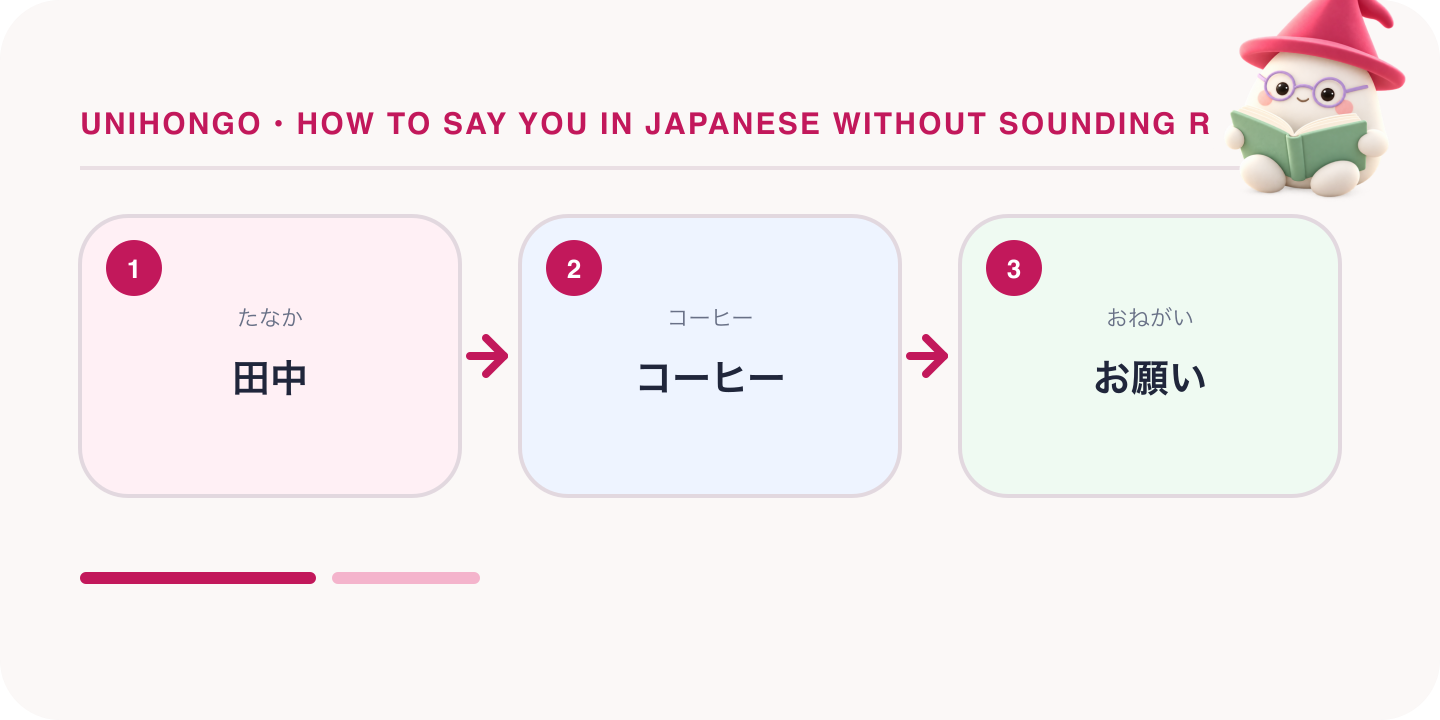
What Japanese speakers use instead
| Situation | Safe way to refer to the listener | Example form |
|---|---|---|
| A colleague you know | Family name plus san | 田中さん Tanaka-san |
| A senior colleague | Family name plus title | 田中部長 Tanaka-buchō |
| A teacher or doctor | Sensei, alone or after the name | 先生 sensei |
| A shop or restaurant customer | Okyakusama | お客様 okyakusama |
| A shop manager | Tenchō | 店長 tenchō |
| A stranger in the street | No word for you; open with sumimasen | すみません sumimasen |
| A child you know | Given name plus chan or kun | ゆうきくん Yūki-kun |
| A group | Minasan, or minasama in formal speech | 皆さん minasan |
| Anyone, in most sentences | Nothing at all | 行きますか? Ikimasu ka? |
The bottom row is the one to internalise. Japanese leaves out whatever the listener can recover, and when you are looking at somebody and asking them a question, they can recover that you mean them. Ikimasu ka is a complete, natural question meaning are you going, with no pronoun anywhere in it.
Note that san goes on other people's names and never on your own. Attaching sensei to a teacher's family name, as in Yamada-sensei, is normal and respectful; calling yourself sensei is not.
Names with san are the everyday answer
Using someone's family name plus san where English would use you is the single most useful habit in this whole topic. It sounds warm rather than formal, it works with people you have just met and people you have known for years, and it removes the anata problem completely. In Japanese it is not odd to use a person's name twice in the same short exchange, even though repeating a name that way in English would sound strained.
Given names with san appear too, mostly among friends, younger speakers and in some workplaces, and are the norm in situations where several people share a family name. Chan and kun are affectionate or junior forms, used mainly with children and close friends; using them upward is a mistake. The honorifics guide on this blog goes into the full set, but name plus san will carry you through nearly every conversation you have this year.
| Japanese | Romaji | Meaning |
|---|---|---|
| 田中さんは何時に来ますか? | Tanaka-san wa nan-ji ni kimasu ka? | What time are you coming, Tanaka? |
| 田中さんもコーヒーにしますか? | Tanaka-san mo kōhī ni shimasu ka? | Will you have coffee too, Tanaka? |
| これは田中さんのですか? | Kore wa Tanaka-san no desu ka? | Is this yours, Tanaka? |
| すみません、田中さんにお願いできますか? | Sumimasen, Tanaka-san ni onegai dekimasu ka? | Excuse me, could I ask you to do it, Tanaka? |
| ゆうきくん、宿題はもう終わった? | Yūki-kun, shukudai wa mō owatta? | Yūki, have you finished your homework? (casual, to a child) |
Titles and roles do the work of a pronoun
Japanese uses job titles as direct forms of address in a way English mostly does not. A teacher is sensei whether or not you know their name, a section head can be addressed as buchō, a shop manager as tenchō, and a customer as okyakusama. This is convenient for learners because a visible role gives you a safe way to address someone the moment you meet them, with no name required.
Sensei covers teachers, doctors, lawyers and some other professionals, and can be used alone or attached to a family name. Company titles such as buchō and kachō are used alone or after the family name, though practice varies by company and some firms now prefer san for everyone. Okyakusama belongs to staff speaking to customers, so you will hear it constantly and say it only if you work in service.
| Japanese | Romaji | Meaning |
|---|---|---|
| 先生、質問してもいいですか? | Sensei, shitsumon shite mo ii desu ka? | May I ask a question, sensei? |
| 山田先生はいらっしゃいますか? | Yamada-sensei wa irasshaimasu ka? | Is Dr Yamada in? |
| 部長、少しお時間よろしいでしょうか。 | Buchō, sukoshi o-jikan yoroshii deshō ka. | Do you have a moment, sir? (to a department head) |
| 店長、レジをお願いします。 | Tenchō, reji o onegai shimasu. | Could you take the till, manager? |
| お客様、こちらへどうぞ。 | Okyakusama, kochira e dōzo. | This way please, sir or madam. (staff to a customer) |
| 運転手さん、次の角で止めてください。 | Untenshu-san, tsugi no kado de tomete kudasai. | Driver, please stop at the next corner. |
The suffix san also attaches to some occupations, giving untenshu-san for a driver and omawari-san for a police officer. It is a friendly way to address someone whose job you can see but whose name you do not know, and it is safer than reaching for anata.
The forms to avoid, and where you will hear them
Omae, kimi and anta all mean you and all carry attitude. Omae is blunt and can be aggressive; it is used between very close male friends, sometimes within families, and it is a standard insult when aimed at a stranger. Kimi points downward, from an older or senior speaker to a younger or junior one, and it is also the word of songs and love stories, where its softness is the point. Anta is a contracted form of anata that sounds casual and often irritated, common in Kansai speech and in family arguments.
You will meet all three constantly in anime, drama, music and manga, which is exactly how learners pick them up and how they end up saying omae to a colleague. The safe position is to understand them and never produce them. There is no situation a learner faces where one of these words is required and a name with san would not work better.
| Japanese | Romaji | Meaning |
|---|---|---|
| お前、何やってるんだよ。 | Omae, nani yatterun da yo. | What do you think you are doing? (rough, close friends or confrontational) |
| 君はどう思う? | Kimi wa dō omou? | What do you think? (casual, often downward) |
| あんた、また遅刻? | Anta, mata chikoku? | Late again, are you? (casual, often exasperated) |
| あなたはどう思いますか? | Anata wa dō omoimasu ka? | What do you think? (correct but distant in speech) |
| 田中さんはどう思いますか? | Tanaka-san wa dō omoimasu ka? | What do you think, Tanaka? (the natural version) |
| どう思いますか? | Dō omoimasu ka? | What do you think? (natural, nobody named) |
Read the last three rows together. They are the same question at three levels of explicitness, and the two safe ones are the versions with a name and with nothing. Anata sits between them and is the only one that could go wrong.
Addressing a stranger without any pronoun
When you need to speak to someone you do not know, Japanese starts with an attention-getter rather than a pronoun. Sumimasen does the job in almost every case: it opens a question to a passer-by, calls a member of staff, and apologises for interrupting, all at once. Anō, sumimasen is a softer opening that gives the person a moment to turn round. Once you have their attention, the question itself needs no word for you.
In shops the direction of address reverses. Staff will call you okyakusama and use honorific verbs, and you do not mirror those words back. Answering a shop assistant with hai, onegai shimasu or kekkō desu is enough, and reaching for anata to address them would sound strange. Listening for who is being elevated in each sentence tells you which side of the counter a phrase belongs on.
| Japanese | Romaji | Meaning |
|---|---|---|
| すみません、ちょっといいですか? | Sumimasen, chotto ii desu ka? | Excuse me, do you have a moment? |
| あの、すみません。これ落としましたよ。 | Anō, sumimasen. Kore otoshimashita yo. | Excuse me, you dropped this. |
| すみません、駅はどちらですか? | Sumimasen, eki wa dochira desu ka? | Excuse me, which way is the station? |
| お客様、袋はご利用になりますか? | Okyakusama, fukuro wa go-riyō ni narimasu ka? | Would you like a bag? (staff to customer) |
| はい、お願いします。 | Hai, onegai shimasu. | Yes, please. |
| いえ、結構です。 | Ie, kekkō desu. | No, thank you. |
Asking for a name so you can stop guessing
The long-term fix for the anata problem is getting the person's name early, because once you have it every later sentence becomes easy. In a business setting the formal request is o-namae o ukagatte mo yoroshii desu ka. In friendlier settings, o-namae wa or namae, nante iu no is enough, and exchanging names in the first minute is normal when you have been introduced or seated together.
Confirm the reading rather than assuming it, because Japanese names can be read several ways and getting one wrong is a small but memorable stumble. Asking nan to o-yomi shimasu ka is a polite way to check. Business cards make this simple: the exchange usually happens standing, and you can read the name aloud as you accept the card to confirm you have it right.
| Japanese | Romaji | Meaning |
|---|---|---|
| 失礼ですが、お名前を伺ってもよろしいですか? | Shitsurei desu ga, o-namae o ukagatte mo yoroshii desu ka? | Excuse me, may I ask your name? |
| お名前は? | O-namae wa? | And your name? |
| 名前、なんて言うの? | Namae, nante iu no? | What is your name? (casual) |
| こちらのお名前は何とお読みしますか? | Kochira no o-namae wa nan to o-yomi shimasu ka? | How do you read this name? |
| すみません、もう一度お名前をお願いできますか? | Sumimasen, mō ichido o-namae o onegai dekimasu ka? | Sorry, could you tell me your name once more? |
| 田中さんですね。よろしくお願いします。 | Tanaka-san desu ne. Yoroshiku onegai shimasu. | Tanaka, is that right? Pleased to meet you. |
One question, six settings
The clearest way to feel how this works is to take a single question and address it correctly to different people. The Japanese verb barely changes; what changes is the reference to the listener and the politeness of the ending. Read these aloud in order and you will hear the ladder from a close friend up to a customer.
| Japanese | Romaji | Meaning |
|---|---|---|
| もう食べた? | Mō tabeta? | Have you eaten yet? (close friend, casual) |
| 田中さん、もう食べましたか? | Tanaka-san, mō tabemashita ka? | Have you eaten yet, Tanaka? (colleague) |
| 部長、もうお昼は召し上がりましたか? | Buchō, mō o-hiru wa meshiagarimashita ka? | Have you had lunch yet, sir? (to a department head) |
| 先生、もうお昼を食べられましたか? | Sensei, mō o-hiru o taberaremashita ka? | Have you had lunch yet, sensei? |
| ゆうきちゃん、ごはん食べた? | Yūki-chan, gohan tabeta? | Have you eaten, Yūki? (to a child) |
| 皆さん、もうお昼は済みましたか? | Minasan, mō o-hiru wa sumimashita ka? | Has everyone had lunch? |
Meshiagarimasu is the honorific verb for eating and elevates the listener, which is why it fits a department head and a customer. Taberaremasu is the respectful passive-style form, slightly lighter and very common in the office. Both raise the listener, so you never use them about yourself; for your own lunch you say tabemashita.
Talking about someone rather than to them
The same avoidance applies when the person you are discussing is not in the room. Japanese uses names and roles here too, and adds the demonstrative words kono kata, sono kata and ano kata, meaning this person, that person and that person over there, which are polite ways to refer to somebody without a name. Kare and kanojo exist for he and she, but in conversation they lean toward boyfriend and girlfriend, so a name is again safer.
Inside a company there is one more rule worth knowing. When speaking to an outside client about your own colleagues, you drop their honorifics, even for a manager, because your whole company is being presented humbly. Tanaka-buchō becomes simply Tanaka to the client and goes back to Tanaka-buchō the moment you turn to speak with him.
| Japanese | Romaji | Meaning |
|---|---|---|
| こちらの方はどなたですか? | Kochira no kata wa donata desu ka? | Who is this person? |
| あの方が新しい店長です。 | Ano kata ga atarashii tenchō desu. | That person is the new manager. |
| 田中は今、席を外しております。 | Tanaka wa ima, seki o hazushite orimasu. | Tanaka is away from his desk at the moment. (to an outside caller) |
| 田中さん、お電話です。 | Tanaka-san, o-denwa desu. | Tanaka, there is a call for you. (inside the office) |
| 彼女は同じ部署の同僚です。 | Kanojo wa onaji busho no dōryō desu. | She is a colleague in the same department. |
Mistakes learners make with the word you
- Translating every English you as anata, which makes friendly questions sound cold.
- Picking up omae or kimi from anime and using them with real colleagues.
- Adding san to your own name when introducing yourself.
- Using kare or kanojo for he and she when a name would be clearer and less suggestive.
- Keeping honorifics on your own colleagues' names while speaking to a client.
- Forgetting that the listener is usually recoverable, so the sentence needs no reference at all.
If you catch yourself about to say anata, run through three options in order: is there a name you know, is there a visible role, and does the sentence work with nobody named. One of those three will almost always be available, and any of them lands better than the pronoun.
A drill to build the habit in a week
- Day one: write down the names and roles of five people you speak to, and rehearse one question to each of them by name.
- Day two: take ten English sentences containing you and rebuild each in Japanese with no reference to the listener.
- Day three: practise sumimasen openings for a stranger, a shop assistant and a station attendant.
- Day four: run the name-asking lines until the formal one comes out without hesitation.
- Day five: say the same question at three politeness levels: friend, colleague, superior.
- Day six: watch five minutes of a Japanese drama and note every second-person word you hear and who says it to whom.
- Day seven: hold a full conversation in which you never once say anata, and check afterwards whether anything was unclear.
Day six is the eye-opener. Once you start noticing that omae and kimi cluster in particular relationships and that most characters simply use names, the pattern stops being a rule you memorised and becomes something you can hear.