

Iroiro arigatō: the natural casual version
The word いろいろ (iroiro) means various or all sorts of things. いろいろありがとう (iroiro arigatō) therefore thanks someone for a whole range of help, favours and kindness, which is exactly what English speakers mean by thank you for everything. It works with friends, flatmates, siblings and anyone you speak to casually.
You can soften or strengthen it in small ways. Hontō ni, really, adds sincerity. Ending with ne makes it warmer. Adding a reason, such as tasukatta, you saved me, or tanoshikatta, it was fun, makes the thanks feel personal rather than formulaic.
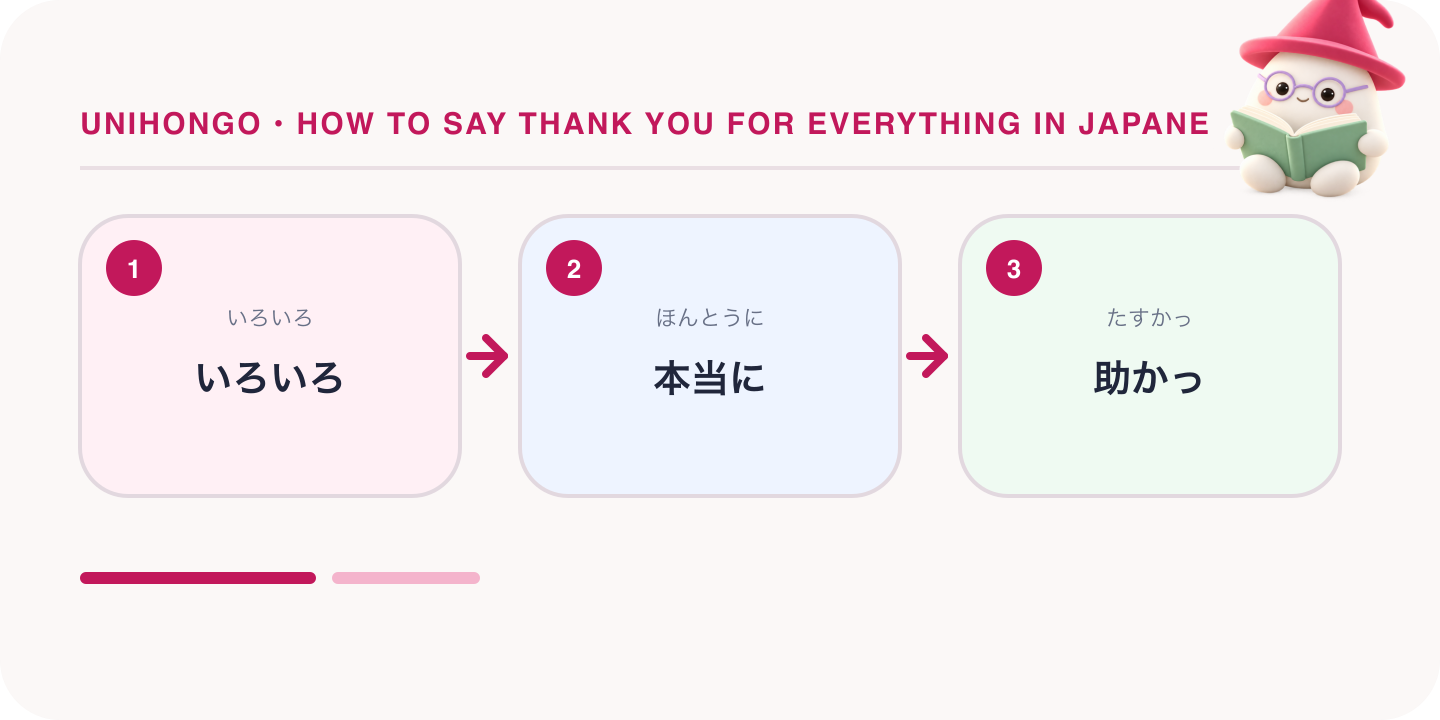
| Japanese | Romaji | Meaning |
|---|---|---|
| いろいろありがとう。 | Iroiro arigatō. | Thanks for everything. |
| 本当にいろいろありがとうね。 | Hontō ni iroiro arigatō ne. | Really, thanks for everything. |
| いろいろ助かったよ。 | Iroiro tasukatta yo. | You helped me so much. |
| 今までありがとう。 | Ima made arigatō. | Thanks for everything up to now. |
| 楽しかった。ありがとう。 | Tanoshikatta. Arigatō. | It was fun. Thank you. |
| マジで感謝してる。 | Maji de kansha shiteru. | I'm seriously grateful. (very casual) |
Polite versions for teachers, neighbours and colleagues
In desu and masu speech, add gozaimasu or gozaimashita. The past form, arigatō gozaimashita, is natural when the help is complete, such as at the end of a course or on your last day. Iroiro to arigatō gozaimashita, with to, is slightly more polished and common in speech to people above you.
Kore made, up to now, is the polite equivalent of ima made and is heard constantly at farewells. Nagai aida, for a long time, is used when the relationship lasted years.
| Japanese | Romaji | Meaning |
|---|---|---|
| いろいろとありがとうございました。 | Iroiro to arigatō gozaimashita. | Thank you for everything. |
| これまで本当にありがとうございました。 | Kore made hontō ni arigatō gozaimashita. | Thank you so much for everything until now. |
| 長い間ありがとうございました。 | Nagai aida arigatō gozaimashita. | Thank you for all this time. |
| いつも助けていただいて、ありがとうございました。 | Itsumo tasukete itadaite, arigatō gozaimashita. | Thank you for always helping me. |
| 先生のおかげで、日本語が上手になりました。 | Sensei no okage de, nihongo ga jōzu ni narimashita. | Thanks to you, my Japanese improved. |
O-sewa ni narimashita: thanks for looking after me
お世話になりました (o-sewa ni narimashita) is the phrase Japanese speakers reach for when they leave somewhere they were cared for. Sewa means care or looking after, so the sentence acknowledges everything the other person did for you, not just one favour. It is heard when people leave a company, finish a homestay, check out of a small inn where the staff were kind, or leave a hospital.
Its present-tense cousin, o-sewa ni natte orimasu, opens business emails and calls to mean "thank you for your continued support". The past form marks the end of a period, which is why it belongs at farewells. Add hontō ni or taihen for extra weight: taihen o-sewa ni narimashita is the formal version.
| Japanese | Romaji | Meaning |
|---|---|---|
| お世話になりました。 | O-sewa ni narimashita. | Thank you for looking after me. |
| 本当にお世話になりました。 | Hontō ni o-sewa ni narimashita. | Thank you so much for everything you did for me. |
| 大変お世話になりました。 | Taihen o-sewa ni narimashita. | Thank you very much for all your support. (formal) |
| 在職中は大変お世話になりました。 | Zaishoku-chū wa taihen o-sewa ni narimashita. | Thank you for all your support while I worked here. |
| 短い間でしたが、お世話になりました。 | Mijikai aida deshita ga, o-sewa ni narimashita. | It was only a short time, but thank you for everything. |
Leaving a job: farewell lines and a short speech
On your last day at a Japanese workplace, you usually thank your team as a group, sometimes standing at the front of the office, and again at a sōbetsukai, a farewell party. The pattern is predictable: thank everyone, mention something specific you learned or enjoyed, apologise briefly for any trouble you caused, and wish them well. A short, sincere speech is better than a long one.
A standard closing is minasan no go-kenkō to go-katsuyaku o o-inori shite orimasu, I wish you all good health and success. It is formal but expected in this setting, and colleagues will appreciate hearing it from a learner.
| Japanese | Romaji | Meaning |
|---|---|---|
| 本日で最終日となりました。 | Honjitsu de saishūbi to narimashita. | Today is my last day. |
| 皆さんには本当にお世話になりました。 | Minasan ni wa hontō ni o-sewa ni narimashita. | Thank you all so much for everything. |
| ここで学んだことを次の仕事でも生かしたいです。 | Koko de mananda koto o tsugi no shigoto demo ikashitai desu. | I want to use what I learned here in my next job. |
| ご迷惑をおかけしたこともあったと思います。 | Go-meiwaku o okake shita koto mo atta to omoimasu. | I'm sure I caused you trouble at times. |
| 皆さんのご健康とご活躍をお祈りしております。 | Minasan no go-kenkō to go-katsuyaku o o-inori shite orimasu. | I wish you all good health and success. |
If you want to rehearse the whole thing aloud, the Speech at a Farewell Party mission in Unihongo is built around exactly this moment, from the opening line to the final bow.
Leaving a homestay or host family
Leaving a host family is emotional, and Japanese gives you room to be warm as well as polite. Most students use desu and masu with host parents, but hosts often invite a more casual tone after a while. Either way, o-sewa ni narimashita is the core phrase, and it lands best with one or two concrete memories: the food, a trip together, help with Japanese homework.
Many students also leave a short handwritten letter or card. Writing it in simple Japanese, even with mistakes, is usually valued far more than perfect English.
| Japanese | Romaji | Meaning |
|---|---|---|
| ホームステイ中は本当にお世話になりました。 | Hōmusutei-chū wa hontō ni o-sewa ni narimashita. | Thank you so much for looking after me during my homestay. |
| 毎日おいしいご飯をありがとうございました。 | Mainichi oishii gohan o arigatō gozaimashita. | Thank you for the delicious meals every day. |
| 本当の家族みたいでした。 | Hontō no kazoku mitai deshita. | It felt like a real family. |
| また必ず会いに来ます。 | Mata kanarazu ai ni kimasu. | I'll definitely come back to see you. |
| 向こうに着いたら連絡します。 | Mukō ni tsuitara renraku shimasu. | I'll get in touch when I arrive. |
| お体に気をつけてください。 | O-karada ni ki o tsukete kudasai. | Please take care of yourselves. |
What people say back
The most common reply to any of these phrases is こちらこそ (kochira koso), "likewise" or "no, thank you". It turns the thanks back to the speaker and is used at every level of politeness: kochira koso arigatō casually, kochira koso o-sewa ni narimashita politely.
People also add encouragement for the future. Colleagues often say atarashii shokuba de mo ganbatte kudasai, good luck at your new workplace, and host families may say itsu demo kaette kite ne, come back any time.
| Reply | Romaji | Meaning |
|---|---|---|
| こちらこそありがとう。 | Kochira koso arigatō. | Thank you too. (casual) |
| こちらこそお世話になりました。 | Kochira koso o-sewa ni narimashita. | You helped us just as much. (polite) |
| 元気でね。 | Genki de ne. | Take care. (casual) |
| お元気で。 | O-genki de. | Take care. (polite) |
| 新しい職場でも頑張ってください。 | Atarashii shokuba demo ganbatte kudasai. | Good luck at your new job. |
| いつでも帰ってきてね。 | Itsu demo kaette kite ne. | Come back any time. |
Common mistakes when thanking someone for everything
- Translating word for word as subete ni kansha shimasu or zenbu arigatō. Both are understandable, but iroiro arigatō and o-sewa ni narimashita are what people actually say.
- Using o-sewa ni narimashita for a single small favour. For one act of help, arigatō gozaimashita or tasukarimashita is enough; o-sewa is for care over time.
- Using the present tense arigatō gozaimasu on your last day. The past form arigatō gozaimashita marks that the period is over and sounds more natural at a farewell.
- Speaking casually to a boss or host parent who has not invited it. When unsure, stay with desu and masu; warmth comes from what you say, not from dropping politeness.
- Forgetting the forward-looking line. A Japanese farewell feels incomplete without a wish such as o-genki de or a promise like mata renraku shimasu.
- Bowing while walking away. Stop, face the person, say the phrase, then bow; the sequence matters as much as the words.
Putting it together: three short farewells
Here are three complete farewells you can adapt. Each has the same shape: thanks, something specific, and a look to the future. Say them aloud until the rhythm feels natural rather than memorised.
| Japanese | Romaji | Meaning |
|---|---|---|
| いろいろありがとう。すごく楽しかった。また会おうね。 | Iroiro arigatō. Sugoku tanoshikatta. Mata aō ne. | Thanks for everything. It was so much fun. Let's meet again. (friend) |
| 短い間でしたが、本当にお世話になりました。また遊びに来ます。 | Mijikai aida deshita ga, hontō ni o-sewa ni narimashita. Mata asobi ni kimasu. | It was short, but thank you for everything. I'll visit again. (host family) |
| これまで大変お世話になりました。皆さんのご活躍をお祈りしております。 | Kore made taihen o-sewa ni narimashita. Minasan no go-katsuyaku o o-inori shite orimasu. | Thank you for all your support. I wish you every success. (workplace) |