
Why kaigo Japanese is its own register
A care facility asks you to hold two registers at once. Toward the residents, called riyōsha or nyūkyosha, you speak with warmth and light keigo, because they are adults who have run households and careers and are now being helped with private things. Toward colleagues you use crisp, short reporting Japanese where a fact takes five words. The mistake new caregivers make is mixing them: chatting to the nurse in soft resident language, or slipping into casual forms with a resident who calls you by your first name.
The second thing to know is that almost nothing you say is new. A morning round has perhaps twenty sentences, and they repeat for every person on the floor. That makes kaigo one of the fastest jobs in Japan to become verbally competent in, provided you learn the sentences as sounds you produce automatically rather than as text. Everything below is arranged in shift order so you can rehearse it as a day.
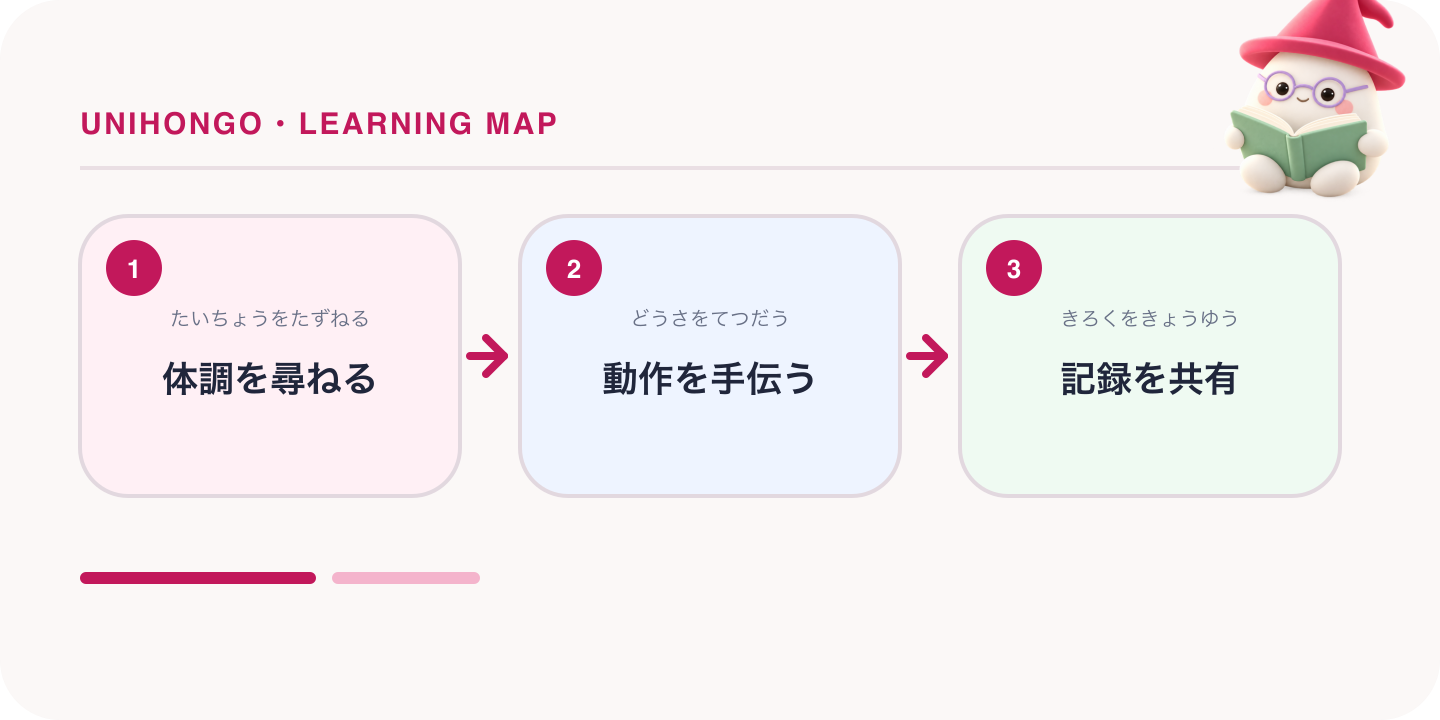
Greeting residents by name
Every interaction starts with the resident's family name plus san, then a greeting, then one small question. Never obāchan or ojiichan unless the facility and the resident have explicitly asked for it, and never chan. The question after the greeting is not small talk; it is your first observation of the day, so listen to how the answer sounds as much as what it says. A slow reply or a resident who is usually chatty and is quiet today is something you will report later.
| Japanese | Romaji | Meaning |
|---|---|---|
| 失礼します。田中さん、おはようございます。 | Shitsurei shimasu. Tanaka-san, ohayō gozaimasu. | Excuse me. Good morning, Mr Tanaka. |
| よく眠れましたか? | Yoku nemuremashita ka? | Did you sleep well? |
| おかげさまで、よく寝ました。 | Okagesama de, yoku nemashita. | Yes, thank you, I slept well. (a typical reply) |
| あまり眠れなかったよ。 | Amari nemurenakatta yo. | I didn't sleep much. (casual reply from a resident) |
| 今日は少し寒いですね。 | Kyō wa sukoshi samui desu ne. | It is a little cold today, isn't it. |
| 鈴木さん、お加減はいかがですか? | Suzuki-san, okagen wa ikaga desu ka? | Mrs Suzuki, how are you feeling? |
| 今日もよろしくお願いします。 | Kyō mo yoroshiku onegai shimasu. | I look forward to today with you too. |
Asking how they feel
Residents often minimise, so ask one thing at a time and make the question easy to answer with a yes or no. Negative questions such as samuku nai desu ka are the natural Japanese way to check for a problem gently. When you get a vague answer like mā mā, follow with a more specific question rather than accepting it, and if they name a pain, ask where and how much so you can carry the answer to the nurse in the same words.
| Japanese | Romaji | Meaning |
|---|---|---|
| 気分はどうですか? | Kibun wa dō desu ka? | How are you feeling? |
| どこか痛いところはありますか? | Dokoka itai tokoro wa arimasu ka? | Does anything hurt anywhere? |
| 痛みはどのくらいですか? | Itami wa dono kurai desu ka? | How bad is the pain? |
| 気持ち悪くないですか? | Kimochi waruku nai desu ka? | You are not feeling sick, are you? |
| 寒くないですか? | Samuku nai desu ka? | Are you cold? |
| お腹は空いていますか? | Onaka wa suite imasu ka? | Are you hungry? |
| 何かほしいものはありますか? | Nanika hoshii mono wa arimasu ka? | Is there anything you would like? |
Offering help instead of giving orders
The grammar of dignity is three endings. Mashō ka proposes an action you will do together or on the resident's behalf, and leaves room for no. Te mo ii desu ka asks permission before you touch or adjust anything. Te itadakemasu ka asks the resident to do something themselves, from holding a rail to lifting an arm. A bare te kudasai is not rude, but heard twenty times a day it starts to sound like instructions to a child. Reserve it for safety moments where speed matters.
Pair every offer with an announcement of what happens next, using masu ne or masu yo. Residents with poor sight or hearing cannot see your hands coming, and a touch without warning is frightening. The pattern is name, offer, wait for the answer, announce, act.
| Japanese | Romaji | Meaning |
|---|---|---|
| お手伝いしましょうか? | Otetsudai shimashō ka? | Shall I help you? |
| 一緒に行きましょうか? | Issho ni ikimashō ka? | Shall we go together? |
| 腕に触ってもいいですか? | Ude ni sawatte mo ii desu ka? | May I touch your arm? |
| こちらに座っていただけますか? | Kochira ni suwatte itadakemasu ka? | Could you sit here, please? |
| 手すりを持っていただけますか? | Tesuri o motte itadakemasu ka? | Could you hold the handrail, please? |
| 触りますね。 | Sawarimasu ne. | I am going to touch you now. |
| ゆっくりで大丈夫ですよ。 | Yukkuri de daijōbu desu yo. | Take your time, there is no rush. |
Shift moments and the phrase that goes with them
| Moment | What you say | Why |
|---|---|---|
| Entering a room | 失礼します。 Shitsurei shimasu. | Knock, say it, pause, then enter |
| Morning round | おはようございます。よく眠れましたか? Ohayō gozaimasu. Yoku nemuremashita ka? | Greeting plus first observation |
| Before any touch | 触りますね。 Sawarimasu ne. | Warning before contact |
| Before a transfer | 立ちますよ。いち、にの、さん。 Tachimasu yo. Ichi, ni no, san. | Shared count so you move together |
| Mealtime | お食事の時間ですよ。 Oshokuji no jikan desu yo. | Announce, then offer the apron |
| Medication | お薬の時間です。 Okusuri no jikan desu. | Same words every time, so it is recognised |
| Leaving a room | 何かあったら呼んでくださいね。 Nanika attara yonde kudasai ne. | Reassurance that help is near |
| Reporting a concern | 田中さんの様子が気になります。 Tanaka-san no yōsu ga ki ni narimasu. | Opens a report to the nurse |
| Handover | 申し送りをお願いします。 Mōshiokuri o onegai shimasu. | Asks the outgoing shift to begin |
| End of shift | お先に失礼します。 Osaki ni shitsurei shimasu. | Leaving before colleagues |
The count before a transfer deserves a note. Ichi, ni no, san is said with the resident, and the movement happens on san. Some floors use sē no instead. Ask which one your facility uses and use it every time, because a resident who has learnt the rhythm helps you lift, and one who has not becomes dead weight at exactly the wrong moment.
Meals, bathing, toileting and moving
These four moments are where dignity is won or lost, so the language is deliberately plain and unhurried. At meals, name the food, offer the apron, and encourage one mouthful at a time; a resident who eats slowly is not a problem to be solved. In the bath, ask about the water before anything else and narrate every step. For toileting, offer rather than ask whether they need to go, because the offer is easier to accept, and announce each item of clothing before you touch it.
| Japanese | Romaji | Meaning |
|---|---|---|
| 今日のお昼は魚ですよ。 | Kyō no ohiru wa sakana desu yo. | Today's lunch is fish. |
| エプロンをつけましょうか? | Epuron o tsukemashō ka? | Shall we put on your apron? |
| 一口ずつ、ゆっくり食べましょう。 | Hitokuchi zutsu, yukkuri tabemashō. | Let's eat one mouthful at a time, slowly. |
| もう少し食べられそうですか? | Mō sukoshi taberaresō desu ka? | Do you think you could eat a little more? |
| お茶を飲みますか? | Ocha o nomimasu ka? | Would you like some tea? |
| お風呂に入りましょうか? | Ofuro ni hairimashō ka? | Shall we have a bath? |
| お湯加減はいかがですか?熱くないですか? | Oyukagen wa ikaga desu ka? Atsuku nai desu ka? | How is the water? Not too hot? |
| 背中を流しますね。 | Senaka o nagashimasu ne. | I will rinse your back now. |
| お手洗いに行きましょうか? | Otearai ni ikimashō ka? | Shall we go to the bathroom? |
| ズボンを下ろしますね。 | Zubon o oroshimasu ne. | I am going to lower your trousers now. |
| 終わったら呼んでくださいね。 | Owattara yonde kudasai ne. | Call me when you are done. |
| 車いすに移りましょうか? | Kurumaisu ni utsurimashō ka? | Shall we move to the wheelchair? |
| ベッドを少し上げますね。 | Beddo o sukoshi agemasu ne. | I will raise the bed a little. |
| 体の向きを変えますね。 | Karada no muki o kaemasu ne. | I am going to turn you now. |
Symptom words you report
You are the person who sees the resident for eight hours, and the nurse sees them for eight minutes, so your report matters. Describe what you observed, not what you concluded: a red patch on the heel is a fact, a bedsore is a diagnosis. The sentence shape is name, body part or symptom, ga arimasu or ga dete imasu, and a time if you have one. Learn the words below as spoken sentences, because you will say them into a room of busy colleagues, not write them in peace.
| Japanese | Romaji | Meaning |
|---|---|---|
| 熱があります。 | Netsu ga arimasu. | There is a fever. |
| 食欲がありません。 | Shokuyoku ga arimasen. | There is no appetite. |
| 咳が出ています。 | Seki ga dete imasu. | There is a cough. |
| 便が出ていません。 | Ben ga dete imasen. | There has been no bowel movement. |
| 右足にあざがあります。 | Migi ashi ni aza ga arimasu. | There is a bruise on the right leg. |
| かかとの皮膚が赤くなっています。 | Kakato no hifu ga akaku natte imasu. | The skin on the heel has turned red. |
| 足にむくみがあります。 | Ashi ni mukumi ga arimasu. | There is swelling in the legs. |
| 少しふらつきがありました。 | Sukoshi furatsuki ga arimashita. | There was some unsteadiness. |
| いつもより元気がありません。 | Itsumo yori genki ga arimasen. | Less lively than usual. |
Handover and record vocabulary
Mōshiokuri, the handover, is the most formulaic five minutes of the day and the easiest to learn by imitation. Each resident gets one or two lines: what they ate as a fraction, fluids, toilet visits, bath or no bath, mood, and anything unusual. The record you write afterwards uses the same nouns, often as bare words on a chart. Read the list below aloud until the readings are automatic, because you will hear them spoken quickly and see them written in kanji on the same day.
| Japanese | Romaji | Meaning |
|---|---|---|
| 田中さん、朝食は全量摂取です。 | Tanaka-san, chōshoku wa zenryō sesshu desu. | Mr Tanaka ate all of his breakfast. |
| 鈴木さんは特変なしです。 | Suzuki-san wa tokuhen nashi desu. | No particular change with Mrs Suzuki. |
| 佐藤さん、夜中に二回トイレに行きました。 | Satō-san, yonaka ni nikai toire ni ikimashita. | Mr Sato went to the toilet twice during the night. |
| 体温は三十七度五分でした。 | Taion wa sanjū-nana do go bu deshita. | Temperature was 37.5. |
| 看護師さんに報告しました。 | Kangoshi-san ni hōkoku shimashita. | I reported it to the nurse. |
| 引き続き見守りをお願いします。 | Hikitsuzuki mimamori o onegai shimasu. | Please keep watching over them. |
| Japanese | Romaji | Meaning |
|---|---|---|
| バイタル | baitaru | vital signs |
| 体温 | taion | body temperature |
| 血圧 | ketsuatsu | blood pressure |
| 脈拍 | myakuhaku | pulse |
| 食事量 | shokujiryō | amount eaten |
| 全量 | zenryō | all of it |
| 半量 | hanryō | half |
| 水分量 | suibunryō | fluid intake |
| 排泄 | haisetsu | toileting, elimination |
| 排便 | haiben | bowel movement |
| 排尿 | hainyō | urination |
| 入浴 | nyūyoku | bathing |
| 服薬 | fukuyaku | taking medication |
| 体位交換 | taii kōkan | repositioning in bed |
| 移乗 | ijō | transfer, e.g. bed to wheelchair |
| 見守り | mimamori | watching over, supervision |
| 様子 | yōsu | condition, how they seem |
| 傾眠 | keimin | drowsiness |
| 転倒 | tentō | a fall |
| ヒヤリハット | hiyari hatto | near miss |
| 特変なし | tokuhen nashi | no particular change |
| 申し送り | mōshiokuri | handover |
| 記録 | kiroku | record, notes |
Speaking to family members
Families are visitors and customers at the same time, and they are often anxious. Greet them with the standard business opener, give one positive concrete fact about the day, and hand any medical question to the nurse rather than guessing. Sonkeigo verbs for the resident, such as meshiagaru and sugosareru, are expected here even if your floor is relaxed about them in daily care, because the family is listening for whether their parent is respected.
| Japanese | Romaji | Meaning |
|---|---|---|
| いつもお世話になっております。 | Itsumo osewa ni natte orimasu. | Thank you for your continued support. |
| 田中さんは今日、お元気に過ごされました。 | Tanaka-san wa kyō, ogenki ni sugosaremashita. | Mr Tanaka had a good day today. |
| お昼はよく召し上がりました。 | Ohiru wa yoku meshiagarimashita. | He ate lunch well. |
| 何かご心配なことはありますか? | Nanika goshinpai na koto wa arimasu ka? | Is there anything you are worried about? |
| 詳しいことは看護師から説明させていただきます。 | Kuwashii koto wa kangoshi kara setsumei sasete itadakimasu. | The nurse will explain the details. |
| 担当の者を呼んでまいります。 | Tantō no mono o yonde mairimasu. | I will fetch the person in charge. |
Responding to confusion or refusal
Residents with dementia may ask for a spouse who has died, insist they must go home, or refuse a bath they took yesterday. The language rule is simple: do not argue with the content, respond to the feeling, and offer a small next step. Iya desu ka, then a postponement, keeps the resident's right to say no without abandoning the task. Orientation is given as a gentle fact, not a correction, and your name and the time are more useful than the year.
| Japanese | Romaji | Meaning |
|---|---|---|
| そうですね。心配ですよね。 | Sō desu ne. Shinpai desu yo ne. | I see. That is worrying, isn't it. |
| お話、聞かせてください。 | Ohanashi, kikasete kudasai. | Please tell me about it. |
| 今は朝の八時ですよ。私はリンです。 | Ima wa asa no hachi-ji desu yo. Watashi wa Rin desu. | It is eight in the morning now. I am Rin. |
| 嫌ですか。じゃあ、後にしましょうか。 | Iya desu ka. Jā, ato ni shimashō ka. | You would rather not? Then shall we do it later? |
| 無理しなくて大丈夫ですよ。 | Muri shinakute daijōbu desu yo. | You do not have to push yourself. |
| 大丈夫ですよ。私がそばにいますから。 | Daijōbu desu yo. Watashi ga soba ni imasu kara. | It is all right. I am right here with you. |
| 娘さんは夕方に来られますよ。 | Musume-san wa yūgata ni koraremasu yo. | Your daughter is coming this evening. |
| 一緒に探しましょうか。 | Issho ni sagashimashō ka. | Shall we look for it together? |
Asking for repetition without losing face
Instructions on a care floor are given fast, in kanji compounds and facility shorthand, and the polite way to handle one you did not catch is to confirm it, not to say you did not understand. Repeat the key noun back with desu ne, or ask what a word refers to with to iu no wa. Both are what Japanese colleagues do themselves, so neither marks you as the foreigner. The one phrase to avoid is a silent nod, because a misheard bath or medication instruction becomes an incident report.
| Japanese | Romaji | Meaning |
|---|---|---|
| すみません、もう一度お願いします。 | Sumimasen, mō ichido onegai shimasu. | Sorry, once more please. |
| 確認させてください。田中さんの入浴はなしでよろしいですか? | Kakunin sasete kudasai. Tanaka-san no nyūyoku wa nashi de yoroshii desu ka? | Let me confirm. No bath for Mr Tanaka, is that right? |
| とろみというのは、とろみ剤のことですか? | Toromi to iu no wa, toromi-zai no koto desu ka? | By toromi, do you mean the thickener? |
| ゆっくり話していただけますか? | Yukkuri hanashite itadakemasu ka? | Could you speak a little more slowly? |
| 分かりました。すぐやります。 | Wakarimashita. Sugu yarimasu. | Understood. I will do it right away. |
| やり方を教えていただけますか? | Yarikata o oshiete itadakemasu ka? | Could you show me how to do it? |
A last word on paperwork. Whether you arrive through a care category of the Specified Skilled Worker system, a technical intern programme or a partnership scheme, there is usually a Japanese test and a care skills test, and some workers later sit the national care worker examination, which is in Japanese. Requirements shift, so confirm the current route with your employer or the relevant authority. This article is language help, not care training; the techniques for transfers, feeding and bathing come from your facility's instructors.