
The exchange is a short scene, not a hidden test
A meishi exchange takes roughly twenty seconds and runs in a fixed order, which is good news for a learner. Two people stand, move so that no table sits between them, offer their cards, say one set line each, receive with both hands, read what is printed, and sit down. Once the order is familiar, your attention is free for the part that actually matters, which is the name and company now in your hand.
It helps to treat every convention as practical rather than mystical. Standing and using both hands makes a small card easy to pass and hard to drop. Reading it aloud confirms a name you will need for the next hour. Not writing on it in front of its owner is ordinary courtesy. Each rule has a plain reason behind it, and remembering the reason is far easier than memorising a list of prohibitions you half understand.
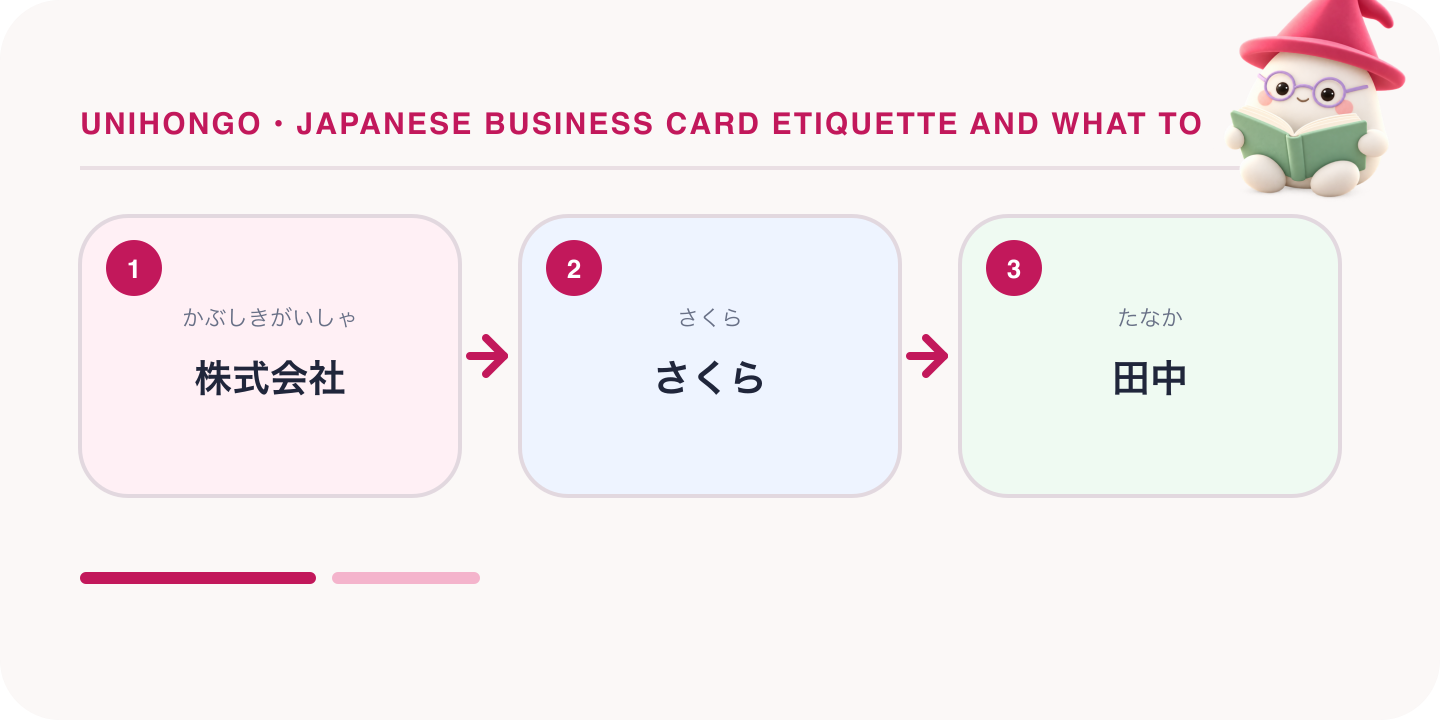
Who offers first and why it is usually you
The side with lower standing in that particular meeting offers first. That means the visiting side goes before the host side, and the selling side before the buying side. If you travelled to someone's office to propose something, you offer first. Within each team the order runs from the top down: your manager exchanges with their counterpart, then you exchange with theirs, so watch the person above you and follow.
Modern practice is usually a simultaneous exchange. Both people hold their own card in the right hand, offer it a little lower than the other card if that person outranks them, take the offered card with the left hand, then bring the right hand across so both hands support the card they received. If the timing goes wrong, simply hand yours over and receive afterwards. Nobody is counting the beats.
- Visiting side first, host side second.
- Selling side first, buying side second.
- The most senior person on each side exchanges first, then the rest in order of rank.
- Hold your card by the edges so your fingers cover neither the name nor the logo.
- Turn the card to face the person receiving it, so they can read it without rotating it.
The exchange as a two-sided sequence
Below is a full exchange from both sides, in order, with you as the visitor. Read it as a scene rather than a vocabulary list. Notice how short each turn is: one line to name yourself, one line to accept, one line to confirm what you just read. The whole conversation fits into the time it takes to sit back down.
| Japanese | Romaji | Meaning |
|---|---|---|
| 株式会社さくらの田中と申します。 | Kabushiki-gaisha Sakura no Tanaka to mōshimasu. | You: I am Tanaka from Sakura Inc. |
| よろしくお願いいたします。 | Yoroshiku onegai itashimasu. | You: I look forward to working with you. |
| ご丁寧にありがとうございます。頂戴いたします。 | Go-teinei ni arigatō gozaimasu. Chōdai itashimasu. | Them: That is very kind of you. I will take it. |
| 申し遅れました。株式会社みどりの佐藤でございます。 | Mōshiokuremashita. Kabushiki-gaisha Midori no Satō de gozaimasu. | Them: I should have said so sooner. I am Satō from Midori Inc. |
| 頂戴いたします。 | Chōdai itashimasu. | You: Thank you, I will take it. |
| 営業部の佐藤様でいらっしゃいますね。 | Eigyō-bu no Satō-sama de irasshaimasu ne. | You: So you are Mr Satō from the sales department. |
| はい、さようでございます。 | Hai, sayō de gozaimasu. | Them: Yes, that is right. |
| 本日はよろしくお願いいたします。 | Honjitsu wa yoroshiku onegai itashimasu. | You: Thank you for having me today. |
Mōshiokuremashita means roughly that the speaker should have introduced themselves earlier, and it appears whenever someone speaks before handing over their card. Chōdai itashimasu is the humble verb for receiving, and it is the single most useful line here; arigatō gozaimasu alone is warm but slightly under-formal in a first business meeting.
Saying your own name and company clearly
The offering line has a fixed shape: company, no, family name, to mōshimasu. Company comes first because your affiliation identifies you here more than your given name does. Say the company slowly, then a small gap, then the name, because the listener is trying to match sound to print at the same time. If your name is not Japanese, say the family name first and slightly louder, and be ready to repeat it once.
| Japanese | Romaji | Meaning |
|---|---|---|
| 初めまして、株式会社さくらの田中と申します。 | Hajimemashite, kabushiki-gaisha Sakura no Tanaka to mōshimasu. | How do you do. I am Tanaka from Sakura Inc. |
| 営業部でマーケティングを担当しております。 | Eigyō-bu de māketingu o tantō shite orimasu. | I am in charge of marketing in the sales department. |
| 本日はお時間をいただき、ありがとうございます。 | Honjitsu wa ojikan o itadaki, arigatō gozaimasu. | Thank you for making time today. |
| どうぞよろしくお願い申し上げます。 | Dōzo yoroshiku onegai mōshiagemasu. | I look forward to working with you. |
Receiving the card and reading it aloud
Take the card with both hands at the lower corners, hold it at about chest height, and actually look at it for a couple of seconds. Then say one thing you have just read. This is not flattery; it is how you check that you have the department, the title, and the name right while the owner is standing in front of you and can correct you for free.
The line that does the work is a plain observation with ne on the end. It invites confirmation without asking a direct question, and the reply is usually a short hai plus a sentence of extra detail, which gives you something to open small talk with once you sit down. Keep the card in your hand, not in your pocket, until everyone is seated.
| Japanese | Romaji | Meaning |
|---|---|---|
| ありがとうございます。頂戴いたします。 | Arigatō gozaimasu. Chōdai itashimasu. | Thank you. I will take your card. |
| 恐れ入ります。 | Osore irimasu. | Thank you, that is very kind. |
| 技術部の部長でいらっしゃるのですね。 | Gijutsu-bu no buchō de irassharu no desu ne. | So you are the head of the engineering department. |
| 御社は大阪にも拠点がおありなのですね。 | Onsha wa Ōsaka ni mo kyoten ga oari na no desu ne. | I see your company has a base in Osaka as well. |
Asking how a name is read
Japanese family names are written in kanji whose readings are not predictable, and the same characters can be read several ways. Japanese people therefore ask each other about readings at exactly this moment, and it is heard as attentive rather than ignorant. The exchange is the cheapest possible time to ask, because after it you would have to admit that you have been avoiding the person's name for half an hour.
Ask before you put the card down. Lead with shitsurei desu ga or osore irimasu ga, then ask directly. If you have a plausible guess, offering it is friendlier than asking cold, because the other person only has to confirm or correct one syllable. Repeat the reading back once you hear it, then use it in your very next sentence so it fixes in memory.
| Japanese | Romaji | Meaning |
|---|---|---|
| 失礼ですが、お名前は何とお読みすればよろしいでしょうか。 | Shitsurei desu ga, onamae wa nan to oyomi sureba yoroshii deshō ka. | Excuse me, how should I read your name? |
| 恐れ入りますが、下のお名前の読み方を教えていただけますでしょうか。 | Osore irimasu ga, shita no onamae no yomikata o oshiete itadakemasu deshō ka. | May I ask how your given name is read? |
| はせがわ様でよろしいでしょうか。 | Hasegawa-sama de yoroshii deshō ka. | Would Hasegawa be correct? |
| はい、はせがわと申します。珍しい読み方でして。 | Hai, Hasegawa to mōshimasu. Mezurashii yomikata deshite. | Yes, it is read Hasegawa. It is an unusual reading. |
| ありがとうございます。はせがわ様ですね。 | Arigatō gozaimasu. Hasegawa-sama desu ne. | Thank you. Hasegawa, then. |
Cards on the table during the meeting
Received cards stay out. Putting a card straight into your case looks like closing a file on someone you have just met, so instead you lay the cards on the table in front of you, arranged to match where their owners are sitting. That layout is a seating chart: it lets you address the right person by name for the whole meeting without guessing, which is the real reason the habit survives.
Handle the cards as little as possible while they are out. Do not write on them, do not stack a notebook on top of them, do not slide them around while you think. If a card is left behind on the table at the end, that reads as forgetting the person, so make putting them away part of standing up rather than something you might remember later.
- Lay the cards out in the seating order of the people opposite you.
- Put the most senior person's card on top of your own card case, to your front left.
- Keep the cards clear of cups, condensation, and your laptop.
- Write nothing on a card while its owner can see you.
- At the end of the meeting, gather them and place them into your card case, not into a trouser pocket.
- Say shitsurei itashimasu as you tidy the cards away and stand.
When you run out or forget your cards
This happens to everyone, and there is a fixed formula for it. Apologise once, briefly, and move on; a long explanation makes the moment bigger than it is. The standard verb is kirasu, to have run out, and it is used even when the honest truth is that you left the case on your desk. Then promise to send your details, and actually send them the same day.
| Japanese | Romaji | Meaning |
|---|---|---|
| あいにく名刺を切らしておりまして、大変申し訳ございません。 | Ainiku meishi o kirashite orimashite, taihen mōshiwake gozaimasen. | I am afraid I have run out of cards. I am very sorry. |
| 後日、改めてお送りいたします。 | Gojitsu, aratamete o-okuri itashimasu. | I will send you my details again at a later date. |
| 恐れ入りますが、お名刺を頂戴できますでしょうか。 | Osore irimasu ga, omeishi o chōdai dekimasu deshō ka. | Excuse me, may I have your card? |
| お名前をお伺いしてもよろしいでしょうか。 | Onamae o o-ukagai shite mo yoroshii deshō ka. | May I ask your name? |
If the other side has no cards either, ask for the name out loud and write it in your notebook straight away, including the reading. When you are the one without a card, still receive theirs with both hands and still read it aloud. The exchange is not cancelled by your empty case; only your half of it is postponed to email.
The follow-up email that references the meeting
The card exchange is only worth anything if a message follows it. Send a short email the same day or the next morning. A useful subject line names the purpose and identifies you, for example 本日のお礼(株式会社さくら・田中), because the recipient may have collected several cards that afternoon and needs to place you at a glance.
The body has four moves: thank them for their time, say who you are and where you met, refer to one concrete thing that was discussed so the message is clearly not a template, and close with a forward-looking greeting. Keep it to a screen. Long first emails in Japanese business correspondence invite a delayed reply rather than a warm one.
| Japanese | Romaji | Meaning |
|---|---|---|
| 本日はお忙しい中、お時間をいただきありがとうございました。 | Honjitsu wa oisogashii naka, ojikan o itadaki arigatō gozaimashita. | Thank you for making time today despite your busy schedule. |
| 先ほどご挨拶させていただきました、株式会社さくらの田中です。 | Sakihodo goaisatsu sasete itadakimashita, kabushiki-gaisha Sakura no Tanaka desu. | This is Tanaka of Sakura Inc., whom you met earlier today. |
| ご相談いただいた件につきまして、社内で確認いたします。 | Gosōdan itadaita ken ni tsukimashite, shanai de kakunin itashimasu. | Regarding the matter you raised, I will check internally. |
| 改めてご連絡差し上げます。 | Aratamete gorenraku sashiagemasu. | I will contact you again shortly. |
| 今後ともよろしくお願い申し上げます。 | Kongo tomo yoroshiku onegai mōshiagemasu. | I look forward to working with you from now on. |
How to rehearse the whole scene
Practise this standing, out loud, with a real card in your hand, because the language and the movement have to arrive together. Sitting at a desk and reading the lines silently trains none of the timing that makes the exchange feel calm. Five minutes of physical rehearsal is worth more than an hour of reading about the customs.
- Say your offering line while actually holding a card out, until you no longer look at your hands.
- Rehearse receiving: chōdai itashimasu, two seconds of looking, then one observation ending in ne.
- Drill the name-reading question until it comes out fluently, so surprise never turns into silence.
- Practise the no-card apology once, so the wording is ready before the day you need it.
- Write the follow-up email from memory the same evening and compare it with the phrases above.
- Pair this with a self-introduction you can already say, so the meeting after the exchange has somewhere to go.