

Tanoshikatta and tanoshikatta desu
Tanoshii means fun, pleasant or enjoyable, and describes an experience you are in the middle of. Tanoshikatta is its past tense, so it looks back at something now finished: the day, the trip, the dinner. Between friends, tanoshikatta on its own, often with a satisfied sigh, is a complete sentence. Add ne to share the feeling, tanoshikatta ne, and the other person will agree with ne or un.
Add desu for people you speak to politely: a colleague, a host family, someone older, or anyone you have just met. Tanoshikatta desu is the whole polite form; desu does not itself change to the past. To make it stronger, put totemo, very, or hontō ni, really, in front. Sugoku and meccha are casual intensifiers you will hear from younger speakers.
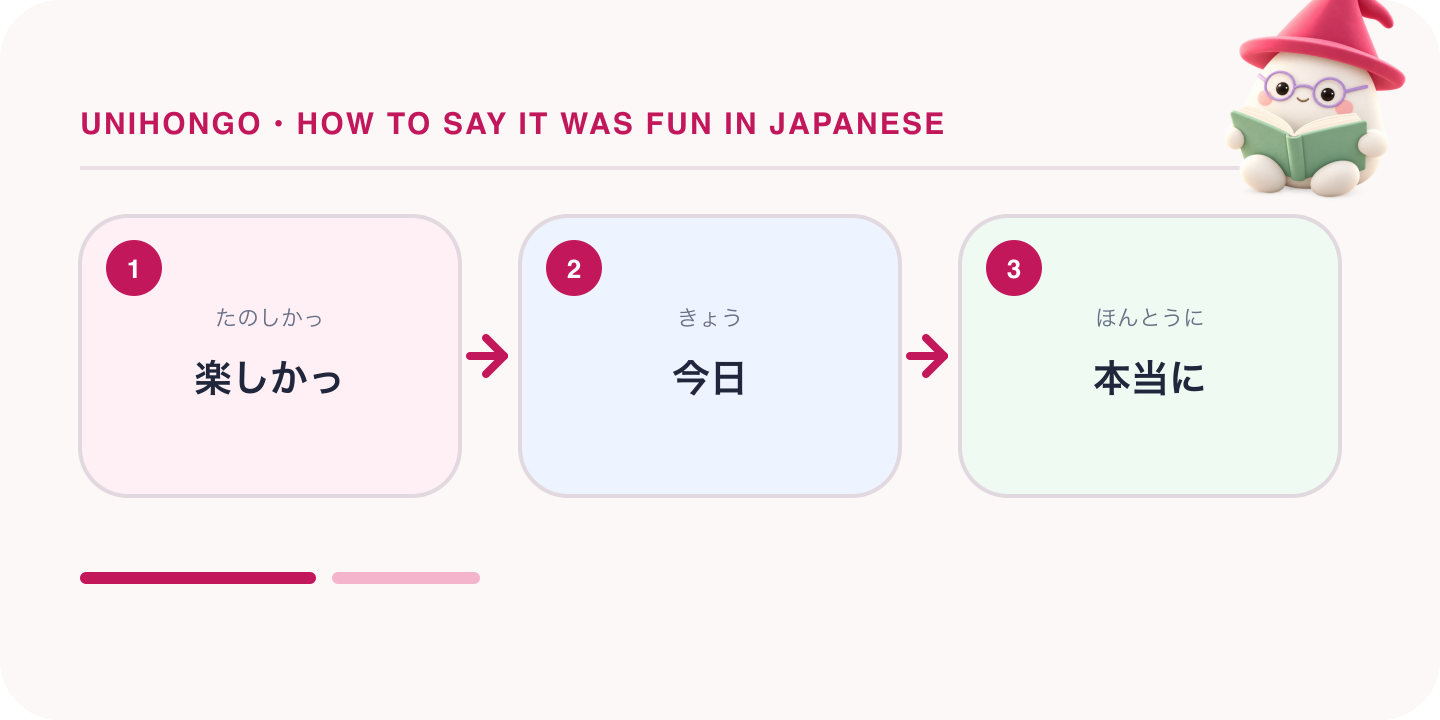
The subject is usually left out because it is obvious, but you can name it: kyō wa tanoshikatta, today was fun; ryokō, tanoshikatta ne, the trip was fun, wasn't it. When something was fun but is not entirely over, such as the middle of a long trip, Japanese people still use the past for the part completed so far.
| Japanese | Romaji | Meaning |
|---|---|---|
| 楽しかった! | Tanoshikatta! | That was fun! |
| 今日は楽しかったです。 | Kyō wa tanoshikatta desu. | Today was fun. (polite) |
| 本当に楽しかったです。 | Hontō ni tanoshikatta desu. | I really enjoyed it. |
| めっちゃ楽しかった。 | Meccha tanoshikatta. | That was so much fun. (casual) |
| 旅行、楽しかったね。 | Ryokō, tanoshikatta ne. | The trip was fun, wasn't it? |
| 楽しかったですね。 | Tanoshikatta desu ne. | That was fun, wasn't it? (polite) |
Saying goodbye after an outing
At the end of a day together, Japanese friends run through a small sequence rather than a single goodbye. First comes the verdict, tanoshikatta. Then a thank-you for the day, kyō wa arigatō, thanks for today, which acknowledges the other person's time even when nobody paid for anything. Then a plan, however vague, to meet again: mata asobō, let's hang out again; mata ikō, let's go again; mata ne, see you. Finally a parting word such as ki o tsukete, take care, or o-yasumi, good night.
The order is flexible but the pieces are fairly constant, and leaving out the thank-you can make a goodbye feel slightly cold. If the other person planned the day or bought the tickets, upgrade the thank-you to kyō wa iroiro arigatō, thanks for everything today. If they paid for a meal, add gochisō-sama deshita.
Polite versions swap in desu and gozaimashita: kyō wa tanoshikatta desu, arigatō gozaimashita, mata zehi. Mata zehi, again by all means, is the polite equivalent of mata asobō and sounds warm without presuming friendship.
| Japanese | Romaji | Meaning |
|---|---|---|
| 今日はありがとう。楽しかった! | Kyō wa arigatō. Tanoshikatta! | Thanks for today. It was fun! |
| また遊ぼうね。 | Mata asobō ne. | Let's hang out again. |
| また行こうね。 | Mata ikō ne. | Let's go again. |
| 今日はいろいろありがとうございました。 | Kyō wa iroiro arigatō gozaimashita. | Thank you for everything today. |
| またぜひ。 | Mata zehi. | Let's do it again sometime. (polite) |
| 気をつけて帰ってね。 | Ki o tsukete kaette ne. | Get home safely. |
| ごちそうさまでした。 | Gochisō-sama deshita. | Thank you for the meal. |
Texting after a meetup
The goodbye at the station is usually followed by a short message that evening or the next morning. Japanese people call this an o-rei no messēji, a thank-you message, and it is expected after a first meetup, a meal someone paid for, or any outing the other person organised. It is not a long letter: one to three lines, often with a sticker.
The message repeats the goodbye in writing. Start with kyō wa arigatō, say tanoshikatta, mention one specific thing you liked, and end with mata. The specific detail is what makes it feel personal: ano rāmen, oishikatta ne, that ramen was good; hanabi, kirei datta ne, the fireworks were beautiful. Polite messages to a senior person use desu and masu and add o-tsukare-sama deshita if it was a work-related evening.
Replies are equally short. Kochira koso, likewise, is the standard opener: kochira koso arigatō, tanoshikatta, mata ne. If you receive a message first, reply the same day; a thank-you left unanswered reads as cool.
| Japanese | Romaji | Meaning |
|---|---|---|
| 今日はありがとう!すごく楽しかった。またね。 | Kyō wa arigatō! Sugoku tanoshikatta. Mata ne. | Thanks for today! It was so fun. See you. |
| あのラーメン、おいしかったね。 | Ano rāmen, oishikatta ne. | That ramen was good, wasn't it? |
| こちらこそありがとう。楽しかった! | Kochira koso arigatō. Tanoshikatta! | Thank you too. It was fun! |
| 本日はありがとうございました。とても楽しかったです。 | Honjitsu wa arigatō gozaimashita. Totemo tanoshikatta desu. | Thank you for today. I had a very good time. (formal) |
| また近いうちに遊びましょう。 | Mata chikai uchi ni asobimashō. | Let's meet up again soon. (polite) |
| 無事に着いた? | Buji ni tsuita? | Did you get home OK? |
Omoshirokatta and other past-tense feelings
Omoshiroi is the word learners most often confuse with tanoshii. Omoshiroi means interesting, amusing or entertaining, and it is a judgement about the thing: a film, a book, a person's story, a museum. Tanoshii is about the experience of spending time. A comedy show is omoshirokatta; the evening you spent laughing at it with friends was tanoshikatta. You can say both about the same outing, and Japanese people often do: eiga mo omoshirokatta shi, tanoshikatta.
A few other past-tense adjectives sit next to tanoshikatta at the end of an outing. Oishikatta, it was delicious, for a meal. Kirei datta, it was beautiful, for scenery, and note that kirei is a na-adjective, so it takes datta rather than katta. Yokatta, it was good, is the all-purpose relief and satisfaction word: kite yokatta, I'm glad I came. Ureshikatta, I was happy, is for something the other person did for you.
Yokatta deserves its own sentence, because it is the most Japanese of these. Kyō wa kite yokatta, it was good that I came today, tells the other person that their invitation was worth accepting, which is a compliment in a way tanoshikatta alone is not.
| Japanese | Romaji | Meaning |
|---|---|---|
| 映画、面白かったね。 | Eiga, omoshirokatta ne. | The film was interesting, wasn't it? |
| 面白かったし、楽しかった。 | Omoshirokatta shi, tanoshikatta. | It was interesting, and it was fun. |
| 料理、おいしかったです。 | Ryōri, oishikatta desu. | The food was delicious. |
| 景色がきれいだった。 | Keshiki ga kirei datta. | The scenery was beautiful. |
| 来てよかった。 | Kite yokatta. | I'm glad I came. |
| 会えてうれしかったです。 | Aete ureshikatta desu. | I was happy to see you. |
The past tense of i-adjectives in a nutshell
Tanoshikatta is the template for every i-adjective. Take the dictionary form, remove the final i, and add katta. The negative past adds kunakatta instead: tanoshikunakatta, it was not fun. Desu goes after the finished adjective for politeness and never changes. The one irregular member is ii, good, which uses the older form yo- for its past: yokatta, yokunakatta.
| Adjective | Reading | Past tense and meaning |
|---|---|---|
| 楽しい | tanoshii | tanoshikatta: it was fun |
| 面白い | omoshiroi | omoshirokatta: it was interesting |
| おいしい | oishii | oishikatta: it was delicious |
| うれしい | ureshii | ureshikatta: I was happy |
| いい | ii | yokatta: it was good |
| すごい | sugoi | sugokatta: it was amazing |
| 寒い | samui | samukatta: it was cold |
| 暑い | atsui | atsukatta: it was hot |
| 眠い | nemui | nemukatta: I was sleepy |
| 忙しい | isogashii | isogashikatta: it was busy |
Na-adjectives and nouns take datta or deshita instead: kirei datta, shizuka deshita. If you find yourself about to say tanoshii deshita, stop and move the past tense into the adjective; that single correction removes the most common error in this whole area.
Situations and the right register
The words stay the same across situations; what changes is the politeness and the thank-you that goes with them. Use this list to pick the right combination before you speak.
- Close friend after a day out: tanoshikatta, arigatō, mata asobō
- New acquaintance after a first meetup: tanoshikatta desu, mata zehi
- Host family or someone who cooked: gochisō-sama deshita, totemo tanoshikatta desu
- Senior colleague after a company dinner: honjitsu wa arigatō gozaimashita, tanoshikatta desu
- Group chat after a party: minna arigatō, tanoshikatta ne
- Someone who showed you around: annai shite kurete arigatō, tanoshikatta
Kurete after a te-form verb, as in annai shite kurete, thanks the person for doing something for you, and it turns a generic thank-you into a specific one. Japanese thank-yous are strongest when they name the favour.
Common mistakes
The grammar slip, tanoshii deshita, is the one every teacher hears. The past goes into the adjective, so it is tanoshikatta desu. A second slip is saying tanoshimi, which means something you look forward to, when you mean tanoshikatta; a separate guide covers tanoshimi in detail, so here it is enough to remember that tanoshimi looks ahead and tanoshikatta looks back.
A tone slip is saying tanoshikatta alone and walking off. Without arigatō and mata, it can sound like a review rather than a goodbye. Conversely, a very long polite speech to a close friend feels distant; match the other person's level. If they say tanoshikatta ne, answer in kind, not with tanoshikatta desu.
Lastly, omoshirokatta about a person can be risky. Omoshiroi hito means an interesting or funny person, which is usually a compliment, but said about someone's serious story it can sound as if you found it amusing. When in doubt about a heartfelt conversation, use tanoshikatta or hanasete yokatta, I'm glad we could talk.
| Japanese | Romaji | Meaning |
|---|---|---|
| 楽しかったです。 | Tanoshikatta desu. | It was fun. (correct polite form) |
| 楽しかった。ありがとう。またね。 | Tanoshikatta. Arigatō. Mata ne. | It was fun. Thanks. See you. |
| 話せてよかったです。 | Hanasete yokatta desu. | I'm glad we could talk. |
| 次は私が誘うね。 | Tsugi wa watashi ga sasou ne. | Next time I'll invite you. |
| 楽しみにしてるね。 | Tanoshimi ni shiteru ne. | I'm looking forward to it. (future, not past) |