

Tsun tsun and dere dere: the sounds behind the word
Japanese has a huge stock of gitaigo, words that imitate a manner or a state rather than a sound. Many are doubled, and a lot of them describe mood. Tsun tsun is one: it paints someone with their nose in the air, curt and unapproachable. Dere dere is its opposite, someone melted by affection, grinning helplessly, unable to keep their composure around the person they like. Both are used as verbs with suru and both are perfectly ordinary spoken Japanese, older than any anime.
Tsundere simply takes the first half of each and joins them: tsun plus dere. The word describes a person who moves between the two states, or who is tsun on the outside and dere underneath. The stress usually falls at the start, and it is written in hiragana or katakana, ツンデレ being the commonest spelling in print.
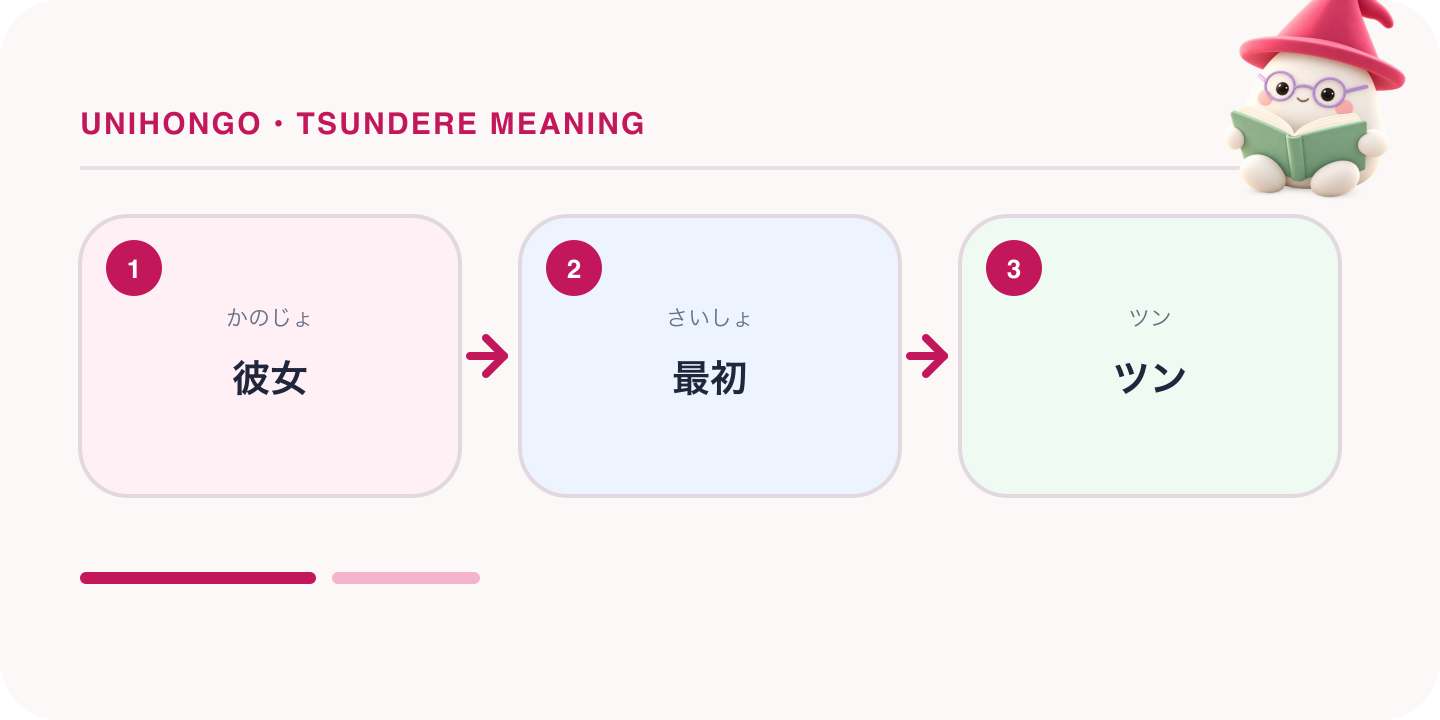
| Japanese | Romaji | Meaning |
|---|---|---|
| 彼女は最初、ツンツンしていました。 | Kanojo wa saisho, tsun tsun shite imashita. | She was standoffish at first. |
| 彼は彼女の前ではデレデレです。 | Kare wa kanojo no mae de wa dere dere desu. | He goes all soft in front of his girlfriend. |
| ツンとデレを合わせてツンデレです。 | Tsun to dere o awasete tsundere desu. | Put tsun and dere together and you get tsundere. |
| このキャラは典型的なツンデレですね。 | Kono kyara wa tenkeiteki na tsundere desu ne. | This character is a typical tsundere, isn't he. |
| 擬態語は日本語にたくさんあります。 | Gitaigo wa Nihongo ni takusan arimasu. | Japanese has many words that mimic a manner. |
The dere family in one table
Four dere types are widely known, and a few more circulate among fans. The first four below are the ones a Japanese speaker will recognise without explanation; the rest are worth understanding but not worth using unless you are talking with fans.
| Type | Reading | First part and what the personality is like |
|---|---|---|
| ツンデレ | tsundere | Tsun tsun (prickly); cold outside, warm inside, often blushing while denying it |
| ヤンデレ | yandere | Yamu (to be sick); loving to the point of obsession, can become frightening |
| クーデレ | kūdere | Cool; calm and expressionless, shows affection in small, quiet ways |
| ダンデレ | dandere | Danmari (silence); shy and quiet, opens up only with the one person |
| デレデレ | dere dere | The base sound word; openly lovestruck and gushing |
| ツンツン | tsun tsun | The base sound word; aloof, curt, turning away |
| メガデレ | megadere | Mega; over the top devotion, played for comedy |
| ヒメデレ | himedere | Hime (princess); wants to be treated like royalty by the person they like |
| バカデレ | bakadere | Baka (silly); clumsy, ditzy and affectionate |
| ツンデレ気味 | tsundere-gimi | Slightly tsundere; -gimi softens any label |
The suffix -gimi in the last row is useful well beyond this topic. Kaze-gimi is a touch of a cold; tsukare-gimi is a bit tired. Adding it to a personality label turns a blunt category into a gentle observation, which is often what you want.
Describing characters: seikaku vocabulary you need alongside dere
Seikaku means personality, and it is the word you use to ask about a character or a person: dō iu seikaku desu ka, what sort of personality do they have. The dere words are labels, and Japanese speakers rarely leave a label on its own. They pair it with ordinary adjectives that explain what the label means in that case, so learning a handful of seikaku words is what makes your descriptions sound fluent.
For a tsundere, the supporting words are sunao ja nai, not honest about their feelings; tereya, easily embarrassed; and makezugirai, hating to lose. For a kūdere, kūru and mukuchi, quiet, do the work. For a dandere, uchiki, shy, and hikaeme, reserved. A yandere gets shitto-bukai, jealous, and shūchaku ga tsuyoi, obsessive. These words also describe real people without any anime flavour at all.
| Japanese | Romaji | Meaning |
|---|---|---|
| 主人公はどういう性格ですか。 | Shujinkō wa dō iu seikaku desu ka. | What is the main character's personality like? |
| 素直じゃないけど、本当は優しいです。 | Sunao ja nai kedo, hontō wa yasashii desu. | She isn't honest about her feelings, but she's really kind. |
| 照れ屋で、すぐ顔が赤くなります。 | Tereya de, sugu kao ga akaku narimasu. | He's easily embarrassed and blushes right away. |
| 負けず嫌いなところがツンデレっぽいです。 | Makezugirai na tokoro ga tsundere-ppoi desu. | The way she hates losing is a bit tsundere. |
| 無口だけど、行動で気持ちを見せます。 | Mukuchi da kedo, kōdō de kimochi o misemasu. | He's quiet, but shows his feelings through actions. |
| 嫉妬深いキャラは苦手です。 | Shitto-bukai kyara wa nigate desu. | I'm not keen on jealous characters. |
How tsundere is used in real conversation
Among friends, tsundere is a warm tease. The classic uses are for a friend who grumbles about helping and then helps anyway, for a cat that ignores you all day and then sleeps on your chest, and for a celebrity or athlete with a gruff public image and a soft side. The word is also common in dating talk: a woman might say her boyfriend is tsundere, meaning he is gruff but caring, and everyone will understand.
The word has also entered marketing and media: cat cafés advertise tsundere cats and variety shows label guests as tsundere. It is fully mainstream, and using it correctly makes you sound current rather than nerdy.
| Japanese | Romaji | Meaning |
|---|---|---|
| うちの猫、完全にツンデレなんだよね。 | Uchi no neko, kanzen ni tsundere nan da yo ne. | My cat is a total tsundere. |
| 文句言いながら手伝ってくれた。ツンデレだね。 | Monku iinagara tetsudatte kureta. Tsundere da ne. | You complained but helped anyway. Such a tsundere. |
| 彼、ツンデレだけどいい人だよ。 | Kare, tsundere da kedo ii hito da yo. | He's a bit tsundere, but a good guy. |
| あの選手、実はツンデレらしいよ。 | Ano senshu, jitsu wa tsundere rashii yo. | Apparently that athlete is secretly a tsundere. |
| 別にあなたのためじゃないんだからね。 | Betsu ni anata no tame ja nai n da kara ne. | It's not like I did it for you or anything. |
The last phrase is the stock tsundere line, endlessly quoted and parodied. Saying it with a straight face to a Japanese friend will usually get a laugh, because everyone knows exactly what you are referencing.
When the word does not fit
There are contexts where tsundere is the wrong tool. Job interviews, meetings, emails to clients and conversations with older people you do not know well are all places where a slang label from fan culture will jar, even if the person understands it. Describing a boss or a client as tsundere to their face is unwise, since the word implies that their sternness is a pose.
The word can also land as an insult if the tone is wrong. Telling someone they are tsundere when they are genuinely upset trivialises their feelings. Yandere is worse: it implies mental instability, and using it about a real person, even in jest, can offend.
In these situations, plain Japanese carries the same meaning gracefully. Kuchi wa warui kedo, kokoro wa atatakai, sharp tongued but warm hearted, is how a Japanese speaker would describe a tsundere colleague without the label.
- Do not label a boss, client or teacher as tsundere in a work setting
- Do not call someone tsundere while they are actually annoyed
- Never call a real person yandere, even as a joke, unless they are a close friend who started it
- Do not lead with dere words when you want to sound sincere
- Use -ppoi or -gimi to soften the label when you do use it
- If the other person is not a fan, explain the word with tsun tsun and dere dere
Plain ways to describe the same personalities
Every dere type has a set of everyday equivalents, and these are what you need for CVs, introductions, dating profiles and any conversation with someone who does not share the slang. Sappari shita seikaku, an easy-going and unfussy personality, and hitomishiri, shy with strangers, are two of the most common self-descriptions in Japanese, and they cover a lot of what dere words compress.
The verbs are useful too. Kokoro o hiraku, to open one's heart, describes the moment a dandere or tsundere warms up. Tsuyogaru, to act tough, and terekakushi, hiding embarrassment, name the tsun behaviour directly.
| Japanese | Romaji | Meaning |
|---|---|---|
| 口は悪いけど、心は温かい人です。 | Kuchi wa warui kedo, kokoro wa atatakai hito desu. | Sharp tongued, but warm hearted. |
| 人見知りですが、慣れるとよく話します。 | Hitomishiri desu ga, nareru to yoku hanashimasu. | I'm shy with strangers, but talk a lot once I'm used to people. |
| 彼は強がっているだけです。 | Kare wa tsuyogatte iru dake desu. | He's just acting tough. |
| それは照れ隠しだと思います。 | Sore wa terekakushi da to omoimasu. | I think that's him hiding his embarrassment. |
| 時間がたつと心を開いてくれました。 | Jikan ga tatsu to kokoro o hiraite kuremashita. | With time, she opened up to me. |
| さっぱりした性格で、付き合いやすいです。 | Sappari shita seikaku de, tsukiaiyasui desu. | An easy-going personality, easy to get along with. |
Other personality words from anime that entered daily speech
A few other character-type words have made the same journey as tsundere and are understood widely, though each carries its own tone. Chūnibyō, eighth-grader syndrome, describes a teenager, or an adult, who acts as though they have secret powers or a dark past; it is now used about anyone being grandly theatrical. Genki-kko is a bubbly, energetic character, mostly used affectionately about children and friends. Tennen, natural airhead, is the most mainstream: it predates anime and describes someone charmingly scatterbrained.
Otome, maiden, appears in otome gēmu, romance games aimed at women, and in the phrase otome kokoro, a girlish romantic heart. Kūru-kei, the cool type, and iyashi-kei, the soothing type, are used for celebrities and even for cafés and music. These are personality categories, and the section on anime vocabulary generally is in the separate guide on this blog.
| Japanese | Romaji | Meaning |
|---|---|---|
| あの人、ちょっと中二病っぽいね。 | Ano hito, chotto chūnibyō-ppoi ne. | That person is a bit chūnibyō, isn't he. |
| 妹は天然で、よく面白いことを言います。 | Imōto wa tennen de, yoku omoshiroi koto o iimasu. | My little sister is a natural airhead and often says funny things. |
| 彼女は癒し系だと言われています。 | Kanojo wa iyashi-kei da to iwarete imasu. | She is said to be the soothing type. |
| クール系より元気な人が好きです。 | Kūru-kei yori genki na hito ga suki desu. | I prefer lively people to the cool type. |
When the conversation goes wrong
Two things tend to misfire. The first is that the other person does not know the word, which still happens with older listeners. Explain it with the sound words: tsun tsun to dere dere o awaseta kotoba desu, and most people nod at once. The second is that a joke label lands badly. The repair is quick: say it was a tease, and follow with the sincere version of the compliment.
| Japanese | Romaji | Meaning |
|---|---|---|
| ツンツンとデレデレを合わせた言葉です。 | Tsun tsun to dere dere o awaseta kotoba desu. | It's a word combining tsun tsun and dere dere. |
| 冗談だよ。本当は優しいって言いたかった。 | Jōdan da yo. Hontō wa yasashii tte iitakatta. | Just joking. I meant that you're actually kind. |
| 変な言い方をしてすみません。 | Hen na iikata o shite sumimasen. | Sorry for the odd way of putting it. |
| 日本語でどう説明すればいいですか。 | Nihongo de dō setsumei sureba ii desu ka. | How should I explain it in Japanese? |