
Daruma and maneki-neko in one minute
A daruma is a hollow, round doll, usually made of papier-mache and usually red, modelled on Bodhidharma, the monk credited with founding Zen. It has no arms or legs and a weighted base, so it swings upright again when you tip it over. A maneki-neko is a seated cat with one front paw raised. In Japan you call someone over with the palm facing down and the fingers moving toward you, and that is what the cat is doing: calling people in, not waving goodbye.
Both belong to a wider family called engimono (縁起物), lucky objects, sold at temple markets and souvenir shops alike.
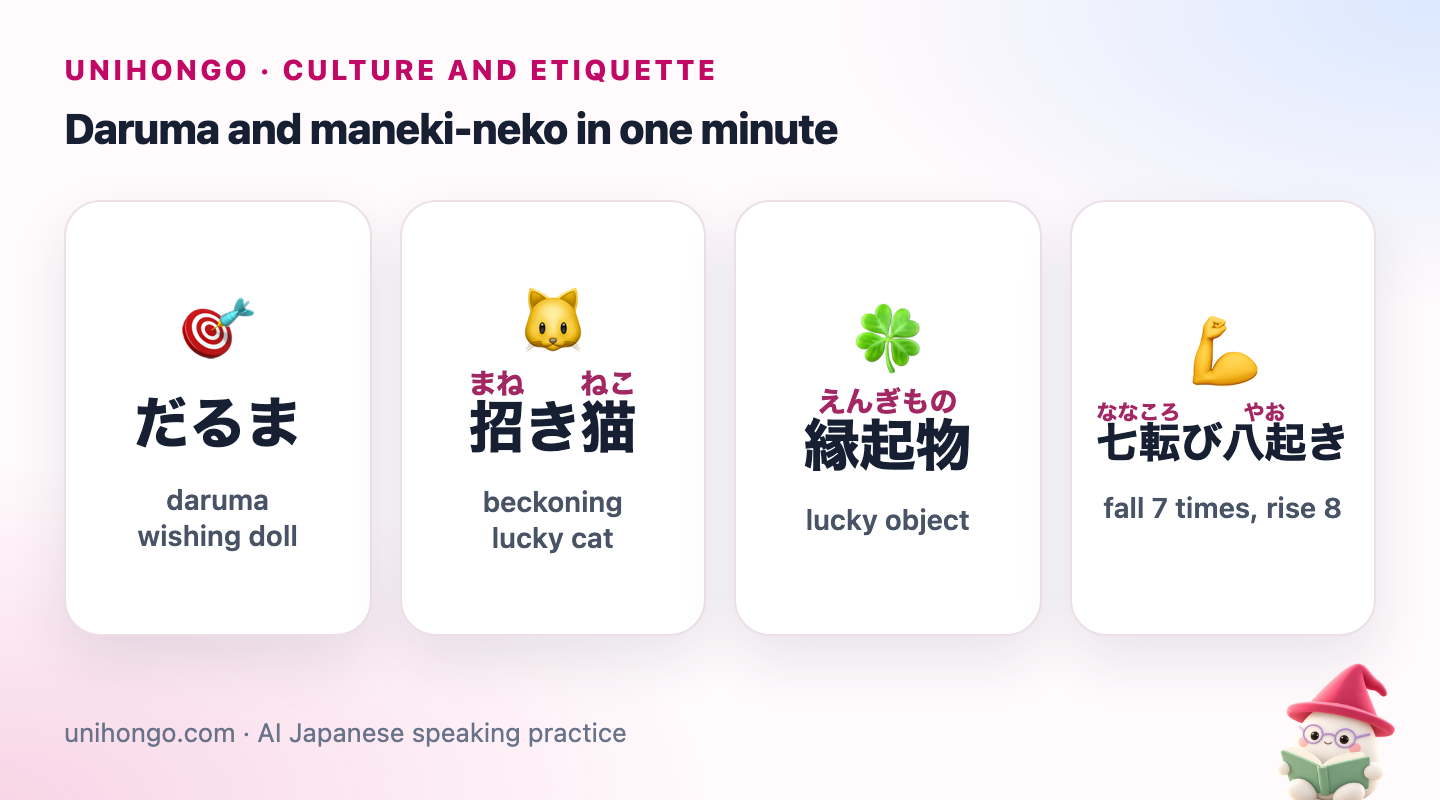
| Japanese | Romaji | Meaning |
|---|---|---|
| だるま | daruma | daruma wishing doll |
| 招き猫 | manekineko | beckoning lucky cat |
| 縁起物 | engimono | lucky object |
| 七転び八起き | nanakorobi yaoki | fall 7 times, rise 8 |
How a daruma works: one eye now, one eye later
A new daruma has two blank white circles where the eyes should be. When you decide on a goal, such as passing an exam, opening a shop or winning an election, you paint one pupil in black while thinking of that goal. The doll then sits where you will see it every day, looking at you with one eye until you finish the job. When the goal is achieved, you paint the second eye. The action is called me o ireru (目を入れる), literally to put in the eye.
Which eye comes first? Most commonly the doll's left eye, which is on your right as you face it, but customs differ and nobody will correct you. On election night, winning politicians paint the second eye of a huge daruma on television.
At the end of the year many people return the doll to the temple where they bought it, to be burned with thanks, and buy a new one. Takasaki in Gunma Prefecture is the best-known production area, and daruma markets, daruma-ichi (だるま市), are held around New Year in many towns.
| Japanese | Romaji | Meaning |
|---|---|---|
| だるまに目を入れます。 | Daruma ni me o iremasu. | I paint in the daruma's eye. |
| 目標を決めました。 | Mokuhyō o kimemashita. | I have decided on a goal. |
| 願いがかないました。 | Negai ga kanaimashita. | My wish came true. |
| 試験に合格しました。 | Shiken ni gōkaku shimashita. | I passed the exam. |
Nanakorobi yaoki: the proverb inside the doll
The saying nanakorobi yaoki (七転び八起き) means fall down seven times, get up eight. The daruma's weighted base is the proverb in physical form: push it over and it rises again. People quote it to encourage someone after a failure, and it is often written on the dolls themselves.
| Japanese | Romaji | Meaning |
|---|---|---|
| 人生は七転び八起きです。 | Jinsei wa nanakorobi yaoki desu. | Life is falling seven times and rising eight. |
| あきらめないでください。 | Akiramenaide kudasai. | Please don't give up. |
| もう一度がんばります。 | Mō ichido ganbarimasu. | I'll try hard once more. |
Maneki-neko: what people say about paws and colours
Everything in this table is popular belief. Makers and shops explain the details differently, and some reverse them, so treat it as a guide to what you will usually hear.
| Feature | What it is commonly said to bring |
|---|---|
| Right paw raised | Money and good fortune |
| Left paw raised | Customers and visitors |
| White with patches of colour | The classic cat, for general good luck |
| Gold | Luck with money |
| Black | Protection from misfortune |
Several places claim to be the birthplace of the maneki-neko, and the true origin is not settled. The best-known is Gōtoku-ji, a temple in Tokyo where visitors leave rows and rows of white cat figures. Tokoname in Aichi Prefecture is known for making ceramic ones.
Engi: the word behind engimono
Engi (縁起) began as a Buddhist term, but in daily speech it means an omen: a sign of how things will go. Something that bodes well is engi ga ii, and something that bodes badly is engi ga warui. An engimono is simply an engi thing, an object that is a good sign to have around.
Do not confuse it with un (運), luck as an outcome. A person who wins a prize is un ga ii. A tea stalk floating upright in your cup, a traditional lucky sign, is engi ga ii. The verb phrase engi o katsugu (縁起を担ぐ) describes people who choose dates, numbers and actions for luck.
| Japanese | Romaji | Meaning |
|---|---|---|
| 縁起がいいですね。 | Engi ga ii desu ne. | That's a good omen, isn't it? |
| 縁起が悪いです。 | Engi ga warui desu. | It's bad luck. |
| 縁起でもない。 | Engi demo nai. | Don't say such an unlucky thing. |
| 縁起を担ぎます。 | Engi o katsugimasu. | I do things for luck. |
| 運がいいですね。 | Un ga ii desu ne. | You're lucky, aren't you? |
Engi demo nai is a casual, fairly sharp reaction when someone mentions death or failure at a happy moment. Keep it for friends and family.
Other engimono you will see around New Year
- Kumade (熊手): a bamboo rake covered in decorations, said to rake in luck and customers. Shop owners buy them at Tori no Ichi fairs in November, and sellers and buyers clap together when a sale is made.
- Hamaya (破魔矢): literally an arrow that breaks evil. Shrines sell them at New Year, and people display one at home for protection during the year.
- Fukubukuro (福袋): a lucky bag. Shops sell sealed bags of goods at New Year for less than the contents are worth. It is shopping, not religion, but fuku (福) is the same good fortune you see on charms.
Buying a charm at a temple market
Stallholders are used to questions, and polite desu and masu forms are all you need. On a daruma you will often see a wish already painted in kanji: hisshō (必勝), certain victory; gōkaku (合格), passing an exam; shōbai hanjō (商売繁盛), a thriving business; kanai anzen (家内安全), a safe household. To make a wish on something is negai o kakeru (願いをかける).
| Japanese | Romaji | Meaning |
|---|---|---|
| だるまを一つください。 | Daruma o hitotsu kudasai. | One daruma, please. |
| 一番小さいのはいくらですか。 | Ichiban chiisai no wa ikura desu ka. | How much is the smallest one? |
| どちらの目から入れますか。 | Dochira no me kara iremasu ka. | Which eye do I paint first? |
| 右手と左手はどう違いますか。 | Migite to hidarite wa dō chigaimasu ka. | How are the right and left paws different? |
| だるまに願いをかけます。 | Daruma ni negai o kakemasu. | I make a wish on the daruma. |
| 古いだるまはどうしますか。 | Furui daruma wa dō shimasu ka. | What do I do with the old daruma? |