

Hajimemashite: what it means and when to say it
Hajimemashite comes from hajimeru, to begin, and its sense is roughly for the first time, or this is where we begin. It is said at the very first moment of a first meeting, usually before your name, and it works with anyone from a child to a company president because it has no politeness levels to choose between. That makes it the one part of the exchange you cannot get wrong, as long as you say it only once per person, ever.
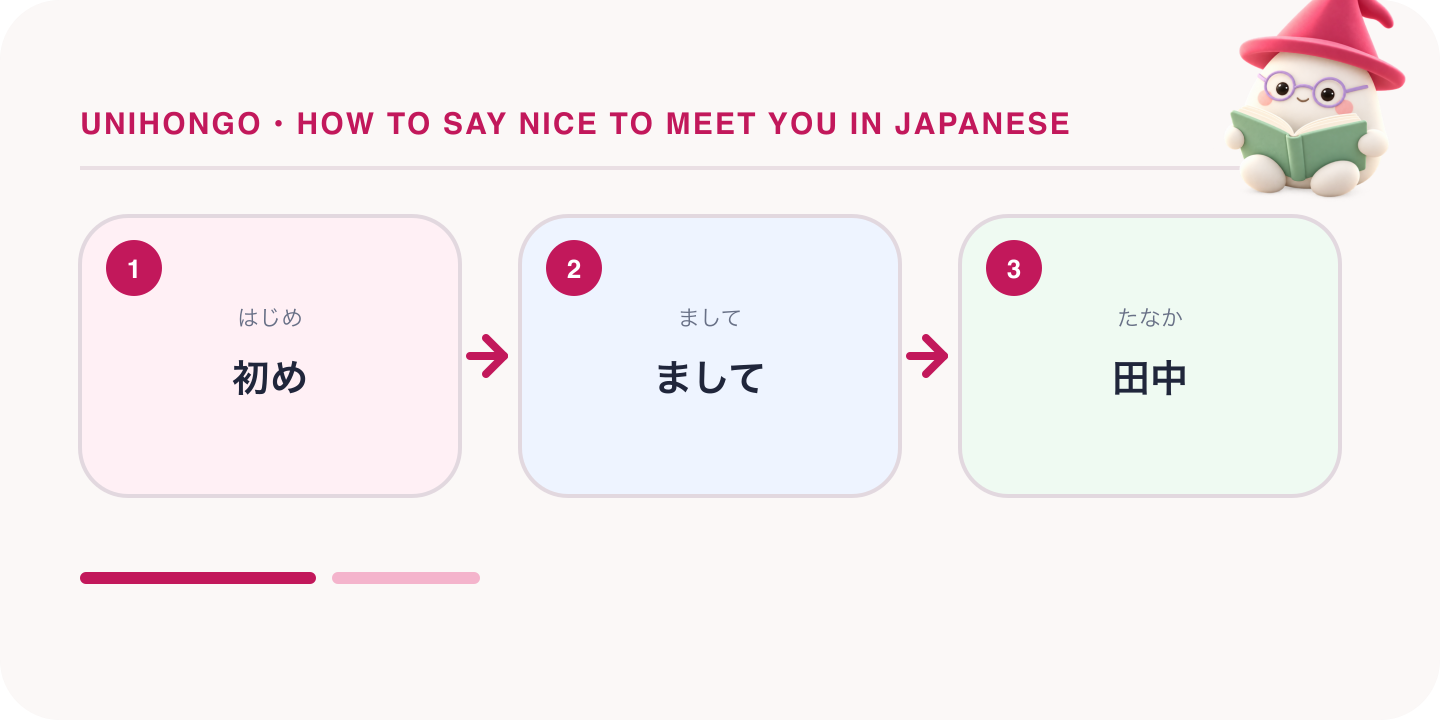
The full opening is hajimemashite, name, desu. Foreigners often add the name of their country or company before desu. You can also say to mōshimasu, I am called, instead of desu, which is more formal and standard in business. Because hajimemashite already signals a first meeting, you do not need to say anything that translates nice to meet you at this point; that job is done by the closing phrase.
| Japanese | Romaji | Meaning |
|---|---|---|
| 初めまして。田中です。 | Hajimemashite. Tanaka desu. | How do you do. I'm Tanaka. |
| 初めまして。アンナと申します。 | Hajimemashite. Anna to mōshimasu. | How do you do. My name is Anna. |
| 初めまして。イギリスから来ました。 | Hajimemashite. Igirisu kara kimashita. | How do you do. I'm from the UK. |
| 初めまして。今日からお世話になります。 | Hajimemashite. Kyō kara o-sewa ni narimasu. | How do you do. I'll be in your care from today. |
| 初めまして。お名前を伺ってもいいですか。 | Hajimemashite. O-namae o ukagatte mo ii desu ka. | How do you do. May I ask your name? |
Yoroshiku onegaishimasu and dōzo yoroshiku
Yoroshiku onegaishimasu is the sentence that actually carries the goodwill of nice to meet you. Literally it asks the other person to treat you favourably, and its real meaning is something like I look forward to our relationship, please be kind to me. It closes the introduction and comes with the bow. It is also used at the end of requests and at the start of projects, so you will hear it constantly; in an introduction it simply means we are now acquainted, and I hope it goes well.
Dōzo, please, can be added at the front for warmth or emphasis. Dōzo yoroshiku onegaishimasu is a touch more polite and heartfelt; dōzo yoroshiku without onegaishimasu is friendlier and common between people of similar standing at a party or a class. Yoroshiku on its own is casual, for friends of friends and people younger than you. A useful rule: keep onegaishimasu whenever you would use desu and masu with the person.
| Japanese | Romaji | Meaning |
|---|---|---|
| よろしくお願いします。 | Yoroshiku onegaishimasu. | Please treat me well. (the standard closing) |
| どうぞよろしくお願いします。 | Dōzo yoroshiku onegaishimasu. | I very much look forward to working with you. |
| どうぞよろしく。 | Dōzo yoroshiku. | Good to meet you. (friendly, peers) |
| よろしくね。 | Yoroshiku ne. | Nice to meet you. (casual) |
| これからよろしくお願いします。 | Kore kara yoroshiku onegaishimasu. | I look forward to working with you from now on. |
| よろしくお願いいたします。 | Yoroshiku onegai itashimasu. | Please treat me well. (more formal) |
O-ai dekite ureshii desu and other warm additions
Learners who look up nice to meet you in a dictionary find o-ai dekite ureshii desu, I am happy to have been able to meet you. It is correct and pleasant, but it is not the default. Japanese speakers use it when the meeting itself is something to be pleased about: meeting a person they have heard a lot about, a contact they have only emailed, or someone whose work they admire. Said to a random new colleague, it can sound a little intense, as if the meeting were a special event.
The natural place for it is after the standard exchange, as an extra. Hajimemashite, name, o-ai dekite ureshii desu, yoroshiku onegaishimasu is a warm and complete first meeting. If you have heard about the person, o-uwasa wa kanegane, I have heard so much about you, is a classic addition. If someone has helped you before meeting, itsumo o-sewa ni natte orimasu, thank you for your continued support, is the business equivalent.
| Japanese | Romaji | Meaning |
|---|---|---|
| お会いできて嬉しいです。 | O-ai dekite ureshii desu. | I'm glad to meet you. |
| やっとお会いできました。 | Yatto o-ai dekimashita. | I finally get to meet you. |
| お噂はかねがね伺っております。 | O-uwasa wa kanegane ukagatte orimasu. | I've heard a great deal about you. |
| いつもお世話になっております。 | Itsumo o-sewa ni natte orimasu. | Thank you for your continued support. |
| お会いできるのを楽しみにしていました。 | O-ai dekiru no o tanoshimi ni shite imashita. | I've been looking forward to meeting you. |
Business versions: hajimete o-me ni kakarimasu
In a business setting the same exchange moves up a level of formality. The very polite opener is hajimete o-me ni kakarimasu, which uses the humble verb o-me ni kakaru, to be seen by your eyes, and means it is my first time to meet you. It is used when meeting clients, senior people from other companies and anyone you are addressing with keigo. Your name follows with to mōshimasu and your company before it, then the business card exchange, then yoroshiku onegai itashimasu.
You do not need hajimete o-me ni kakarimasu with new colleagues in your own company, where hajimemashite is fine even with senior people. It belongs to the world of visits, sales calls and formal introductions. Once you have said it, the rest of the meeting can relax to ordinary polite Japanese.
| Japanese | Romaji | Meaning |
|---|---|---|
| 初めてお目にかかります。ユニ商事の山田と申します。 | Hajimete o-me ni kakarimasu. Yuni Shōji no Yamada to mōshimasu. | It's my first time meeting you. I'm Yamada from Uni Trading. |
| 本日はお時間をいただき、ありがとうございます。 | Honjitsu wa o-jikan o itadaki, arigatō gozaimasu. | Thank you for making time today. |
| 名刺を頂戴します。 | Meishi o chōdai shimasu. | I'll accept your business card. (said as you receive it) |
| 今後ともよろしくお願いいたします。 | Kongo tomo yoroshiku onegai itashimasu. | I look forward to working with you in future. |
| ご担当の方はどちらですか。 | Go-tantō no kata wa dochira desu ka. | Who is the person in charge? |
Replying when someone introduces themselves to you
When the other person opens with hajimemashite, you mirror it: hajimemashite, your name, yoroshiku onegaishimasu. When they close with yoroshiku onegaishimasu before you have said it, the reply is kochira koso yoroshiku onegaishimasu, where kochira koso means it is I who should say so. It is the Japanese for likewise or the pleasure is mine, and it is used constantly.
If the other person has been introduced by a third party, for example a colleague saying kochira wa Suzuki-san desu, this is Ms Suzuki, you still open with hajimemashite and your own name; the introducer does not do the exchange for you. If someone greets you with o-ai dekite ureshii desu, reply with kochira koso, and if you like, add o-ai dekite kōei desu, it is an honour to meet you, when the person is senior.
| Japanese | Romaji | Meaning |
|---|---|---|
| こちらこそ、よろしくお願いします。 | Kochira koso, yoroshiku onegaishimasu. | Likewise, I look forward to working with you. |
| こちらこそ。 | Kochira koso. | The pleasure is mine. |
| こちらこそ、お会いできて光栄です。 | Kochira koso, o-ai dekite kōei desu. | It's an honour to meet you too. |
| はい、初めまして。鈴木と申します。 | Hai, hajimemashite. Suzuki to mōshimasu. | Yes, how do you do. I'm Suzuki. |
| すみません、もう一度お名前をお願いします。 | Sumimasen, mō ichido o-namae o onegaishimasu. | Sorry, could you tell me your name again? |
The second meeting: what replaces hajimemashite
Hajimemashite is a one-time phrase, and saying it to someone you have already met is a small but noticeable slip, because it tells them you have forgotten the first meeting. The second time, greet normally with konnichiwa or the workplace greeting, then refer back to the previous meeting. Senjitsu wa arigatō gozaimashita, thank you for the other day, is the standard line and works even if nothing much happened; it simply acknowledges the earlier contact. If it has been a long time, o-hisashiburi desu or go-busata shite orimasu, sorry to have been out of touch, do the same job.
If you are not sure whether you have met, mae ni o-ai shimashita deshō ka, have we met before, is polite and saves you from either error. The closing phrase changes too: mata yoroshiku onegaishimasu, again please, or hikitsuzuki yoroshiku onegaishimasu, continued goodwill please, replace the first-meeting version.
| Situation | Reading | What to say |
|---|---|---|
| 初対面 | shotaimen | Hajimemashite, name, yoroshiku onegaishimasu |
| 二回目、先週会った | nikaime, senshū atta | Senjitsu wa arigatō gozaimashita |
| 久しぶり | hisashiburi | O-hisashiburi desu |
| ご無沙汰 | go-busata | Go-busata shite orimasu (formal, long gap) |
| 覚えていない | oboete inai | Mae ni o-ai shimashita deshō ka |
| 名前を忘れた | namae o wasureta | Sumimasen, o-namae o mō ichido |
| 紹介された | shōkai sareta | Hajimemashite plus your own name, even after an introduction |
| 二回目の締め | nikaime no shime | Mata yoroshiku onegaishimasu |
The table is a quick reminder of which opener fits which situation. Notice that the second-meeting lines all refer to time: the other day, a long while, before. That backward glance is what replaces the fresh start of hajimemashite.
Online meetings and written introductions
Video calls have kept the same ritual but changed the timing. The host usually opens with a general greeting, then each person introduces themselves in turn. Hajimemashite is still used, even through a screen, and people bow slightly to the camera. Because there are no business cards, the name and company are said clearly and often typed into the chat. When several people speak, keep your line short: hajimemashite, company, name, yoroshiku onegaishimasu, and stop.
In writing, the first email to someone begins with hajimete go-renraku itashimasu, I am contacting you for the first time, or totsuzen no mēru de shitsurei itashimasu, apologies for the sudden email. Hajimemashite works in a casual message to a new acquaintance but is a little light for business email. The email ends, as always, with yoroshiku onegai itashimasu.
- Say hajimemashite even on video; the phrase does not need a physical meeting
- Bow slightly to the camera when you say yoroshiku onegaishimasu
- State your company and name clearly and type them into the chat if there is one
- In a first email, open with hajimete go-renraku itashimasu
- Close every written introduction with yoroshiku onegai itashimasu
- When you are the last to introduce yourself, add ijō desu, that is all, to hand back
If your camera is off, say your name a little more slowly; the other participants have no face to attach it to and will rely on the sound.
Common mistakes with the first-meeting exchange
The most frequent mistake is saying hajimemashite at a second meeting, which this guide has covered. Close behind is dropping yoroshiku onegaishimasu, so the exchange feels unfinished; Japanese speakers will wait a beat for it. Third is the order: some learners say yoroshiku onegaishimasu first and hajimemashite second, which sounds backwards. Opener, name, closer is the fixed sequence.
A subtler mistake is using o-ai dekite ureshii desu with everybody, which comes across as slightly gushing. Save it for meetings that really are a pleasure. Finally, in business, remember that hajimete o-me ni kakarimasu is for the other company, not for your own new colleagues, and that keigo is not required with everyone you meet on your first day. Matching the level of the person in front of you is the whole skill.
| Japanese | Romaji | Meaning |
|---|---|---|
| あ、すみません。前にお会いしましたね。 | A, sumimasen. Mae ni o-ai shimashita ne. | Oh, sorry. We've met before, haven't we. |
| 失礼しました。改めて、よろしくお願いします。 | Shitsurei shimashita. Aratamete, yoroshiku onegaishimasu. | Excuse me. Once again, I look forward to working with you. |
| 先日はありがとうございました。 | Senjitsu wa arigatō gozaimashita. | Thank you for the other day. |
| お名前を聞き取れなくて、すみません。 | O-namae o kikitorenakute, sumimasen. | Sorry, I didn't catch your name. |