

What sararīman means and where the word comes from
Sararīman is wasei eigo, Japanese-made English. It joins sararī, salary, and man to describe someone who earns a fixed monthly wage from a company rather than running a shop, farming or working by the day. In Japanese it is written in katakana, サラリーマン, and often shortened in speech to rīman. The word spread through the twentieth century as office work became the typical career, and today it is simply the everyday word for a male white-collar employee.
The meaning has an edge that the English translation misses. Sararīman is not just a job description; it describes a way of life. A sararīman commutes on a crowded train, wears a suit, works in a large office, goes drinking with colleagues and stays with one company for a long time. Whether or not any individual actually lives that way, the word summons the picture, which is why some people say it with a shrug and others avoid it.
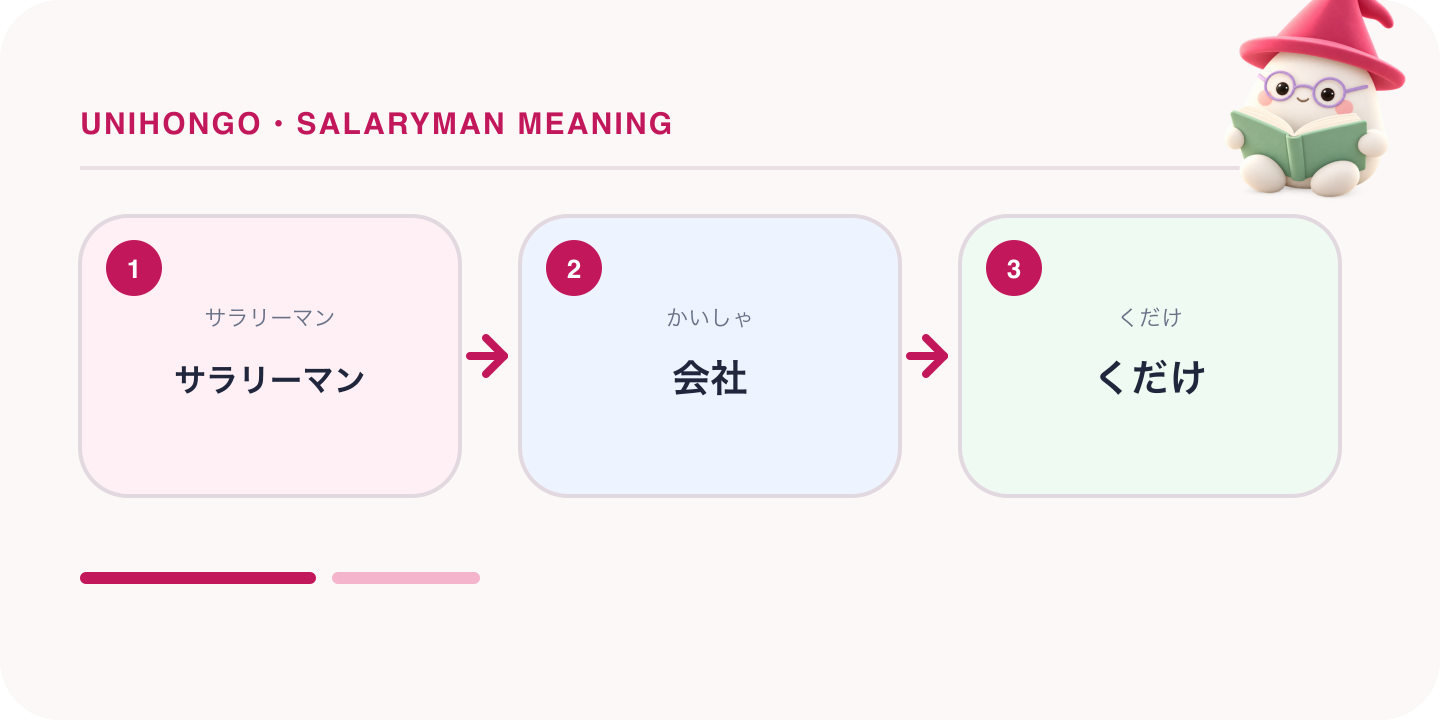
| Japanese | Romaji | Meaning |
|---|---|---|
| サラリーマンは会社員のくだけた言い方です。 | Sararīman wa kaishain no kudaketa iikata desu. | Sararīman is a casual way of saying company employee. |
| 父はごく普通のサラリーマンでした。 | Chichi wa goku futsū no sararīman deshita. | My father was a completely ordinary salaryman. |
| まあ、しがないサラリーマンですよ。 | Mā, shiganai sararīman desu yo. | Oh, I'm just a humble salaryman. (self-deprecating) |
| 朝の電車はサラリーマンでいっぱいです。 | Asa no densha wa sararīman de ippai desu. | The morning train is full of office workers. |
| サラリーマン生活はもう二十年です。 | Sararīman seikatsu wa mō nijū-nen desu. | I've been living the salaryman life for twenty years now. |
Kaishain, shain, seishain and the words for status
Kaishain, 会社員, is the neutral occupation word: a person employed by a company. It is what you write on a form and what you say when a stranger asks about your job. Shain, 社員, is the word from the company's point of view, its members. Companies say shain, not kaishain, in shain ryō, company housing, shain wari, staff discount, and shin-nyū shain, new hires. Both words are unmarked for gender, which is one reason they have replaced sararīman and OL in careful speech.
Add a prefix to shain and you describe employment status. Seishain is a permanent, full-time employee, the status that traditionally came with the salaryman life. Keiyaku shain is a fixed-term contract employee, haken shain is a worker dispatched by a staffing agency, and pāto and arubaito are part-time positions. These distinctions matter in Japan because pay, benefits and stability differ, and people ask about them directly. Kōmuin, public servant, is a separate category and not a kaishain at all.
| Japanese | Romaji | Meaning |
|---|---|---|
| 会社員です。 | Kaishain desu. | I'm a company employee. |
| 正社員として採用されました。 | Seishain to shite saiyō saremashita. | I was hired as a permanent employee. |
| 今は契約社員で働いています。 | Ima wa keiyaku shain de hataraite imasu. | I'm currently working as a contract employee. |
| 派遣社員から正社員になりました。 | Haken shain kara seishain ni narimashita. | I went from agency worker to permanent employee. |
| 新入社員の研修が来週あります。 | Shin-nyū shain no kenshū ga raishū arimasu. | The training for new employees is next week. |
| 兄は公務員で、私は会社員です。 | Ani wa kōmuin de, watashi wa kaishain desu. | My brother is a civil servant and I'm a company employee. |
OL and the gender problem with these words
OL, pronounced ōeru, stands for office lady, and for decades it was the female counterpart of sararīman: a woman doing clerical and support work in an office, often expected to leave on marriage. The word is still heard, especially from older speakers and in magazines, but it has aged badly. It labels a woman by her sex and by a narrow job type, at a time when women hold every kind of role. Many women dislike it, and it does not appear in formal writing.
The practical rule is to describe women exactly as you would describe men: by company, department and role. Kaishain works for anyone. If someone calls a colleague an OL, you do not need to correct them, but do not adopt the word yourself. Note that sararīman also has this problem in reverse: it means a man, so a woman does not normally call herself a sararīman, though you may hear it used playfully.
| Japanese | Romaji | Meaning |
|---|---|---|
| OLという言葉は今はあまり使いません。 | Ōeru to iu kotoba wa ima wa amari tsukaimasen. | The word OL is not used much these days. |
| 妻も会社員で、営業をしています。 | Tsuma mo kaishain de, eigyō o shite imasu. | My wife is also a company employee, working in sales. |
| 彼女は人事部の課長です。 | Kanojo wa jinjibu no kachō desu. | She is a section chief in the HR department. |
| 同期の女性は経理を担当しています。 | Dōki no josei wa keiri o tantō shite imasu. | The woman who joined with me handles accounting. |
| 役職で呼ぶのが普通です。 | Yakushoku de yobu no ga futsū desu. | It's normal to refer to people by their position. |
The culture around the word: suits, trains and nomikai
The image of the salaryman rests on a few real habits. The first is the sūtsu: a dark suit, white shirt and plain tie, worn even in summer heat until many companies introduced kūru bizu, a summer dress code that allows short sleeves and no tie. The second is tsūkin, commuting, often an hour or more each way on a manin densha, a packed train. The morning rush is called tsūkin rasshu, and the last train home is the shūden, which sets the end of many evenings.
The third habit is the nomikai, drinking with colleagues after work. A nomikai can be a welcome party, a year-end bōnenkai or simply a Friday. Attendance is technically voluntary and in practice often expected, though this is changing, especially at newer companies. Together, these habits give the word its flavour: sararīman describes not only a salary but a rhythm of the day. Long hours are part of that picture too; a separate post on the word karōshi, death from overwork, deals with that side of it.
| Japanese | Romaji | Meaning |
|---|---|---|
| 毎朝満員電車で通勤しています。 | Maiasa manin densha de tsūkin shite imasu. | I commute on a packed train every morning. |
| 終電に間に合わなかった。 | Shūden ni maniawanakatta. | I missed the last train. |
| 今日はクールビズでネクタイなしです。 | Kyō wa kūru bizu de nekutai nashi desu. | It's cool biz today, so no tie. |
| 金曜日は部署の飲み会があります。 | Kin'yōbi wa busho no nomikai ga arimasu. | There's a department drinking party on Friday. |
| 飲み会は自由参加ですよ。 | Nomikai wa jiyū sanka desu yo. | The drinking party is optional, you know. |
| 残業で帰りが遅くなりました。 | Zangyō de kaeri ga osoku narimashita. | I got home late because of overtime. |
Company sizes and types: ōte, chūshō kigyō and more
When Japanese people ask about your work, they often want to place your company by size and type before they ask what you do. Ōte kigyō, or just ōte, means a major, leading company, and daikigyō means a large company generally. Chūshō kigyō, small and medium-sized enterprises, employ most of the working population and the phrase is neutral, not apologetic. A very small business is a reishō kigyō, and a benchā kigyō or sutāto appu is a young growth company. The table gathers the words you need to describe where you work.
| Word | Reading | Meaning |
|---|---|---|
| 大手企業 | ōte kigyō | Major, leading company in its field |
| 大企業 | daikigyō | Large company |
| 中小企業 | chūshō kigyō | Small and medium-sized enterprise |
| 零細企業 | reishō kigyō | Very small business |
| ベンチャー企業 | benchā kigyō | Young growth company, start-up |
| 外資系 | gaishikei | Foreign-owned or foreign-affiliated company |
| 上場企業 | jōjō kigyō | Listed company |
| 子会社 | kogaisha | Subsidiary |
| 本社 | honsha | Head office |
| 支社 | shisha | Branch office |
| 取引先 | torihikisaki | Client or business partner company |
| 自営業 | jieigyō | Self-employed |
Gaishikei, foreign-affiliated companies, are a category of their own in Japanese conversation, with a reputation for higher pay, English at work and less of the traditional salaryman culture. If you work for one, saying gaishikei ni tsutomete imasu already answers several questions people would otherwise ask.
Saying what you do without the word sararīman
Sararīman tells people almost nothing about your actual work, so in conversation it is more useful to give your company type, your department and your role. The standard pattern is company ni tsutomete imasu, I work for a company, followed by busho, the department, and the work itself with o shite imasu. Common departments are eigyō, sales; jinji, human resources; keiri, accounting; kaihatsu, development; and kikaku, planning. A separate post on explaining your job in Japanese covers job titles in depth, so this section gives only the frame.
- Ōte no mēkā ni tsutomete imasu: I work for a major manufacturer
- Chūshō kigyō de eigyō o shite imasu: I do sales at a small or medium-sized company
- Gaishikei no IT gaisha de enjinia o shite imasu: I'm an engineer at a foreign IT company
- Benchā de kikaku o tantō shite imasu: I handle planning at a start-up
- Jieigyō de honyaku o shite imasu: I'm self-employed as a translator
- Kōmuin de, shiyakusho de hataraite imasu: I'm a civil servant working at city hall
Notice that none of these sentences needs sararīman. If someone else uses the word about you, for example sararīman desu ka, a simple hai, kaishain desu with your role attached answers the question and quietly upgrades the vocabulary.
Mistakes learners make with salaryman words
The first mistake is using sararīman at a job interview or in a formal self-introduction. The word is casual and slightly self-deprecating, and it leaves the interviewer with no information about your skills. Use kaishain to state the category and then your role and achievements. The second mistake is applying the word to everyone: a woman, a shop owner, a doctor or a public servant is not a sararīman, even if they wear a suit and work long hours.
A third mistake is confusing shain with kaishain in company contexts, for example saying watashi wa kaishain no Tanaka desu on the phone. Inside a company you are a shain of it, and the natural phone introduction is the company name followed by your own name, with no employee word at all. Finally, be careful with the emotional colour of the word. Sararīman said with a sigh can mean a life of routine; do not use it about someone who is proud of their career unless you know they use it themselves.
| Japanese | Romaji | Meaning |
|---|---|---|
| 面接では会社員ではなく、職種を言いましょう。 | Mensetsu de wa kaishain de wa naku, shokushu o iimashō. | In an interview, state your occupation type, not just company employee. |
| ABC商事の田中と申します。 | Ēbīshī shōji no Tanaka to mōshimasu. | This is Tanaka from ABC Trading. |
| 前職は中小企業の経理でした。 | Zenshoku wa chūshō kigyō no keiri deshita. | My previous job was accounting at a small company. |
| サラリーマンという言葉には少し疲れたイメージがあります。 | Sararīman to iu kotoba ni wa sukoshi tsukareta imēji ga arimasu. | The word sararīman has a slightly tired image. |
| 医者や公務員はサラリーマンとは言いません。 | Isha ya kōmuin wa sararīman to wa iimasen. | Doctors and civil servants are not called salarymen. |