
Four words of freelance life
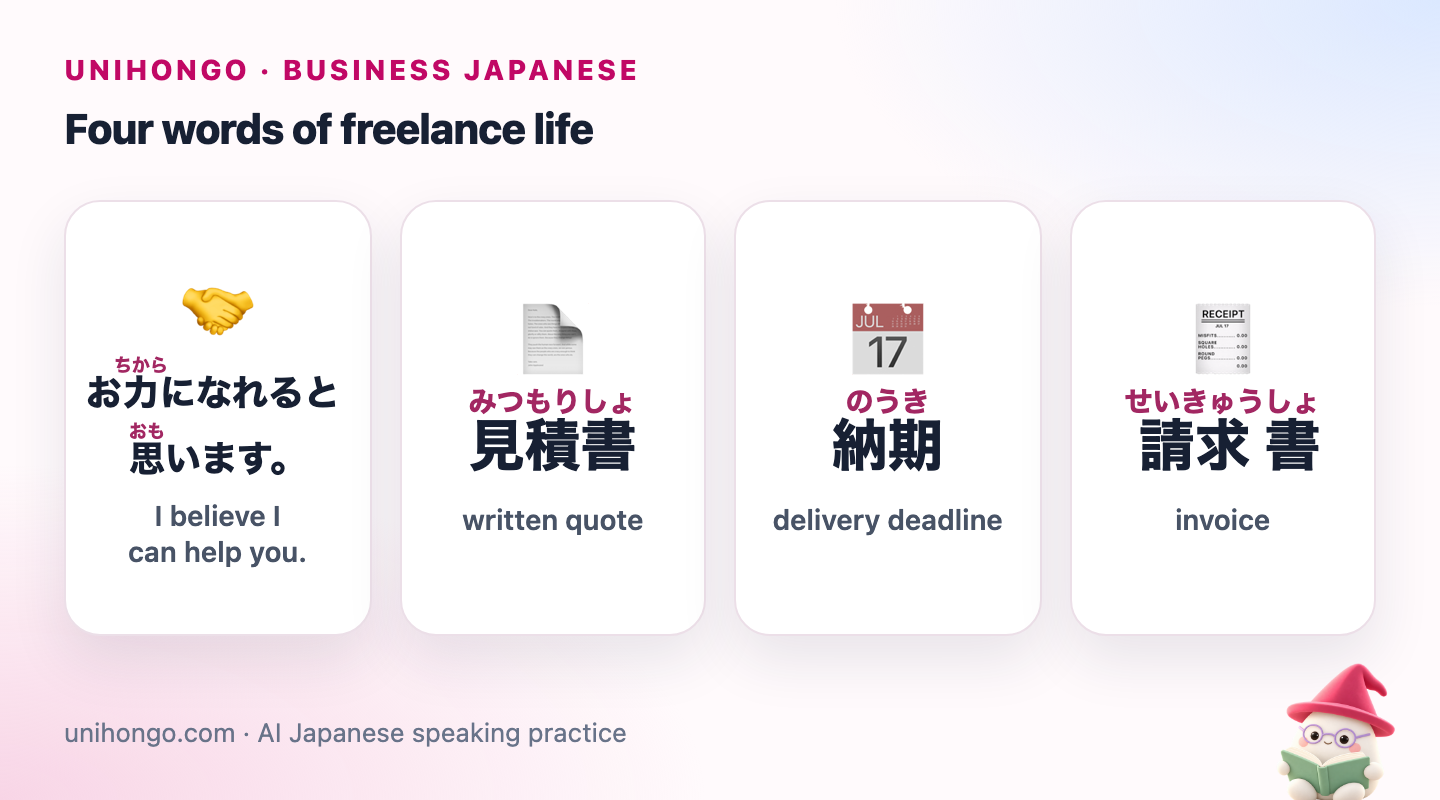
Ochikara ni nareru to omoimasu, I believe I can help you, is the confident but humble line that closes a good first meeting; ochikara is the client's strength or need, which you offer to serve. The mitsumorisho is the quote, nōki is the deadline, and the seikyūsho is the invoice. Two more words describe your status: gyōmu itaku (業務委託) is contract work done by an outside party, the legal shape of most freelance jobs, and kojin jigyōnushi (個人事業主) is a sole proprietor, which is what you are for tax purposes.
| Japanese | Romaji | Meaning |
|---|---|---|
| お力になれると思います。 | Ochikara ni nareru to omoimasu. | I believe I can help you. |
| 見積書 | mitsumorisho | written quote |
| 納期 | nōki | delivery deadline |
| 請求書 | seikyūsho | invoice |
| 業務委託 | gyōmu itaku | freelance contract work |
| 個人事業主 | kojin jigyōnushi | sole proprietor |
Introducing your services
Clients in Japan often come through shōkai (紹介), introductions, so your self-introduction will be repeated at coworking spaces, meetups and first calls. Make it one sentence about what you do and one about your track record, jisseki (実績). Uketamawaru is the humble verb for taking on work and sounds professional; shite imasu is fine too. Mentioning Japanese clients you have worked with, if true, reassures a cautious buyer. End with an open door rather than a pitch.
Where do the clients come from? For many foreign freelancers the first jobs arrive through other foreigners and through coworking spaces, then through Japanese clients who were introduced by a satisfied one. Local chambers of commerce, industry meetups and the business-networking events that coworking spaces run are all places where a short, clear Japanese introduction does more than a polished portfolio. Online freelance marketplaces exist in Japan too, and a profile written in natural Japanese, ideally checked by a native speaker, is the entry ticket.
| Japanese | Romaji | Meaning |
|---|---|---|
| フリーランスでデザインをしています。 | Furīransu de dezain o shite imasu. | I work as a freelance designer. |
| ウェブサイト制作と英語のライティングを承っています。 | Webusaito seisaku to eigo no raitingu o uketamawatte imasu. | I take on website production and English writing. |
| 実績はこちらでご覧いただけます。 | Jisseki wa kochira de goran itadakemasu. | You can see my past work here. |
| 日本の企業とも取引があります。 | Nihon no kigyō to mo torihiki ga arimasu. | I also work with Japanese companies. |
| お役に立てることがあれば、ぜひご連絡ください。 | Oyaku ni tateru koto ga areba, zehi gorenraku kudasai. | If I can be of use, please get in touch. |
Scope and deadlines
Most freelance disputes are about scope, so settle it before the quote. Sagyō naiyō (作業内容) is the work content, shūsei (修正) is a revision, and tsuika (追加) is additional work. Say how many revisions are included and that extra requests are quoted separately, betto omitsumori. For the deadline, ask the client's wish first, then commit to a date with made ni nōhin shimasu, and if you need more time ask early rather than late.

| Japanese | Romaji | Meaning |
|---|---|---|
| 作業内容を確認させてください。 | Sagyō naiyō o kakunin sasete kudasai. | Let me confirm the scope of work. |
| 納期はいつごろをご希望ですか。 | Nōki wa itsu goro o gokibō desu ka. | When would you like it delivered? |
| 修正は2回まで含まれています。 | Shūsei wa nikai made fukumarete imasu. | Up to two rounds of revisions are included. |
| 追加のご依頼は別途お見積りします。 | Tsuika no goirai wa betto omitsumori shimasu. | Additional requests are quoted separately. |
| 来週の月曜日までに納品します。 | Raishū no getsuyōbi made ni nōhin shimasu. | I'll deliver by next Monday. |
| 少しお時間をいただけますか。 | Sukoshi ojikan o itadakemasu ka. | Could I have a little more time? |
| Word | Reading | Meaning |
|---|---|---|
| 作業内容 | sagyō naiyō | Scope, what the work includes |
| 納期 | nōki | Deadline for delivery |
| 納品 | nōhin | Delivering the finished work |
| 修正 | shūsei | A revision or correction round |
| 追加 | tsuika | Additional work beyond the scope |
Quotes and talking about money
The quote goes out as a document, but the price is often discussed first in a meeting. Always say whether a figure is zeinuki (税抜き), excluding consumption tax, or zeikomi (税込み), including it. A chakushukin (着手金), an upfront payment, is common for larger projects. If the client's budget is below your price, do not simply drop the number: adjust the scope, which protects your rate and gives the client a real choice. Asking about budget directly is acceptable in business Japanese when wrapped in ukagatte mo yoroshii deshō ka.
Whether you charge consumption tax, and how the invoice registration system affects you, depends on your turnover and registration; the rules have changed in recent years, so confirm them with the tax office or an accountant.
| Japanese | Romaji | Meaning |
|---|---|---|
| お見積りをお送りします。 | Omitsumori o ookuri shimasu. | I'll send you a quote. |
| 金額は税抜きです。 | Kingaku wa zeinuki desu. | The amount excludes consumption tax. |
| 着手金として半額をお願いしています。 | Chakushukin toshite hangaku o onegai shite imasu. | I ask for half as an upfront payment. |
| ご予算を伺ってもよろしいでしょうか。 | Goyosan o ukagatte mo yoroshii deshō ka. | May I ask your budget? |
| この金額では難しいです。 | Kono kingaku dewa muzukashii desu. | That amount would be difficult. |
| 内容を調整すれば対応できます。 | Naiyō o chōsei sureba taiō dekimasu. | If we adjust the scope, I can do it. |
Invoices and payment terms
A Japanese seikyūsho lists the client's name, the date, each item, the subtotal, tax and total, the payment deadline and the furikomisaki (振込先), your bank details. A common cycle is getsumatsu jime yokugetsu matsu barai: invoices dated by the end of the month are paid at the end of the next. Write your terms on the quote and repeat them on the invoice. Bank transfer fees are usually paid by the client in Japan, but say so. Confirm payment with a one-line thank-you; clients notice.
| Japanese | Romaji | Meaning |
|---|---|---|
| 請求書を添付いたします。 | Seikyūsho o tenpu itashimasu. | I attach the invoice. |
| お支払いは月末締め翌月末払いでお願いします。 | Oshiharai wa getsumatsu jime yokugetsu matsu barai de onegai shimasu. | Payment terms: month-end close, paid end of next month. |
| 振込先は請求書に記載しています。 | Furikomisaki wa seikyūsho ni kisai shite imasu. | The bank details are on the invoice. |
| 振込手数料はご負担いただけますか。 | Furikomi tesūryō wa gofutan itadakemasu ka. | Could you cover the transfer fee? |
| ご入金を確認しました。ありがとうございます。 | Gonyūkin o kakunin shimashita. Arigatō gozaimasu. | I've confirmed your payment. Thank you. |
Chasing politely
A late payment is usually an oversight, and the first reminder should assume so. Open with osoreirimasu ga, excuse me, state that you have not been able to confirm payment, and offer the client a face-saving exit: ikichigai deshitara, if our messages have crossed. Resend the invoice nen no tame, just in case. A second reminder a week later can be firmer but still polite. The same soft structure works for chasing feedback on delivered work, with gokakunin no jōkyō, the state of your review.
| Japanese | Romaji | Meaning |
|---|---|---|
| 恐れ入りますが、ご入金の確認が取れておりません。 | Osoreirimasu ga, gonyūkin no kakunin ga torete orimasen. | Excuse me, I haven't yet been able to confirm payment. |
| お忙しいところ恐縮ですが、ご確認いただけますでしょうか。 | Oisogashii tokoro kyōshuku desu ga, gokakunin itadakemasu deshō ka. | Sorry to trouble you, could you check? |
| 念のため、請求書を再送いたします。 | Nen no tame, seikyūsho o saisō itashimasu. | Just in case, I'm resending the invoice. |
| 行き違いでしたら申し訳ありません。 | Ikichigai deshitara mōshiwake arimasen. | Apologies if our messages have crossed. |
| ご確認の状況はいかがでしょうか。 | Gokakunin no jōkyō wa ikaga deshō ka. | How is the review coming along? |
Keeping clients and getting referrals
Repeat work and shōkai are how freelancers in Japan survive, and both depend on how a job ends. Deliver, thank the client, and leave the door open with okoegake kudasai, let me know. Asking for referrals is acceptable when phrased as a wish rather than a request. If a client's late brief caused a rush, say so gently after delivery, framed as what would help next time.
| Japanese | Romaji | Meaning |
|---|---|---|
| 今後ともよろしくお願いいたします。 | Kongo tomo yoroshiku onegai itashimasu. | I look forward to working with you again. |
| また何かあれば、お声がけください。 | Mata nanika areba, okoegake kudasai. | If anything comes up, just let me know. |
| ご紹介いただけるとうれしいです。 | Goshōkai itadakeru to ureshii desu. | I'd be glad of any referrals. |
| 次回は少し早めにご相談いただけると助かります。 | Jikai wa sukoshi hayame ni gosōdan itadakeru to tasukarimasu. | Next time, a little earlier notice would help. |
Common mistakes
- Quoting without saying zeinuki or zeikomi. The client will assume the cheaper reading.
- Leaving scope vague. Count the revisions and name the extras before the first invoice, not after.
- Dropping the price instead of the scope. A lower number teaches the client your rate is negotiable; a smaller scope does not.
- Chasing with blame. Mada haratte imasen, you have not paid yet, is true and fatal; use the soft forms above.
- Going casual with a friendly client. Even after a year, written Japanese to a client stays in polite register.