

Ii desu ne and ii ne: approving the idea
Ii desu ne is the core phrase. Ii means good, desu makes it polite, and ne asks the other person to share the feeling, so together the sentence says that sounds good, doesn't it. It is warm and it works with almost anyone: a colleague proposing a lunch place, a host suggesting a walk, a friend planning a trip. Ii ne is the casual version, and the stretched ii nē adds enthusiasm.
The important thing to notice is what ii desu ne does not do. It approves the idea, but it does not commit you to it. Japanese speakers often say ii desu ne and then add a but: ii desu ne, demo raishū wa chotto, sounds good, but next week is a bit difficult. So if you mean yes, let's, you need the second step covered in the next section.
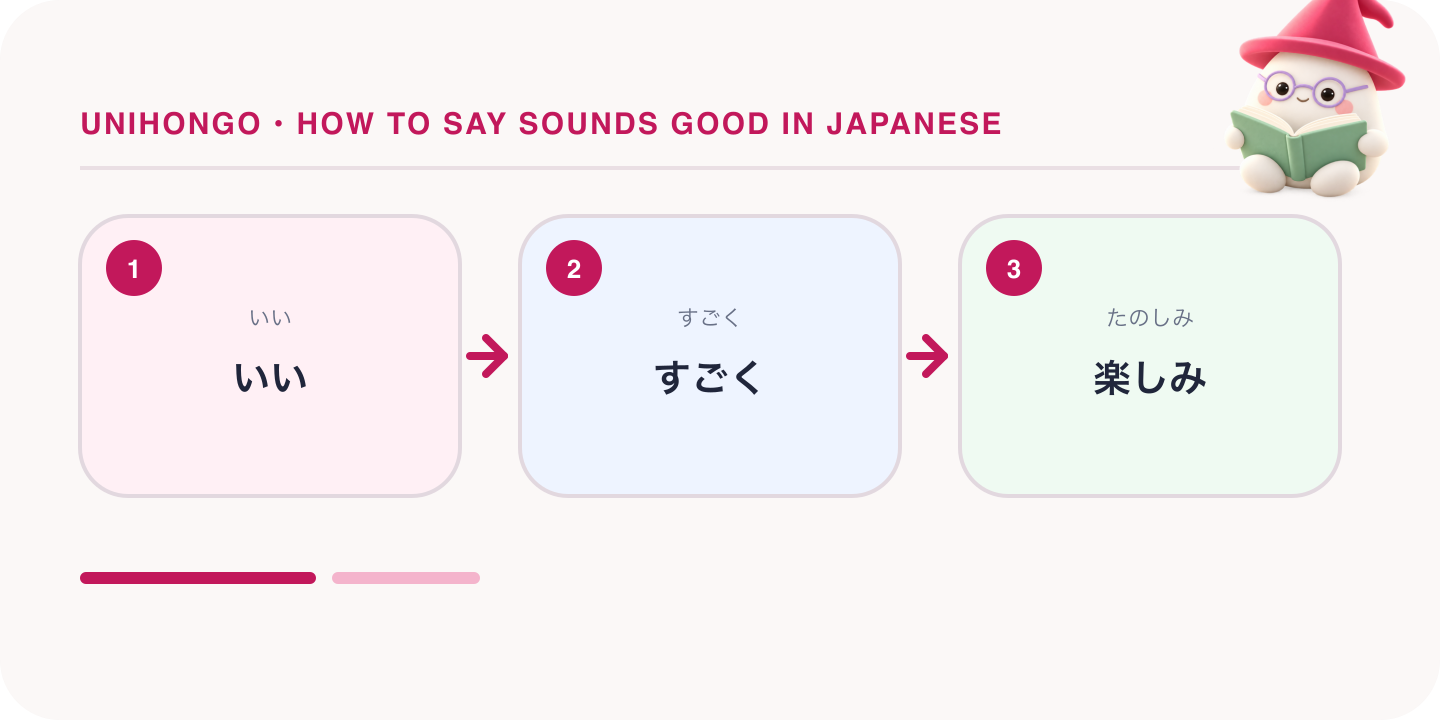
Stronger approvals are easy to build. Sugoku ii desu ne, that sounds really good; saikō desu ne, that's the best; tanoshimi desu, I'm looking forward to it. All of them work as a reply to a suggestion.
| Japanese | Romaji | Meaning |
|---|---|---|
| いいですね。 | Ii desu ne. | Sounds good. |
| いいね! | Ii ne! | Sounds good! (casual) |
| それ、いいですね。 | Sore, ii desu ne. | That sounds good. |
| すごくいいですね。 | Sugoku ii desu ne. | That sounds really good. |
| いいですね、楽しみです。 | Ii desu ne, tanoshimi desu. | Sounds good, I'm looking forward to it. |
| いいですね。でも来週はちょっと。 | Ii desu ne. Demo raishū wa chotto. | Sounds good, but next week is a bit difficult. |
Sō shimashō and sō shiyō: committing to the plan
Once you approve, you commit. Sō shimashō, let's do that, is the polite volitional of suru with sō, that way. Sō shiyō is the casual form, and among friends you will also hear sō shiyo with a short vowel. These phrases turn a suggestion into a decision, and they are the usual second half of the reply: ii desu ne, sō shimashō.
The suggestion often comes with its own volitional, shimasen ka or shimashō ka, shall we, and you can echo it: nanika tabe ni ikimasen ka, shall we go and eat something; ii desu ne, ikimashō, sounds good, let's go. Echoing the verb sounds especially natural.
Three more phrases do the same job. Sore de ii desu, that's fine, sounds a little flat, as if you are settling; sore de daijōbu desu, that works for me, is warmer; and sore ni shimashō, let's go with that, is the phrase for choosing between options, for example on a menu or between two dates.
| Japanese | Romaji | Meaning |
|---|---|---|
| そうしましょう。 | Sō shimashō. | Let's do that. |
| そうしよう。 | Sō shiyō. | Let's do that. (casual) |
| いいですね、行きましょう。 | Ii desu ne, ikimashō. | Sounds good, let's go. |
| それで大丈夫です。 | Sore de daijōbu desu. | That works for me. |
| それにしましょう。 | Sore ni shimashō. | Let's go with that one. |
| じゃあ、七時に駅で。 | Jā, shichi-ji ni eki de. | So, seven at the station then. |
Sansei desu: being in favour
Sansei means being in favour, and sansei desu is the phrase for a decision that a group is making: a meeting choosing a launch date, friends voting on a restaurant, a family deciding where to go in the holidays. It says I vote for that. In casual speech sansei! on its own is common, and among friends the loanword ōkē is everywhere.
Sansei desu is a little heavy for a two-person plan. If a friend suggests a coffee and you answer sansei desu, it sounds like you are passing a motion. Use it when there is a choice on the table and several people are weighing in. Its opposite, hantai desu, I'm against it, belongs in the same setting.
Daisansei, big agreement, is the enthusiastic form, and it is a good phrase for a group chat when someone proposes something everyone wanted anyway.
| Japanese | Romaji | Meaning |
|---|---|---|
| 賛成です。 | Sansei desu. | I'm in favour. |
| 私も賛成です。 | Watashi mo sansei desu. | I'm in favour too. |
| 大賛成! | Daisansei! | Totally in favour! |
| その案に賛成です。 | Sono an ni sansei desu. | I support that proposal. |
| じゃあ、多数決で決めましょう。 | Jā, tasūketsu de kimemashō. | Then let's decide by majority. |
At work: ii to omoimasu and sore de onegaishimasu
In an office, the reply depends on who made the suggestion. To a colleague at your level, ii desu ne is fine. To a manager or a client, the safer phrases are ii to omoimasu, I think that is good, which sounds considered rather than casual, and sore de onegaishimasu, please go ahead with that, which accepts a proposal and asks the other person to proceed. Both are standard in emails and chat as well as in speech.
When the suggestion is really an instruction, the reply is not sounds good but understood: kashikomarimashita in customer-facing and formal settings, shōchi shimashita in most offices, and the more casual ryōkai desu among colleagues. Answering a manager's instruction with ii desu ne can sound as if you are evaluating them.
For proposals in meetings, mondai arimasen, no problem, and sono hōkō de susumemashō, let's proceed in that direction, are natural ways to accept. If you accept but want to add a condition, put the acceptance first: ii to omoimasu, tada hiyō dake kakunin sasete kudasai, I think it's good, only let me check the cost.
| Japanese | Romaji | Meaning |
|---|---|---|
| いいと思います。 | Ii to omoimasu. | I think that's good. |
| それでお願いします。 | Sore de onegaishimasu. | Please go ahead with that. |
| 承知しました。 | Shōchi shimashita. | Understood. (polite) |
| かしこまりました。 | Kashikomarimashita. | Certainly. (formal, customer-facing) |
| 問題ありません。 | Mondai arimasen. | No problem. |
| その方向で進めましょう。 | Sono hōkō de susumemashō. | Let's proceed in that direction. |
| いいと思います。ただ、費用だけ確認させてください。 | Ii to omoimasu. Tada, hiyō dake kakunin sasete kudasai. | I think it's good. Only, let me check the cost. |
Choosing the right phrase
The table below puts the phrases side by side by situation and by how much they commit you. Reading down the right-hand column will show why native speakers so often use two of them together: one to react, one to decide.
| Phrase | Reading | Best for |
|---|---|---|
| いいですね | Ii desu ne | Approving a suggestion, most situations |
| いいね | Ii ne | Friends, family, texting |
| そうしましょう | Sō shimashō | Committing to a plan, polite |
| そうしよう | Sō shiyō | Committing to a plan, casual |
| それにしましょう | Sore ni shimashō | Choosing between options |
| それで大丈夫です | Sore de daijōbu desu | Accepting a time, place or arrangement |
| 賛成です | Sansei desu | Group decisions and votes |
| いいと思います | Ii to omoimasu | Work, replying to a manager or client |
| それでお願いします | Sore de onegaishimasu | Work, accepting a proposal and asking them to proceed |
| 承知しました | Shōchi shimashita | Work, acknowledging an instruction |
| 了解 | Ryōkai | Casual acknowledgement among colleagues and friends |
| オッケー | Okkē | Casual yes, friends and texting |
If you are unsure, ii desu ne followed by a specific detail, such as the time, is almost never wrong. The detail shows you have taken the plan on board without needing a more formal phrase.
Sounds good in text messages
In messages the phrases get shorter and more playful. いいね is the standard, often stretched to いいねー or いいね! with an exclamation mark. Friends also send 了解 or its slang spellings such as りょ, オッケー or OK, and a sticker or thumbs-up often replaces words entirely. The key habit is to add one concrete detail after the approval, じゃあ7時に, so, at seven then, so the plan is confirmed rather than merely liked.
In work chat, keep the polite forms: 承知しました for instructions, それでお願いします or いいと思います for proposals. A bare いいね to a manager looks like a social media reaction rather than a reply.
- いいね! or いいねー for friends, with a detail to confirm the plan
- 了解 or りょ for a quick roger among friends and close colleagues
- オッケー or OK is common and casual
- 承知しました and それでお願いします for work chat
- Add the time or place after the approval so nothing is left vague
Accepting a plan versus agreeing with an opinion
English uses sounds good for plans and I agree for opinions, and Japanese keeps them apart too. When someone proposes an action, shall we, how about, let's, the replies are ii desu ne, sō shimashō and the work phrases above. When someone states a view, that film was long, this design is better, the replies are sō desu ne, that's true; watashi mo sō omoimasu, I think so too; and tashika ni, indeed. Those phrases have their own guide on this site.
The overlap causes trouble in one direction. Ii desu ne as a reply to an opinion is possible but means that's nice rather than I agree, so it can sound like you missed the point. Sō desu ne as a reply to a plan is worse: it means I see or well, and it often signals hesitation, so a friend who suggests a café and hears sō desu ne will assume you are about to say no.
| Japanese | Romaji | Meaning |
|---|---|---|
| ラーメン、食べに行きませんか。 | Rāmen, tabe ni ikimasen ka. | Shall we go for ramen? (a plan) |
| いいですね、行きましょう。 | Ii desu ne, ikimashō. | Sounds good, let's go. (accepting a plan) |
| あの映画、長かったですね。 | Ano eiga, nagakatta desu ne. | That film was long, wasn't it? (an opinion) |
| 確かに、私もそう思います。 | Tashika ni, watashi mo sō omoimasu. | True, I think so too. (agreeing with an opinion) |
| そうですね、ちょっと考えます。 | Sō desu ne, chotto kangaemasu. | Well, let me think about it. (hesitating) |
Common mistakes
The first mistake is answering a request with ne. If someone asks kore, tsukatte mo ii desu ka, may I use this, the answer is ii desu yo, not ii desu ne. The second is stopping at ii desu ne when you mean yes, let's. Without sō shimashō or a detail, the other person may keep waiting for the decision.
The third is sansei desu for small plans, which sounds oddly formal. The fourth is ii desu as a flat yes, without ne or yo: it can sound like no thanks, especially when declining an offer, since ii desu is also the standard soft refusal at a shop counter. Add ne for approval or yo for permission, and add a detail whenever you mean it.
| Japanese | Romaji | Meaning |
|---|---|---|
| これ、使ってもいいですか。 | Kore, tsukatte mo ii desu ka. | May I use this? |
| いいですよ、どうぞ。 | Ii desu yo, dōzo. | Sure, go ahead. (permission, not ne) |
| 袋はいいです。 | Fukuro wa ii desu. | No bag, thanks. (ii desu as a refusal) |
| いいですね、そうしましょう。 | Ii desu ne, sō shimashō. | Sounds good, let's do that. |