
Why learners freeze when it is time to speak
The freeze rarely comes from a single cause. Perfectionism makes you refuse to say a sentence until it is correct, which means you never say it. Politeness worries add a second filter: is this rude, should it be keigo, is desu enough? Meanwhile, you are building the sentence in your own language and translating it word by word, which takes longer than the conversation allows. By the time it is ready, the moment has passed.
Underneath all of this sits the fear of the reply. Speaking invites an answer, and if you do not understand it, you feel exposed. This is why many learners can order confidently but panic at a follow-up question. Naming these four worries matters because each has a specific fix, and progress feels faster when you know which worry you are working on rather than fighting a vague dread.
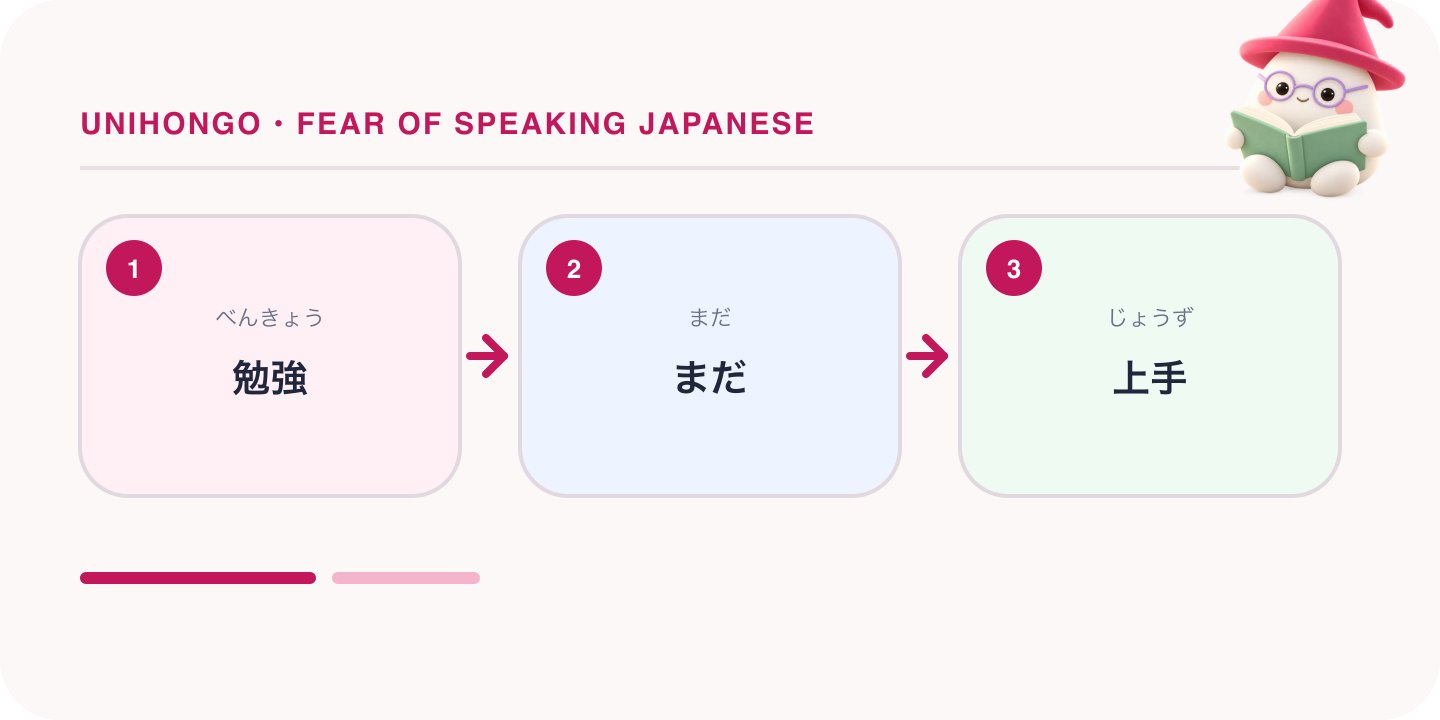
The exposure ladder: from speaking alone to real conversations
Confidence is built by taking small steps that are slightly uncomfortable and repeating them until they are not. The first rung is speaking alone: describe what you are doing, read a dialogue aloud, or explain your day to the kettle. Nobody is listening, so the only barrier is the odd feeling of hearing your own Japanese. Stay here until that feeling fades, which usually takes a few days.
The second rung is speaking with an AI tutor that never gets impatient. You can repeat a question five times, ask for simpler Japanese, or stop mid-sentence and start again, and the cost of failure is zero. The third rung is short, predictable exchanges with staff in shops, cafés, and stations. The fourth is conversations with people who might ask anything. Move up when the current rung feels only mildly uncomfortable, and move down for a day whenever a step goes badly.
Scripts for the first ten seconds
The hardest part of any exchange is the opening, so prepare it in advance. A memorised first line removes the translation step at the moment when anxiety is highest, and it signals that you are a learner making an effort, which changes how people speak to you. Choose one opener for each rung, practise it aloud until it is automatic, and use the same one every time.
- To yourself: Kyou wa nani o shita ka na. Then answer in three short sentences.
- To an AI tutor: Konnichiwa. Kyou wa kafe no kaiwa o renshuu shitai desu. Yukkuri hanashite kudasai.
- In a shop: Sumimasen, kore wa arimasu ka. Point if you need to; pointing is not a failure.
- At a café: Kohi o hitotsu onegaishimasu. Add mochikaeri de if you are taking it away.
- To a new acquaintance: Hajimemashite. Nihongo o benkyouchuu desu. Yoroshiku onegaishimasu.
- When you are lost: Sumimasen, eki wa doko desu ka. Then repeat the answer back as a question.
Each script ends with something the other person can respond to, which is deliberate. An opener that invites a predictable reply keeps you inside a pattern you have rehearsed, and predictable replies are where confidence grows.
How to handle not understanding the reply
Not understanding is not a failure; it is a normal part of every conversation in a second language. What matters is having a plan. The moment you lose the thread, say so immediately in Japanese instead of nodding. Mou ichido onegaishimasu asks for repetition, and yukkuri hanashite moraemasu ka asks for slower speech. Most people will simplify without being asked twice, and the exchange continues.
Then confirm what you think you heard. Repeating a key word with rising intonation, such as ashita desu ka, lets the other person correct you cheaply. If you still cannot follow, an honest sumimasen, wakarimasen deshita closes the topic without embarrassment and often prompts a gesture or a written note. Practise these rescue moves with an AI tutor by asking it to speak too fast on purpose, so that using them becomes a reflex.
Confidence-saving phrases to keep ready
These sentences buy you time, lower the other person's expectations kindly, and keep the conversation alive when your Japanese runs out. Say each one aloud until you can produce it while nervous, because that is when you will need it.
| Japanese | Romaji | Meaning |
|---|---|---|
| 日本語を勉強中です。 | Nihongo o benkyōchū desu. | I am studying Japanese. |
| まだ上手じゃないですが、頑張ります。 | Mada jōzu ja nai desu ga, ganbarimasu. | I am not good yet, but I will do my best. |
| ゆっくり話してもらえますか。 | Yukkuri hanashite moraemasu ka. | Could you speak slowly, please? |
| もう一度お願いします。 | Mō ichido onegaishimasu. | Once more, please. |
| 〜と言いたいんですが。 | ... to iitai n desu ga. | I want to say ... (asking for the word). |
| すみません、わかりませんでした。 | Sumimasen, wakarimasen deshita. | Sorry, I did not understand. |
| 日本語で何と言いますか。 | Nihongo de nan to iimasu ka. | How do you say it in Japanese? |
Reframing mistakes so they stop costing you courage
Perfectionism survives on a false idea: that a mistake is evidence of failure. In speaking practice, a mistake is evidence that you attempted something beyond your current level, which is the only place learning happens. Try counting attempts rather than errors. A day with ten imperfect sentences spoken to real people beats a day with no sentences and no mistakes, and keeping that tally makes the comparison visible.
It also helps to collect the reactions you actually receive. Most learners expect impatience and get patience, expect laughter and get help. Write down what happened after each exchange in plain terms: 'asked for a bag, got a bag, staff smiled.' Over a few weeks that record becomes stronger than the fear, because it is made of real events rather than imagined ones. Session reports from an AI tutor serve the same purpose, showing corrections as information instead of verdicts.
A 21-day confidence plan
Three weeks is long enough to move up two rungs of the ladder if you practise daily for ten minutes. The plan below gives each week one goal, a daily task, and a concrete sign that you are ready to move on. If the success sign does not appear, repeat the week; there is no penalty for climbing slowly.
| Week | Goal | Daily practice | Success sign |
|---|---|---|---|
| Week 1 | Hear your own voice without flinching | Five minutes describing your day aloud, then a short AI tutor conversation with a prepared opener | You can finish a three-turn exchange with the tutor without stopping to translate |
| Week 2 | Survive not understanding | Ask the AI tutor to speak fast, use two rescue phrases, then say one sentence to shop or café staff | You used mou ichido onegaishimasu with a real person and the conversation continued |
| Week 3 | Hold a short real conversation | Rehearse with the tutor first, then hold one two-minute conversation with a person on a simple topic | You answered an unplanned question and nobody, including you, needed to switch to English |
Unihongo's roleplay missions, from café orders to hotel check-ins, and its live conversations with an AI Sensei are built for the middle rungs of this ladder. Human conversation partners and teachers remain the goal and the best test. The plan simply makes sure that by the time you face a person, you have already spoken every phrase you need many times.