
The four lines of making up
A reconciliation in Japanese often follows the same arc: someone admits the fight, someone owns their part, the other person shares the blame, and both agree to move on. These four lines carry that arc.
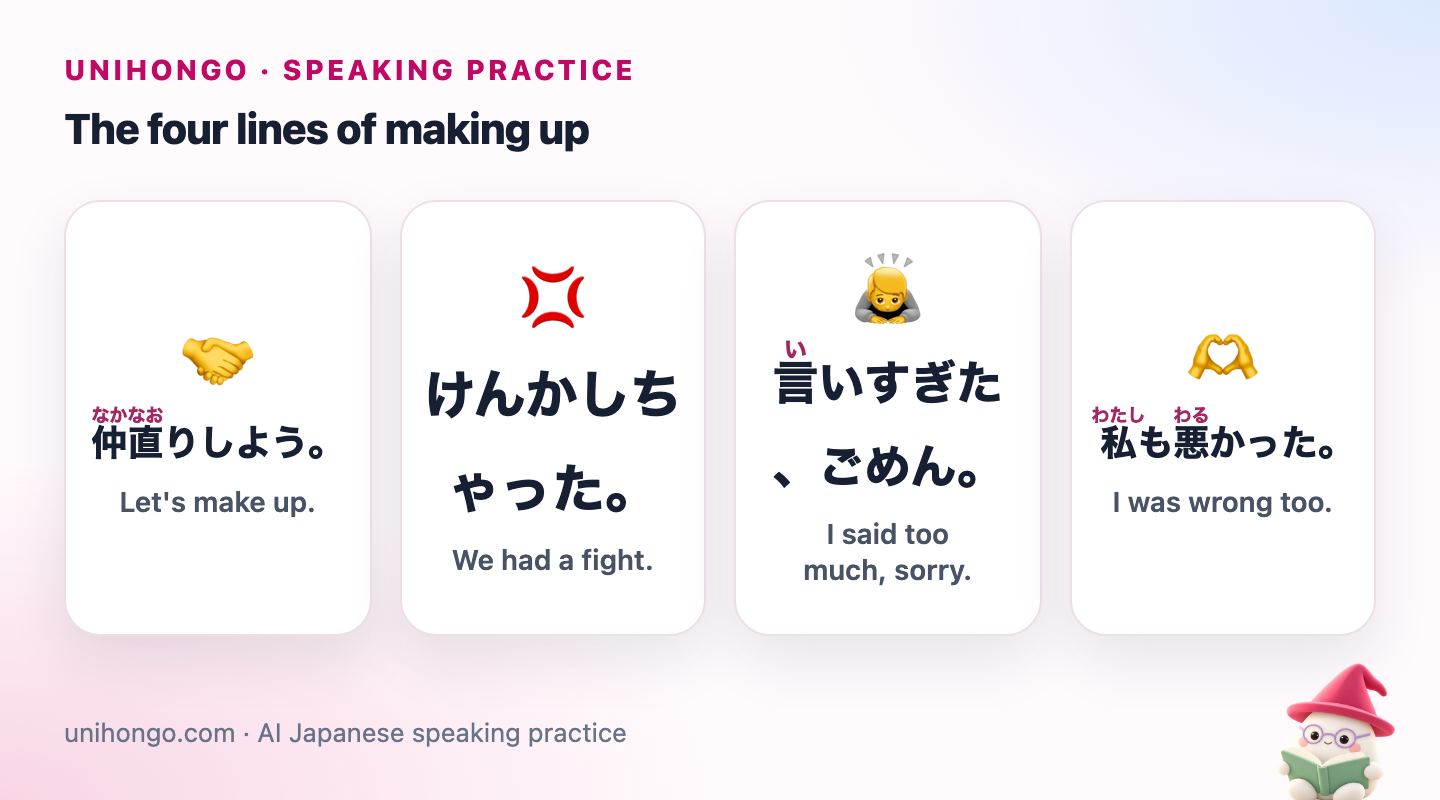
| Japanese | Romaji | Meaning |
|---|---|---|
| 仲直りしよう。 | Nakanaori shiyō. | Let's make up. |
| けんかしちゃった。 | Kenka shichatta. | We had a fight. |
| 言いすぎた、ごめん。 | Iisugita, gomen. | I said too much, sorry. |
| 私も悪かった。 | Watashi mo warukatta. | I was wrong too. |
Kenka: talking about the fight
Kenka is the everyday word for any fight, from a shouting match to a sulky afternoon of silence. Kenka shichatta, with the casual chau ending, adds a sense of regret: we ended up fighting. Kenka-chū means you are still in the middle of one.
Messaging apps add their own vocabulary. Kidoku mushi (既読無視) means leaving a message read but unanswered, which many people treat as a sign that someone is upset.
| Japanese | Romaji | Meaning |
|---|---|---|
| 彼氏とけんかしちゃった。 | Kareshi to kenka shichatta. | I had a fight with my boyfriend. |
| 今、けんか中なんだ。 | Ima, kenkachū na n da. | We're fighting right now. |
| まだ怒ってるみたい。 | Mada okotteru mitai. | It seems she's still angry. |
| 既読無視されてる。 | Kidoku mushi sareteru. | He's reading my messages and not replying. |
Apologies, from light to heartfelt
Among friends, the core word is gomen. Its strength depends on what you add to it and how you say it. Sumimasen sounds oddly formal between close friends, and the very formal mōshiwake nai is sometimes used between male friends, either playfully or to sound especially serious.
| Japanese | Romaji | Meaning |
|---|---|---|
| 本当にごめん。 | Hontō ni gomen. | I'm really sorry. |
| ひどいこと言ってごめんね。 | Hidoi koto itte gomen ne. | Sorry for saying something mean. |
| ちゃんと話を聞かなくてごめん。 | Chanto hanashi o kikanakute gomen. | Sorry for not really listening. |
| 俺が悪かった。 | Ore ga warukatta. | It was my fault. (male, casual) |
| Apology | Strength | Typical use |
|---|---|---|
| gomen | Light | Small things; also part of bigger apologies |
| gomen ne | Soft and warm | Friends, partners, family |
| hontō ni gomen | Strong | When you really hurt someone |
| gomennasai | Clear and sincere | Family, friends, children to parents |
| warukatta | Owning it: my bad | Friends, often male speakers |
The ~te gomen pattern (sorry for doing) and ~nakute gomen (sorry for not doing) make your apology specific, and specific apologies are taken more seriously than a bare gomen.
Sending the first message
Many reconciliations start with a short message. Keep it brief: an apology and an opening, not a long defence. Explaining at length why you were right usually restarts the argument, and a datte excuse at this point can undo the apology.
| Japanese | Romaji | Meaning |
|---|---|---|
| 昨日はごめん。言いすぎた。 | Kinō wa gomen. Iisugita. | Sorry about yesterday. I said too much. |
| ちょっと話せる? | Chotto hanaseru? | Can we talk for a bit? |
| 会って話したい。 | Atte hanashitai. | I'd like to talk in person. |
| 落ち着いたら連絡してね。 | Ochitsuitara renraku shite ne. | Get in touch when you've calmed down. |
Accepting an apology, and the tricky mō ii yo
When someone apologises to you, the warm replies are ki ni shitenai yo (I'm not upset about it) and daijōbu da yo (it's okay). Sharing the blame with watashi mo warukatta or otagaisama da yo (we were both at fault) is often what turns an apology into a real reconciliation.
Mō ii yo deserves a warning. Said softly with a smile, it means it's fine now, let's drop it. Said flatly, or with the speaker turning away, it means forget it, I'm done. Learners sometimes hear the words and relax when the conversation is actually getting worse. Listen to the voice, and if you are not sure, ask.
| Japanese | Romaji | Meaning |
|---|---|---|
| 気にしてないよ。 | Ki ni shitenai yo. | I'm not upset about it. |
| お互いさまだよ。 | Otagaisama da yo. | We were both at fault. |
| もういいよ。 | Mō ii yo. | It's fine now. / Forget it. (tone decides) |
| まだ怒ってる? | Mada okotteru? | Are you still angry? |
Scenario: meeting up to make peace
Yesterday you and your friend Haruka argued about a trip plan, and you said something harsh. You messaged, she agreed to meet, and now you are at the park near the station with two cans of her favourite tea.
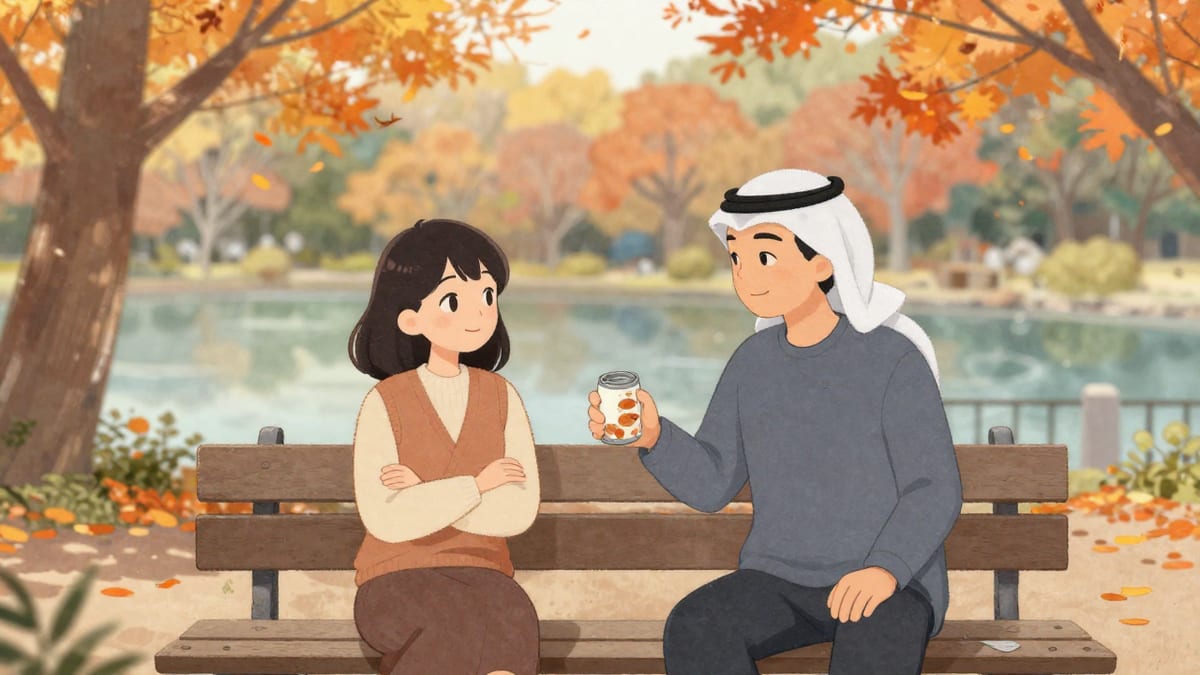
| Japanese | Romaji | Meaning |
|---|---|---|
| 昨日は本当にごめん。言いすぎた。 | Kinō wa hontō ni gomen. Iisugita. | You: I'm really sorry about yesterday. I said too much. |
| ううん、私も悪かった。 | Uun, watashi mo warukatta. | Haruka: No, I was wrong too. |
| ハルカの気持ち、ちゃんと考えてなかった。 | Haruka no kimochi, chanto kangaetenakatta. | You: I didn't really think about how you felt. |
| もう気にしてないよ。 | Mō ki ni shitenai yo. | Haruka: I'm not upset anymore. |
| じゃあ、仲直りしよう。はい、これ。 | Jā, nakanaori shiyō. Hai, kore. | You: Then let's make up. Here, this is for you. |
| ありがとう。旅行の計画、もう一回立てよう。 | Arigatō. Ryokō no keikaku, mō ikkai tateyō. | Haruka: Thanks. Let's plan the trip again. |
Uun (ううん) is a casual no, used here to brush off the apology. A small gesture, such as a drink, a snack, or an invitation for ramen, often seals the peace without more words, though customs differ between friends and families.
Asking for advice and sharing the good news
Fights are rarely private for long. You may want to ask another friend what to do, and once it is over, mutual friends will want to know whether everything is fine. Jitsu wa, actually, is a natural way to bring the subject up, and the ~chatte form (kenka shichatte) leaves the sentence open, inviting the listener to respond.
When you ask for advice, dō sureba ii to omou?, what do you think I should do?, is the standard question. When it is over, nakanaori dekita? and nakanaori shita! are the lines you will hear and say. Keep the details light when you talk to third parties: Japanese friends often prefer not to hear one side of the story in detail, especially when they know both people.
| Japanese | Romaji | Meaning |
|---|---|---|
| 実は、ユミとけんかしちゃって。 | Jitsu wa, Yumi to kenka shichatte. | Actually, I had a fight with Yumi. |
| どうすればいいと思う? | Dō sureba ii to omou? | What do you think I should do? |
| 先に謝ったほうがいいよ。 | Saki ni ayamatta hō ga ii yo. | Friend: You should apologise first. |
| 仲直りできた? | Nakanaori dekita? | Friend: Did you two make up? |
| うん、仲直りした! | Un, nakanaori shita! | Yes, we made up! |
Mistakes that keep the fight going
Couples use the same words, often more softly: gomen ne, and for the very sweet or very guilty, yurushite (forgive me) with a pleading face. In a workplace, though, none of this applies: apologies to colleagues and customers use polite forms and a different set of phrases.
- Apologising with datte: sorry, but... turns the apology into an argument.
- Using sumimasen with a close friend: it sounds distant, as if the friendship has cooled.
- Taking a flat mō ii yo as forgiveness: check with mada okotteru?
- A bare gomen for something serious: add what you are sorry for with ~te gomen.
- Pressing for an immediate answer: ochitsuitara renraku shite gives space and keeps the door open.