
The first month in three sentences
Three things to be able to say in your first week, before any grammar: that you want to speak Japanese, that English is not necessary, and that you would like to be corrected. Said early, they set the terms of every friendship you will make. Said in Japanese, they prove you mean it.
| Japanese | Romaji | Meaning |
|---|---|---|
| 日本語で話したいです。 | Nihongo de hanashitai desu. | I want to talk in Japanese. |
| 英語じゃなくて大丈夫です。 | Eigo ja nakute daijōbu desu. | You don't need to use English with me. |
| 間違えたら、直してください。 | Machigaetara, naoshite kudasai. | If I make a mistake, please correct me. |
Orientation week: who you are and what you need
The first days are introductions and forms. You will say what you are and where you live dozens of times, to staff, classmates and the dorm manager, so make those sentences automatic. The four cards below are the ones you will use most; the vocabulary that follows is what the forms and the staff will use.
Two visits sit outside the campus. Within a set period after moving in, commonly fourteen days, foreign residents register their address at the city or ward office; at the same visit most students join the national health insurance scheme. Your international office will tell you exactly what to bring; the words below let you follow what is said at the counter.
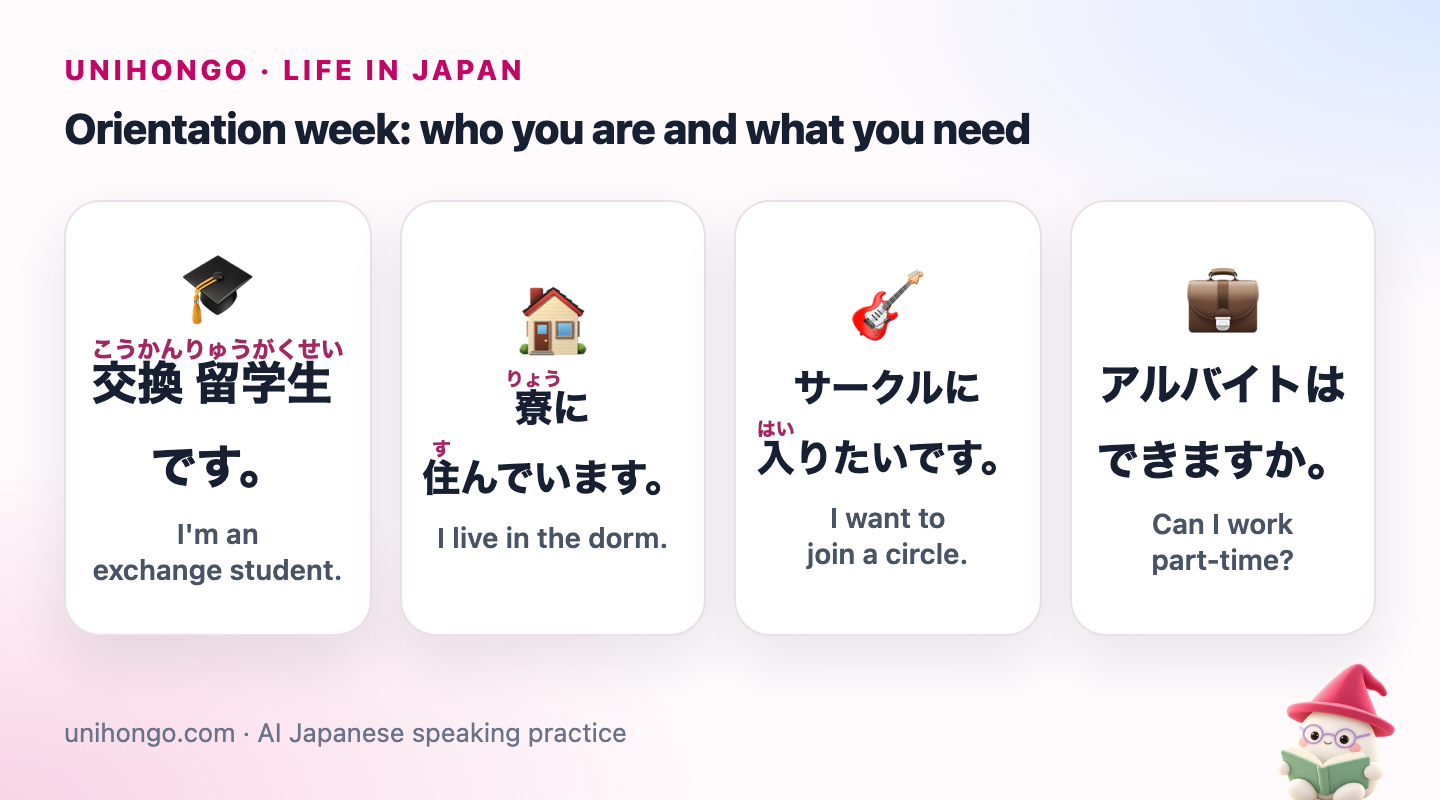
| Japanese | Romaji | Meaning |
|---|---|---|
| 交換留学生です。 | Kōkan ryūgakusei desu. | I'm an exchange student. |
| 寮に住んでいます。 | Ryō ni sunde imasu. | I live in the dorm. |
| サークルに入りたいです。 | Sākuru ni hairitai desu. | I want to join a circle. |
| アルバイトはできますか。 | Arubaito wa dekimasu ka. | Can I work part-time? |
| 履修登録 | rishū tōroku | course registration |
| 学生証 | gakuseishō | student ID card |
| 在留カード | zairyū kādo | residence card |
| 住民登録 | jūmin tōroku | resident registration at city hall |
| 国民健康保険 | kokumin kenkō hoken | national health insurance |
| 留学生センター | ryūgakusei sentā | international student centre |
Dorm life: the words on the kitchen wall
A Japanese student dorm, ryō, runs on a handful of rules that everyone is expected to know: which day each kind of rubbish goes out, whether there is a curfew, how the shared kitchen and laundry are used, and when quiet hours begin. The dorm manager, often called ryōchō or kanrinin, is the person to ask, and asking in Japanese on day one is the best first impression you can make. Rubbish sorting is taken seriously everywhere in Japan; the categories differ by city, so ask rather than guess.
| Japanese | Romaji | Meaning |
|---|---|---|
| ゴミの日はいつですか。 | Gomi no hi wa itsu desu ka. | When are the rubbish days? |
| 燃えるゴミは月曜日と木曜日です。 | Moeru gomi wa getsuyōbi to mokuyōbi desu. | Manager: Burnable rubbish is Monday and Thursday. |
| 門限はありますか。 | Mongen wa arimasu ka. | Is there a curfew? |
| 洗濯機、今使ってますか。 | Sentakuki, ima tsukattemasu ka. | Are you using the washing machine right now? (casual) |
| 冷蔵庫のこれ、誰のですか。 | Reizōko no kore, dare no desu ka. | Whose is this in the fridge? |
| 夜十時以降は静かにしてください。 | Yoru jūji ikō wa shizuka ni shite kudasai. | Manager: Please be quiet after ten at night. |
| すみません、鍵を忘れました。 | Sumimasen, kagi o wasuremashita. | Sorry, I forgot my key. |
Tsukattemasu is the spoken contraction of tsukatte imasu; dropping the i is normal in casual and even polite everyday speech. You will hear it constantly in the dorm.
Circles and clubs: how recruitment works and how to join
Japanese campus life happens in groups. A bukatsu is a club, usually official and fairly serious; a sākuru is a circle, student-run and often relaxed, covering everything from tennis to tea ceremony to international exchange. Recruitment, called shinkan, peaks in April with stalls, flyers and welcome parties, but most groups take members all year, and autumn arrivals are usually welcome if they ask. The normal first step is kengaku, watching a session, and the normal first question is whether a beginner is all right.
Circles are also where friendships form, because you see the same people every week doing something that is not studying. If you want Japanese friends, join one circle that has few other exchange students in it.
| Japanese | Romaji | Meaning |
|---|---|---|
| 見学してもいいですか。 | Kengaku shite mo ii desu ka. | May I come and watch? |
| 初心者でも大丈夫ですか。 | Shoshinsha demo daijōbu desu ka. | Is it okay for a beginner? |
| 活動は週に何回ですか。 | Katsudō wa shū ni nankai desu ka. | How many times a week do you meet? |
| もちろん!来週の水曜日、来てね。 | Mochiron! Raishū no suiyōbi, kite ne. | Member: Of course! Come next Wednesday. (casual) |
| 新歓コンパ | shinkan konpa | welcome party for new members |
| 部費はいくらですか。 | Buhi wa ikura desu ka. | How much are the club fees? |
| よろしくお願いします。 | Yoroshiku onegai shimasu. | I look forward to joining you. |
Part-time work: the rules to check before you start
Many exchange students work part-time, arubaito or baito, in cafés, convenience stores, language schools and tutoring. Before you start, check two things with your international office and official sources. First, whether you need permission for activities outside your visa status, commonly called shikakugai katsudō kyoka; students on a student visa generally do. Second, the weekly hours limit, commonly stated as twenty-eight hours during term and more during long vacations. Rules depend on your status and change over time, so treat this paragraph as a reason to ask, not as the answer.
At the job itself, the first conversation is the interview, which for a student job is brief and friendly. Being able to state your permission and your availability in Japanese often matters more than fluency.
| Japanese | Romaji | Meaning |
|---|---|---|
| 資格外活動許可を持っています。 | Shikakugai katsudō kyoka o motte imasu. | I have the permit to work outside my visa status. |
| 週に二十八時間までです。 | Shū ni nijūhachi jikan made desu. | It's up to twenty-eight hours a week. |
| 週に三日働けます。 | Shū ni mikka hatarakemasu. | I can work three days a week. |
| 平日の夜と土曜日が空いています。 | Heijitsu no yoru to doyōbi ga aite imasu. | I'm free on weekday evenings and Saturdays. |
| 時給はいくらですか。 | Jikyū wa ikura desu ka. | What is the hourly wage? |
| いつから働けますか。 | Itsu kara hatarakemasu ka. | Manager: When can you start? |
Jikyū is the hourly wage; minimum wages are set by prefecture and change yearly, so compare offers locally rather than against what friends elsewhere earn.
Making friends who keep speaking Japanese
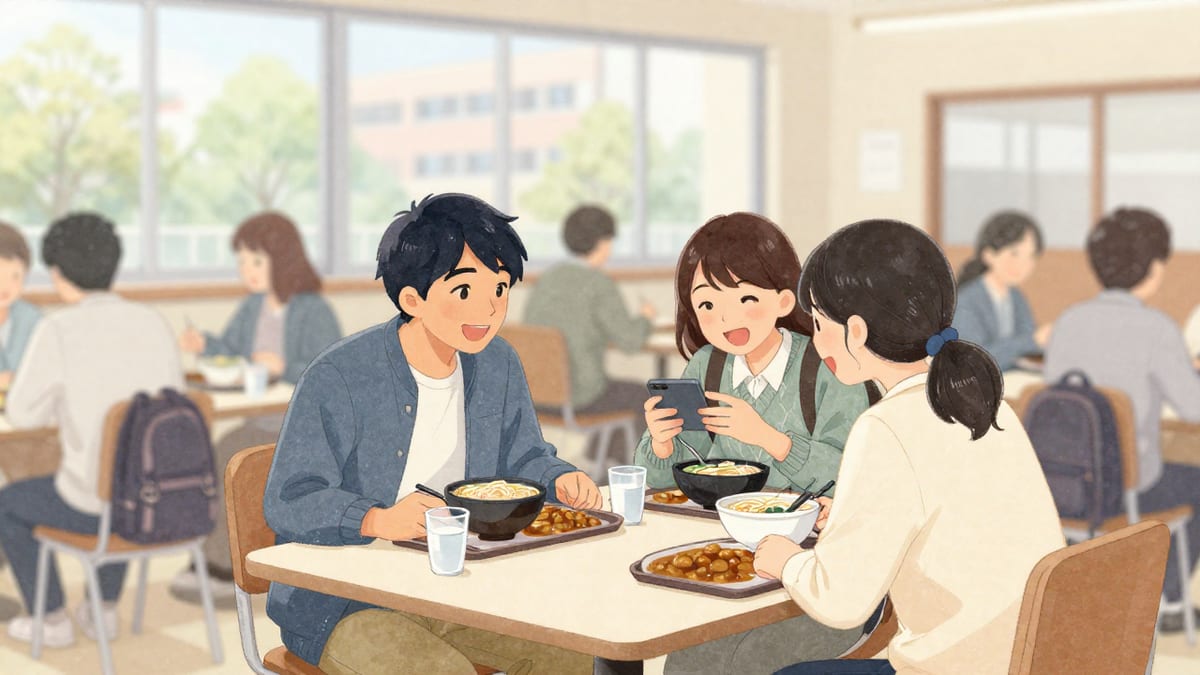
Here is why classmates switch to English: they are being kind, they want to practise too, and your pause looked like distress. All three are solved by saying, in Japanese, what you want. Explain that you came to practise Japanese and ask whether you can speak Japanese together. Then make it fair: offer to help with their English on another day or for the last ten minutes. Finally, remove the trigger for switching: when you are lost, ask them to repeat or to say it more simply, in Japanese, so that the conversation never leaves the language.
The second half of the trick is to be easy to talk to. Ask questions, react, use the casual forms your friends use, and suggest the next meeting yourself. Exchanging contacts on a messaging app usually happens in the first conversation, and the phrase for it is below.
| Japanese | Romaji | Meaning |
|---|---|---|
| 日本語を練習したいので、日本語で話してもいいですか。 | Nihongo o renshū shitai node, Nihongo de hanashite mo ii desu ka. | I want to practise Japanese, so is it okay if we speak Japanese? |
| 英語の勉強も手伝うよ。 | Eigo no benkyō mo tetsudau yo. | I'll help with your English too. (casual) |
| ゆっくり言ってもらえる? | Yukkuri itte moraeru? | Could you say that slowly? (casual) |
| もっと簡単に言うと? | Motto kantan ni iu to? | How would you say that more simply? (casual) |
| 今度一緒にお昼食べない? | Kondo issho ni ohiru tabenai? | Want to have lunch together sometime? (casual) |
| LINE交換しない? | Rain kōkan shinai? | Shall we exchange LINE contacts? (casual) |
| いいね、しよう! | Ii ne, shiyō! | Friend: Sure, let's! |
The negative question, tabenai? or shinai?, is the standard casual invitation among students: literally won't you eat?, in effect shall we? It sounds far more natural than tabemashō ka at a cafeteria table.
Mistakes that build the English bubble
- Sitting with students from your own country at every meal. Eat with your circle or your Japanese classmates at least half the time.
- Letting the buddy programme do the talking. Buddies are a start; ask yours to introduce you to their friends, in Japanese.
- Switching to English yourself at the first pause. Ask for a repeat or a simpler version instead; the pause is normal.
- Using only polite forms with classmates. Students speak casually; if you do not, you sound like a visitor, and they will treat you like one.
- Skipping the circle because you are not good at the activity. You are joining for the people; being a beginner is the best conversation starter there is.
- Treating the first month as settling in. It is the month when habits are set; the Japanese you speak now is the Japanese you will speak all year.