
Service Japanese is a script, not a conversation
The polite Japanese you learned in class is flexible: you choose words to suit a situation. Service Japanese works the other way round. Each moment of a transaction has one accepted line, and staff deliver it whether the shop is empty or queued to the door. Customers recognise the script and rarely respond to most of it, which means a mistake in wording is far more noticeable than a mistake in tone.
Two grammar habits drive the whole register. Your own actions become humble: oazukari shimasu rather than uketorimasu, mairimasu rather than ikimasu, itashimasu rather than shimasu. The customer's actions become honorific: omeshiagari, okimari, ossharu, omochi. On top of that, desu becomes de gozaimasu and shimasu becomes itashimasu. The keigo guide on this blog covers the underlying system; here you only need the fixed output.
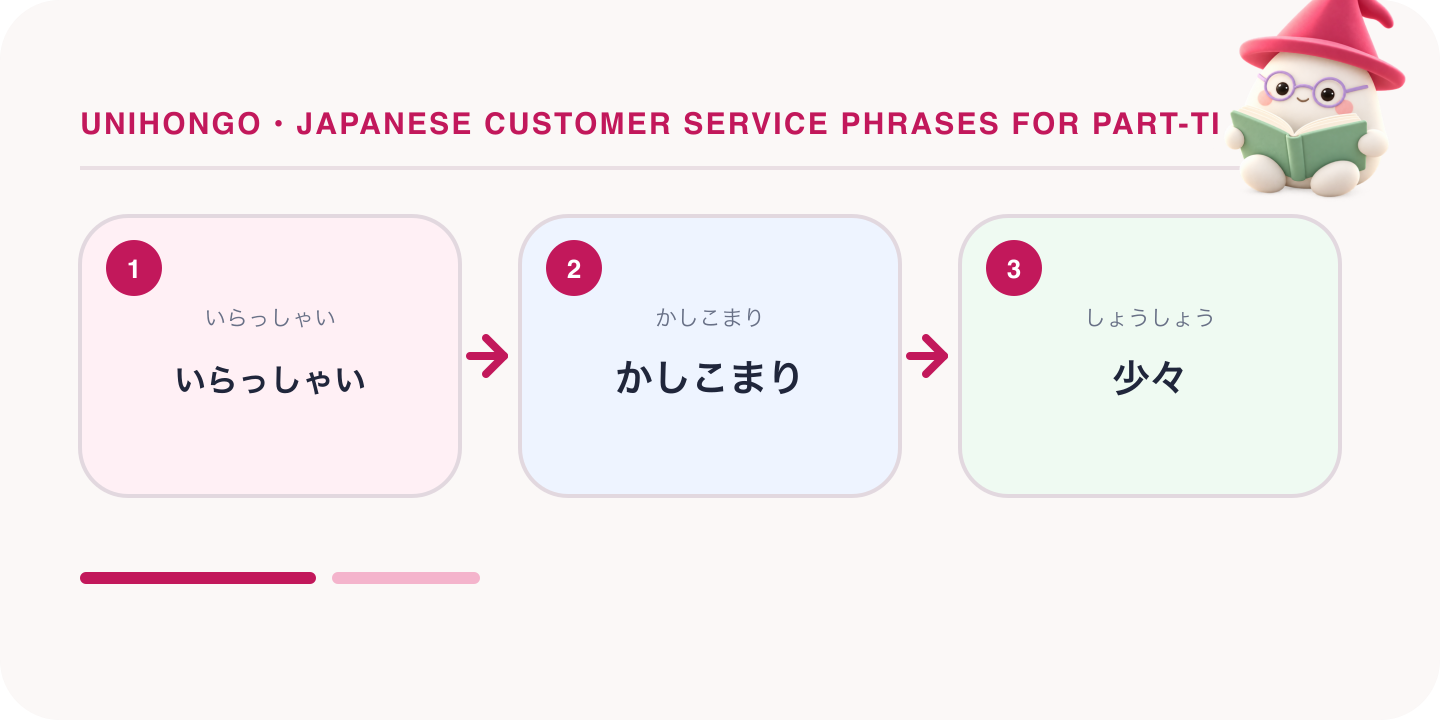
- Say the line at normal volume and normal speed; muttering it sounds unwilling rather than modest.
- Never soften the script with casual endings such as ne or yo when speaking to a customer.
- Use kochira and sochira instead of kore and sore when pointing at goods or a card reader.
- Bow lightly with the phrase rather than after it, so the two arrive together.
The seven phrases that carry a whole shift
| Japanese | Romaji | Meaning |
|---|---|---|
| いらっしゃいませ。 | Irasshaimase. | Welcome. (said to anyone entering) |
| かしこまりました。 | Kashikomarimashita. | Certainly. (accepting a customer's request) |
| 少々お待ちください。 | Shōshō omachi kudasai. | Please wait a moment. |
| お待たせいたしました。 | Omatase itashimashita. | Thank you for waiting. |
| 恐れ入りますが、こちらへどうぞ。 | Osoreirimasu ga, kochira e dōzo. | Excuse me, this way please. |
| 申し訳ございません。 | Mōshiwake gozaimasen. | I am very sorry. |
| ありがとうございました。 | Arigatō gozaimashita. | Thank you very much. (as they leave) |
Kashikomarimashita is the service version of wakarimashita and is used only downward in the service direction, from staff to customer. Osoreirimasu is the softener that opens anything you ask of a customer, from moving along the counter to producing a receipt. Arigatō gozaimashita takes the past form because the transaction is finished; using arigatō gozaimasu at the door instead is not an error, but the past form is what most manuals teach.
The convenience store script from door to farewell
Here is the whole sequence in the order it happens at a register. Read it top to bottom rather than picking phrases out; the value is in the running order, because knowing what comes next removes most of the panic. Amounts are examples, so swap in whatever your till shows.
| Japanese | Romaji | Meaning |
|---|---|---|
| いらっしゃいませ。 | Irasshaimase. | Welcome. |
| こちらのレジへどうぞ。 | Kochira no reji e dōzo. | Come to this register, please. |
| お弁当は温めますか? | Obentō wa atatamemasu ka? | Would you like the bento heated? |
| お箸はお付けしますか? | Ohashi wa otsuke shimasu ka? | Shall I add chopsticks? |
| レジ袋は有料ですが、お付けしますか? | Rejibukuro wa yūryō desu ga, otsuke shimasu ka? | Bags are chargeable. Would you like one? |
| ポイントカードはお持ちでしょうか? | Pointo kādo wa omochi deshō ka? | Do you have a point card? |
| お会計は1,200円でございます。 | Okaikei wa sen nihyaku en de gozaimasu. | That comes to 1,200 yen. |
| お支払い方法はいかがなさいますか? | Oshiharai hōhō wa ikaga nasaimasu ka? | How would you like to pay? |
| カードをお預かりします。 | Kādo o oazukari shimasu. | I will take your card. |
| こちらにタッチをお願いいたします。 | Kochira ni tatchi o onegai itashimasu. | Please tap here. |
| 2,000円お預かりします。 | Nisen en oazukari shimasu. | Taking 2,000 yen. |
| 800円のお返しでございます。 | Happyaku en no okaeshi de gozaimasu. | Here is 800 yen change. |
| レシートはご利用でしょうか? | Reshīto wa goriyō deshō ka? | Would you like your receipt? |
| ありがとうございました。またお越しくださいませ。 | Arigatō gozaimashita. Mata okoshi kudasaimase. | Thank you very much. Please come again. |
Notice how many steps are yes-or-no questions. That is deliberate: it keeps the exchange short and lets a customer answer with one word or a gesture. Two pairs should be chained without pausing, because customers expect them together: the heating question with the chopsticks question, and the total with the payment method.
What customers say back to you
The half of the job that catches learners out is the reply. Customers are not performing keigo, so they answer fast, quietly and in fragments. Daijōbu desu is the one that costs beginners money, because in a shop it almost always means no thank you rather than everything is fine.
| Japanese | Romaji | Meaning |
|---|---|---|
| お願いします。 | Onegai shimasu. | Yes, please. |
| 大丈夫です。 | Daijōbu desu. | No, I am fine. (usually a refusal) |
| 結構です。 | Kekkō desu. | No, thank you. |
| 袋、ください。 | Fukuro, kudasai. | A bag, please. |
| カードで。 | Kādo de. | By card. |
| 温めなくていいです。 | Atatamenakute ii desu. | No need to heat it. |
When a reply is ambiguous, confirm rather than assume, using the item plus de yoroshii deshō ka. Confirmation is expected in service Japanese and never reads as incompetence or as poor listening, whereas charging for a bag the customer just refused does, and it is the kind of small error a queue notices immediately.
The cafe version: ordering, sizes and handing over drinks
| Japanese | Romaji | Meaning |
|---|---|---|
| ご注文はお決まりでしょうか? | Gochūmon wa okimari deshō ka? | Are you ready to order? |
| 店内でお召し上がりですか、お持ち帰りですか? | Tennai de omeshiagari desu ka, omochikaeri desu ka? | Is it for here or to take away? |
| サイズはいかがなさいますか? | Saizu wa ikaga nasaimasu ka? | Which size would you like? |
| ご注文を繰り返します。 | Gochūmon o kurikaeshimasu. | Let me repeat your order. |
| 出来上がりましたらお呼びいたします。 | Dekiagarimashitara oyobi itashimasu. | I will call you when it is ready. |
| 熱いのでお気をつけください。 | Atsui node oki o tsuke kudasai. | Please be careful, it is hot. |
A cafe shift adds one skill the convenience store does not need: repeating an order back accurately. Say gochūmon o kurikaeshimasu, list the items with counters, then close with ijō de yoroshii deshō ka. Getting the counters right matters here, so the counters guide on this blog is worth a pass before your first weekend. When you call a finished drink, name the item rather than the person: kafe rate no okyakusama, omatase itashimashita.
Apologising for a wait
| Japanese | Romaji | Meaning |
|---|---|---|
| 大変お待たせいたしました。 | Taihen omatase itashimashita. | Thank you very much for waiting. |
| お待たせして申し訳ございません。 | Omatase shite mōshiwake gozaimasen. | I am sorry to have kept you waiting. |
| ただいま混み合っておりまして、五分ほどお時間をいただきます。 | Tadaima komiatte orimashite, go-fun hodo ojikan o itadakimasu. | We are busy at the moment, so it will take about five minutes. |
| 順番にご案内いたしますので、こちらでお待ちくださいませ。 | Junban ni goannai itashimasu node, kochira de omachi kudasaimase. | We will serve you in turn, so please wait here. |
The rule on a busy shift is to give a number. Shōshō omachi kudasai on its own buys about a minute of goodwill; naming five minutes buys five. If the wait then runs longer, go back to the customer before they come to you and say omatase shite orimasu, ato sū-fun de goannai itashimasu. Acknowledging the wait early is what stops it turning into a complaint.
When you cannot do what the customer asks
| Japanese | Romaji | Meaning |
|---|---|---|
| 申し訳ございません、ただいま切らしております。 | Mōshiwake gozaimasen, tadaima kirashite orimasu. | I am sorry, we are out of that at the moment. |
| あいにく、そちらは取り扱っておりません。 | Ainiku, sochira wa toriatsukatte orimasen. | Unfortunately we do not carry that. |
| 確認してまいりますので、少々お待ちいただけますか? | Kakunin shite mairimasu node, shōshō omachi itadakemasu ka? | I will go and check, so could you wait a moment? |
| 代わりにこちらはいかがでしょうか? | Kawari ni kochira wa ikaga deshō ka? | Would this work instead? |
| お力になれず、申し訳ございません。 | Ochikara ni narezu, mōshiwake gozaimasen. | I am sorry that I cannot help. |
A refusal in service Japanese has three moves: apologise, state the limit in a humble form, offer a next step. The verbs that carry the limit are kanemasu and orimasen, both of which sound softer than dekimasen. Taiō itashikanemasu means we are unable to do that and is the standard phrase for a request outside the rules. Never leave a refusal bare; ending on an alternative or on kakunin shite mairimasu keeps the exchange cooperative.
Asking a customer to repeat or slow down
| Japanese | Romaji | Meaning |
|---|---|---|
| 恐れ入りますが、もう一度おっしゃっていただけますか? | Osoreirimasu ga, mō ichido osshatte itadakemasu ka? | Excuse me, could you say that once more? |
| 申し訳ございません、聞き取れませんでした。 | Mōshiwake gozaimasen, kikitoremasen deshita. | I am sorry, I did not catch that. |
| もう少しゆっくりお話しいただけますでしょうか。 | Mō sukoshi yukkuri ohanashi itadakemasu deshō ka. | Could you speak a little more slowly? |
| こちらの商品でお間違いないでしょうか? | Kochira no shōhin de omachigai nai deshō ka? | Is this the right item? |
Ask early. A learner who nods through three unclear sentences and then has to unpick the order loses far more face than one who asks at the first unclear word. Kikitoremasen deshita is better than wakarimasen deshita because it blames the hearing rather than your Japanese, and it invites a repeat rather than an explanation.
Getting help and calling a manager
| Japanese | Romaji | Meaning |
|---|---|---|
| 店長を呼んでまいりますので、少々お待ちください。 | Tenchō o yonde mairimasu node, shōshō omachi kudasai. | I will fetch the manager, so please wait a moment. |
| 私では分かりかねますので、確認いたします。 | Watashi de wa wakarikanemasu node, kakunin itashimasu. | I am afraid I cannot say, so let me check. |
| すみません、レジをお願いできますか。 | Sumimasen, reji o onegai dekimasu ka. | Excuse me, could you take the register? |
| お客様がお呼びです。 | Okyakusama ga oyobi desu. | A customer is asking for you. |
Note the register change in the middle of that list. Lines aimed at the customer use mairimasu and itashimasu; the line aimed at your colleague uses plain polite sumimasen and onegai dekimasu ka. Staff do not use full service keigo with each other, and doing so sounds stiff. Escalate whenever money, refunds, alcohol or an angry customer is involved, and escalate before the customer asks you to.
Manual keigo: the forms staff are told to say
Part-time staff are trained in a set of phrases often called baito keigo. Several are criticised by style guides as over-polite or logically odd, yet they are what your manual will print and what colleagues will say beside you. Learn both columns: the manual version so you are not surprised, and the shorter version so you sound clean when a manager, an interviewer or a client is listening.
| Manual form you will hear | Cleaner form | What to do on shift |
|---|---|---|
| 1,000円になります Sen en ni narimasu | 1,000円でございます Sen en de gozaimasu | Both are used everywhere; de gozaimasu is safer in a formal shop |
| 1,000円からお預かりします Sen en kara oazukari shimasu | 1,000円お預かりします Sen en oazukari shimasu | Drop kara; nobody has ever objected to the shorter line |
| よろしかったでしょうか Yoroshikatta deshō ka | よろしいでしょうか Yoroshii deshō ka | Use the present tense while the order is still open |
| お会計のほう、お願いします Okaikei no hō, onegai shimasu | お会計をお願いいたします Okaikei o onegai itashimasu | Cut no hō; it softens nothing and adds noise |
| こちらメニューになります Kochira menyū ni narimasu | こちらがメニューでございます Kochira ga menyū de gozaimasu | Ni narimasu should describe a change, not an object |
The pattern behind the criticism is that ni narimasu describes something becoming something else, and yoroshikatta puts a present decision in the past. None of this will cost you a shift. It can cost you marks in a job interview, so keep the right-hand column ready for the day someone senior is standing behind you.
How to rehearse before your first shift
- Write the script on one card in the order above and keep it in your apron pocket for the first week.
- Say the whole sequence out loud five times a day, standing, with your hands doing the actions.
- Drill numbers separately: prices, change and counters are where fluent-sounding staff still stall.
- Record yourself saying irasshaimase ten times and keep the version that sounds open rather than apologetic.
- Shadow the staff at a shop you visit as a customer; two minutes of listening at a real counter beats a page of notes.
- Prepare one line about yourself for the moment a regular asks where you are from, so it does not derail the queue.