

The washlet panel, button by button
Washlet is a brand name that has become the general word for a toilet seat with a built-in bidet, and almost every hotel, office and newer home has one. The panel is either on the side of the seat or on the wall, and the buttons carry short kanji labels with pictograms. The two wash buttons are oshiri, rear wash, and bide, front wash; some panels add yawaraka, a softer rear spray. Tomeru, stop, is usually orange or red and is the button to locate before you press anything else. Kansō is the warm-air dryer.
Around the main buttons sit the adjustments. Suisei, water pressure, has plus and minus or tsuyoku and yowaku, stronger and weaker. Ichi is the nozzle position, mae and ushiro, forward and back. Onsui ondo sets the water temperature and benza ondo the seat temperature; setsuden is the power-saving mode.
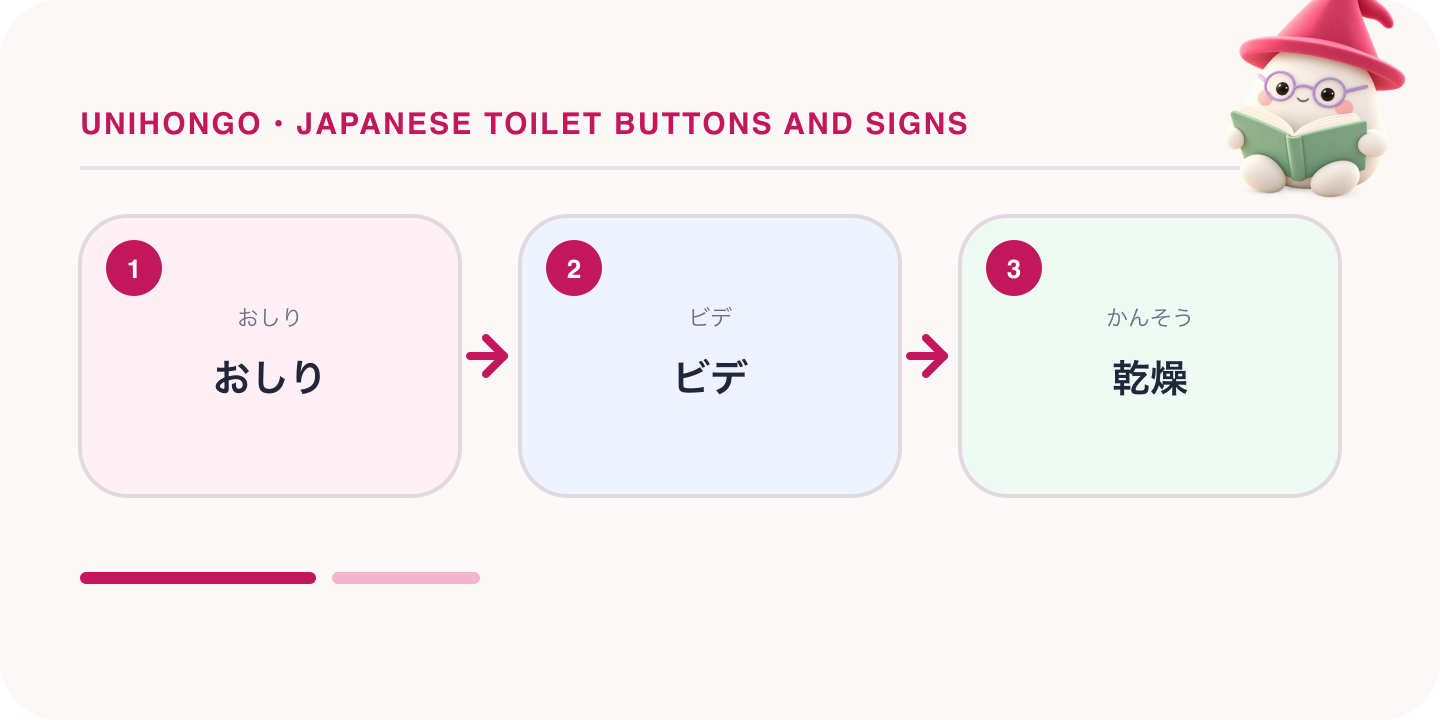
| Button | Reading | What it does |
|---|---|---|
| おしり | oshiri | rear wash |
| ビデ | bide | front wash |
| 止 | tomeru | stop |
| 乾燥 | kansō | warm-air dryer |
| 水勢 | suisei | water pressure |
| 位置 | ichi | nozzle position |
| 音 | oto | masking sound |
| 流す | nagasu | flush |
| 便座 | benza | seat (temperature) |
| 節電 | setsuden | power saving |
| 脱臭 | dasshū | deodoriser |
| ノズル掃除 | nōzuru sōji | nozzle cleaning |
Flushing: levers, buttons and sensors
Flushing is where visitors get stuck, because the flush is often not on the washlet panel at all. On a tank toilet, look for a lever on the side of the tank marked dai, big, and shō, small: turn it one way for a full flush and the other for a light one. On wall panels, nagasu is the flush button, again usually in a dai and shō pair, and sometimes with eko shō, an economy flush. In hotels and newer buildings, the flush may be a large round button on the wall at hand height.
Sensor flushes are increasingly common in stations, shopping centres and offices. A small panel on the wall reads te o kazasu, hold your hand over it, or has a hand icon; wave your hand a few centimetres from the sensor and the toilet flushes. Some toilets flush automatically when you stand up, which can be startling the first time. If nothing happens, look for a small manual button under the sensor marked nagasu or a lever hidden behind the seat.
| Japanese | Romaji | Meaning |
|---|---|---|
| 大と小、どちらで流せばいいですか。 | Dai to shō, dochira de nagaseba ii desu ka. | Should I flush with big or small? |
| 水が流れません。 | Mizu ga nagaremasen. | The toilet won't flush. |
| センサーに手をかざしてください。 | Sensā ni te o kazashite kudasai. | Please hold your hand over the sensor. |
| 立つと自動で流れます。 | Tatsu to jidō de nagaremasu. | It flushes automatically when you stand up. |
| 流すボタンはどこですか。 | Nagasu botan wa doko desu ka. | Where is the flush button? |
The sound button and other panel extras
Many toilets, especially in women's facilities, have a separate button or sensor for a masking sound, labelled oto, sound, or otohime, sound princess, which is a product name that became the general word. Pressing it plays a recording of running water for about twenty seconds, and pressing again stops it. It exists because people used to flush repeatedly to hide noise, which wasted water. Using it is normal.
Two other things near the panel can confuse. Hijōyō or yobidashi is an emergency call button, usually red and sometimes on a cord, that alerts staff; it is not a flush, and pressing it by mistake brings someone running. Koshō-chū on a taped-over panel means out of order. If the washlet panel is dark, look for a power button; in some homes the seat is switched off to save electricity.
| Japanese | Romaji | Meaning |
|---|---|---|
| 音姫を押すと水の音が流れます。 | Otohime o osu to mizu no oto ga nagaremasu. | Press otohime and a water sound plays. |
| すみません、間違えて呼び出しボタンを押しました。 | Sumimasen, machigaete yobidashi botan o oshimashita. | Sorry, I pressed the call button by mistake. |
| ウォシュレットが止まりません。 | Woshuretto ga tomarimasen. | The washlet won't stop. |
| このトイレは故障中です。 | Kono toire wa koshō-chū desu. | This toilet is out of order. |
| 便座が冷たいです。電源が入っていますか。 | Benza ga tsumetai desu. Dengen ga haitte imasu ka. | The seat is cold. Is the power on? |
Signs on and around the door
Public toilets are marked with pictograms almost everywhere, but the words matter when the pictograms are stylised or missing. Otearai and toire are the two general words on signs, and keshōshitsu, powder room, appears in department stores. Danshi or dansei is men, joshi or josei is women. Tamokuteki toire, multipurpose toilet, is the large accessible room with a changing table and space for a wheelchair; anyone with a real need may use it, but leave it free if an ordinary cubicle will do.
On cubicle doors, the lock shows a coloured tab or a word: shiyōchū, in use, usually red, and kūshitsu, vacant, usually green or blue. Yōshiki is a Western toilet and washiki a Japanese squat toilet, and a bank of cubicles often labels each door so you can choose. Seisō-chū means cleaning in progress, and staff will usually let you through if you ask.
| Sign | Reading | Meaning |
|---|---|---|
| お手洗い | otearai | toilet, polite general word |
| 男子 / 男性 | danshi / dansei | men |
| 女子 / 女性 | joshi / josei | women |
| 多目的トイレ | tamokuteki toire | multipurpose accessible toilet |
| 使用中 | shiyōchū | in use, occupied |
| 空室 | kūshitsu | vacant |
| 洋式 | yōshiki | Western-style seat toilet |
| 和式 | washiki | Japanese squat toilet |
| 清掃中 | seisō-chū | cleaning in progress |
| 故障中 | koshō-chū | out of order |
| 非常用 | hijōyō | emergency (call button) |
Squat toilets and where the paper goes
Washiki, the squat toilet, is disappearing but still common in older stations, parks, schools and some countryside restaurants. It is a porcelain trough set into the floor with a raised hood at one end. Face the hood, squat with your feet either side of the trough, and keep your weight forward. Trousers come down only to the knees. The flush is a lever on the pipe or a button on the wall, again often with dai and shō.
Paper goes into the toilet in almost all of Japan, because the paper is made to dissolve, and a sign often says so: toire pēpā igai wa nagasanaide kudasai, flush nothing but toilet paper. The small bin in the cubicle is for sanitary products, not for paper. The exception is a facility with a large bin and a sign asking you to put used paper in it; when that sign exists, follow it. Park and station toilets sometimes have no paper at all, which is why many people carry pocket tissues.
- Face the hood of a squat toilet, feet either side of the trough
- Flush paper unless a sign and bin tell you otherwise
- The small covered bin is for sanitary products only
- Carry pocket tissues; park and station toilets may have no paper
- Look for a hand dryer or bring a handkerchief; paper towels are rare
A hankachi, handkerchief, is a normal thing to carry, because hand dryers and paper towels are often missing.
Toilet slippers and home etiquette
In a Japanese home, a ryokan or a traditional restaurant, the toilet is its own zone. A pair of toire surippa, toilet slippers, often plastic and sometimes printed with a helpful label, waits inside the door. Step out of your house slippers, into the toilet slippers, and swap back when you leave. Walking back to the dining room in toilet slippers is the classic mistake, and your host will notice even if they are too polite to say so.
Other small points: lower the lid after use in a home, leave the slippers facing outward for the next person, and in a shared house, replace the paper if you finish a roll. If the toilet has a control panel, leave the settings as you found them.
| Japanese | Romaji | Meaning |
|---|---|---|
| トイレのスリッパに履き替えてください。 | Toire no surippa ni hakikaete kudasai. | Please change into the toilet slippers. |
| あ、スリッパのまま出てきてしまいました。 | A, surippa no mama dete kite shimaimashita. | Oh, I came out still wearing the slippers. |
| トイレットペーパーがなくなりました。 | Toiretto pēpā ga nakunarimashita. | The toilet paper has run out. |
| ふたは閉めたほうがいいですか。 | Futa wa shimeta hō ga ii desu ka. | Should I close the lid? |
| お手洗いをお借りしてもいいですか。 | Otearai o o-kari shite mo ii desu ka. | May I use your toilet? |
Toilets in stations, konbini and hotels
Station toilets are free and usually inside the ticket gates, so if you are outside, ask staff before buying a ticket; some stations let you through. Convenience stores in most areas let customers use the toilet, often with a sign asking you to tell staff first. A quick sumimasen, toire o karite mo ii desu ka is enough. Department stores and shopping centres have the cleanest public toilets, usually with washlets and a tamokuteki room.
Hotel toilets are almost always washlets, and the panel may be in English as well as Japanese. If the washlet runs or will not stop, press tomeru, then tell the front desk. If the flush is a sensor and does not respond, look for a manual button.
| Japanese | Romaji | Meaning |
|---|---|---|
| トイレをお借りしてもいいですか。 | Toire o o-kari shite mo ii desu ka. | May I use the toilet? |
| 改札の中にトイレはありますか。 | Kaisatsu no naka ni toire wa arimasu ka. | Is there a toilet inside the ticket gates? |
| 多目的トイレはどこですか。 | Tamokuteki toire wa doko desu ka. | Where is the accessible toilet? |
| トイレが詰まってしまいました。 | Toire ga tsumatte shimaimashita. | The toilet is blocked. |
| 部屋のウォシュレットが動きません。 | Heya no woshuretto ga ugokimasen. | The washlet in my room isn't working. |
Mistakes and how to recover
The three classic mistakes are pressing oshiri while standing beside the toilet, pressing the emergency call button instead of the flush, and walking out in toilet slippers. The first does nothing, because of the seat sensor, so there is no puddle to explain. The second brings a staff member; say sumimasen, machigaemashita, sorry, I made a mistake, and nothing more is needed. The third is fixed by turning round, swapping the slippers and laughing about it, which your host will do too.
Less obvious mistakes: flushing sanitary products, which blocks pipes; using the multipurpose toilet when an ordinary cubicle would do; and talking on the phone in a cubicle, which is frowned on. If a toilet is blocked, dirty or out of paper, tell staff rather than leaving quietly; they will thank you for the report.
| Japanese | Romaji | Meaning |
|---|---|---|
| すみません、間違えました。 | Sumimasen, machigaemashita. | Sorry, I made a mistake. |
| トイレの紙がありません。 | Toire no kami ga arimasen. | There is no toilet paper. |
| トイレが汚れています。 | Toire ga yogorete imasu. | The toilet is dirty. |
| 止めるボタンはどれですか。 | Tomeru botan wa dore desu ka. | Which is the stop button? |