
Four ways to say take your time
These four lines cover friends, colleagues, customers and anyone feeling pressure. Yukkuri de ii yo is the friendly take your time. Isoganakute ii desu yo is the polite no need to hurry. Goyukkuri dōzo is the staff and host phrase. Aseranaide is a gentle don't rush, for someone who is flustered.
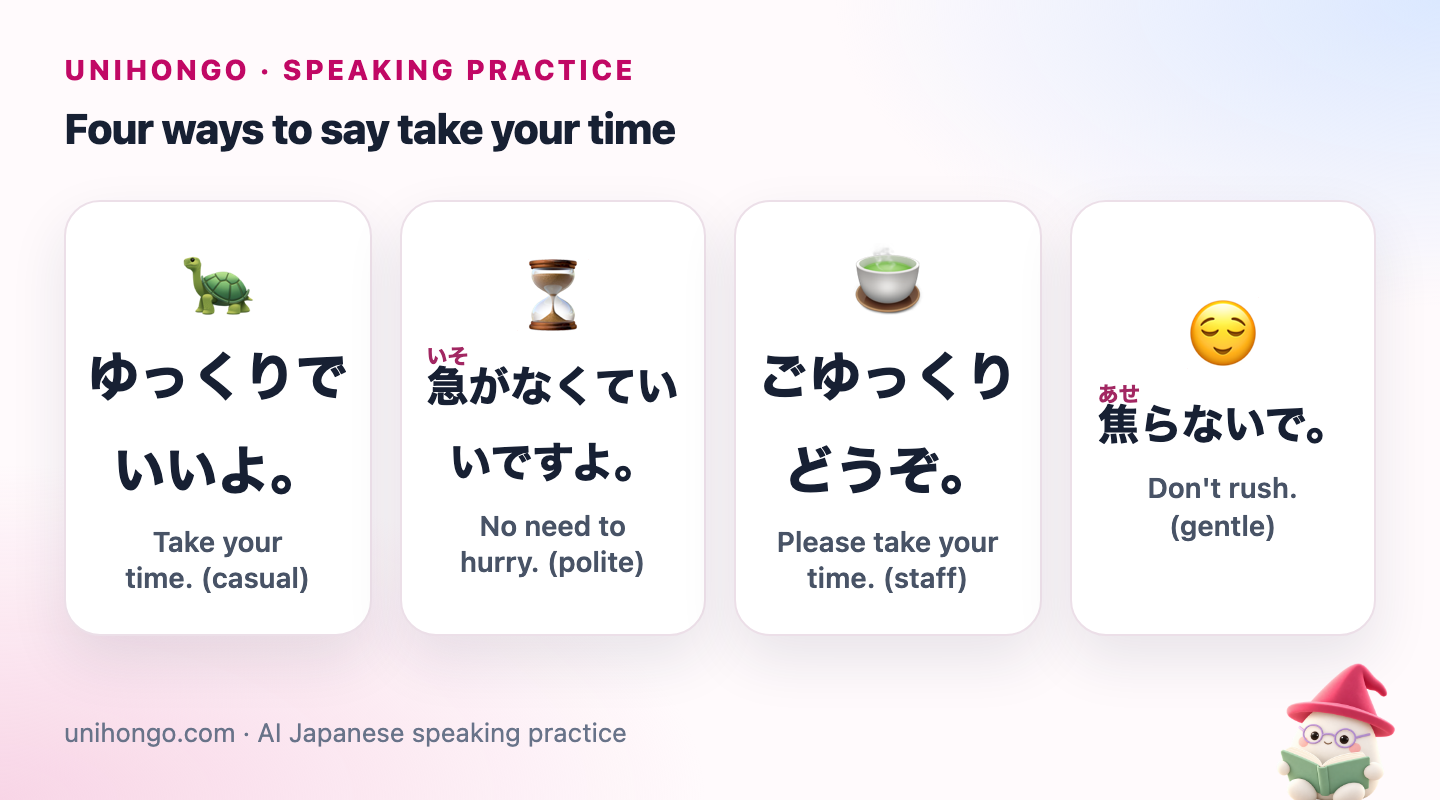
| Japanese | Romaji | Meaning |
|---|---|---|
| ゆっくりでいいよ。 | Yukkuri de ii yo. | Take your time. (casual) |
| 急がなくていいですよ。 | Isoganakute ii desu yo. | No need to hurry. (polite) |
| ごゆっくりどうぞ。 | Goyukkuri dōzo. | Please take your time. (staff) |
| 焦らないで。 | Aseranaide. | Don't rush. (gentle) |
All four take the pressure off, but in different ways: yukkuri praises a slow pace, isoganakute removes the deadline, goyukkuri offers hospitality, and aseranaide calms nerves.
Yukkuri de ii and isoganakute ii
Yukkuri means slowly or at leisure, and de ii means is fine: slowly is fine. It is warm and casual, and it suits friends, family, children and language-exchange partners. Isoganakute ii, you don't have to hurry, comes from isogu, to hurry. With desu yo it becomes a polite reassurance for colleagues or people you have just met. Daijōbu can replace ii: isoganakute daijōbu desu.
| Japanese | Romaji | Meaning |
|---|---|---|
| ゆっくりでいいですよ。 | Yukkuri de ii desu yo. | Take your time. (polite) |
| 急がなくて大丈夫です。 | Isoganakute daijōbu desu. | There's no rush. |
| 返事はいつでもいいよ。 | Henji wa itsu demo ii yo. | Reply whenever you like. |
| 自分のペースでいいよ。 | Jibun no pēsu de ii yo. | Go at your own pace. |
The same idea works from the customer side. If a shop clerk is rushing to find your size, yukkuri de daijōbu desu, there's no hurry, is a kind thing to say, and it often earns a grateful smile.
Goyukkuri dōzo: from staff and hosts
Goyukkuri dōzo is the polite go- prefix on yukkuri plus dōzo, please. You hear it when a waiter sets down your food, when a ryokan attendant leaves your room, and when a host welcomes you into their home. It means enjoy yourself, stay as long as you like. Hosts in casual speech say yukkuri shite itte ne.
This is a phrase given, not returned. As a guest or customer, answer with arigatō gozaimasu, or simply a nod.
| Japanese | Romaji | Meaning |
|---|---|---|
| お待たせしました。ごゆっくりどうぞ。 | Omatase shimashita. Goyukkuri dōzo. | Staff: Sorry to keep you. Enjoy your meal. |
| ありがとうございます。 | Arigatō gozaimasu. | Customer: Thank you. |
| ゆっくりしていってね。 | Yukkuri shite itte ne. | Host: Stay and relax as long as you like. |
At someone's home, the host may say dōzo, oagari kudasai, please come in, before goyukkuri. The guest says ojama shimasu, sorry to intrude, on arrival and ojama shimashita on leaving.
Aseranaide and jikkuri: no pressure
Aseru means to feel rushed or flustered. Aseranaide, don't panic, don't rush, is for someone who is visibly stressed: a friend fumbling for a ticket, a student stuck on a word. Aseranakute ii yo is softer still.
For decisions, Japanese uses jikkuri, carefully and thoroughly, or jikan o kakete, taking time. Jikkuri kangaete means think it over properly, and it is a kind thing to say when someone is weighing a job offer or a big purchase.
| Japanese | Romaji | Meaning |
|---|---|---|
| 大丈夫、焦らなくていいよ。 | Daijōbu, aseranakute ii yo. | It's OK, no need to rush. |
| 時間をかけて考えて。 | Jikan o kakete kangaete. | Take time to think it over. |
| じっくり考えてください。 | Jikkuri kangaete kudasai. | Please think it over carefully. |
Aseranaide works for yourself too: aseranai, aseranai, said quietly, is how many Japanese speakers calm themselves down. Learners can borrow it before a speaking test.
With seniors: say you are not in a hurry
Telling a boss or client isoganakute ii desu can sound as if you are granting permission. The polite workaround is to talk about yourself: isogimasen node, I'm not in a hurry. Otesūki no toki ni, when you have a free moment, finishes the request gracefully.
| Japanese | Romaji | Meaning |
|---|---|---|
| 急ぎませんので、お手すきの時にお願いします。 | Isogimasen node, otesuki no toki ni onegai shimasu. | No rush; whenever you have a moment. |
| ご都合のいい時で大丈夫です。 | Gotsugō no ii toki de daijōbu desu. | Whenever suits you is fine. |
| Listener | Natural line | Why |
|---|---|---|
| Friend | Yukkuri de ii yo | Warm and casual |
| Colleague | Isoganakute ii desu yo | Polite reassurance |
| Boss or client | Isogimasen node | Talks about you, not them |
| Customer | Goyukkuri dōzo | Hospitality phrase |
In emails, people write isogi de wa arimasen node, as this is not urgent, which does the same job in more formal language. Talking about your own schedule lets the senior choose the timing, which is the polite outcome.
A spoken exchange: a friend searches for the word
You are at a language exchange. Your Japanese friend is telling a story in English and gets stuck. You reassure them, then offer to switch to Japanese, which you are both happy to practise.

| Japanese | Romaji | Meaning |
|---|---|---|
| えっと、英語で何て言うんだろう… | Etto, eigo de nan te iu n darō... | Friend: Um, how do you say it in English... |
| ゆっくりでいいよ。 | Yukkuri de ii yo. | You: Take your time. |
| ごめんね、なかなか出てこなくて。 | Gomen ne, nakanaka dete konakute. | Friend: Sorry, it just won't come out. |
| 大丈夫。焦らないで。 | Daijōbu. Aseranaide. | You: It's fine. Don't rush. |
| 日本語で言ってもいいよ。 | Nihongo de itte mo ii yo. | You: You can say it in Japanese, too. |
| ありがとう。じゃあ、日本語で説明するね。 | Arigatō. Jā, Nihongo de setsumei suru ne. | Friend: Thanks. Then I'll explain in Japanese. |
Switching languages to help is common at language exchanges, and offering it with ii yo makes it a choice, not a judgement. Your friend can accept or keep trying.
Yukkuri phrases that mean something else
Yukkuri appears in several common phrases, and they do not all mean take your time. Yukkuri hanashite kudasai asks someone to speak slowly, one of the most useful phrases for learners. Yukkuri yasunde kudasai means get plenty of rest, for someone who is ill or exhausted. Yukkuri shite kudasai usually means relax or make yourself comfortable.
The pattern is simple: yukkuri describes how the action is done, and the verb tells you what the action is. Only yukkuri de ii, slowly is fine, releases someone from a deadline. Kind Japanese speakers often say yukkuri hanashimasu ne, I'll speak slowly, to learners, and tasukarimasu, that really helps, is a lovely way to thank them.
| Japanese | Romaji | Meaning |
|---|---|---|
| もう少しゆっくり話してください。 | Mō sukoshi yukkuri hanashite kudasai. | Please speak a little more slowly. |
| ゆっくり休んでください。 | Yukkuri yasunde kudasai. | Get plenty of rest. |
| どうぞ、ゆっくりしてください。 | Dōzo, yukkuri shite kudasai. | Please make yourself at home. |
| 週末はゆっくりしました。 | Shūmatsu wa yukkuri shimashita. | I had a relaxing weekend. |
Common mistakes
- Saying goyukkuri dōzo back to the staff. It is their line; answer with thanks.
- Using yukkuri shite kudasai for take your time. It usually means relax or make yourself at home.
- Confusing it with yukkuri hanashite kudasai, which asks someone to speak slowly.
- Telling a boss isoganakute ii desu. Say isogimasen node instead.
When in doubt, yukkuri de ii desu yo with a smile is safe with almost anyone your own age or younger.