
Why common Japanese speaking mistakes are worth fixing early
The mistakes below are common because they are reasonable. Each one is what you get when you build Japanese out of English parts: a subject in every sentence, a verb that takes an object, a yes that agrees with the fact rather than the question, and vowels of equal length. Nobody needs a new grammar book to fix them; they need to hear themselves, know what to listen for, and repeat the natural version until it wins. Fix them early, because habits harden.
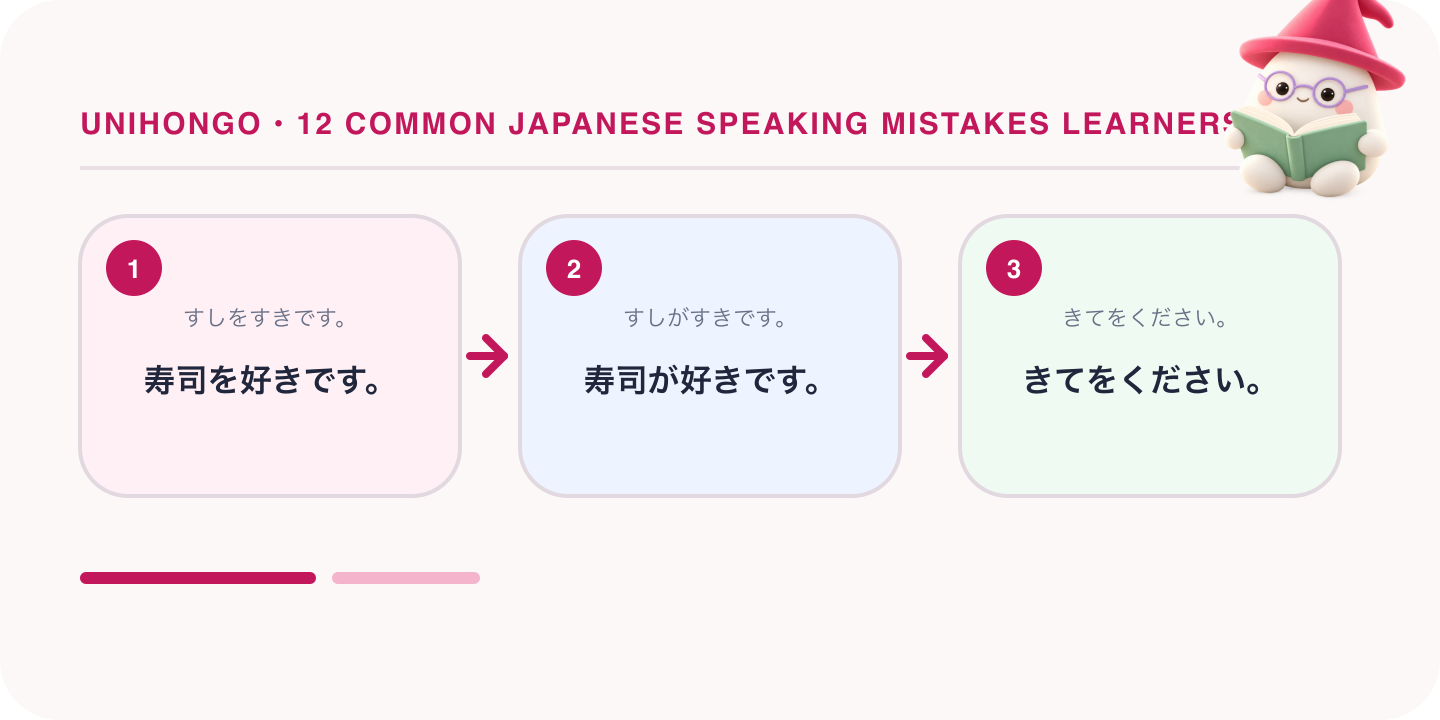
Grammar habits: mistakes 1 to 4
These four are the ones learners know about and still make, because they come from English sentence-building reflexes rather than from missing rules. The fix in each case is the same: notice the reflex, say the natural version aloud until it becomes the default, and let the context do the work that English words used to do. None of them needs new vocabulary.
- 1. Overusing watashi wa and anata. Japanese drops the subject once it is clear, so watashi wa gakusei desu, watashi wa Oosaka ni sunde imasu sounds like a list of announcements. Say it once, or not at all, and never repeat a subject the context supplies. For 'you', use the person's name with san; anata is for spouses, arguments, and forms.
- 2. The wrong particle after suki. Suki, kirai, jouzu, hoshii, and wakaru take ga, not o, because they describe a state rather than an action: sushi ga suki desu. The English verb like takes an object, and o follows it unless you train it out.
- 3. Mixing desu with plain verbs. Desu attaches to nouns and adjectives; verbs already carry politeness in the masu form, so ashita iku desu mixes two systems. Say ashita ikimasu, or, when explaining a reason, ashita iku n desu.
- 4. Answering negative questions literally. Hai agrees with the question, iie disagrees with it. Asked mada tabete inai n desu ka, a learner who has not eaten says iie, mada tabete imasen, which contradicts itself. The natural answer is hai, mada tabete imasen.
Politeness: mistakes 5 to 7
Politeness mistakes rarely stop anyone understanding you, but they change how you come across. Japanese has no neutral register: every sentence is either plain or polite, and the choice signals how you see the relationship. The first two errors below are mirror images of each other, and the third is about what you do while the other person is speaking.
- 5. Casual forms with strangers. Eki, doko? to a passer-by sounds abrupt, however friendly your face. Strangers, staff, and anyone older than you get masu and desu by default: sumimasen, eki wa doko desu ka.
- 6. Over-polite forms with friends. If a friend has switched to plain forms and you keep saying hirugohan o tabe ni ikimasen ka, it reads as distance. Mirror their level: hirugohan, tabe ni ikanai?
- 7. Forgetting aizuchi. In Japanese, silence while listening feels like absence. Short responses such as hai, ee, sou desu ne, naruhodo, and sou nan desu ka at natural pauses show that you are following.
Sound: mistakes 8 to 10
Sound mistakes are the hardest to notice in yourself because your ear was trained on English long before you started Japanese. They also matter more than learners expect: length and pitch are not accent colouring in Japanese, they distinguish words. The three below make correct sentences sound foreign, and all three respond well to shadowing a recording and copying the melody of whole phrases.
- 8. Flat or English-stressed pitch. Japanese words carry a pitch pattern, not a stressed syllable. In standard Tokyo pronunciation ame with high-low pitch is rain and with low-high pitch is a sweet; hashi high-low is chopsticks, low-high is a bridge. Imitate the rise and fall of a whole phrase as a tune.
- 9. Dropping long vowels and double consonants. Obasan is an aunt; obaasan is a grandmother. Kite is come; kitte is a stamp. English shortens unstressed vowels and has no pause consonants, so learners cut both. Count the beats: o-ba-a-sa-n has five, ki-t-te has three, and the small tsu is a silent beat.
- 10. The English r. Japanese ra, ri, ru, re, ro use a quick tap of the tongue tip behind the top teeth, closer to the tt in an American butter, or a light d, than to a curled English r. Say arigatou with a tap and the whole word changes.
Conversation flow: mistakes 11 and 12
Mistake 11 is answering with one word. Asked shuumatsu wa nani o shimashita ka, a nervous learner says eiga and stops, leaving the other person to dig for the rest. A complete answer has a simple shape: verb, one extra detail, question back. Eiga o mimashita. Tomodachi to atarashii akushon eiga o mi ni ikimashita. Tanaka-san wa? The question back turns an interview into a conversation.
Mistake 12 is silence instead of rescue phrases. When a sentence goes past you, freezing signals that the conversation has broken; a rescue phrase signals that it needs a small repair. Keep three ready: sumimasen, mou ichido onegaishimasu; yukkuri onegaishimasu; and eeto, nan to ieba ii ka na while you search for a word. Native speakers use fillers constantly, so eeto sounds far more natural than a blank pause.
Mistakes side by side: what learners say and what sounds natural
| Mistake | What learners say | More natural version |
|---|---|---|
| Starting every sentence with watashi wa | 私は学生です。私は大阪に住んでいます。 | 学生です。大阪に住んでいます。 |
| Using anata for 'you' | あなたは週末、何をしましたか。 | 田中さんは週末、何をしましたか。 |
| Wrong particle after suki | 寿司を好きです。 | 寿司が好きです。 |
| Desu after a plain verb | 明日、東京に行くです。 | 明日、東京に行きます。 |
| Literal answer to まだ食べていないんですか。 | いいえ、まだ食べていません。 | はい、まだ食べていません。 |
| Over-polite with a close friend | 昼ご飯を食べに行きませんか。 | 昼ご飯、食べに行かない? |
| Short vowel in obaasan | おばさんは八十歳です。 | おばあさんは八十歳です。 |
| Missing double consonant in kitte | きてをください。 | 切手をください。 |
Model sentences to say aloud
These sentences contain the natural version of most of the mistakes above. Say each one three times, slowly enough to hear the long vowels and the pause in kitte, then again at normal speed. Once they are comfortable, change one detail: a different food before ga suki desu, a different relative in the Kyoto sentence, a different number of stamps. Varied repetition turns a correction into something you say.
| Japanese | Romaji | Meaning |
|---|---|---|
| 寿司が好きです。 | Sushi ga suki desu. | I like sushi. |
| 週末は友達と映画を見ました。 | Shūmatsu wa tomodachi to eiga o mimashita. | At the weekend I watched a film with a friend. |
| 田中さんは何をしましたか。 | Tanaka-san wa nani o shimashita ka. | What did you do, Tanaka-san? |
| はい、まだ食べていません。 | Hai, mada tabete imasen. | That's right, I haven't eaten yet. |
| おばあさんは京都に住んでいます。 | Obāsan wa Kyōto ni sunde imasu. | My grandmother lives in Kyoto. |
| 切手を三枚ください。 | Kitte o sanmai kudasai. | Three stamps, please. |
| すみません、もう一度お願いします。 | Sumimasen, mō ichido onegaishimasu. | Sorry, could you say that again? |
| ええと、何と言えばいいかな。 | Ēto, nan to ieba ii ka na. | Um, how should I put this... |
How to catch your own speaking mistakes
You cannot fix what you cannot hear, and while speaking you hear almost nothing. Record yourself instead. Sixty seconds answering an everyday question on your phone is enough; listen the next day, when the sentences no longer feel like yours, with the list above beside you. Most learners find two or three of the twelve on the first listen, and the sound mistakes are obvious on a recording in a way they never are live.
Feedback from a tool or teacher covers what your ear misses. An AI tutor such as Unihongo's AI Sensei produces a session report after each conversation with your sentences, corrections, and pronunciation notes, so a missing ga or a shortened obaasan appears in writing. Whatever the source, take one correction at a time: choose the mistake that appears most often, work only on that for a week, and ignore the rest. Twelve mistakes fixed one by one disappear; twelve fixed at once rotate.