
Start with five stable vowels
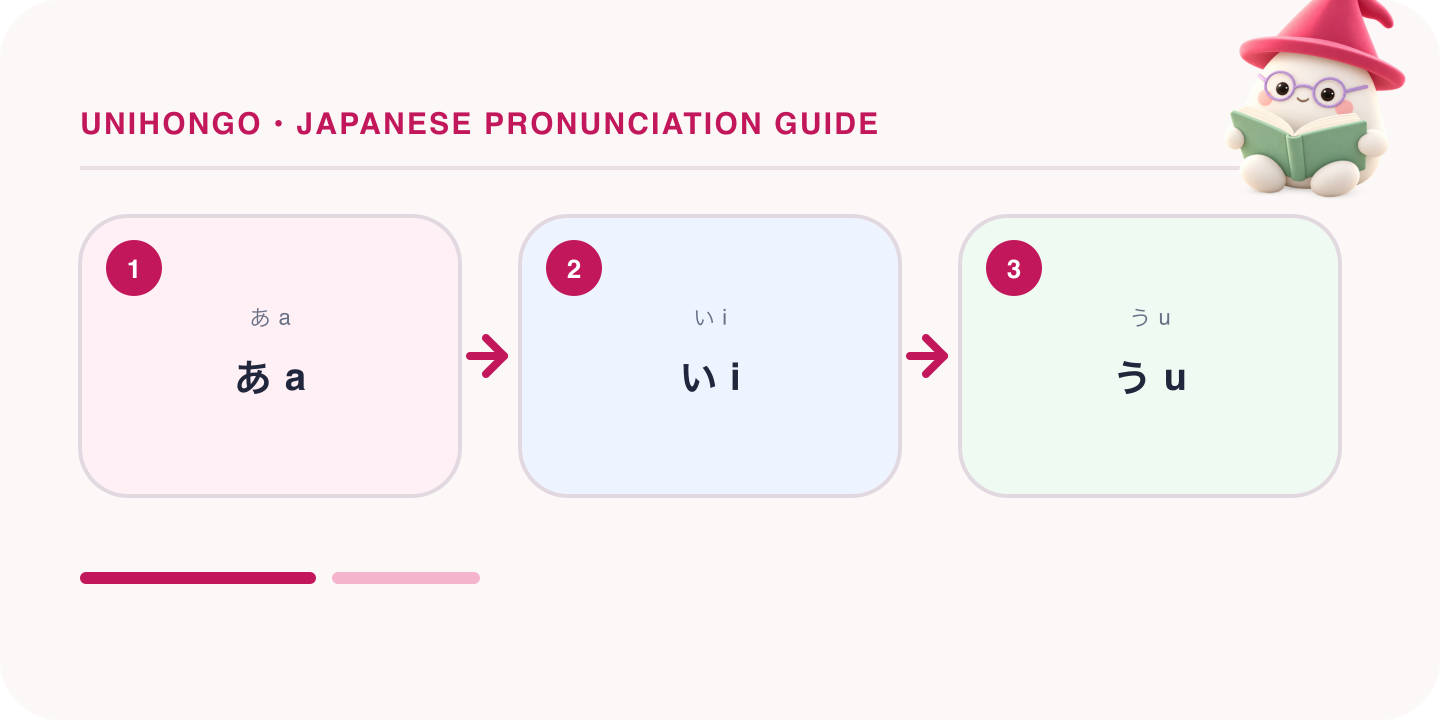
| Kana | Approximate sound | Example |
|---|---|---|
| あ a | Open a, as in father | 朝 asa, morning |
| い i | Clear ee, as in machine | 犬 inu, dog |
| う u | Short unrounded oo, lips relaxed | 海 umi, sea |
| え e | Clean e, without a glide | 駅 eki, station |
| お o | Pure o, without turning into ow | 音 oto, sound |
English vowels often glide from one position to another. Japanese vowels are steadier. Hold a single mouth shape through each one, and keep the same quality whether the vowel is short or long.
Hear morae: the beats inside words
Japanese rhythm is organised around morae, small timing units. A simple kana such as ka takes one beat. A long vowel takes two, the moraic n takes one, and the small tsu reserves one beat before the next consonant. Syllables alone do not capture these contrasts.
| Word | Beat breakdown | Morae |
|---|---|---|
| 日本 nihon | ni-ho-n | 3 |
| 東京 Tōkyō | to-o-kyo-o | 4 |
| 切手 kitte | ki-(pause)-te | 3 |
| 新聞 shinbun | shi-n-bu-n | 4 |
Long vowels change words
| Japanese | Romaji | Meaning |
|---|---|---|
| おばさん | Obasan | Aunt / middle-aged woman |
| おばあさん | Obāsan | Grandmother / elderly woman |
| ここ | Koko | Here |
| こうこう | Kōkō | High school |
| ビル | Biru | Building |
| ビール | Bīru | Beer |
Do not merely make a long vowel louder or change its quality. Give it two timing units. Katakana often writes the extension with ー, while hiragana spelling varies by vowel pattern.
Small tsu creates a consonant beat
| Japanese | Romaji | Meaning |
|---|---|---|
| 来て | Kite | Come (te-form) |
| 切って | Kitte | Cut (te-form) |
| 坂 | Saka | Slope |
| 作家 | Sakka | Writer |
| 音 | Oto | Sound |
| 夫 | Otto | Husband |
The small tsu is not pronounced tsu. Close into the following consonant and hold one silent beat before releasing it. Practise with a hand tap: ki—tap—te.
Make the Japanese r a quick tap
Touch the tongue briefly near the ridge behind your upper teeth, then release immediately. Do not curl and hold it as in many English r sounds, and do not maintain side contact as in a strong English l. A relaxed ara, iri, uru, ere, oro sequence helps the tongue learn the single tap.
| Japanese | Romaji | Meaning |
|---|---|---|
| ラーメン | Rāmen | Ramen |
| ありがとう | Arigatō | Thank you |
| 料理 | Ryōri | Cooking / cuisine |
| 分かりました | Wakarimashita | I understood |
Quiet i and u without deleting the beat
High vowels i and u often become devoiced between voiceless consonants or at the end after one. This is why suki can sound close to ski and desu close to des. The effect varies with speaker, speed, emphasis, and region. Imitate what you hear instead of applying a rigid deletion rule.
| Japanese | Romaji | Meaning |
|---|---|---|
| 好きです。 | Suki desu. | I like it. |
| 明日来ます。 | Ashita kimasu. | I will come tomorrow. |
| 学生です。 | Gakusei desu. | I am a student. |
A pronunciation priority ladder
- First, make each vowel identifiable without an English-style glide.
- Second, preserve long vowels, small tsu, and moraic n as full beats.
- Third, refine consonants such as r, f, and the difference between shi and hi.
- Fourth, match word and sentence pitch after the segments and timing are stable.
- Finally, shadow whole phrases so careful sounds survive at conversational speed.