
The four lines you will use all day
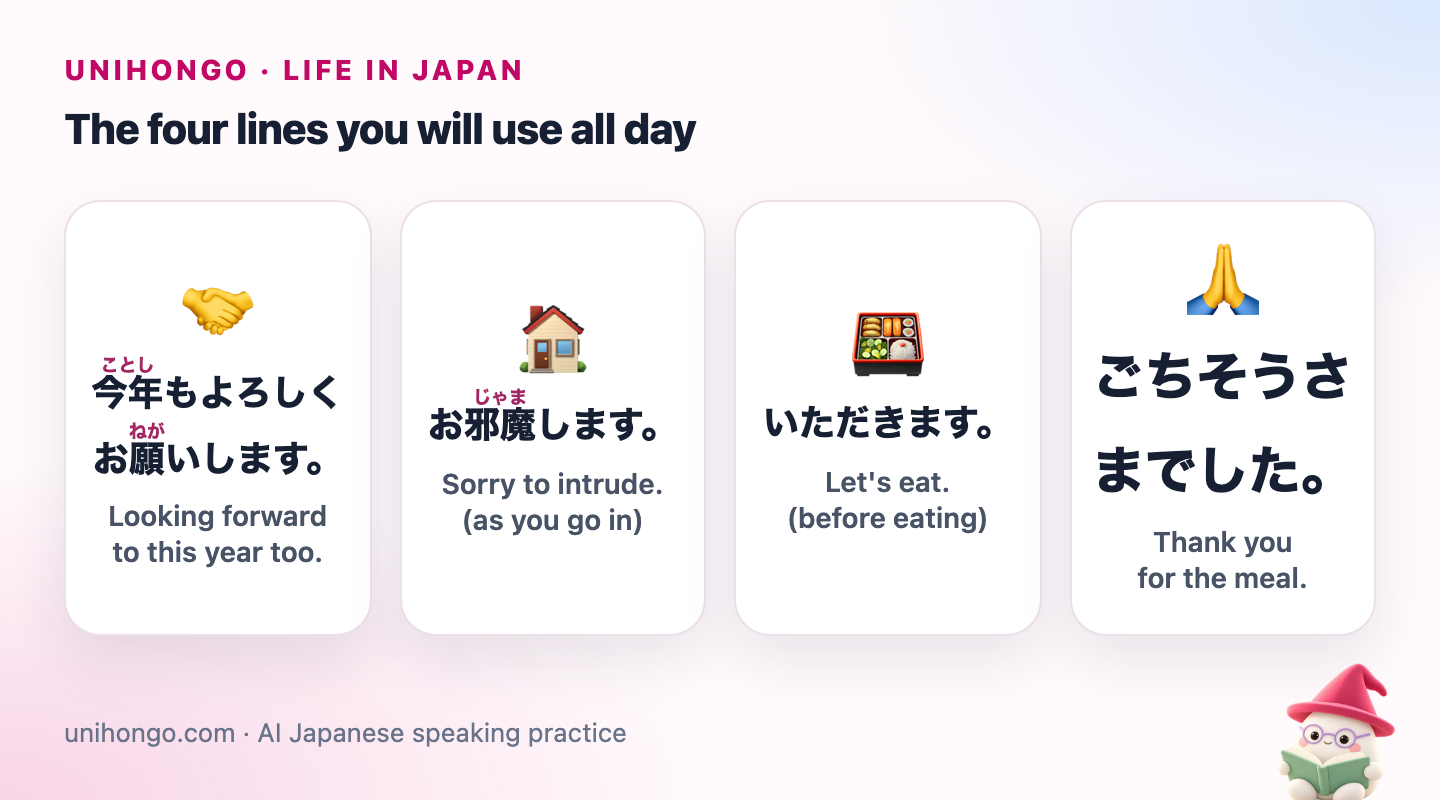
These lines carry most of a New Year visit. The first is the second half of the New Year greeting you say to every family member. Then come the phrase for stepping inside and the pair you say before and after every meal. The full greeting starts with akemashite omedetō gozaimasu, the last line below.
| Japanese | Romaji | Meaning |
|---|---|---|
| 今年もよろしくお願いします。 | Kotoshi mo yoroshiku onegai shimasu. | Looking forward to this year too. |
| お邪魔します。 | Ojama shimasu. | Sorry to intrude. (as you go in) |
| いただきます。 | Itadakimasu. | Let's eat. (before eating) |
| ごちそうさまでした。 | Gochisōsama deshita. | Thank you for the meal. |
| あけましておめでとうございます。 | Akemashite omedetō gozaimasu. | Happy New Year. (polite) |
Before you go: ask, and choose a gift
Every family does New Year differently. Before the visit, ask your partner or friend some practical questions: how long you will stay, who will be there, what to wear, whether to give otoshidama to the children, and whether there is anything you should not bring up. Asking shows care, and they will be glad to coach you.
Bring a small gift, temiyage (手土産): good sweets, a nice bottle, or something from your home country. Hand it over in the entrance hall or the living room, not on the doorstep, with both hands and a modest line. The old phrase tsumaranai mono desu ga, it is nothing much, is still heard but can sound dated; kokorobakari desu ga, just a small token, or simply minasan de dōzo is common now.
| Japanese | Romaji | Meaning |
|---|---|---|
| 何を持って行けばいいかな。 | Nani o motte ikeba ii ka na. | I wonder what I should bring. (to your partner) |
| お年玉はどうすればいい? | Otoshidama wa dō sureba ii? | What should I do about otoshidama? (casual) |
| 心ばかりですが、どうぞ。 | Kokorobakari desu ga, dōzo. | It's just a small token, please accept it. |
| 皆さんでどうぞ。 | Minasan de dōzo. | Please enjoy this together. |
At the door: the New Year greeting
At the entrance, bow and say the full greeting. If it is your first meeting, add your name and a short introduction. Take your shoes off in the entrance, the genkan, and turn them to face the door, or follow what your partner does. Each time another relative arrives or you meet someone new, repeat the greeting; it is expected, not repetitive.
If you have met the family before, add sakunen wa osewa ni narimashita, thank you for everything last year.
| Japanese | Romaji | Meaning |
|---|---|---|
| はじめまして。エマと申します。 | Hajimemashite. Ema to mōshimasu. | Nice to meet you. My name is Emma. (humble) |
| 昨年はお世話になりました。 | Sakunen wa osewa ni narimashita. | Thank you for everything last year. |
| どうぞ上がって。 | Dōzo agatte. | Host: Come on in. (casual) |
| 寒かったでしょう。 | Samukatta deshō. | Host: You must be cold. |
Osechi, ozōni and table manners
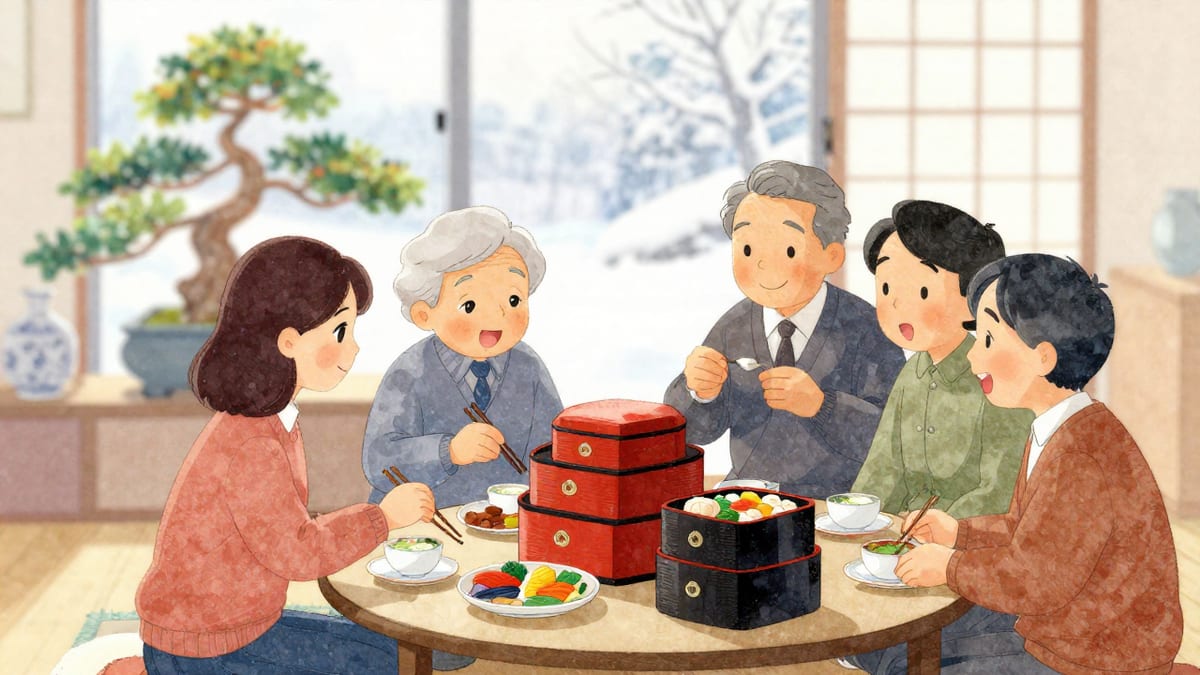
Osechi ryōri (おせち料理) is the New Year feast, packed in tiered lacquer boxes, jūbako. Each dish carries a wish: black beans, kuromame, for health and hard work; herring roe, kazunoko, for many descendants; sweet rolled omelette, datemaki, for learning. Families also eat ozōni (お雑煮), a soup with mochi rice cakes, which varies enormously by region and family: clear or miso broth, square or round mochi. Asking about it is one of the best conversation starters of the day.
Special long chopsticks, iwaibashi (祝い箸), are tapered at both ends; one end is said to be for you and the other for the gods, so use only one end. Mochi is very sticky: cut it into small pieces and chew well. Some families start with a sip of spiced sake, otoso, from youngest to oldest. Follow the family's lead.
| Japanese | Romaji | Meaning |
|---|---|---|
| お雑煮、いい香りですね。 | Ozōni, ii kaori desu ne. | The ozōni smells wonderful. |
| これは何という料理ですか。 | Kore wa nan to iu ryōri desu ka. | What is this dish called? |
| どんな意味がありますか。 | Donna imi ga arimasu ka. | What does it mean? |
| とてもおいしいです。 | Totemo oishii desu. | It's delicious. |
| すみません、これはちょっと苦手で。 | Sumimasen, kore wa chotto nigate de. | Sorry, I'm not very good with this one. |
| お宅のお雑煮はおすましですか。 | Otaku no ozōni wa osumashi desu ka. | Is your family's ozōni a clear soup? |
Otoshidama and the children
Otoshidama (お年玉) is money given to children at New Year in small decorated envelopes, pochibukuro (ぽち袋). Usually parents, grandparents and relatives give it. Whether you, as a partner or friend, should give it depends entirely on the family: some expect it once you are close to the family, others would find it unnecessary. Ask your partner, and if you do give it, hand it to the child with a warm word, often with the parents watching.
| Japanese | Romaji | Meaning |
|---|---|---|
| はい、お年玉。 | Hai, otoshidama. | Here, your New Year money. (to a child) |
| ありがとうございます! | Arigatō gozaimasu! | Child: Thank you! |
| すみません、気を遣っていただいて。 | Sumimasen, ki o tsukatte itadaite. | Parent: Oh, you shouldn't have. |
| 何歳になったの? | Nansai ni natta no? | How old are you now? (to a child) |
Offering help in the kitchen
Offering to help is good manners, especially when food is served or cleared. The host will often decline the first time: ii no yo, suwattete, it is fine, stay seated. You can offer once more, then accept gracefully. Carrying dishes to the kitchen or helping wash up are common ways to help.
| Japanese | Romaji | Meaning |
|---|---|---|
| 何かお手伝いしましょうか。 | Nanika otetsudai shimashō ka. | Can I help with anything? |
| いいのよ、座ってて。 | Ii no yo, suwattete. | Host: It's fine, stay seated. (casual) |
| じゃあ、お皿を運びますね。 | Jā, osara o hakobimasu ne. | Then I'll carry the plates. |
| お料理、とてもおいしかったです。 | Oryōri, totemo oishikatta desu. | The food was wonderful. |
Leaving, and common mistakes
Signal that you will leave a little before you go with sorosoro shitsurei shimasu. Your hosts may say mō kaeru no, leaving already? That is politeness; a short thank-you and a smile is enough. At the door, say ojama shimashita and repeat your thanks.
| Japanese | Romaji | Meaning |
|---|---|---|
| そろそろ失礼します。 | Sorosoro shitsurei shimasu. | I should be going soon. |
| 今日はありがとうございました。 | Kyō wa arigatō gozaimashita. | Thank you for today. |
| お邪魔しました。 | Ojama shimashita. | Thank you for having me. |
| また遊びに来てね。 | Mata asobi ni kite ne. | Host: Come and visit again. (casual) |
- Saying akemashite omedetō only once. Greet each family member as you meet them.
- Using casual speech with your partner's parents. Stay polite unless they clearly invite you to relax.
- Using the wrong end of iwaibashi, or passing food chopstick to chopstick. Place food on a plate instead.
- Deciding about otoshidama on the spot. Ask your partner first.