Japanese Small Talk: Natural Questions and Responses for Beginners
Small talk is not a vocabulary test. It is a short exchange of attention: notice something shared, ask lightly, react, and offer a little about yourself.
Japanese Small Talk: Natural Questions and Responses for Beginners
Japanese small talk often begins with the immediate setting—the weather, journey, food, event, or something both people can see. The best beginner conversations use short answers plus one extra detail, then return a question. This guide gives safe openings, follow-up patterns, mini-dialogues, and graceful endings for classmates, colleagues, neighbours, and people you meet while travelling.
Begin from a shared situation instead of an intimate question
Use answer plus one detail to give the other person something to follow
React with aizuchi before asking the next question
Keep early topics light and let the relationship set the depth
The four-beat small-talk loop
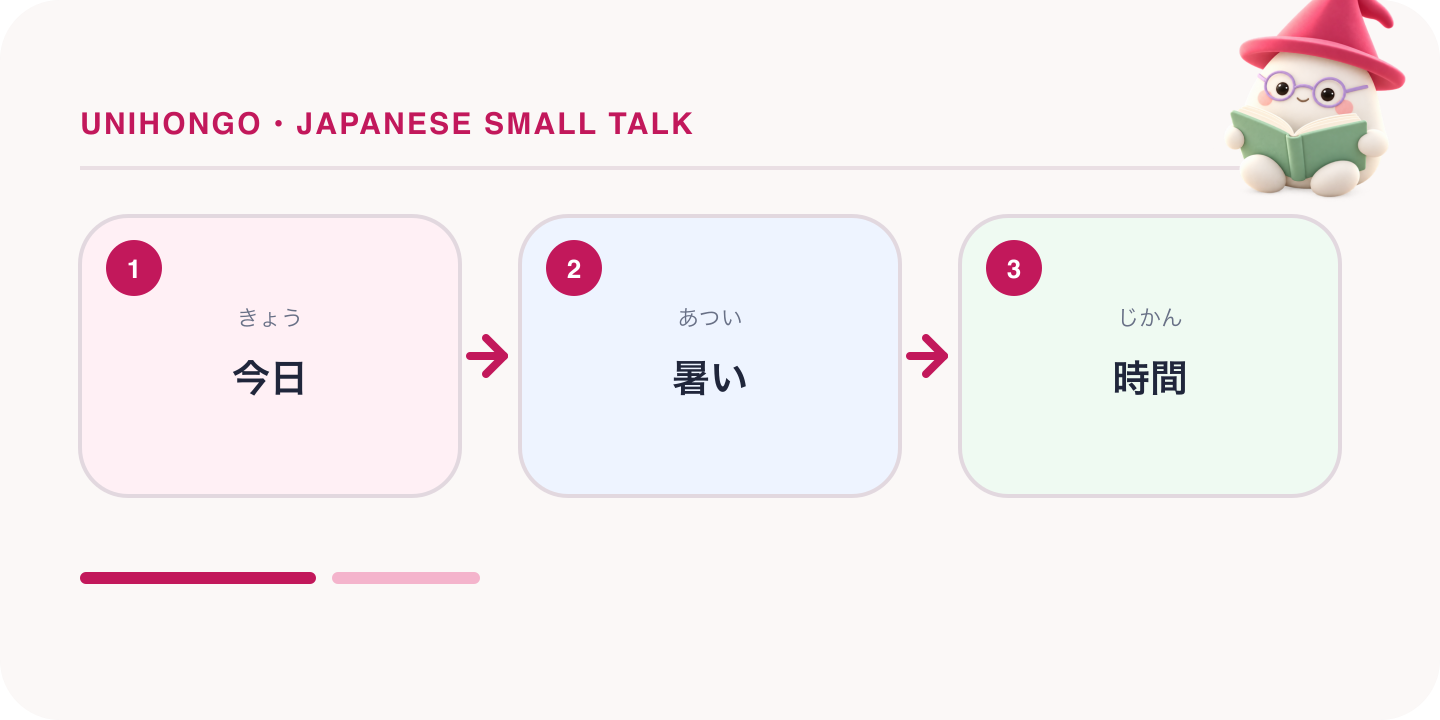
A visual learning path for Japanese Small Talk: Natural Questions and Responses for Beginners, with three key Japanese study points.
Notice: open with something shared, immediate, and easy to answer.
Ask: use one light question rather than several questions at once.
React: show interest with a matching aizuchi or short comment.
Share: add one related detail about yourself, then return the turn.
Repeating this loop makes the exchange mutual. Learners who ask question after question can sound like interviewers; learners who answer with one word give their partner nowhere to go. One extra detail solves both problems.
Open from the shared situation
Japanese
Romaji
Meaning
今日は暑いですね。
Kyō wa atsui desu ne.
It is hot today, isn't it?
ここまで時間がかかりましたか?
Koko made jikan ga kakarimashita ka?
Did it take long to get here?
このイベントは初めてですか?
Kono ibento wa hajimete desu ka?
Is this your first time at this event?
この料理、おいしいですね。
Kono ryōri, oishii desu ne.
This food is delicious, isn't it?
よくここに来ますか?
Yoku koko ni kimasu ka?
Do you come here often?
Safe topics and useful questions
Topic
Question
Natural follow-up
Hometown
ご出身はどちらですか? Goshusshin wa dochira desu ka?
どんなところですか? Donna tokoro desu ka?
Work/study
どんなお仕事をしていますか? Donna oshigoto o shite imasu ka?
忙しいですか? Isogashii desu ka?
Hobbies
趣味は何ですか? Shumi wa nan desu ka?
いつからですか? Itsu kara desu ka?
Weekend
週末は何をしましたか? Shūmatsu wa nani o shimashita ka?
どうでしたか? Dō deshita ka?
Food
何料理が好きですか? Nani ryōri ga suki desu ka?
おすすめはありますか? Osusume wa arimasu ka?
Turn short answers into conversation hooks
Japanese
Romaji
Meaning
大阪から来ました。食べ物が大好きです。
Ōsaka kara kimashita. Tabemono ga daisuki desu.
I am from Osaka. I love the food there.
週末は映画を見ました。新しいアニメ映画です。
Shūmatsu wa eiga o mimashita. Atarashii anime eiga desu.
I watched a film this weekend. It was a new anime film.
日本語を一年ぐらい勉強しています。会話はまだ難しいです。
Nihongo o ichi-nen gurai benkyō shite imasu. Kaiwa wa mada muzukashii desu.
I have studied Japanese for about a year. Conversation is still difficult.
Each answer contains the requested fact and a hook: food, a film, or conversation practice. Your partner can now ask about that hook without inventing a new subject.
Mini-dialogue: meeting a classmate
Japanese
Romaji
Meaning
このクラスは初めてですか?
Kono kurasu wa hajimete desu ka?
Is this your first time in this class?
はい、今日が初めてです。
Hai, kyō ga hajimete desu.
Yes, today is my first time.
そうなんですね。私も先週始めました。
Sō nan desu ne. Watashi mo senshū hajimemashita.
I see. I started last week too.
どうですか?
Dō desu ka?
How is it?
楽しいですよ。先生も親切です。
Tanoshii desu yo. Sensei mo shinsetsu desu.
It is fun. The teacher is kind too.
よかった。安心しました。
Yokatta. Anshin shimashita.
That is good. I am relieved.
Topics that need more context
Income, politics, religion, health, and relationship status may be too personal for a first exchange.
Compliments about Japanese appearance or stereotypes can put the listener in an awkward representative role.
Family questions are easier once the other person mentions family first.
Age and seniority sometimes matter socially, but they are not necessary as a universal opener.
If an answer becomes short or vague, return to the setting rather than pressing for detail.
End without an awkward disappearance
Japanese
Romaji
Meaning
そろそろ失礼します。
Soro soro shitsurei shimasu.
I should be going soon.
お話しできてよかったです。
Ohanashi dekite yokatta desu.
It was nice talking with you.
また話しましょう。
Mata hanashimashō.
Let's talk again.
では、また。
Dewa, mata.
Well then, see you.
Key points
A practical way to improve
Choose one setting—class, office, cafe, or trip—and prepare only an opener, two follow-ups, and an exit. Roleplay it three times with Unihongo's AI teacher. Its immersive 3D classroom environment feels closer to speaking face to face in a real class, while changing replies keep you listening instead of reciting both sides.
1
Choose one clear goal
Focus each session on a situation or skill you can actually use.
2
Practice actively
Say complete answers aloud instead of only reading or recognizing Japanese.
3
Review and repeat
Keep useful corrections and revisit the same skill until it feels natural.
FAQ
Frequently asked questions
What do Japanese people talk about in small talk?
Common safe topics include weather, travel to the location, food, the shared event, hobbies, weekends, and seasonal changes. The setting and relationship determine what feels natural.
How do I keep a Japanese conversation going?
React first, choose one detail from the answer, and ask a follow-up about it. Add a small fact about yourself so the exchange does not become an interview.
Is asking someone's age rude in Japanese?
Age may arise in contexts where status or school year matters, but it can still feel personal. Do not use it as a default opener with an adult; begin with the shared situation.
How can I end Japanese small talk politely?
Give a brief reason or transition, show appreciation, and close warmly. Expressions such as soro soro shitsurei shimasu and mata hanashimashō make the ending clear without sounding abrupt.
Turn Japanese knowledge into speaking confidence
Practice with Unihongo's AI Sensei in an immersive 3D classroom, with roleplay missions, pronunciation coaching, useful feedback, and learning games that build your vocabulary while you play.