
Why Japanese names trip up English speakers
English speakers usually stress one syllable strongly and shorten the others. Say Hiroshi in English and you get hi-RO-shi, with the first and last syllables almost swallowed. Japanese does not work that way. Each beat, called a mora, takes about the same time, and the voice moves up or down in pitch rather than getting louder. Hiroshi is three calm beats: hi-ro-shi.
Romaji makes it worse in a quiet way. On name cards, passports and email addresses, the long-vowel marks usually disappear, so Satō becomes Sato and Yūko becomes Yuko. Your eyes see a short name, and your mouth follows. A good habit is to treat every romaji name as a question until you have heard it from the owner.
| Japanese | Romaji | Meaning |
|---|---|---|
| お名前はどう読みますか。 | Onamae wa dō yomimasu ka. | How do you read your name? |
| ひろし | Hiroshi | Hiroshi: three even beats, hi-ro-shi |
| さとう | Satō | Satō: sa-to-o, three beats |
The four traps, one name each
Almost every mistake with Japanese names falls into four groups. Learn one model name for each group and you will spot the trap in new names.
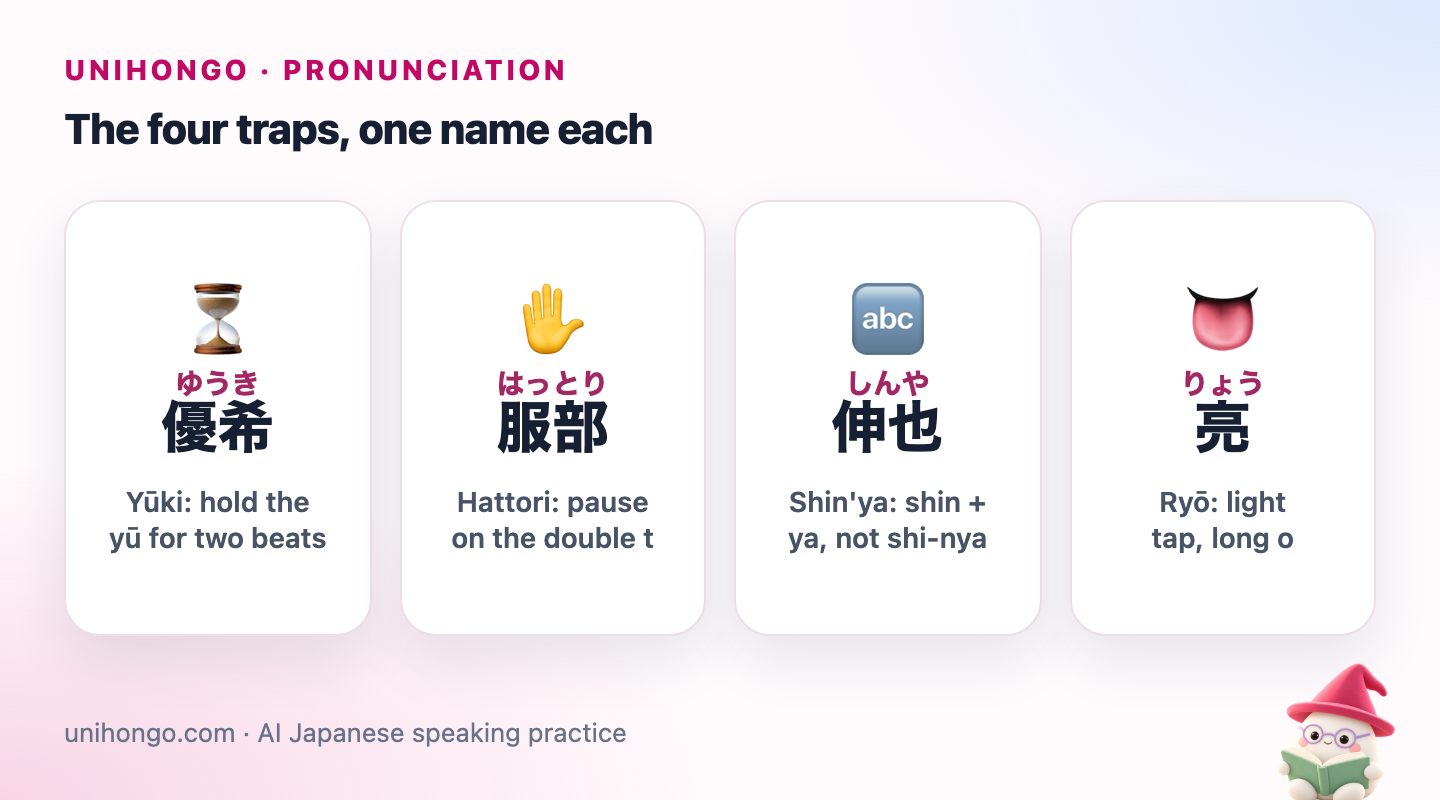
| Japanese | Romaji | Meaning |
|---|---|---|
| 優希 | Yūki | Yūki: hold the yū for two beats |
| 服部 | Hattori | Hattori: pause on the double t |
| 伸也 | Shin'ya | Shin'ya: shin + ya, not shi-nya |
| 亮 | Ryō | Ryō: light tap, long o |
Long vowels change meaning, not just accent. Yūki and Yuki can be different names, and Ōno (大野) and Ono (小野) are different surnames. Hold a long vowel for a full extra beat, the way you hold a note in a song.
A double consonant, written with a small っ in kana, is a tiny silent pause before the consonant. In Hattori you stop for one beat after ha, then release the t: ha-t-to-ri, four beats. Saying Hatori is like dropping a letter from someone's name.
The apostrophe in Shin'ya tells you that n is its own beat. Shin'ya is shi-n-ya, three beats, while Shinya written without the apostrophe could be read shi-nya. Ken'ichi works the same way: ke-n-i-chi.
Long vowels hiding in common names
Long vowels appear in many of the most familiar Japanese names, especially in surnames ending in -tō and given names ending in -rō or -ta. The table shows how the same name often looks in passports, in careful romaji and in beats.
| Japanese | Romaji | Meaning |
|---|---|---|
| 佐藤さん | Satō san | Mr or Ms Satō |
| 伊藤さん | Itō san | Mr or Ms Itō |
| 斎藤さん | Saitō san | Mr or Ms Saitō |
| 裕子さん | Yūko san | Yūko (given name, with san) |
| 恵子さん | Keiko san | Keiko (given name, with san) |
| Name card often shows | Careful romaji | Beats | Watch out for |
|---|---|---|---|
| Sato | Satō | sa-to-o (3) | a long final o |
| Ito | Itō | i-to-o (3) | short Ito sounds like a different word |
| Saito | Saitō | sa-i-to-o (4) | ai is two beats, not one sound |
| Taro | Tarō | ta-ro-o (3) | the -rō ending of many older boys' names |
| Yuko | Yūko | yu-u-ko (3) | the long u at the start |
| Kei | Kei | ke-i (2) | often sounds like kē in fast speech |
The pair ei is a special case. In careful speech, Kei and Keiko are said with e then i, but in everyday speech the ei often sounds like a long e. Both are acceptable, and you will hear Japanese speakers do both. What matters is that the name keeps its two beats.
Quiet vowels and the r sound
Two more details make names sound natural. First, the vowels i and u often become very quiet, almost whispered, between certain consonants such as k, s, t and sh. Daisuke is often heard as dais-ke, and Takuya can sound close to tak-ya. You do not need to force this, but if you hear it, it is not a mistake; it is normal Japanese.
Second, the Japanese r. It is a single quick tap of the tongue behind the upper teeth, a little like the d in the American pronunciation of ladder. In names such as Rie, Ryōta and Haruka, aim for that light tap. A heavy English r or a clear English l both sound foreign, but the tap is easy once you think of it as a soft d.
| Japanese | Romaji | Meaning |
|---|---|---|
| 大輔 | Daisuke | Daisuke: the su is often whispered |
| 拓也 | Takuya | Takuya: the ku can be very soft |
| 遥 | Haruka | Haruka: a light tapped r |
| 理恵 | Rie | Rie: two beats, ri-e |
| 健一 | Ken'ichi | Ken'ichi: ke-n-i-chi, four beats |
Asking how a name is read, politely
Because one kanji name can have several readings, Japanese people ask each other how names are read, especially when they see the name written first, on a list, a form or a business card. You can do the same. Use polite Japanese with people you have just met, and soften the question with sumimasen.
Once you have heard the name, repeat it back with san and confirm. This gives the person a chance to correct you, and it fixes the name in your memory. If you got it wrong earlier, a short apology is enough; nobody expects a long explanation.

| Japanese | Romaji | Meaning |
|---|---|---|
| すみません、お名前は何とお読みすればいいですか。 | Sumimasen, onamae wa nan to oyomi sureba ii desu ka. | Excuse me, how should I read your name? (very polite) |
| もう一度お願いできますか。 | Mō ichido onegai dekimasu ka. | Could you say it once more? |
| さいとうさんで合っていますか。 | Saitō san de atte imasu ka. | Is it Saitō? Have I got that right? |
| 失礼しました。お名前を間違えていました。 | Shitsurei shimashita. Onamae o machigaete imashita. | I'm sorry. I had your name wrong. |
| 下の名前でお呼びしてもいいですか。 | Shita no namae de oyobi shite mo ii desu ka. | May I call you by your given name? |
Shita no namae, literally the lower name, means the given name, because in vertical writing it comes below the surname. In most workplaces you use the surname with san unless the person invites you to do otherwise.
Mini dialogue: getting a coworker's name right
| Japanese | Romaji | Meaning |
|---|---|---|
| はじめまして。今日からお世話になります。 | Hajimemashite. Kyō kara osewa ni narimasu. | You: Nice to meet you. I start working with you today. |
| はじめまして。服部です。 | Hajimemashite. Hattori desu. | Coworker: Nice to meet you. I'm Hattori. |
| はとりさん、ですか。 | Hatori san, desu ka. | You: Hatori, is it? |
| いえ、はっとりです。小さい「っ」が入ります。 | Ie, Hattori desu. Chiisai "tsu" ga hairimasu. | Coworker: No, Hattori. There's a small tsu in it. |
| 失礼しました。はっとりさんですね。 | Shitsurei shimashita. Hattori san desu ne. | You: Sorry. Hattori, then. |
| そうです。よろしくお願いします。 | Sō desu. Yoroshiku onegai shimasu. | Coworker: That's right. I look forward to working with you. |
Common learner mistakes with names
- Stressing one syllable hard, as in na-KA-mu-ra, instead of keeping Nakamura as four even beats.
- Trusting romaji without macrons. Yuko on a card may be Yūko, and Ono may be Ōno; listen before you decide.
- Merging the ai or ei pairs into one short sound, so Saitō turns into Sato, which is a different surname.
- Swallowing the double consonant: Hatori for Hattori, or Nita for Nitta, changes the name.
- Adding san to your own name when introducing yourself. San is only for other people.
- Guessing a reading from kanji alone. Names often use special readings, so ask rather than assume.
Make the names you need automatic with Mocchi
Tell Mocchi the names you need this month, such as your manager, your neighbours or your host family, and ask: "Quiz me on these names, one at a time, and tell me which beats I usually get wrong." Mocchi keeps track of the names you miss, so a later /review session brings back Saitō and Hattori rather than the ones you already know.
For the sound itself, open the pronunciation coach and choose a long-vowel drill. You listen, slow the model down if you need to, record yourself and get scores for rhythm and pitch, which is exactly where name mistakes hide. Then say the names in a real introduction with AI Sensei; Hana-sensei can play a new coworker who introduces herself with a name that has a long vowel.