
Seiza in four cards
These four words cover the whole seiza experience: the posture, your host's kind invitation to relax, the moment your legs go numb, and the most common relaxed alternative.
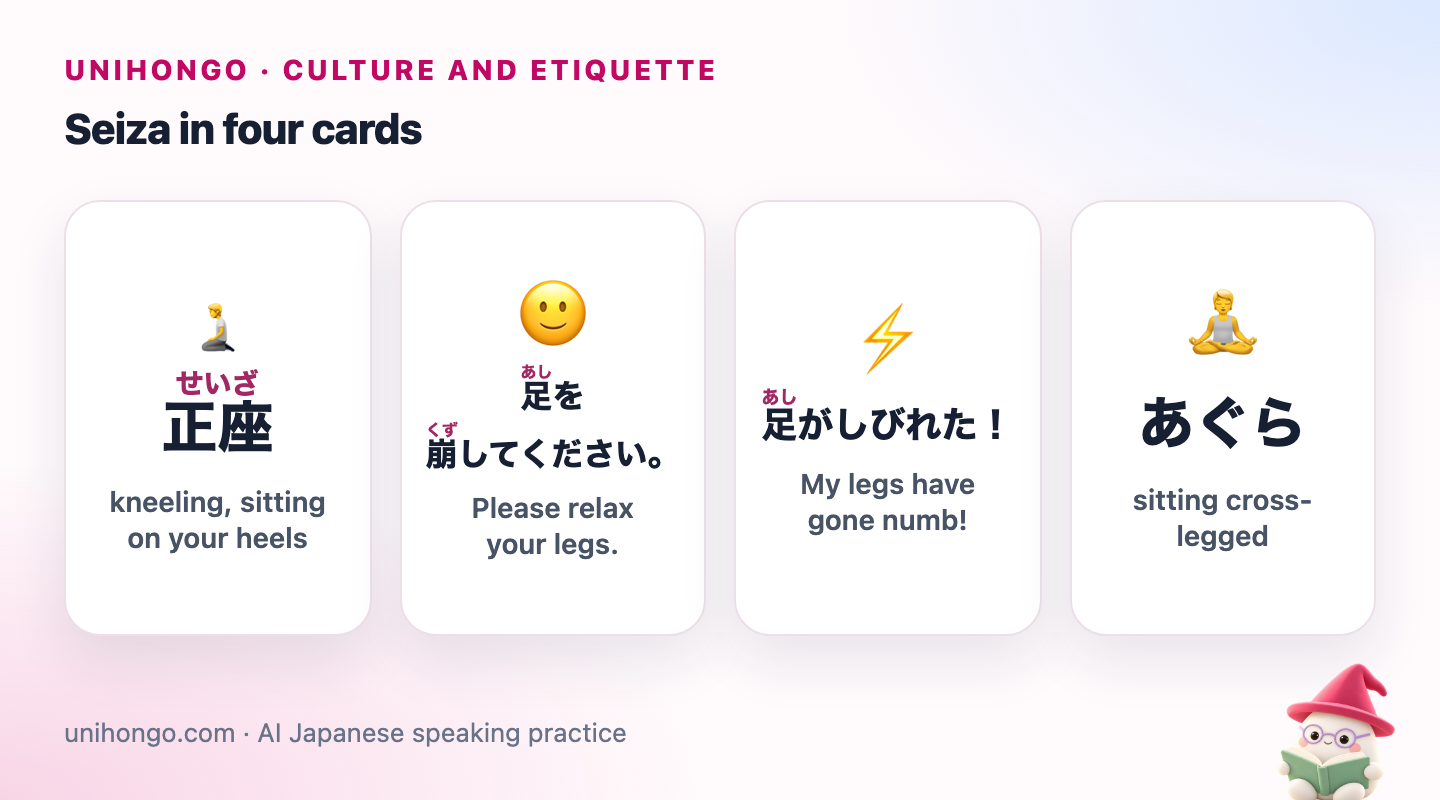
| Japanese | Romaji | Meaning |
|---|---|---|
| 正座 | seiza | kneeling, sitting on your heels |
| 足を崩してください。 | Ashi o kuzushite kudasai. | Please relax your legs. |
| 足がしびれた! | Ashi ga shibireta! | My legs have gone numb! |
| あぐら | agura | sitting cross-legged |
Kuzusu means to break down or loosen, so ashi o kuzusu is to break your formal sitting posture. Shibireru describes pins and needles, and ashi ga shibireta is something almost every Japanese person has said after a long ceremony.
How to sit seiza, step by step
To stand up, first tuck your toes under so you are kneeling on the balls of your feet, wait a moment for the blood to return, then rise on one leg. If your legs are numb, take your time; standing up too fast on numb feet is how people stumble.
| Japanese | Romaji | Meaning |
|---|---|---|
| 背筋を伸ばしてください。 | Sesuji o nobashite kudasai. | Please straighten your back. |
| かかとの上に座ります。 | Kakato no ue ni suwarimasu. | You sit on your heels. |
| ゆっくり立ってください。 | Yukkuri tatte kudasai. | Please stand up slowly. |
- Stand at your place, usually on or just behind a flat cushion, the zabuton.
- Kneel down one knee at a time, keeping your back upright.
- Bring your knees together. Men often leave a gap of about one fist; women usually keep their knees touching.
- Point your toes backwards so the tops of your feet lie flat on the floor or cushion.
- Let your big toes touch or overlap lightly, so your heels open slightly to make a seat.
- Lower your hips onto your heels. Keep your back straight and your shoulders relaxed.
- Rest your hands on your thighs, fingers together, or one hand over the other in your lap.
Where seiza is expected
Most Japanese homes now have chairs and sofas, and many young people rarely sit in seiza. It still matters in certain settings, especially formal and traditional ones.
| Situation | How formal | What usually happens |
|---|---|---|
| Tea ceremony | Very formal | Seiza for most of the time; ask about stools if needed |
| Buddhist memorial service or funeral at home | Formal | Seiza during the sutra reading; chairs often available |
| Martial arts or calligraphy class | Formal | Seiza for greetings and at the start and end |
| Formal greeting in a tatami room | Formal | Seiza for the greeting, then hosts invite you to relax |
| Ryokan dinner or tatami restaurant | Relaxed | Seiza optional; most guests relax quickly |
A formal bow from seiza is called zarei: place your hands on the floor in front of your knees and bow from the waist. You will see it at the start and end of martial arts lessons, tea ceremonies and formal visits.
When your host says relax
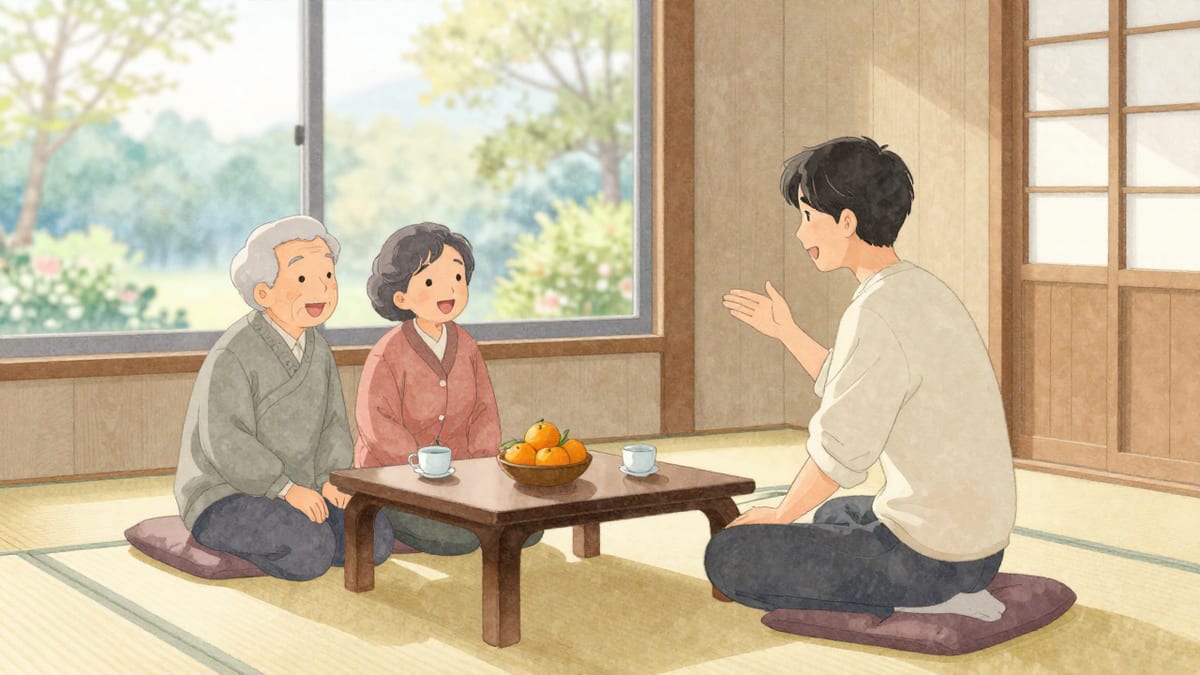
In most homes and restaurants, the host will soon invite you to sit more comfortably. This is a real invitation, not a test. A common graceful reply is okotoba ni amaete, I will accept your kind offer, literally depending on your words. If you prefer to stay in seiza a little longer, a light ie, daijōbu desu is fine too.
| Japanese | Romaji | Meaning |
|---|---|---|
| どうぞ、楽にしてください。 | Dōzo, raku ni shite kudasai. | Host: Please make yourself comfortable. |
| では、お言葉に甘えて。 | Dewa, okotoba ni amaete. | Guest: Then I'll take you up on that. |
| いえ、大丈夫です。 | Ie, daijōbu desu. | Guest: No, I'm fine, thank you. |
| 正座に慣れていなくて。 | Seiza ni narete inakute. | I'm not used to sitting seiza. |
| 膝が悪いので、椅子をお借りしてもいいですか。 | Hiza ga warui node, isu o okari shite mo ii desu ka. | My knees are bad; may I borrow a chair? |
Relaxed alternatives
Once your host has invited you to relax, these are the usual positions. Which one people choose depends on gender, clothing and the mood of the room.
| Japanese | Romaji | Meaning |
|---|---|---|
| あぐらをかく | agura o kaku | to sit cross-legged |
| 横座り | yokozuwari | sitting with both legs to one side |
| 体育座り | taiiku suwari | sitting hugging your knees |
| 足を伸ばす | ashi o nobasu | to stretch your legs out |
Agura is the usual relaxed position for men and, in casual settings, for women in trousers. Yokozuwari is common for women, particularly in skirts. Taiiku suwari, PE sitting, is how children sit in school assemblies; adults use it only in very casual moments. Stretching your legs out straight is fine among friends, but avoid pointing the soles of your feet at someone or at a Buddhist altar.
Tips to make seiza easier
- Practise at home for a few minutes a day, on a carpet or folded blanket.
- Keep your back straight; slouching puts more weight on your ankles.
- Shift your weight gently from one side to the other now and then.
- Wear loose trousers or a long skirt; tight clothing makes seiza harder.
- Do not step on the zabuton cushion with your feet as you sit down; many people consider it bad manners. Kneel onto it from behind or the side.
Common learner mistakes
Many Japanese people are just as uncomfortable in seiza as you are, and a shared laugh about numb legs after a ceremony is one of the easiest ways to make a connection.
| Japanese | Romaji | Meaning |
|---|---|---|
| しびれた? | Shibireta? | Did your legs go numb? (casual) |
| もう足の感覚がないです。 | Mō ashi no kankaku ga nai desu. | I can't feel my legs any more. |
| 正座は苦手です。 | Seiza wa nigate desu. | I'm not good at seiza. |
- Staying in seiza until you cannot stand. Accept the host's invitation to relax, or shift quietly before your legs go completely numb.
- Jumping up quickly on numb legs. Tuck your toes under, wait, then rise slowly.
- Saying seiza dekimasen bluntly. Seiza ni narete inakute, I'm not used to it, sounds softer and more natural.
- Sitting cross-legged during the formal part of a memorial service or tea ceremony. Wait for the relaxed part, or ask for a stool.
- Pointing your feet towards a Buddhist altar or the alcove, the tokonoma. Tuck them away or to the side.
Rehearse a tatami visit with Mocchi and Hana-sensei
Start with Mocchi: ask /grammar on te kudasai and te mo ii desu ka, using ashi o kuzushite kudasai and isu o okari shite mo ii desu ka as examples. Mocchi explains who says each and why, and keeps a note of which one you confuse, so it reappears in your next review.
Then choose Hana-sensei in AI Sensei and ask her to play a tea ceremony host. Greet her, answer her invitation to relax, ask for a stool, and thank her at the end. Ask her to speak more slowly the first time; the session report afterwards lists the corrections.