
One word, two meanings
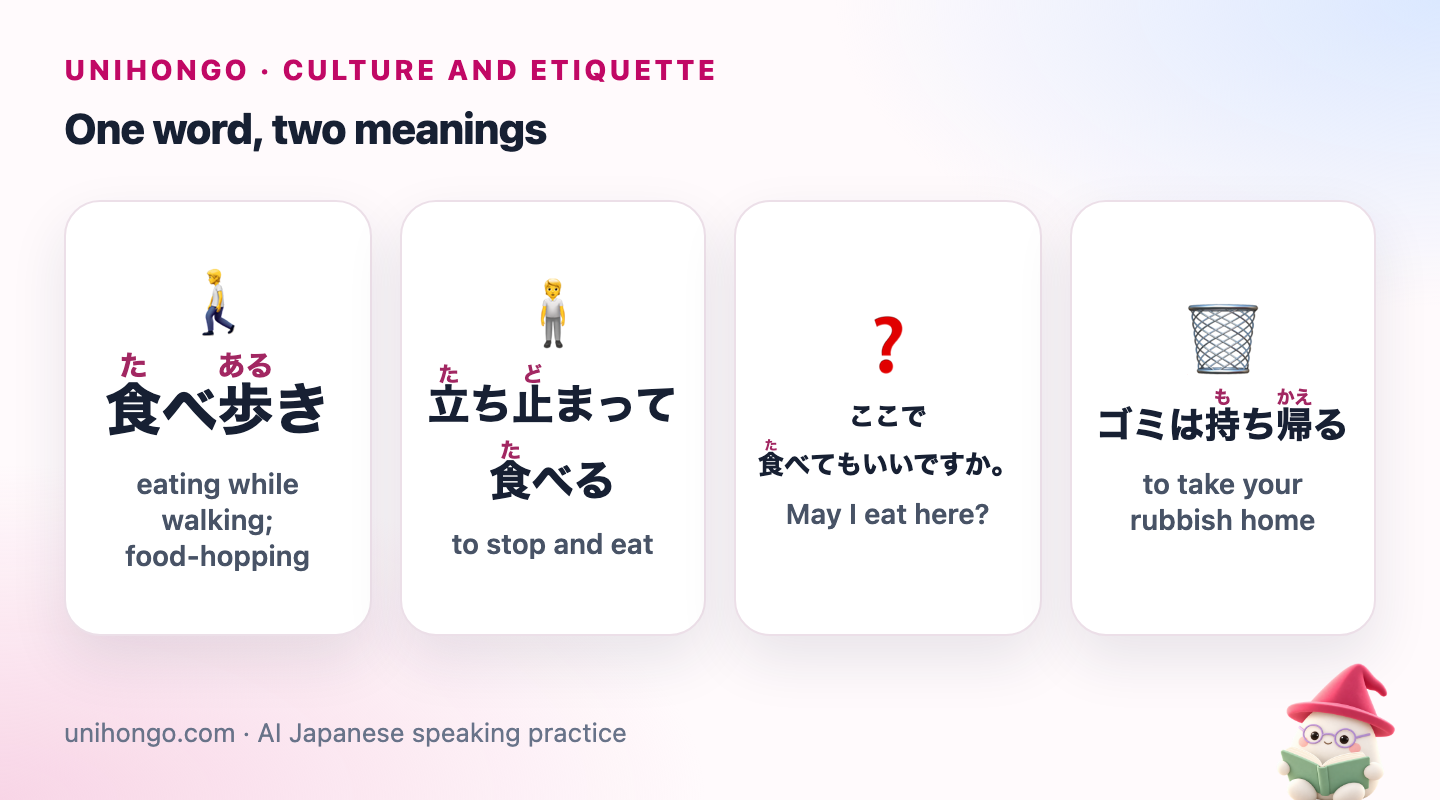
Tabearuki combines taberu (to eat) and aruku (to walk). In everyday speech it can mean literally eating as you walk down the street, which many people avoid. But in travel magazines and on television it usually means going around a market, a shrine approach or a shopping street, buying small things from several shops and tasting as you go. A tabearuki map of a town is a guide to snacks, not an invitation to eat while walking through the crowd.
So a Japanese friend may say tabearuki shiyō (let's go food-hopping) with a smile and still stop beside each stall to eat. The context tells you which meaning is intended.
| Japanese | Romaji | Meaning |
|---|---|---|
| 食べ歩き | tabearuki | eating while walking; food-hopping |
| 立ち止まって食べる | tachidomatte taberu | to stop and eat |
| ここで食べてもいいですか。 | Koko de tabete mo ii desu ka. | May I eat here? |
| ゴミは持ち帰る | gomi wa mochikaeru | to take your rubbish home |
| 食べ歩きしよう! | Tabearuki shiyō! | Let's go food-hopping! (casual) |
Tabearuki as food-hopping: where people go
The positive kind of tabearuki is a favourite weekend outing. Classic spots are covered shopping arcades (shōtengai), the approach roads to famous shrines and temples (sandō), morning and fish markets, hot-spring towns and old merchant streets. Shops there sell small portions designed for snacking: a single croquette, one skewer of grilled rice cakes, a cup of fried chicken, a fish-shaped cake filled with red bean paste.
Food-hopping is also the moment for tabekurabe, comparing the same snack from different shops. Friends buy one each, share them on a bench and decide which they like best. It is sociable and slow, which is part of why people stop to eat: the point is to taste and talk, not to fill up quickly on the move.
| Japanese | Romaji | Meaning |
|---|---|---|
| 商店街 | shōtengai | shopping arcade, shopping street |
| 参道 | sandō | approach road to a shrine or temple |
| 市場 | ichiba | market |
| 食べ比べ | tabekurabe | tasting and comparing |
| 一個ずつ買って、半分こしよう。 | Ikko zutsu katte, hanbunko shiyō. | Let's buy one each and share them half and half. (casual) |
| どっちがおいしかった? | Dotchi ga oishikatta? | Which one tasted better? (casual) |
Why many people avoid it
Nobody will arrest you for eating a rice cracker on the pavement, but you may notice disapproving looks in some places. The reasons people give are mostly about other people rather than about you.
| Japanese | Romaji | Meaning |
|---|---|---|
| 歩きながら食べるのは、ちょっと… | Arukinagara taberu no wa, chotto... | Eating while walking is a bit... (disapproving) |
| 人にぶつかると危ないよ。 | Hito ni butsukaru to abunai yo. | It's risky if you bump into someone. (casual) |
| 服に付いちゃった! | Fuku ni tsuichatta! | It got on my clothes! (casual) |
| Reason | What people worry about |
|---|---|
| Crowds | Bumping into someone and staining their clothes with sauce or ice cream |
| Spills | Dropping food or drips on a clean street or a shop's floor |
| Rubbish | Carrying sticks and wrappers with nowhere to throw them away |
| The shop | Taking food into another shop, especially clothes or crafts |
| Upbringing | Many were taught that eating means sitting, or at least standing still |
These views are not universal. Younger people and busy city workers sometimes grab a quick bite on the move, and the feeling differs between a quiet residential street and a lively food market. A useful rule: if the people around you are standing still to eat, do the same.
What shop signs and staff say
Many shops on busy tourist streets put up requests about where to eat. The wording is usually very polite and indirect: instead of telling you that something is forbidden, they ask you to refrain or say they would be grateful. Recognising these phrases helps you understand what is expected, even when the request is printed in Japanese only.
| Japanese | Romaji | Meaning |
|---|---|---|
| 食べ歩きはご遠慮ください。 | Tabearuki wa goenryo kudasai. | Please refrain from eating while walking. |
| 店内でお召し上がりください。 | Tennai de omeshiagari kudasai. | Please eat inside the shop. |
| 店の前でお召し上がりください。 | Mise no mae de omeshiagari kudasai. | Please eat in front of the shop. |
| お召し上がりになってからお進みください。 | Omeshiagari ni natte kara osusumi kudasai. | Please finish eating before you move on. |
| ゴミはこちらへどうぞ。 | Gomi wa kochira e dōzo. | Please put your rubbish here. |
Festivals, food streets and convenience stores
At a summer festival, the rules feel more relaxed. Stalls sell yakisoba, takoyaki, grilled squid and shaved ice, and people eat standing at the side of the path or sitting on steps, then move on. Even here, walking through a dense crowd with a hot skewer is best avoided, especially near children in yukata.
On shopping streets near shrines and in markets, many shops have a small bench or a standing space just outside. Eat there, return the stick or cup to the shop's bin if they have one, and continue. At a convenience store, you can take your food home, use the eat-in corner if there is one, or eat outside near the shop's bins, where you can throw the wrapper away immediately.
| Japanese | Romaji | Meaning |
|---|---|---|
| イートインはありますか。 | Īto in wa arimasu ka. | Is there an eat-in area? |
| 店内で食べます。 | Tennai de tabemasu. | I'll eat in the shop. |
| 袋は大丈夫です。すぐ食べます。 | Fukuro wa daijōbu desu. Sugu tabemasu. | I don't need a bag. I'll eat it right away. |
| ゴミはどこに捨てればいいですか。 | Gomi wa doko ni sutereba ii desu ka. | Where should I throw away the rubbish? |
| 串はこちらで回収します。 | Kushi wa kochira de kaishū shimasu. | Staff: We'll take the skewers back here. |
Trains, buses and other quiet places
On local trains and city buses, eating is generally avoided, particularly when they are crowded. Long-distance trains are different: buying an ekiben (station lunch box) and eating it in your seat on the shinkansen is a much-loved tradition. Snacks on a quiet commuter train, especially anything with a strong smell, tend to draw looks.
Inside shrines and temples, eat only in rest areas or tea houses. Food is not usually taken into the main grounds, and you should never eat near the place where people pray.
| Japanese | Romaji | Meaning |
|---|---|---|
| 新幹線で駅弁を食べよう。 | Shinkansen de ekiben o tabeyō. | Let's eat a station bento on the shinkansen. |
| 電車の中では食べないほうがいいよ。 | Densha no naka de wa tabenai hō ga ii yo. | Better not to eat on the train. (casual advice) |
| 休憩所はどこですか。 | Kyūkeijo wa doko desu ka. | Where is the rest area? |
Mini dialogue: at a festival stall
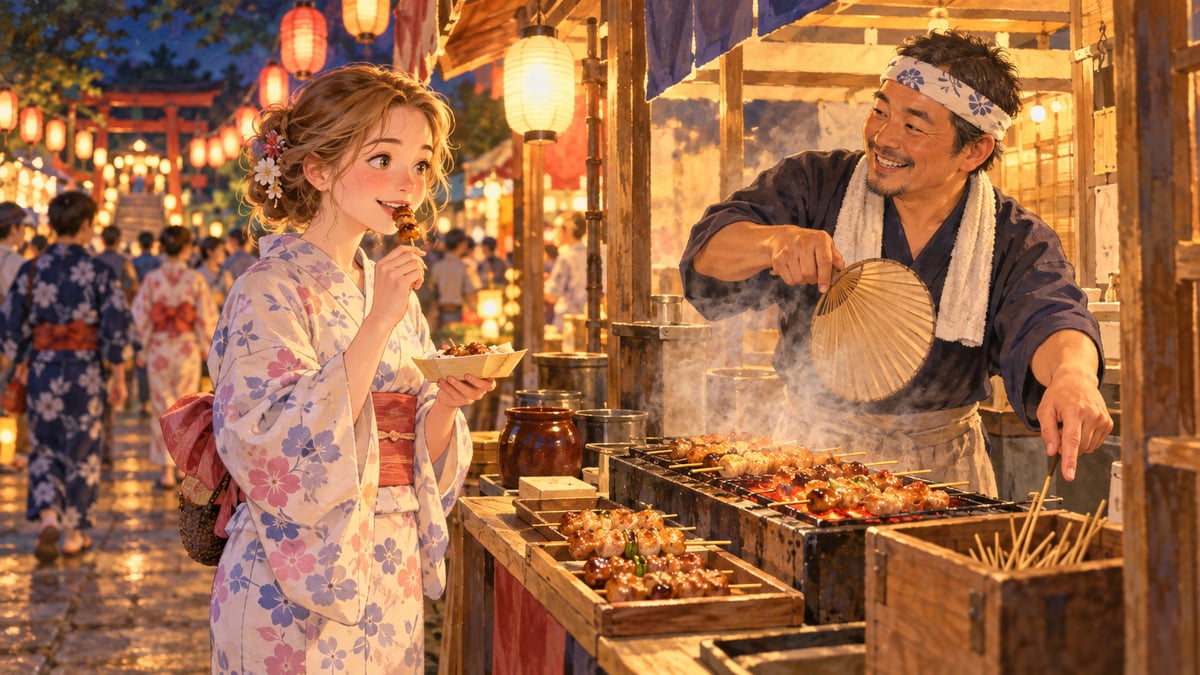
You have just bought grilled chicken skewers at an evening festival. The path is crowded, so you check with the vendor before wandering off.
| Japanese | Romaji | Meaning |
|---|---|---|
| 焼き鳥、二本ください。 | Yakitori, nihon kudasai. | You: Two chicken skewers, please. |
| はい、熱いから気をつけてね。 | Hai, atsui kara ki o tsukete ne. | Vendor: Here you go, careful, they're hot. |
| ここで食べてもいいですか。 | Koko de tabete mo ii desu ka. | You: Is it OK if I eat here? |
| どうぞどうぞ。串はこの箱に入れてね。 | Dōzo dōzo. Kushi wa kono hako ni irete ne. | Vendor: Go ahead. Put the skewers in this box. |
| ありがとうございます。おいしいです! | Arigatō gozaimasu. Oishii desu! | You: Thank you. They're delicious! |
Common learner mistakes
- Assuming a tabearuki tour means eating while walking. It usually means tasting your way around, stopping at each shop.
- Carrying a soft-serve ice cream into a crowded alley. Drips and crowds are exactly what people worry about.
- Taking food from one shop into another shop, especially a clothing or pottery shop.
- Leaving sticks and cups on walls or in plant pots. Hand them back to the shop or take them with you.
- Asking daijōbu? with a shrug instead of a full question. Koko de tabete mo ii desu ka is clear and polite.
- Eating on a quiet local train because you saw someone with an ekiben on the shinkansen. Long-distance trains and commuter trains have different norms.
Rehearse the stall moment with Mocchi first
If you snap a polite request at a shop and want to understand it, type it into Mocchi with /explain, for example /explain お召し上がりになってからお進みください. Mocchi breaks it into chunks, names the honorific pattern and gives the plain meaning, and it keeps a note of the polite forms you find hard so that a later /review brings them back.
Then say it out loud: in AI Sensei, ask Sakura-sensei to play a festival vendor and order two items, ask where to eat and where the rubbish goes. Ask her to speak faster once you feel ready, because real stalls are busy.