

Mata ne and jā ne: the everyday casual goodbyes
The two building blocks of casual partings are じゃあ (jā), "well then", and また (mata), "again". Jā signals that the conversation is closing, mata points to the next time you meet, and the particle ne adds a friendly "OK?". Put them together and you get じゃあ、またね (jā, mata ne), the goodbye you will hear most often among friends, classmates and family.
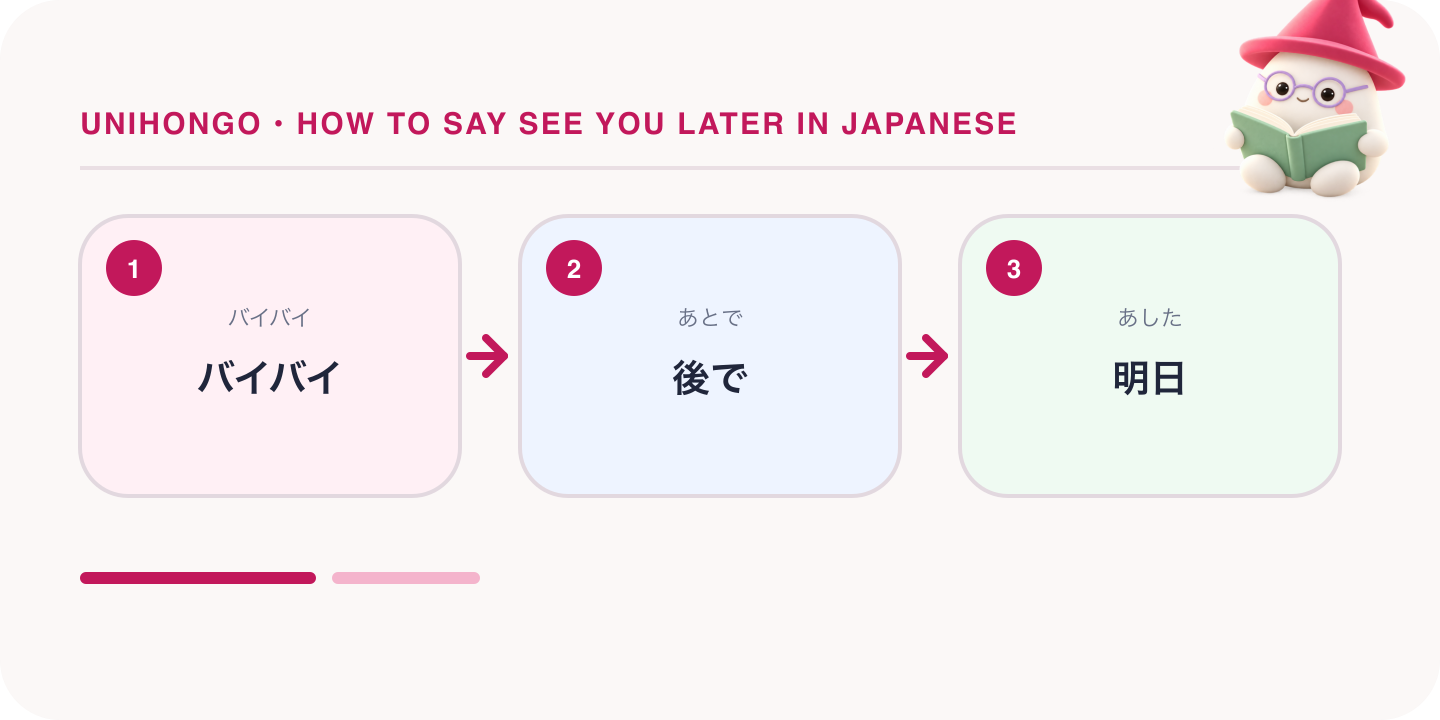
There are many short variations. Jā ne and mata ne work alone. Jā, mata is a little more neutral and is common among men and between colleagues who are friendly. Some people just say mata, or bai bai, borrowed from English and popular with children and young women. In Kansai you will also hear hona, or hona mata, as a local version of jā, mata.
| Japanese | Romaji | Meaning |
|---|---|---|
| じゃあね。 | Jā ne. | See you. / Bye. |
| またね。 | Mata ne. | See you again. |
| じゃあ、またね。 | Jā, mata ne. | Well, see you. |
| じゃあ、また。 | Jā, mata. | See you. (slightly more neutral) |
| バイバイ。 | Bai bai. | Bye-bye. |
| ほな、また。 | Hona, mata. | See you. (Kansai) |
Adding when you'll meet again
Japanese goodbyes become more natural, and more useful, when you add a time word after mata. Mata ato de means later today, so it only fits if you really will see the person again soon. Mata ashita is see you tomorrow, mata raishū is see you next week, and mata kondo means see you next time, with no fixed date.
In polite speech, put dewa in front instead of jā: dewa, mata ashita. You can also turn the time into a friendly check: mata raishū no kayōbi ni, see you next Tuesday, confirms the plan without sounding formal.
| Japanese | Romaji | Meaning |
|---|---|---|
| また後でね。 | Mata ato de ne. | See you later (today). |
| また明日。 | Mata ashita. | See you tomorrow. |
| また来週ね。 | Mata raishū ne. | See you next week. |
| また今度。 | Mata kondo. | See you next time. |
| では、また明日。 | Dewa, mata ashita. | Well then, see you tomorrow. (polite) |
| また月曜日に。 | Mata getsuyōbi ni. | See you on Monday. |
Polite goodbyes for teachers, neighbours and acquaintances
With people you address in desu and masu form, drop jā ne and mata ne and use dewa, mata or dewa, shitsurei shimasu. Shitsurei shimasu literally means "I will be rude", in the sense of excusing yourself, and it is the all-purpose polite way to take your leave in person or on the phone.
If you are likely to see the person again in a related context, such as a teacher before next week's lesson or a neighbour you will meet in the lift, it is common to add a short wish or courtesy: ki o tsukete, take care, or yoi shūmatsu o, have a good weekend.
| Japanese | Romaji | Meaning |
|---|---|---|
| では、また。 | Dewa, mata. | Well then, see you. |
| では、失礼します。 | Dewa, shitsurei shimasu. | Well, I'll be going now. |
| また来週よろしくお願いします。 | Mata raishū yoroshiku onegai shimasu. | I look forward to next week. |
| お気をつけて。 | O-ki o tsukete. | Take care (on your way). |
| 良い週末を。 | Yoi shūmatsu o. | Have a good weekend. |
| ありがとうございました。また来ます。 | Arigatō gozaimashita. Mata kimasu. | Thank you. I'll come again. |
Leaving work: shitsurei shimasu and otsukaresama
At a Japanese workplace, the end of the day has its own script, and see-you-later phrases play a small part. When you leave before others, you say お先に失礼します (osaki ni shitsurei shimasu), "excuse me for leaving ahead of you". The people staying reply お疲れさまです (otsukaresama desu) or お疲れさまでした (otsukaresama deshita), acknowledging your work.
When someone else leaves first, you say otsukaresama deshita to them. Between close colleagues, a casual otsukare and mata ashita is common. To a manager, stick with the full forms. Our otsukaresama guide explains why the greeting also works as hello in the corridor, and when otsukaresama is better than gokurōsama.
| Japanese | Romaji | Meaning |
|---|---|---|
| お先に失礼します。 | Osaki ni shitsurei shimasu. | Excuse me for leaving first. |
| お疲れさまでした。 | Otsukaresama deshita. | Thank you for your work today. |
| お疲れさまです。また明日。 | Otsukaresama desu. Mata ashita. | Good work today. See you tomorrow. |
| お疲れ、また明日ね。 | Otsukare, mata ashita ne. | Cheers, see you tomorrow. (casual) |
| 本日はありがとうございました。失礼いたします。 | Honjitsu wa arigatō gozaimashita. Shitsurei itashimasu. | Thank you for today. I'll take my leave. (formal) |
Business partings with clients
After a meeting with a client or partner company, people do not say see you later. They close by thanking the other side and looking ahead to the next step with 今後ともよろしくお願いいたします (kongo tomo yoroshiku onegai itashimasu), which roughly means "we look forward to continuing to work with you".
When you leave the client's office, a final shitsurei itashimasu with a bow is standard, often at the door and again at the lift. Hosts often see visitors to the lift or the entrance and bow until the doors close, so be ready to bow back. On the phone, business calls also end with shitsurei itashimasu, and the caller traditionally waits for the other side to hang up first.
| Japanese | Romaji | Meaning |
|---|---|---|
| 本日はお時間をいただき、ありがとうございました。 | Honjitsu wa o-jikan o itadaki, arigatō gozaimashita. | Thank you for your time today. |
| 今後ともよろしくお願いいたします。 | Kongo tomo yoroshiku onegai itashimasu. | We look forward to working with you going forward. |
| では、来週の打ち合わせでお会いしましょう。 | Dewa, raishū no uchiawase de o-ai shimashō. | Then let's meet at next week's meeting. |
| 失礼いたします。 | Shitsurei itashimasu. | I'll take my leave. (humble) |
| またご連絡いたします。 | Mata go-renraku itashimasu. | I'll be in touch again. |
Bows, waves and the long goodbye
Body language shifts with the phrase. With friends, a wave with the palm facing out is normal, and people often keep waving as they walk away, turning back once or twice. With teachers, neighbours and colleagues, a small nod or a light bow of about fifteen degrees goes with dewa, shitsurei shimasu. With clients, the bow is deeper and held a little longer.
Japanese goodbyes are often long. Friends may say jā ne, keep talking for a minute, then say mata ne, then wave at the ticket gate. This is not indecision; stretching the goodbye shows you enjoyed the time together. If you walk off after one quick bye, it can feel abrupt.
- Friends: wave, smile, and look back once as you walk away.
- Teachers and acquaintances: a light bow with dewa, shitsurei shimasu.
- Colleagues leaving the office: a nod or small bow with osaki ni shitsurei shimasu.
- Clients: a deeper bow at the door, and another if they see you to the lift.
- Train platforms and ticket gates: waving until the other person is out of sight is common.
What people say back
In most cases you simply mirror the goodbye. If a friend says jā ne, you say un, mata ne. If a colleague says mata ashita, you say mata ashita or otsukaresama. Adding a short wish, such as ki o tsukete ne, take care, makes the reply warmer.
If someone says mata ato de and you will not in fact see them later, it is fine to correct it lightly: ā, kyō wa mō kaeru kara, mata ashita ne, I'm heading home today, so see you tomorrow.
| They say | You reply | Situation |
|---|---|---|
| じゃあね | うん、またね | Friends |
| また明日 | また明日 | Classmates, colleagues |
| お先に失礼します | お疲れさまでした | Colleague leaving work |
| では、失礼します | 失礼します / お気をつけて | Polite acquaintances |
| 気をつけてね | ありがとう、またね | Friends, family |
Sayōnara, and why you rarely need it
Many textbooks teach sayōnara as "goodbye", but in real life it often sounds final, as if you do not expect to meet again, or formal and old-fashioned. It survives in schools, where pupils say sayōnara to the teacher at the end of the day, and in some formal or emotional farewells.
For daily life, jā ne, mata ne, dewa, mata and shitsurei shimasu cover almost everything. Our separate guide on why Japanese people don't say sayōnara goes into its history and the situations where it still fits.
| Japanese | Romaji | Meaning |
|---|---|---|
| 先生、さようなら。 | Sensei, sayōnara. | Goodbye, teacher. (school) |
| 元気でね。 | Genki de ne. | Take care of yourself. (longer parting) |
| また会いましょう。 | Mata aimashō. | Let's meet again. |
Common mistakes
- Saying sayōnara to friends or colleagues every day. It can sound final; use jā ne or osaki ni shitsurei shimasu.
- Using mata ato de when you will not see the person again today. It specifically means later on the same day.
- Saying jā ne or mata ne to a manager or client. Use dewa, shitsurei shimasu or shitsurei itashimasu.
- Leaving the office silently. Always say osaki ni shitsurei shimasu, even if people are busy.
- Saying otsukaresama to customers or strangers. It is for people you have worked with.
- Ending a friendly meet-up with one quick word and walking off. A slightly longer goodbye feels warmer.