
Four boy names that show how it works
Like girl names, boy names combine a sound with kanji the parents choose. These four have been popular in recent years and show the range: a plant, the sun, the sea and a tree.
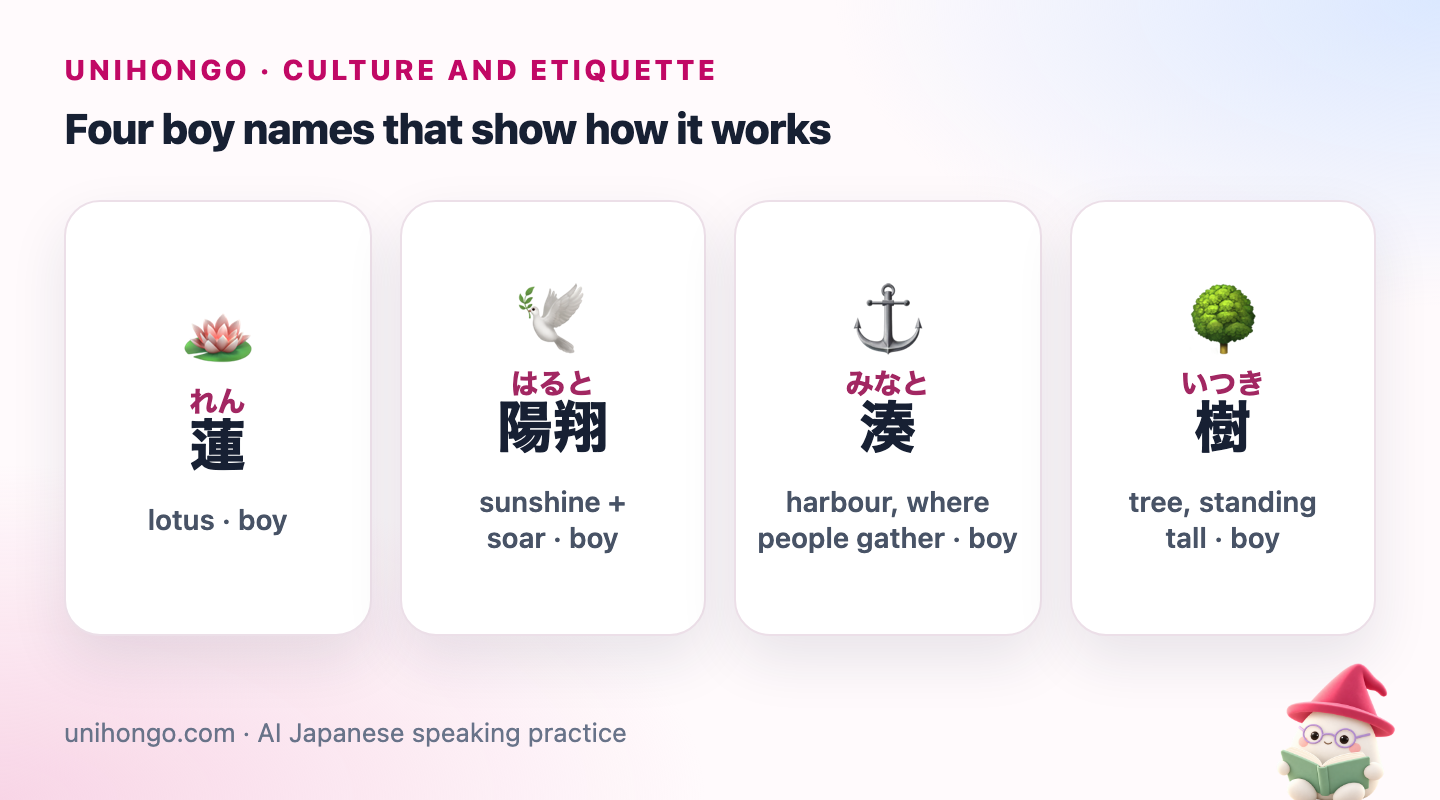
| Japanese | Romaji | Meaning |
|---|---|---|
| 蓮 | Ren | lotus · boy |
| 陽翔 | Haruto | sunshine + soar · boy |
| 湊 | Minato | harbour, where people gather · boy |
| 樹 | Itsuki | tree, standing tall · boy |
The lotus grows clean and beautiful out of muddy water, an image Japanese culture associates with purity. Minato, a harbour, suggests a place where people and ships come together. Itsuki uses 樹, a growing tree, a common wish for a child who grows strong and steady.
Haruto and the many ways to write it
Haruto is a good example of a sound with many spellings. Each one tells a slightly different story, and the parents will often explain their choice with pride.
| Japanese | Romaji | Meaning |
|---|---|---|
| 陽翔 | Haruto | sunshine + soar · boy |
| 晴翔 | Haruto | clear sky + soar · boy |
| 大翔 | Haruto | big + soar · boy |
| 陽斗 | Haruto | sunshine + ladle, the Dipper stars · boy |
| 晴人 | Haruto | clear sky + person · boy |
大翔 is also read Hiroto, and some readers would say Hiroto first. This is why Japanese people ask how a name is read as often as how it is written. The kanji 大 is read dai, ō or hiro depending on the word, and names use readings that everyday words do not.
Common endings and what they suggest
Endings are the quickest clue to a boy's name. Some are old and some are modern, and each pairs with many first kanji.
| Japanese | Romaji | Meaning |
|---|---|---|
| 悠斗 | Yūto | calm, distant + the Dipper · boy |
| 健太 | Kenta | healthy + big · boy |
| 大輝 | Daiki | big + shining · boy |
| 悠真 | Yūma | calm + true · boy |
| Ending | Common kanji | Example names and feel |
|---|---|---|
| -to | 翔, 斗, 人 | Haruto, Yūto: modern and strong |
| -ta | 太 | Kenta, Shōta: cheerful, familiar |
| -ki | 樹, 輝, 貴 | Daiki, Kazuki: growth or brightness |
| -suke | 介, 輔 | Daisuke, Kōsuke: classic, friendly |
| -rō | 郎 | Tarō, Ichirō: traditional |
| -ma | 真, 馬 | Yūma, Kazuma: modern |
Classic names and birth order
In the past, many families showed birth order in a son's name. 太郎 (Tarō) was the eldest, 次郎 (Jirō) the second and 三郎 (Saburō) the third; 一郎 (Ichirō) also suggests a first son. The famous folk tale hero Momotarō, Peach Boy, has the same ending. Today these names sound traditional and a little old-fashioned, and parents who use them rarely mean strict birth order.
Classic grandfather names often use one kanji with a strong meaning, read in a way that feels serious and dignified. Names such as Hiroshi, Takashi, Makoto and Osamu were very common a few generations ago, and you will meet them often among older colleagues, teachers and neighbours. They are rarely chosen for babies now, but nobody thinks of them as strange; they simply sound like a father's or grandfather's generation, in the same way that some English names do.
| Japanese | Romaji | Meaning |
|---|---|---|
| 太郎 | Tarō | big + son: the eldest son · boy |
| 一郎 | Ichirō | first + son · boy |
| 博 | Hiroshi | broad knowledge · boy (classic) |
| 誠 | Makoto | sincerity · boy (classic) |
| 翔太 | Shōta | soar + big · boy |
Names of nature and strength
Modern boy names often use nature kanji that suggest wide spaces and movement: sky, sea, wind and sun. They are short, easy to say and often a single kanji.
| Japanese | Romaji | Meaning |
|---|---|---|
| 蒼 | Sō | deep blue, blue-green · boy |
| 海斗 | Kaito | sea + the Dipper stars · boy |
| 颯 | Hayate | a fresh, sudden breeze · boy |
| 朝陽 | Asahi | morning sun · boy |
| 拓海 | Takumi | open up + sea · boy |
| 大和 | Yamato | an old name for Japan · boy |
These names are often chosen for the feeling of the sound as much as the meaning. Short names like Sō, Ren and Ritsu (律, rhythm, rule) sound crisp and modern, and their single kanji look clean on paper. Longer names like Yamato feel solid and traditional. Parents also say the full name aloud with the family name many times before deciding, to check that it flows and that the initials or the sounds do not clash.
Takumi is another name with very different spellings: 拓海 means opening up the sea, while 匠 means a master craftsman. The sound is the same, the picture is not. 蒼 is also read Aoi, so the same kanji can give a boy two quite different names.
Talking about a baby's name
If a friend or coworker is expecting a baby, the name is a natural topic. Parents often keep it secret until the birth, so ask lightly and accept a smile and a not yet. When they tell you, ask about the kanji and the meaning.

| Japanese | Romaji | Meaning |
|---|---|---|
| 名前、もう決まった? | Namae, mō kimatta? | Have you decided on the name yet? (casual) |
| まだ迷ってるんだ。 | Mada mayotteru n da. | Friend: We still can't decide. |
| 蓮にしました。 | Ren ni shimashita. | Friend: We went with Ren. |
| どういう意味を込めたんですか。 | Dō iu imi o kometa n desu ka. | What meaning did you put into it? |
| 画数も気にしました。 | Kakusū mo ki ni shimashita. | Friend: We also checked the stroke count. |
Some families check the total stroke count of the full name, a kind of name fortune-telling called seimei handan (姓名判断). Many do not care at all; it is one more thing families may or may not consider.
Mini dialogue: introducing yourself with your kanji
| Japanese | Romaji | Meaning |
|---|---|---|
| はじめまして、田中湊です。 | Hajimemashite, Tanaka Minato desu. | Minato: Nice to meet you, I'm Minato Tanaka. |
| みなとさん。どんな字ですか。 | Minato san. Donna ji desu ka. | You: Minato. Which kanji is it? |
| さんずいに「奏でる」の「奏」です。 | Sanzui ni "kanaderu" no "sō" desu. | Minato: The water radical plus the sō of kanaderu. |
| 港の意味ですね。かっこいいです。 | Minato no imi desu ne. Kakkoii desu. | You: It means harbour, right? That's cool. |
Rehearse the name conversation with Mocchi and Haru-sensei
- Ask Mocchi: Which of these boy names have long vowels: Yūto, Kenta, Shōta, Daiki, Tarō? Mocchi explains each one and notes the vowels you miss for your next review.
- Type /kanji 翔 to see the meaning, readings and words for one of the most common name kanji, then do the same for 斗 and 樹.
- Open AI Sensei, choose Haru-sensei and ask the Sensei to play a friend whose baby boy was just born. Ask about the name, the kanji and the meaning, and read the corrections in your session report afterwards.
Mistakes to avoid with boy names
- Shortening long vowels: Yuto and Yūto are heard as different names, and Taro without the long o sounds wrong.
- Reading 大翔 as one fixed name. It can be Haruto or Hiroto; ask.
- Assuming every name ending in -ki is a boy's. Mizuki and Saki are girls' names that end in -ki.
- Calling a boy by his name with kun when you do not know the family. Kun is fine for children and close juniors, but san is safe with adults.
- Choosing a kanji only because it looks powerful. 鬼 (demon) or 悪 (bad) feel wrong in a name, even if they look striking.