

Arimasu ka: asking a shop what it stocks
The verb aru means to exist or to be there, and in shops it does the work of English have. Put the item first, mark it with wa, and finish with arimasu ka. Kasa wa arimasu ka means do you have umbrellas, and because the subject is the item rather than the shop, you never need to say anata or the shop's name.
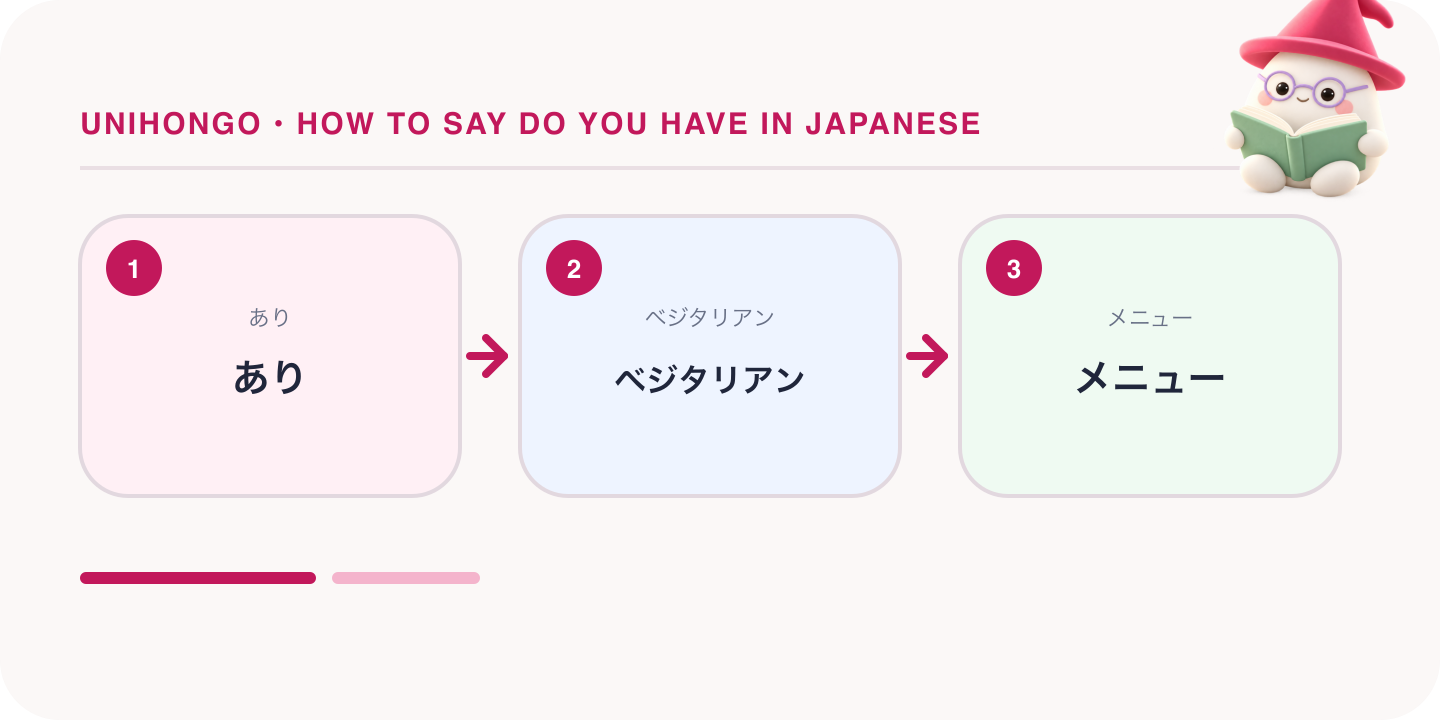
The same pattern asks about facilities and services, because they also exist or do not: toire wa arimasu ka, is there a toilet; Wi-Fi wa arimasu ka, is there Wi-Fi; haitatsu wa arimasu ka, do you do delivery. For a restaurant, use it for dishes and options: bejitarian no menyū wa arimasu ka. When you want to soften the question, add sumimasen at the front or turn it into arimasu ka with a slight fall at the end rather than a sharp rise.
When the item is in front of you, point and say kore no plus the variant: kore no shiro wa arimasu ka, do you have this in white. That small no tells the assistant you mean the same product in a different version.
| Japanese | Romaji | Meaning |
|---|---|---|
| すみません、傘はありますか。 | Sumimasen, kasa wa arimasu ka. | Excuse me, do you have umbrellas? |
| これの白はありますか。 | Kore no shiro wa arimasu ka. | Do you have this in white? |
| ベジタリアンのメニューはありますか。 | Bejitarian no menyū wa arimasu ka. | Do you have a vegetarian menu? |
| もっと安いのはありますか。 | Motto yasui no wa arimasu ka. | Do you have a cheaper one? |
| トイレはありますか。 | Toire wa arimasu ka. | Is there a toilet? |
| 日本語の本はどこにありますか。 | Nihongo no hon wa doko ni arimasu ka. | Where are the Japanese books? |
The replies you will hear back
Shop staff rarely answer with a plain hai or iie. They use polite service language, and three replies cover most cases. Gozaimasu is the humble polite form of arimasu, so hai, gozaimasu means yes, we have it, often followed by kochira desu, here it is, or go-annai shimasu, I'll show you. Kirashite orimasu means we are out of it, from kirasu, to run out; it implies the item is normally stocked and may come back. Atsukatte orimasen means we do not carry it at all, from atsukau, to handle or deal in.
Shōshō o-machi kudasai, please wait a moment, usually means the assistant is going to check the stockroom, zaiko. Nyūka yotei desu means a delivery is expected, and you can ask when with itsu goro nyūka shimasu ka. If it is sold out for good, you may hear urikire desu.
The natural reaction to a no is sō desu ka, I see, followed by a thank-you: arigatō gozaimasu. If you want to keep trying, ask hoka no mise ni wa arimasu ka, does another branch have it, or toriyose wa dekimasu ka, can you order it in.
| Japanese | Romaji | Meaning |
|---|---|---|
| はい、ございます。こちらです。 | Hai, gozaimasu. Kochira desu. | Yes, we have it. Here you are. |
| 申し訳ございません、ただいま切らしております。 | Mōshiwake gozaimasen, tadaima kirashite orimasu. | I'm sorry, we're out of it at the moment. |
| そちらは扱っておりません。 | Sochira wa atsukatte orimasen. | We don't carry that. |
| 在庫を確認してまいります。少々お待ちください。 | Zaiko o kakunin shite mairimasu. Shōshō o-machi kudasai. | I'll check the stock. Please wait a moment. |
| いつごろ入荷しますか。 | Itsu goro nyūka shimasu ka. | Roughly when will it come in? |
| 取り寄せはできますか。 | Toriyose wa dekimasu ka. | Can you order it in? |
Motte imasu ka: things a person owns or carries
When the owner is a person rather than a shop, switch to motsu, to hold or possess. Motte imasu ka asks whether someone has something in their possession, either on them right now or as a belonging: pen o motte imasu ka, do you have a pen; kuruma o motte imasu ka, do you own a car. Note the particle: motsu takes o, whereas aru takes wa or ga, because motsu is an action the person performs.
In casual speech the verb contracts to motteru. Pen motteru? with a rising tone is what friends and colleagues say to each other, and the answer is motteru yo or motte nai. You can also answer a motte imasu ka question with aru or nai, because from your point of view the pen either exists in your bag or it does not; both answers are natural.
Arimasu also works for abstract possessions: jikan ga arimasu ka, do you have time; o-kane ga arimasen, I have no money. For physical objects you are carrying, motte imasu is the more precise choice.
| Japanese | Romaji | Meaning |
|---|---|---|
| ペンを持っていますか。 | Pen o motte imasu ka. | Do you have a pen? |
| 車を持っていますか。 | Kuruma o motte imasu ka. | Do you own a car? |
| 充電器、持ってる? | Jūdenki, motteru? | Got a charger? (casual) |
| はい、持っています。どうぞ。 | Hai, motte imasu. Dōzo. | Yes, I do. Here you are. |
| 今は持っていません。 | Ima wa motte imasen. | I don't have it on me right now. |
| 今日、時間ありますか。 | Kyō, jikan arimasu ka. | Do you have time today? |
O-mochi desu ka: what the cashier asks
At the till, staff use the honorific version of motsu, which is o-mochi desu ka or o-mochi deshō ka. The most common question in Japan by a wide margin is pointo kādo wa o-mochi desu ka, do you have a point card. You will also hear it about coupons, kūpon, a membership card, kaiin kādo, and an app, apuri. Because the honorific is about you, the customer, you answer with a plain polite form, never with o-mochi yourself.
The answers are short: hai, arimasu, or hai, kore desu while you hold the card out; nai desu or motte imasen if you do not have one. Many learners freeze here purely because they were not expecting the question, so rehearse it until the reply is reflexive. If staff offer to make you a card, o-tsukuri shimashō ka, decline with kekkō desu.
| Japanese | Romaji | Meaning |
|---|---|---|
| ポイントカードはお持ちですか。 | Pointo kādo wa o-mochi desu ka. | Do you have a point card? |
| クーポンはお持ちでしょうか。 | Kūpon wa o-mochi deshō ka. | Do you have a coupon? |
| はい、これです。 | Hai, kore desu. | Yes, here it is. |
| いいえ、持っていません。 | Iie, motte imasen. | No, I don't. |
| お作りしましょうか。 | O-tsukuri shimashō ka. | Shall I make one for you? |
| 今日は結構です。 | Kyō wa kekkō desu. | Not today, thank you. |
Imasu ka: family, friends and pets
Do you have a brother, a girlfriend, a dog: all of these use imasu, the existence verb for living beings, and never arimasu. Kyōdai wa imasu ka, do you have siblings, is a standard early question in Japanese conversation. Petto wa imasu ka, do you have pets, is another. The reply mirrors the question: imasu or imasen, and then the detail with a counter: ani ga hitori imasu, I have one older brother; inu ga ni-hiki imasu, I have two dogs.
The line between imasu and arimasu is whether the thing moves by its own will. People and animals take imasu; plants, cars and objects take arimasu. A learner who says imōto ga arimasu is understood, but it lands like saying I possess a younger sister as an object. In casual speech imasu becomes iru: kyōdai iru? and the answer iru yo or inai.
| Japanese | Romaji | Meaning |
|---|---|---|
| 兄弟はいますか。 | Kyōdai wa imasu ka. | Do you have siblings? |
| 姉が一人います。 | Ane ga hitori imasu. | I have one older sister. |
| ペットはいますか。 | Petto wa imasu ka. | Do you have pets? |
| 猫が二匹います。 | Neko ga ni-hiki imasu. | I have two cats. |
| 日本に友達はいますか。 | Nihon ni tomodachi wa imasu ka. | Do you have friends in Japan? |
| 彼女、いるの? | Kanojo, iru no? | Do you have a girlfriend? (casual) |
Asking for a size, colour or version
Once you know arimasu ka, asking for variants is a matter of vocabulary. Sizes in clothing use the Japanese readings of the letters: esu, emu, eru, and eru-eru for XL. Shoes and some clothing use centimetres. Colours follow the item with no. The table gives the words you need for the most common requests, and the pattern is always word plus wa arimasu ka, or, when you are holding the item, kore no plus word plus wa arimasu ka.
| Word | Reading | Meaning |
|---|---|---|
| 大きいサイズ | ōkii saizu | a bigger size |
| 小さいサイズ | chiisai saizu | a smaller size |
| Lサイズ | eru saizu | size L |
| ワンサイズ上 | wan saizu ue | one size up |
| 別の色 | betsu no iro | a different colour |
| 黒 | kuro | black |
| 白 | shiro | white |
| 紺 | kon | navy |
| 在庫 | zaiko | stock |
| 新品 | shinpin | a new one (unopened) |
| 試着 | shichaku | trying on |
Shichaku shite mo ii desu ka, may I try it on, usually follows the size question. Sizing conventions differ between brands and countries, so check the label rather than assuming your usual size matches.
Choosing the verb: a quick guide
When you hesitate, run through this list from the top. The first line that fits tells you which verb to use, and most everyday questions are decided by the first two lines.
- Is it a person or an animal? Use imasu ka.
- Is a shop, restaurant or place the one that has it? Use arimasu ka.
- Is a person carrying it or does a person own it? Use motte imasu ka.
- Is it abstract, such as time, money, plans or experience? Use arimasu ka.
- Is a member of staff asking you? Expect o-mochi desu ka and answer arimasu or nai desu.
- Are you talking to a friend? Shorten to aru, motteru or iru with a rising tone.
Common mistakes
The classic error is arimasu for people, which we covered above. The second is carrying English word order into the question and putting anata wa at the front: anata wa pen o motte imasu ka is grammatical but sounds like a textbook, and in a shop anata is never needed. Drop the subject and let the item lead.
The third is answering an o-mochi desu ka question with o-mochi desu, which turns an honorific about the listener onto yourself. Answer with arimasu, motte imasu or nai desu. A related slip is using gozaimasu about your own belongings; it is service language, so keep it for recognising replies rather than producing them.
Finally, if you did not catch a reply, sumimasen, mō ichido ii desu ka gets you a slower repeat, and staff will often rephrase kirashite orimasu as ima nai n desu, which is easier to hear.
| Japanese | Romaji | Meaning |
|---|---|---|
| 妹がいます。 | Imōto ga imasu. | I have a younger sister. |
| ペン、ありますか。 | Pen, arimasu ka. | Do you have a pen? (to a shop) |
| はい、あります。 | Hai, arimasu. | Yes, I have it. |
| すみません、もう一度いいですか。 | Sumimasen, mō ichido ii desu ka. | Sorry, could you say that again? |
| 今はないんですね。わかりました。 | Ima wa nai n desu ne. Wakarimashita. | You don't have it right now, I see. Understood. |