
What Halloween looks like in Japan
The word is Harowin (ハロウィン), sometimes written with a long vowel as ハロウィーン. It falls on 31 October as elsewhere, but the season starts weeks earlier in shop windows. The three pillars are costumes, events and sweets. Adults take part as eagerly as children, and for many people the whole point is the chance to dress up in public once a year.
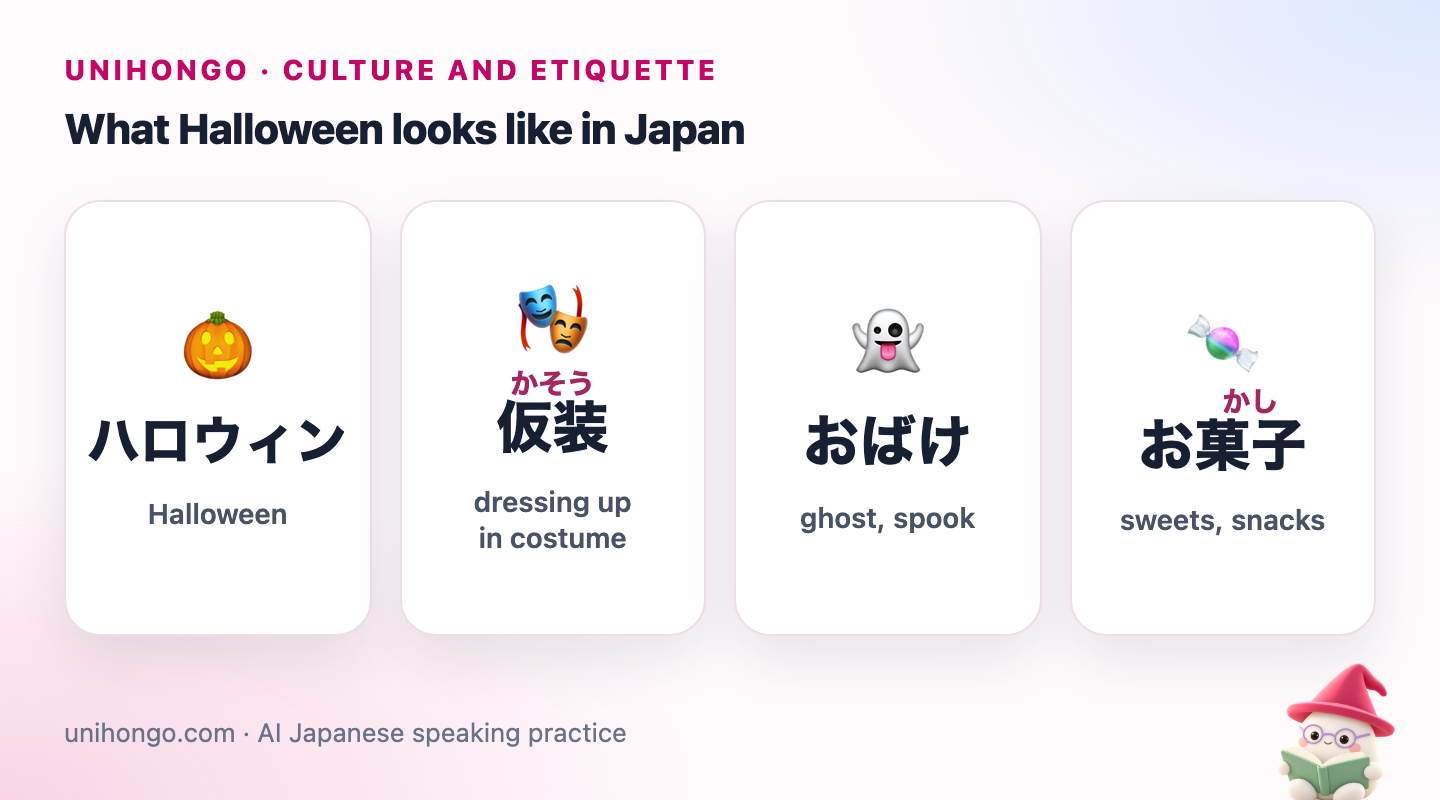
| Japanese | Romaji | Meaning |
|---|---|---|
| ハロウィン | Harowin | Halloween |
| 仮装 | kasō | dressing up in costume |
| おばけ | obake | ghost, spook |
| お菓子 | okashi | sweets, snacks |
| ハロウィンは何かしますか。 | Harowin wa nanika shimasu ka. | Are you doing anything for Halloween? |
| 魔女の仮装をします。 | Majo no kasō o shimasu. | I'm dressing up as a witch. |
Theme parks, shops and school events
The popularity of Halloween in Japan is usually credited to the big theme parks, whose autumn events let visitors come in costume, and to confectionery makers, who saw a new gift season between summer and Christmas. Today almost every shopping centre decorates.
For small children, the event is organised and safe: a parade around the nursery school, or a stamp rally along a shopping street where shopkeepers hand out sweets. For students and young workers it means a party, a themed café or a night out with friends in matching outfits.
Shibuya: the gathering the city asks people to skip
For years, crowds in costume filled the streets around Shibuya's scramble crossing on Halloween night, with no organiser and no venue. The numbers brought litter, noise, safety worries and trouble for local shops.
In recent years Shibuya Ward has responded with a clear message that the area is not a Halloween venue, asking people not to come for that purpose, and with restrictions on drinking alcohol in the street around the station. Rules change, so read the ward's notices before you plan anything. Visitors who want the costume experience are better served by ticketed events.
Trick or treat in Japanese
Children learn the English phrase in its katakana form. The Japanese translation is a full sentence, and a nice piece of grammar: okashi o kurenai to, if you do not give me sweets, itazura suru zo, I will do mischief. Kurenai is the negative of kureru, to give to me, to after a plain verb means if, and zo is a playful threat.
The sentence is plain-form and cheeky, which suits a child in a cape. An adult handing out sweets simply answers with a smile and hai, dōzo, here you are.
| Japanese | Romaji | Meaning |
|---|---|---|
| トリック・オア・トリート | torikku oa torīto | trick or treat |
| お菓子をくれないといたずらするぞ。 | Okashi o kurenai to itazura suru zo. | Give me sweets or I'll play a trick! |
| ハッピーハロウィン! | Happī Harowin! | Happy Halloween! |
| はい、どうぞ。 | Hai, dōzo. | Here you are. |
| いたずら | itazura | a prank, mischief |
Halloween vocabulary: from kabocha to majo
Kabocha (かぼちゃ) is pumpkin or squash. The Japanese kind is green-skinned and sweet, eaten simmered or in tempura; the orange carving pumpkin appears mainly as decoration. The word is usually traced to Cambodia, the country the vegetable was thought to have come from.
Obake (おばけ) is a general word for a spooky being, from bakeru, to change shape. A yūrei (幽霊) is specifically the ghost of a dead person. Children say obake; ghost stories say yūrei.
| Japanese | Romaji | Meaning |
|---|---|---|
| かぼちゃ | kabocha | pumpkin, squash |
| 魔女 | majo | witch |
| 幽霊 | yūrei | ghost of a dead person |
| 吸血鬼 | kyūketsuki | vampire |
| ゾンビ | zonbi | zombie |
| がいこつ | gaikotsu | skeleton |
| こうもり | kōmori | bat |
| 黒猫 | kuroneko | black cat |
| 飾り付け | kazaritsuke | decorations |
Japan's own season for spirits is summer, not autumn. Obon, in midsummer, is when ancestors are said to return home, and ghost stories, kaidan (怪談), are a summer tradition. Halloween sits on top of that calendar as pure fun.
Kikan gentei: reading the seasonal shelves
The two kanji compounds to spot on packaging are kikan gentei (期間限定), for a limited period, and kisetsu gentei (季節限定), seasonal only. In autumn they sit on pumpkin, sweet potato and chestnut flavours of almost everything: puddings, lattes, chocolate, ice cream.
Aji (味) means flavour, so kabocha aji is pumpkin flavour. Limited products vanish quickly, which is the idea, so it is natural to ask a clerk how long something will be on sale.
| Japanese | Romaji | Meaning |
|---|---|---|
| 期間限定 | kikan gentei | limited-time only |
| 季節限定 | kisetsu gentei | seasonal only |
| かぼちゃ味 | kabocha aji | pumpkin flavour |
| かぼちゃプリンを一つください。 | Kabocha purin o hitotsu kudasai. | One pumpkin pudding, please. |
| これはいつまで売っていますか。 | Kore wa itsu made utte imasu ka. | Until when is this on sale? |
| ハロウィン限定の商品はありますか。 | Harowin gentei no shōhin wa arimasu ka. | Do you have any Halloween-only items? |
Complimenting a costume and asking for a photo
People in costume generally enjoy being noticed, and a polite compliment is welcome. Lead with the compliment, then ask. Use desu and masu with anyone you do not know, and wait for a clear yes before you raise your phone.
| Japanese | Romaji | Meaning |
|---|---|---|
| その仮装、すてきですね。 | Sono kasō, suteki desu ne. | Your costume is lovely. |
| すごく似合っていますね。 | Sugoku niatte imasu ne. | It really suits you. |
| 何の仮装ですか。 | Nan no kasō desu ka. | What are you dressed as? |
| 手作りですか。 | Tezukuri desu ka. | Did you make it yourself? |
| 写真を撮ってもいいですか。 | Shashin o totte mo ii desu ka. | May I take a photo? |
| 一緒に写真を撮ってもらえますか。 | Issho ni shashin o totte moraemasu ka. | Could we take a photo together? |
| SNSに載せてもいいですか。 | Esu-enu-esu ni nosete mo ii desu ka. | May I post it online? |
| ありがとうございました。 | Arigatō gozaimashita. | Thank you very much. |
With friends, the casual version is enough: meccha kawaii, so cute, and shashin torō, let's take a picture.
Costume manners that keep everyone happy
A few habits are expected at Halloween events in Japan, and following them is the quickest way to be welcome.
- Ask before you photograph anyone, and ask again before you post the picture.
- Get changed at home, at the venue or in a paid changing space, not in station or shop toilets.
- Take your rubbish home with you; public bins are scarce.
- Follow local rules on street drinking, and keep large props and fake blood away from other passengers on trains.
- If staff or signs ask you to move on, do so at once and without argument.