

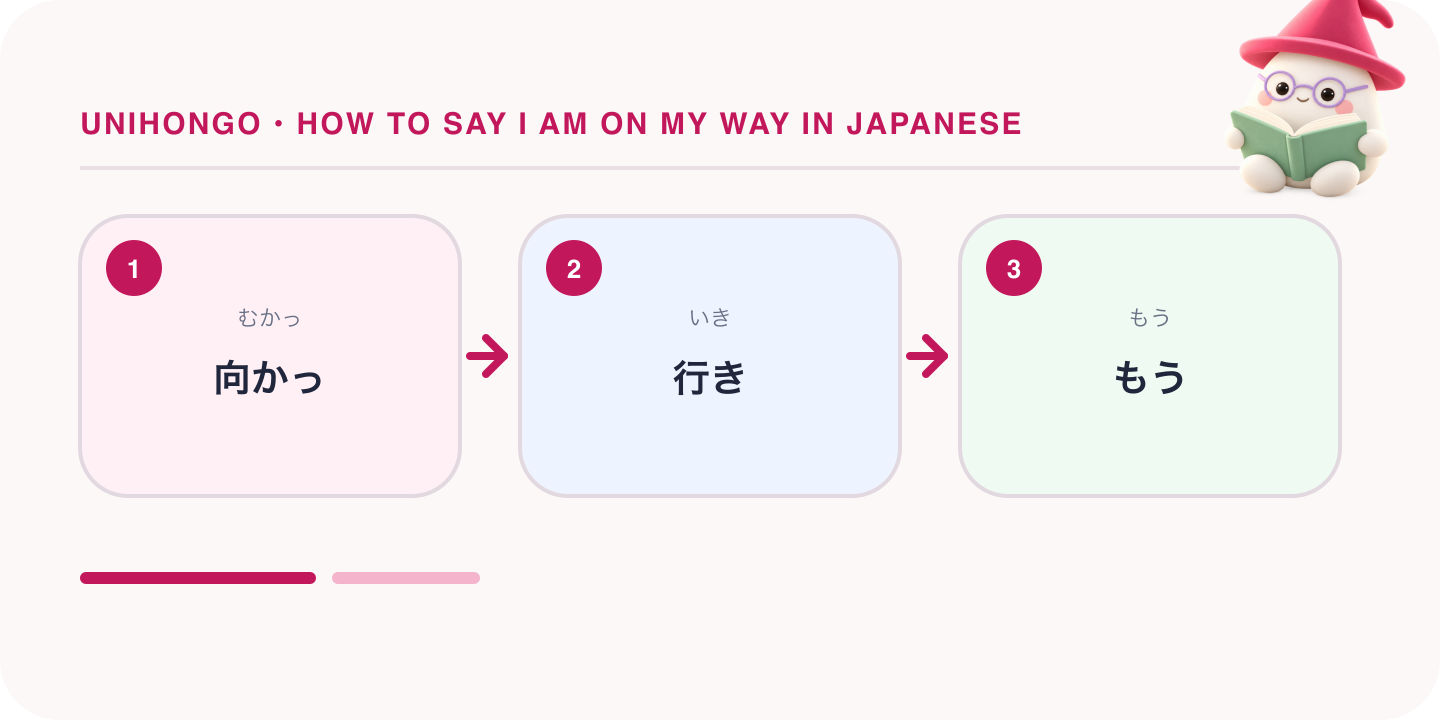
Ima mukatte imasu: the core phrase
Mukau means to head towards a place, and the continuous form mukatte imasu means I am heading there right now. Ima, now, goes at the front. The phrase says nothing about whether you are early or late, which is why it is so useful: it simply reports that you are in motion. To a friend, the contracted mukatteru is what you actually type, often with yo for a bit of reassurance.
Ima iku, or ima ikimasu politely, is a close relative. It fits when you have just set off or are about to, and it is the standard reply when someone asks where you are and you have not left yet. Ima mukatte imasu implies you are already moving. Both are correct in a text; the choice only tells the listener how far along you are.
In a message to a shop, a hotel or a business contact, use the full polite form and add the destination: ima sochira ni mukatte imasu, I am heading to your place now. Sochira, there where you are, is the polite way to refer to their location without naming it.
| Japanese | Romaji | Meaning |
|---|---|---|
| 今向かっています。 | Ima mukatte imasu. | I'm on my way now. |
| 今向かってるよ。 | Ima mukatteru yo. | On my way. (casual) |
| 今行きます。 | Ima ikimasu. | I'm coming now. (polite) |
| 今そちらに向かっています。 | Ima sochira ni mukatte imasu. | I'm heading to you now. (polite) |
| もう出たよ。 | Mō deta yo. | I've already left. |
| これから出ます。 | Kore kara demasu. | I'm leaving now. |
Saying when you will arrive
The other person almost always wants a time, so attach one. Mō sugu tsukimasu, I'll arrive very soon, is for the last few minutes. For anything longer, use ato plus a number of minutes plus de tsukimasu: ato go-fun de tsukimasu, I'll be there in five minutes. Ato means remaining, and de marks the time it takes. If you are unsure, add kurai or gurai after the minutes: ato jup-pun gurai de.
Fun counts minutes and changes sound after some numbers: ip-pun, ni-fun, san-pun, yon-pun, go-fun, rop-pun, nana-fun, hap-pun, kyū-fun, jup-pun. The ones you will use most are go-fun, jup-pun, jūgo-fun and sanjup-pun. For longer waits, switch to a clock time: jū-ji han goro ni tsukimasu, I'll arrive around half past ten.
A useful softener is tsuku to omoimasu, I think I'll arrive, which admits that trains and traffic are not fully in your control. Yotei, schedule, does the same in a slightly more formal way: jū-ji ni tsuku yotei desu, I'm due to arrive at ten.
| Japanese | Romaji | Meaning |
|---|---|---|
| もうすぐ着きます。 | Mō sugu tsukimasu. | I'll be there very soon. |
| あと五分で着きます。 | Ato go-fun de tsukimasu. | I'll arrive in five minutes. |
| あと十分くらいで着くと思います。 | Ato jup-pun kurai de tsuku to omoimasu. | I think I'll arrive in about ten minutes. |
| 十時半ごろに着きます。 | Jū-ji han goro ni tsukimasu. | I'll arrive around half past ten. |
| もうちょっとで着く! | Mō chotto de tsuku! | Almost there! (casual) |
| ちょっと遅れそう。 | Chotto okuresō. | Looks like I'll be a bit late. (casual) |
Saying where you are right now
A location is often more useful than a time, especially in a city where the other person can judge distance better than you. The pattern is ima plus place plus desu, or ni imasu: ima Shibuya desu, I'm in Shibuya now; ima eki ni imasu, I'm at the station. To describe where on a journey you are, name the train and the next stop: ima densha no naka de, tsugi ga Shinjuku, I'm on the train, Shinjuku is next.
Landmarks work well in Japan because everyone uses the same ones: a station exit, a convenience store, a big shop sign. Kita-guchi, north exit; minami-guchi, south exit; kaisatsu, the ticket gate; and the name of a convenience store cover most meeting points. If the other person is already there, ask doko ni iru?, where are you, and go to them rather than describing your own position at length.
When someone asks ima dono hen?, whereabouts are you now, they want a quick position, not a story. Answer with the place and the estimated minutes together: ima Ueno, ato jūgo-fun kurai.
| Japanese | Romaji | Meaning |
|---|---|---|
| 今、渋谷です。 | Ima, Shibuya desu. | I'm in Shibuya now. |
| 今、電車の中です。次が新宿です。 | Ima, densha no naka desu. Tsugi ga Shinjuku desu. | I'm on the train. Shinjuku is next. |
| 今どのへん? | Ima dono hen? | Whereabouts are you now? (casual) |
| 改札を出たところです。 | Kaisatsu o deta tokoro desu. | I've just come out of the ticket gate. |
| 北口のコンビニの前にいます。 | Kita-guchi no konbini no mae ni imasu. | I'm in front of the convenience store at the north exit. |
| どこにいる? | Doko ni iru? | Where are you? (casual) |
Texting a friend
Messages between friends are short, in plain form, and often skip particles. A typical exchange runs: doko? from the person waiting, ima mukatteru, ato go-fun from the one moving, and ryōkai or okkē back. Yo and ne soften the plain forms so they do not read as curt. Stickers and a single emoji do a lot of the emotional work, so the words can stay minimal.
When you arrive, send tsuita, I've arrived, and where you are. If you cannot see each other, describe what you are standing next to rather than sending directions. The final message is usually mieta, I can see you, or a wave.
| Japanese | Romaji | Meaning |
|---|---|---|
| 今どこ? | Ima doko? | Where are you now? |
| 向かってる!あと五分。 | Mukatteru! Ato go-fun. | On my way! Five minutes. |
| 了解。先に入ってるね。 | Ryōkai. Saki ni haitteru ne. | Got it. I'll go in ahead of you. |
| 着いたよ。改札の前にいる。 | Tsuita yo. Kaisatsu no mae ni iru. | I'm here. I'm in front of the ticket gate. |
| 見えた! | Mieta! | I can see you! |
Calling a shop, restaurant or office
On the phone to a business, structure matters more than vocabulary. Give the name on the booking and the time, say you are on your way, give an estimate, and ask whether that is all right. Restaurants and hair salons in particular want to know whether to hold your slot. Ima mukatte orimasu, using the humble orimasu, is the most polite version of the core phrase, though mukatte imasu is perfectly acceptable.
If you are heading to a company for a meeting, the same sentences work with the contact's name and a short apology if you are cutting it fine. How long a restaurant will hold a table, or a clinic will hold an appointment, varies by place, so ask directly instead of assuming: nan-pun made daijōbu desu ka, until how many minutes past is it all right.
| Japanese | Romaji | Meaning |
|---|---|---|
| 七時に予約した田中ですが、今向かっております。 | Shichi-ji ni yoyaku shita Tanaka desu ga, ima mukatte orimasu. | This is Tanaka with a seven o'clock booking; I'm on my way now. |
| 十分ほど遅れて着きそうです。 | Jup-pun hodo okurete tsukisō desu. | It looks like I'll arrive about ten minutes late. |
| 席はそのままで大丈夫でしょうか。 | Seki wa sono mama de daijōbu deshō ka. | Will the table still be held? |
| 何分まで大丈夫ですか。 | Nan-pun made daijōbu desu ka. | Until how many minutes past is it all right? |
| お待ちしております。 | O-machi shite orimasu. | We'll be waiting for you. (what staff say) |
| 今、駅に着きました。五分ほどで伺います。 | Ima, eki ni tsukimashita. Go-fun hodo de ukagaimasu. | I've just reached the station. I'll be there in about five minutes. (humble) |
Words for the journey
The vocabulary below covers the messages in this guide. Most of it is about stations, because most meetings in Japanese cities start at one.
| Word | Reading | Meaning |
|---|---|---|
| 向かう | mukau | to head towards |
| 着く | tsuku | to arrive |
| 出る | deru | to leave, to set off |
| 遅れる | okureru | to be late |
| あと五分 | ato go-fun | five more minutes |
| もうすぐ | mō sugu | very soon |
| 改札 | kaisatsu | ticket gate |
| 北口 | kita-guchi | north exit |
| 乗り換え | norikae | transfer, change of train |
| 次の駅 | tsugi no eki | the next station |
| 了解 | ryōkai | got it, understood |
| 待ち合わせ | machiawase | a meeting arrangement |
Machiawase, the arrangement to meet, gives you machiawase basho, the meeting point, and machiawase jikan, the meeting time. Confirming both before you set off saves most of the messages in this guide.
Iku or kuru: the viewpoint rule
English speakers say I'm coming when heading towards the listener. Japanese does not. Iku is movement away from where the speaker is now, and kuru is movement towards the speaker, so when you are on your way to a friend you are leaving your spot, and you say ima iku. Saying ima kuru would mean someone is coming to you.
The rule holds on the phone as well: the person waiting says hayaku kite, come quickly, and the person moving says ima iku, sugu iku. Once you arrive, the same friend says kita, you came, and you say kita yo, I'm here, because now the arrival is being viewed from the meeting point. There is one polite exception: when speaking humbly to a customer or senior, ukagaimasu or mairimasu replaces ikimasu, as in go-fun hodo de mairimasu.
- You, heading to them: ima iku, ima ikimasu, ima mukatte imasu
- Them, waiting for you: hayaku kite, itsu kuru?
- You, after arriving: kita yo, tsuita yo, tsukimashita
- You, humble, to a customer: sugu mairimasu, go-fun hodo de ukagaimasu
Common mistakes
The first mistake is ima kimasu for I'm coming, which puts you on the wrong side of the viewpoint rule above. The second is a vague message with no time: ima mukatte imasu alone leaves the other person guessing, so add ato and minutes or a location. The third is over-promising: saying ato go-fun when it will be fifteen costs more goodwill than an honest jūgo-fun would.
On the phone, learners sometimes forget to identify themselves and launch straight into ima mukatte imasu, which leaves the restaurant unsure whose booking is affected. Start with your name and the booking time. And if the other person says o-machi shite orimasu, we'll be waiting, the right reply is a simple yoroshiku onegai shimasu.
| Japanese | Romaji | Meaning |
|---|---|---|
| 今行くね。 | Ima iku ne. | I'm coming now. (correct viewpoint) |
| ごめん、十五分くらいかかりそう。 | Gomen, jūgo-fun kurai kakarisō. | Sorry, it looks like it'll take about fifteen minutes. |
| 予約の山田です。今向かっています。 | Yoyaku no Yamada desu. Ima mukatte imasu. | This is Yamada with a booking. I'm on my way. |
| よろしくお願いします。 | Yoroshiku onegai shimasu. | Thank you, please (in reply to we'll be waiting). |
| 電車が止まっていて、少し遅れます。 | Densha ga tomatte ite, sukoshi okuremasu. | The train has stopped, so I'll be a little late. |