
What kaidan means
Kaidan is written 怪談: the first kanji means strange, suspicious or uncanny, and the second means talk or tale. It covers old tales of vengeful spirits, modern school ghost stories and anything in between. The word has a classic ring. When friends swap stories today they usually call them kowai hanashi (怖い話), scary stories.
You may have seen the spelling Kwaidan. That is an older way of writing the same word in Roman letters, used by Lafcadio Hearn as the title of his 1904 collection of Japanese ghost stories in English.
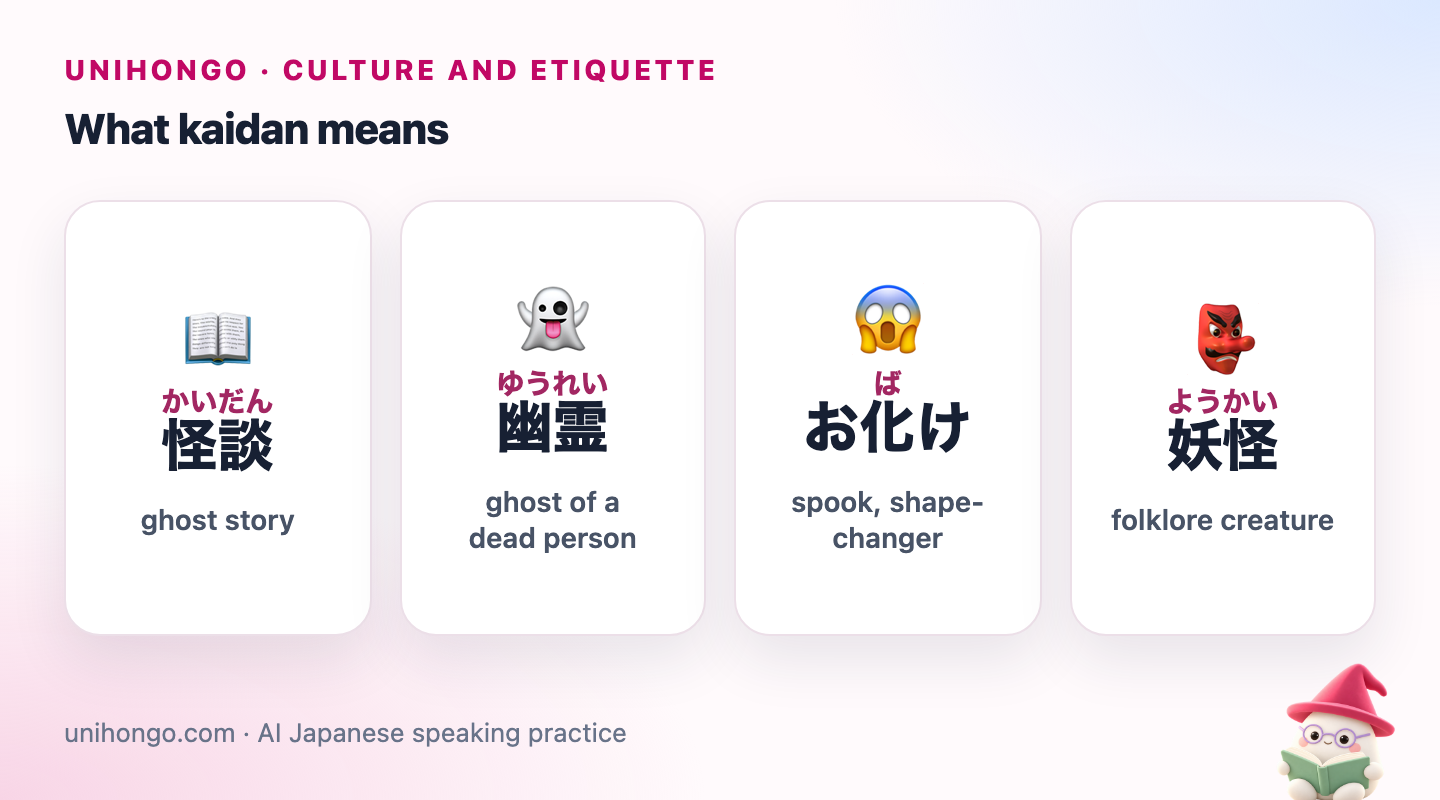
| Japanese | Romaji | Meaning |
|---|---|---|
| 怪談 | kaidan | ghost story |
| 幽霊 | yūrei | ghost of a dead person |
| お化け | obake | spook, shape-changer |
| 妖怪 | yōkai | folklore creature |
| 怖い話 | kowai hanashi | scary story |
| お化け屋敷 | obakeyashiki | haunted house attraction |
Yūrei, obake, yōkai: who is who
| Reading | What it is | Typical image |
|---|---|---|
| yūrei | The spirit of a dead person who cannot rest, often because of a grudge or a regret | White burial kimono, long loose black hair, often drawn without feet |
| obake | A loose everyday word for anything spooky; literally a thing that has changed form | Cartoon ghosts, the monsters in a haunted house |
| yōkai | Supernatural creatures of folklore that were never human | The kappa river imp, the long-nosed tengu, shape-changing foxes |
Obake comes from the verb bakeru (化ける), to change shape. It is the word children use, and it sounds softer than yūrei. If you say yūrei, listeners picture a dead person with unfinished business.
Why ghost stories belong to summer
Ask a Japanese person and you will usually hear two explanations. The first is Obon, the days in mid-August (July in some areas) when the spirits of ancestors are believed to come home. The dead are on everyone's mind. The second is temperature: Japanese describes fear as cold. Your spine goes cold, you shiver, you get gooseflesh. Before air conditioning, a frightening story was said to be a way of cooling down.
Whatever the mix of reasons, the season is now fixed: haunted houses, ghost programmes on television and tests of courage all arrive with the heat.
| Japanese | Romaji | Meaning |
|---|---|---|
| 夏といえば怪談です。 | Natsu to ieba kaidan desu. | Summer means ghost stories. |
| 怖い話で涼しくなります。 | Kowai hanashi de suzushiku narimasu. | Scary stories cool you down. |
| 背筋が寒くなりました。 | Sesuji ga samuku narimashita. | A chill ran down my spine. |
Three stories everyone knows by name
| Japanese | Romaji | Meaning |
|---|---|---|
| 一枚、二枚、三枚 | ichimai, nimai, sanmai | one plate, two plates, three plates |
| 一枚足りない。 | Ichimai tarinai. | One is missing. |
- Yotsuya Kaidan (四谷怪談): Oiwa, called Oiwa-san (お岩さん), is betrayed and poisoned by her husband, and returns with a disfigured face to haunt him. It is best known from a kabuki play first staged in 1825.
- Banchō Sarayashiki (番町皿屋敷): Okiku (お菊), a servant blamed for a missing plate from a precious set of ten, dies in a well. At night her voice counts the plates, one, two, up to nine, and never reaches ten.
- Miminashi Hōichi (耳なし芳一), Hōichi the Earless: a blind lute player is called out night after night to perform for the ghosts of a defeated clan. A priest writes holy text all over his body to hide him, but forgets the ears.
Okiku counts with mai (枚), the counter for flat things such as plates and paper. Count plates slowly in a low voice and Japanese listeners will think of her at once. The plain form tarinai suits a ghost talking to herself; in normal polite speech you would say ichimai tarimasen.
Kimodameshi, haunted spots and a hundred stories
Kimodameshi (肝試し) is a test of courage. Kimo is the liver, the old seat of bravery, and tamesu means to test. It is a standard event at summer camps: pairs walk a dark route while friends hide and jump out.
A shinrei supotto (心霊スポット) is a place with a haunted reputation, such as an old tunnel or an abandoned building. Visiting one at night is a well-known pastime among young people, but many of these places are private property, so enjoy the stories and skip the visit. Hyakumonogatari (百物語), a hundred tales, is an old parlour game: people take turns telling stories and put out one light after each, and when the last light goes out something is said to appear.
| Japanese | Romaji | Meaning |
|---|---|---|
| 肝試しに行きませんか。 | Kimodameshi ni ikimasen ka. | Shall we go on a test of courage? |
| ここは心霊スポットです。 | Koko wa shinrei supotto desu. | This place is a haunted spot. |
| ここは出るそうです。 | Koko wa deru sō desu. | They say this place is haunted. |
| 幽霊を信じますか。 | Yūrei o shinjimasu ka. | Do you believe in ghosts? |
Deru (出る) only means to come out, but in this context everyone understands what comes out. Saying koko, deru rashii yo in a low voice is how many real ghost stories begin.
Telling a story aloud: the connecting words
Folk tales open with mukashi mukashi (昔々), once upon a time. Modern ghost stories open by naming the source: a friend, a senior at school, a taxi driver. After that, three small tools do most of the work. The ending sō desu after a plain verb marks hearsay, so you can pass on what you were told. Suru to (すると) means and then, with a hint of surprise at what follows. Sono toki (その時), at that moment, slows the story down just before the scare.
| Japanese | Romaji | Meaning |
|---|---|---|
| 昔々、あるところに | mukashi mukashi, aru tokoro ni | once upon a time, in a certain place |
| これは友達から聞いた話です。 | Kore wa tomodachi kara kiita hanashi desu. | This is a story I heard from a friend. |
| 夜中に音がしたそうです。 | Yonaka ni oto ga shita sō desu. | They say there was a sound in the middle of the night. |
| すると、ドアが開きました。 | Suru to, doa ga akimashita. | And then the door opened. |
| その時、声が聞こえました。 | Sono toki, koe ga kikoemashita. | At that moment, I heard a voice. |
| 振り返ると、誰もいませんでした。 | Furikaeru to, dare mo imasen deshita. | When I turned around, nobody was there. |
Reacting to a scary story
| Japanese | Romaji | Meaning |
|---|---|---|
| 怖い! | Kowai! | Scary! |
| 怖かったです。 | Kowakatta desu. | That was scary. |
| ぞっとしました。 | Zotto shimashita. | It gave me the chills. |
| 鳥肌が立ちました。 | Torihada ga tachimashita. | I got goosebumps. |
| 怖い話は苦手です。 | Kowai hanashi wa nigate desu. | I'm not good with scary stories. |
| 今夜は眠れません。 | Kon'ya wa nemuremasen. | I won't be able to sleep tonight. |
| それで、どうなったんですか。 | Sorede, dō natta n desu ka. | And then what happened? |
Kowai covers both it is scary and I am scared, so a single kowai is a complete reaction. Zotto suru is the sudden cold shiver, and torihada ga tatsu is gooseflesh. The last line, sorede dō natta n desu ka, is the best gift you can give a storyteller: it asks for more.