
Mono plus tsukuri: the word in pieces
Mono (もの, 物) means thing, and tsukuri (つくり, 作り) is the noun form of tsukuru, to make. The t changes to z when the words join, a common sound change called rendaku, so the result is monozukuri, not monotsukuri. Mono is deliberately vague: it can be a teacup, an engine part, a pair of shoes or a whole building.
Spelling varies. ものづくり in hiragana is the most common and feels soft and human. モノづくり with katakana is popular in company materials and magazines. 物作り and 物づくり also appear. All are read the same.
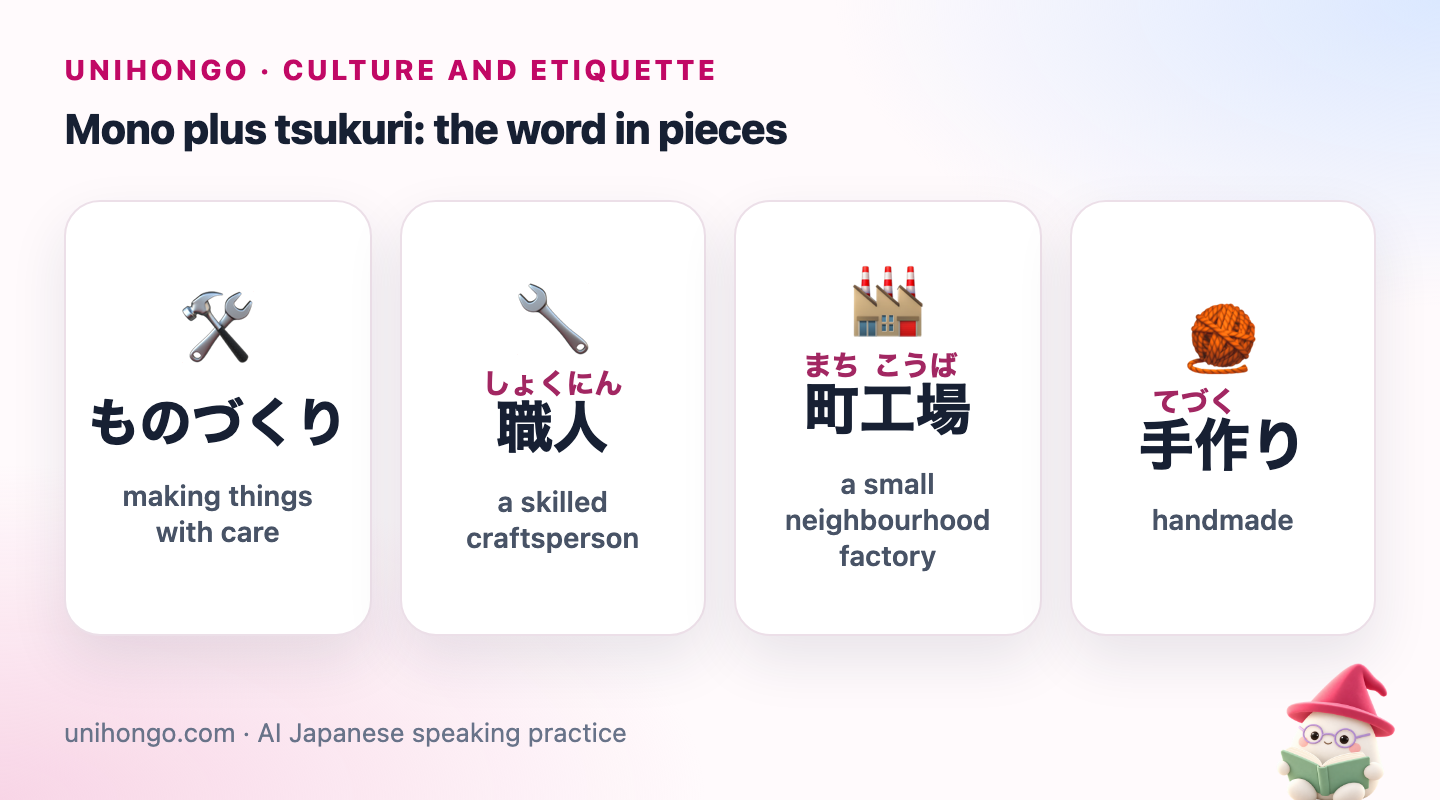
| Japanese | Romaji | Meaning |
|---|---|---|
| ものづくり | monozukuri | making things with care |
| 職人 | shokunin | a skilled craftsperson |
| 町工場 | machikōba | a small neighbourhood factory |
| 手作り | tezukuri | handmade |
What the word carries beyond making
When people praise Nihon no monozukuri, Japanese making, they usually mean a group of attitudes rather than a technique. The most common ones are attention to small details, a long apprenticeship to master a skill, steady improvement over years, and thinking about the person who will use the product. Words like kodawari (a refusal to compromise on details) and teinei (careful, thorough) often appear in the same breath.
The word also has an institutional side. It appears in the title of a 1999 law on promoting core manufacturing technology, in university and school programmes, and in many corporate slogans. Because of that, some people find it overused, and critics point out that it can be used to praise long hours or to sell ordinary products. When you use it, a concrete example always sounds more sincere than the bare word.
Small factories, machikōba, are a big part of the story. Districts such as Ōta in Tokyo and Higashiōsaka near Osaka are known for clusters of small workshops making precise parts for larger companies, and television programmes often show their owners as the heroes of monozukuri. Traditional crafts such as lacquerware, ironware and indigo dyeing are the other face of the word, usually shown with an older master and a young apprentice.
| Japanese | Romaji | Meaning |
|---|---|---|
| 日本のものづくりを支えているのは町工場です。 | Nihon no monozukuri o sasaete iru no wa machikōba desu. | It's the small factories that support Japanese manufacturing. |
| 細部へのこだわりがすごいですね。 | Saibu e no kodawari ga sugoi desu ne. | Their attention to detail is amazing. |
| 丁寧な仕事ですね。 | Teinei na shigoto desu ne. | What careful, thorough work. |
How people use monozukuri in sentences
Monozukuri behaves like an ordinary noun. It often comes with no: monozukuri no genba, the shop floor where things are made, or monozukuri no tanoshisa, the joy of making things. People say they like making things, monozukuri ga suki desu, or that they work in it, monozukuri ni tazusawatte imasu, a slightly formal verb meaning to be involved in.
For visitors, the most practical compound is monozukuri taiken, a hands-on making experience: dyeing cloth, throwing pottery, making chopsticks or glass. Tourist offices and museums advertise these, and children do them at school and summer events.
| Japanese | Romaji | Meaning |
|---|---|---|
| ものづくりが好きです。 | Monozukuri ga suki desu. | I love making things. |
| ものづくりの現場を見学しました。 | Monozukuri no genba o kengaku shimashita. | I toured the workshop floor where things are made. |
| 父は四十年ものづくりに携わってきました。 | Chichi wa yonjūnen monozukuri ni tazusawatte kimashita. | My father has worked in manufacturing for forty years. |
| 子ども向けのものづくり体験があります。 | Kodomo muke no monozukuri taiken ga arimasu. | There's a hands-on making activity for children. |
Monozukuri, tezukuri, seizō and kōgei compared
Several words overlap with monozukuri, and choosing between them changes the tone. Tezukuri describes an object made by hand, such as a handmade cake or a handmade bag. Seizō is the technical, neutral word for manufacturing, the one you see in company departments and statistics. Dentō kōgei is traditional craft, such as lacquerware, washi or woodblock printing. Monozukuri is the broadest and the most emotional of the four.
| Japanese | Romaji | Meaning |
|---|---|---|
| このケーキは手作りです。 | Kono kēki wa tezukuri desu. | This cake is homemade. |
| 製造部で働いています。 | Seizōbu de hataraite imasu. | I work in the manufacturing department. |
| 伝統工芸に興味があります。 | Dentō kōgei ni kyōmi ga arimasu. | I'm interested in traditional crafts. |
| まさに職人技ですね。 | Masa ni shokunin waza desu ne. | That truly is a master's skill. |
| Word | What it means | Tone |
|---|---|---|
| monozukuri | Making things, and the attitude behind it | Warm, proud, sometimes a slogan |
| tezukuri | Made by hand | Homely, personal |
| seizō | Manufacturing as a process or industry | Technical, neutral |
| dentō kōgei | Traditional crafts | Cultural, respectful |
| shokunin waza | A master's skill | Admiring |
The words that travel with monozukuri
If you read an article or watch a documentary about monozukuri, a small set of words comes up again and again. Learning them together makes those programmes much easier to follow. Takumi (匠) is a master craftsman, a word with an old, respectful feel that also appears in product names. Kaizen (改善) is improvement, now known worldwide from factory management. Hinshitsu (品質) is quality, and gijutsu (技術) is technique or technology.
Two more words are worth knowing. Genba (現場) is the actual place where the work happens, the factory floor or the workshop bench, and people who value monozukuri often say that answers are found in the genba, not in the office. Kotsu (コツ) is the knack, the small trick an experienced maker knows; asking a craftsperson kotsu wa nan desu ka, what is the knack, is a friendly question that usually gets a generous answer.
| Japanese | Romaji | Meaning |
|---|---|---|
| 匠の技を受け継ぐ | takumi no waza o uketsugu | to inherit a master's skill |
| 改善を重ねる | kaizen o kasaneru | to keep making improvements |
| 品質にこだわる | hinshitsu ni kodawaru | to be uncompromising about quality |
| 技術を磨く | gijutsu o migaku | to polish your skills |
| 使う人のことを考える | tsukau hito no koto o kangaeru | to think about the person who will use it |
Mini dialogue: a pottery workshop
Sam, a visitor in a small pottery town, joins a one-hour wheel-throwing class. The teacher is a local potter who has run the studio for years. Listen for the polite requests and the way the teacher talks about the work.
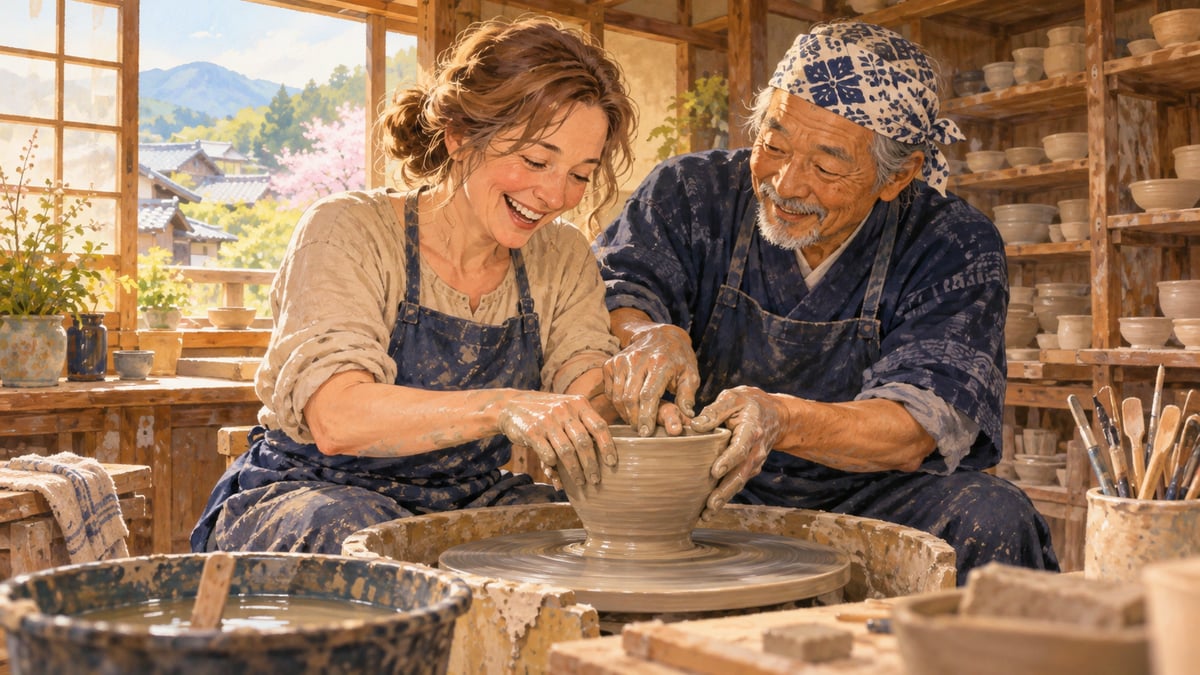
| Japanese | Romaji | Meaning |
|---|---|---|
| 最初は何をすればいいですか。 | Saisho wa nani o sureba ii desu ka. | Sam: What should I do first? |
| まず、手を水でぬらしてください。 | Mazu, te o mizu de nurashite kudasai. | Potter: First, wet your hands with water. |
| あ、崩れちゃいました。すみません。 | A, kuzurechaimashita. Sumimasen. | Sam: Oh, it collapsed. Sorry. |
| 大丈夫ですよ。ものづくりは失敗から学ぶものです。 | Daijōbu desu yo. Monozukuri wa shippai kara manabu mono desu. | Potter: That's fine. Making things means learning from failures. |
| 難しいけど、楽しいです。 | Muzukashii kedo, tanoshii desu. | Sam: It's hard, but it's fun. |
| 焼き上がったら、送りますね。 | Yakiagattara, okurimasu ne. | Potter: I'll send it to you once it's fired. |
Talking about monozukuri at work or in an interview
If you apply to a Japanese manufacturer, the word may come up in the interview. It is fine to use, but a vague line such as I am attracted to your monozukuri sounds like you copied the company website. Pair it with something specific you saw or used: a product, a factory tour, a detail of quality you noticed.
| Japanese | Romaji | Meaning |
|---|---|---|
| 御社の製品の品質に惹かれました。 | Onsha no seihin no hinshitsu ni hikaremashita. | I was drawn to the quality of your products. (interview) |
| 工場見学で、ものづくりへの姿勢に感動しました。 | Kōjō kengaku de, monozukuri e no shisei ni kandō shimashita. | On the factory tour, I was moved by your approach to making things. |
| 現場の声を大切にしたいです。 | Genba no koe o taisetsu ni shitai desu. | I want to value what the people on the floor say. |
Build a monozukuri word bank with Mocchi
Ask Mocchi: make flashcards for shokunin, machikōba, kodawari, kaizen, hinshitsu and tezukuri. With /create-flashcards, Mocchi builds the cards and lets you choose a photo for each one, such as a chisel, a small workshop or a handmade bowl, which makes abstract words much easier to recall. Mocchi then reviews them with you using spaced repetition and keeps track of the ones you miss.
Once the deck feels familiar, play Vocabulary Dash with your own flashcards. Running past the right word at speed is a good test of whether kodawari and teinei really feel different to you yet.
Common learner mistakes
- Saying monotsukuri. The second word is voiced when it joins: monozukuri.
- Using monozukuri for cooking dinner. For food, say ryōri o tsukuru or tezukuri no ryōri.
- Calling one handmade object a monozukuri. The object is tezukuri; monozukuri is the activity or the attitude.
- Using the word as empty praise in an interview. Always add a concrete example.
- Assuming everyone in Japan reveres it. Many people are proud of it, others find it a tired slogan; keep the tone curious rather than reverent.