
Four reasons in four short lines
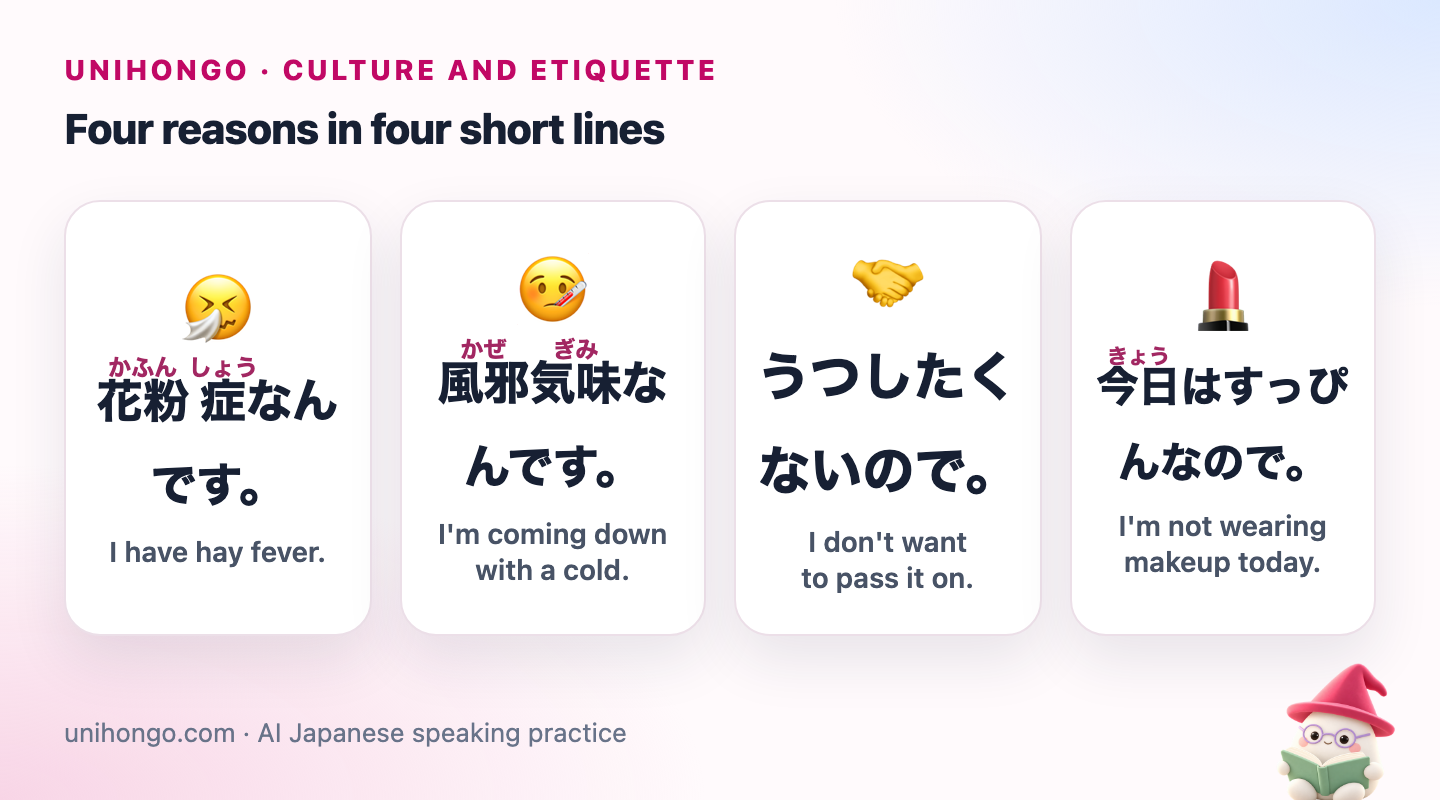
Ask a Japanese friend why they are wearing a mask and you will usually get a one-line answer, not a lecture. These four lines cover most of the real reasons you will hear. Notice the pattern: nan desu and node both soften the explanation, so it sounds like sharing a reason rather than defending yourself.
| Japanese | Romaji | Meaning |
|---|---|---|
| 花粉症なんです。 | Kafunshō nan desu. | I have hay fever. |
| 風邪気味なんです。 | Kazegimi nan desu. | I'm coming down with a cold. |
| うつしたくないので。 | Utsushitaku nai node. | I don't want to pass it on. |
| 今日はすっぴんなので。 | Kyō wa suppin na node. | I'm not wearing makeup today. |
Kazegimi uses the suffix gimi, a touch of, so it means a slight cold rather than a real illness. Utsusu means to pass an illness to someone; its partner utsuru means to catch one from someone. Suppin is a casual word for a bare face without makeup, used mostly among friends.
Hay fever: the big reason every spring
Kafunshō (花粉症), pollen illness, is the main reason masks multiply from around February to April. Large areas of Japan were planted with sugi (Japanese cedar) and hinoki (Japanese cypress) after the Second World War, and their pollen fills the air each spring. Many people suffer from sneezing, a runny nose and itchy eyes, and the weather forecast includes a pollen forecast. The exact season depends on the region and the year, and Hokkaido and Okinawa are much less affected by cedar pollen.
For many sufferers, a mask together with medicine from the pharmacy is the everyday solution. You will also see special pollen glasses, and people changing clothes or wiping their coat at the front door so that less pollen comes inside.
| Japanese | Romaji | Meaning |
|---|---|---|
| 花粉が飛んでいますね。 | Kafun ga tonde imasu ne. | There's a lot of pollen in the air today. |
| 目がかゆくて大変です。 | Me ga kayukute taihen desu. | My eyes are so itchy, it's awful. |
| くしゃみが止まりません。 | Kushami ga tomarimasen. | I can't stop sneezing. |
| 花粉症の薬はありますか。 | Kafunshō no kusuri wa arimasu ka. | Do you have hay fever medicine? (at a pharmacy) |
| スギ花粉がひどい時期ですね。 | Sugi kafun ga hidoi jiki desu ne. | It's the worst time for cedar pollen. |
Colds, flu and not passing it on
The second big reason is consideration for others. In Japan, if you have a cough or a sore throat but still need to go to work or school, wearing a mask is a common way to show that you are trying not to spread it. The message is closer to I'm being careful for your sake than I'm afraid of germs. Many people link this to the value of omoiyari, thoughtfulness towards others, though most would simply call it normal manners.
People also wear masks to avoid catching something before an important day, such as an entrance exam, a wedding or a big presentation. Parents of exam students, in particular, may be extra careful in January and February.
| Japanese | Romaji | Meaning |
|---|---|---|
| 咳が出るので、マスクをします。 | Seki ga deru node, masuku o shimasu. | I'll wear a mask because I have a cough. |
| インフルエンザが流行っていますね。 | Infuruenza ga hayatte imasu ne. | The flu is going around, isn't it? |
| 念のため、マスクをしてきました。 | Nen no tame, masuku o shite kimashita. | I wore a mask here just in case. |
| お大事にしてください。 | Odaiji ni shite kudasai. | Take care of yourself. (to someone unwell) |
| Situation | Common habit | What it signals |
|---|---|---|
| You have a cough on a crowded train | Many people wear a mask | Consideration for others |
| Flu is going around at the office | Some coworkers start wearing masks | Caution, not distrust |
| The week before an exam | Students may mask to stay healthy | Protecting an important day |
| Visiting someone in hospital | Often requested by the hospital | Protecting patients |
These are common patterns, not rules. Plenty of people never wear a mask for a cold, and nobody will scold you for not wearing one.
After 2023: a personal choice
During the pandemic years, almost everyone wore a mask in public. On 13 March 2023 the Japanese government announced that wearing a mask would be left to each person's judgement, kojin no handan. Mask use dropped, but not to zero: many people had grown used to masks, and the older reasons, hay fever and colds, never went away.
Some places still ask visitors to wear one, especially hospitals, clinics and care homes. When you see a request, it is usually written as masuku no chakuyō o onegai shimasu. Chakuyō is a formal word for wearing, used on notices and announcements rather than in conversation.
| Japanese | Romaji | Meaning |
|---|---|---|
| マスクは個人の判断です。 | Masuku wa kojin no handan desu. | Masks are a personal decision. |
| マスクの着用をお願いします。 | Masuku no chakuyō o onegai shimasu. | Please wear a mask. (formal notice) |
| ここはマスクが必要ですか。 | Koko wa masuku ga hitsuyō desu ka. | Do I need a mask here? |
| マスクを外してもいいですか。 | Masuku o hazushite mo ii desu ka. | May I take off my mask? |
| マスクを一枚もらえますか。 | Masuku o ichimai moraemasu ka. | Could I have a mask, please? |
Warmth, dry air, privacy and no makeup
Winter air in much of Japan is very dry, and heated trains and offices make it drier. A mask keeps the throat moist and the face warm on a cold platform, so some people wear one only for comfort. Singers, teachers and others who use their voice a lot may wear one overnight or on the way to work.
There are also social reasons. A mask lets you go to the convenience store without makeup, hide a pimple, or feel a little less visible on a crowded train. The slang date masuku (伊達マスク) describes a mask worn for looks or comfort rather than health; date here means for show. Some young people say they feel calmer with a mask on. These reasons are personal, so do not assume them about anyone in particular.
| Japanese | Romaji | Meaning |
|---|---|---|
| マスクをすると温かいです。 | Masuku o suru to atatakai desu. | A mask keeps my face warm. |
| 乾燥対策です。 | Kansō taisaku desu. | It's to protect against the dry air. |
| 伊達マスク | date masuku | a mask worn for looks or comfort |
| マスクをしていると落ち着きます。 | Masuku o shite iru to ochitsukimasu. | I feel calmer with a mask on. |
Mini dialogue: a coworker in a mask
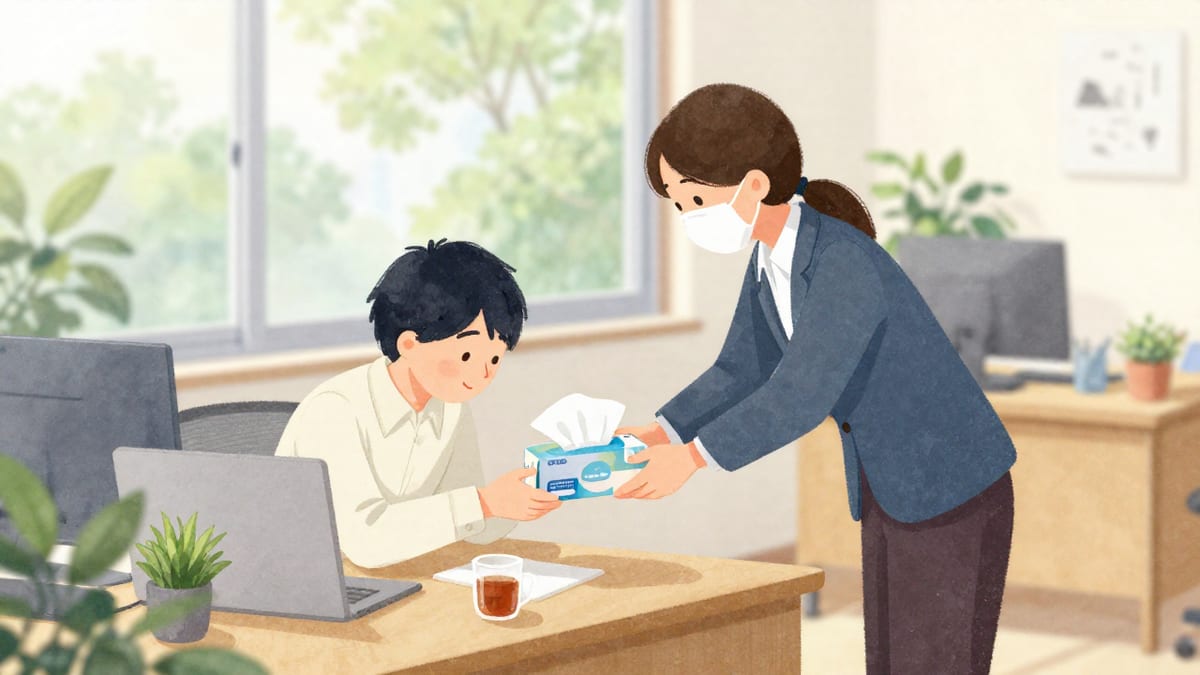
When a coworker suddenly comes in wearing a mask, a short, kind question is fine. Keep it light: you are showing concern, not asking for a medical report.
| Japanese | Romaji | Meaning |
|---|---|---|
| あれ、マスク?風邪ですか。 | Are, masuku? Kaze desu ka. | You: Oh, a mask? Have you got a cold? |
| いえ、花粉症なんです。 | Ie, kafunshō nan desu. | Coworker: No, it's hay fever. |
| そうなんですね。この時期はつらいですよね。 | Sō nan desu ne. Kono jiki wa tsurai desu yo ne. | You: I see. This time of year is tough, isn't it? |
| 毎年三月が一番ひどいんです。 | Maitoshi sangatsu ga ichiban hidoi n desu. | Coworker: March is always the worst for me. |
| ティッシュ、どうぞ。 | Tisshu, dōzo. | You: Here, have a tissue. |
| ありがとうございます。助かります。 | Arigatō gozaimasu. Tasukarimasu. | Coworker: Thank you, that really helps. |
Tasukarimasu, literally I am saved, is a very natural thank-you when someone does something practical for you. With a friend, the casual version is tasukaru.
Common learner mistakes
- Saying masuku o kiru. Kiru is for clothes on your body; for masks use suru or tsukeru, and hazusu for taking one off.
- Asking a stranger why they wear a mask. Between friends or coworkers it is fine; with someone you do not know it can feel intrusive.
- Assuming a masked person is seriously ill or thinks you are dirty. Most of the time it is pollen, a light cold or habit.
- Pulling the mask down to cough or sneeze. If you are wearing one for a cough, keep it on and cough into it or your elbow.
- Using suppin with a coworker you do not know well. It is casual and a bit personal; kansō taisaku desu, it's for the dry air, is a safer explanation.
Explain your own mask habits with Mocchi
Write two sentences about why you wear a mask, or why you do not, and send them to Mocchi with /correct. Mocchi fixes the verb (suru, not kiru), checks whether the tone suits a coworker or a friend, and keeps a note of what you got wrong, so a later /review brings the same point back until it sticks.
Then open the pronunciation coach and pick a long-vowel drill. Kafunshō has a long ō at the end, and shortening it is the most common slip learners make with this word; listening at slow speed and recording yourself makes the difference easy to hear.
What a visitor should do
- Pack a few masks, especially in spring if you have any pollen allergy, and for hospital visits.
- Wear one on public transport if you have a cough or a cold; it is the polite thing to do.
- Follow any request at clinics, hospitals or events, and do not argue about it with staff.
- Do not comment on whether other people wear masks; it is a personal choice.
- If you are unsure, ask: koko wa masuku ga hitsuyō desu ka.