
Two decks and one reader
Every karuta set has two matching decks. The yomifuda (読み札), reading cards, stay in the hands of the reader, the yomite (読み手). The torifuda (取り札), grabbing cards, are spread face up where all the players can reach them. The reader reads one card; the players find its partner and touch it. Whoever touches it first keeps it, and when the cards are gone, the player with the most wins.
A card is a fuda (札). Yomu (読む) is to read and toru (取る) is to take, so the two deck names simply mean cards for reading and cards for taking.
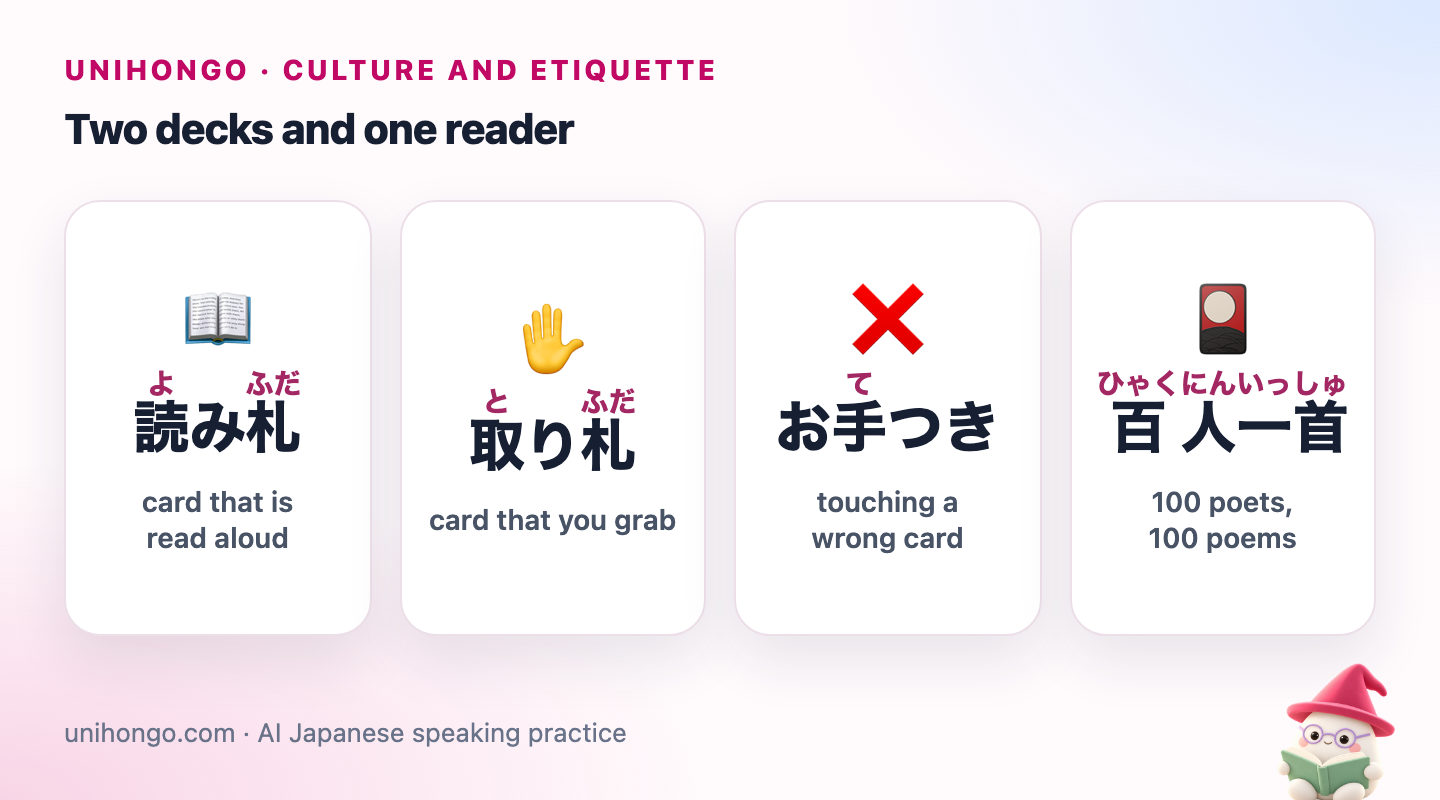
| Japanese | Romaji | Meaning |
|---|---|---|
| 読み札 | yomifuda | card that is read aloud |
| 取り札 | torifuda | card that you grab |
| お手つき | otetsuki | touching a wrong card |
| 百人一首 | Hyakunin Isshu | 100 poets, 100 poems |
| 札 | fuda | card |
| 読み手 | yomite | the reader |
How a round runs
- Lay out the torifuda face up, not overlapping, so that every player can see them.
- The reader shuffles the yomifuda and reads the top one aloud.
- Players search for the matching torifuda. The moment you know it, slap or sweep it; many players call hai as they do.
- The first hand on the card takes it. If two hands land together, the lower hand wins.
- A hand on the wrong card is otetsuki. Agree on the penalty before you begin.
- When the last card is taken, everyone counts. The most cards wins.
Cards are counted with the counter mai (枚), used for flat things: ichimai, nimai, sanmai.
Iroha karuta: proverbs for beginners
Iroha karuta has one card for each kana of the old iroha ordering of the syllabary. Each yomifuda carries a proverb, and the matching torifuda shows a picture and the proverb's first kana. The reader says the proverb; you look for its first sound. Sets differ by region: the Edo set, from old Tokyo, opens with the dog proverb below, while sets from the Kyoto and Osaka area use different sayings.
| Japanese | Romaji | Meaning |
|---|---|---|
| 犬も歩けば棒に当たる | Inu mo arukeba bō ni ataru | Even a dog that walks will meet a stick |
| 論より証拠 | Ron yori shōko | Proof beats argument |
| 花より団子 | Hana yori dango | Dumplings over flowers |
These are the cards for i, ro and ha. The dog proverb is read two ways today: go out and you may run into trouble, or get moving and you may run into luck. Many Japanese adults know their proverbs because they played this game as children.
Hyakunin Isshu: a hundred poems
The Hyakunin Isshu is an anthology of one hundred waka, each by a different poet, selected by Fujiwara no Teika in the thirteenth century. A waka has 31 beats in five lines of 5, 7, 5, 7 and 7. The first three lines are the kami no ku (上の句), the upper verse, and the last two are the shimo no ku (下の句), the lower verse.
In the karuta set, the yomifuda carries the whole poem, usually with a portrait of the poet. The torifuda carries only the shimo no ku, written in kana. So the reader begins a poem and the players must already know how it ends. One of the best-known openings, by Ariwara no Narihira, describes a river red with autumn leaves.
| Japanese | Romaji | Meaning |
|---|---|---|
| 上の句 | kami no ku | upper verse (first three lines) |
| 下の句 | shimo no ku | lower verse (last two lines) |
| ちはやぶる神代も聞かず竜田川 | Chihayaburu kamiyo mo kikazu Tatsutagawa | Unheard of even in the age of the gods: the Tatsuta River |
Kyōgi karuta: the competitive sport
Kyōgi karuta (競技かるた) is played one against one. Fifty of the hundred torifuda are used, twenty-five laid out in each player's territory, and the players get time to memorise where every card lies. The reader reads from all one hundred poems, so some readings match no card on the floor. When you take a card from your opponent's side, you send one of your own across. The first player with no cards left wins.
Speed comes from the kimariji (決まり字), the deciding syllables: the shortest opening that separates one poem from all the others. Seven poems can be identified from their first syllable alone; others need up to six. Top players move on a fraction of a sound. The title matches for Meijin, the men's champion, and Queen, the women's champion, are held each January at Ōmi Shrine in Ōtsu, and the manga and anime Chihayafuru brought the sport to a wide audience.
A New Year tradition
Karuta belongs to oshōgatsu (お正月), the New Year holiday, along with kite flying and board games. Families play at home, and many schools hold a karuta or Hyakunin Isshu tournament in January, which is why so many adults can still finish a poem when they hear its opening.
There are gentler games for the same cards. In bōzu mekuri (坊主めくり), players simply turn over the picture cards one at a time, and drawing a monk costs you your pile; no poetry knowledge is needed. Many regions also have local sets about their own history and sights. Jōmō Karuta from Gunma is the most famous, and people raised there are known for being able to recite it.
Words to use at the table
| Japanese | Romaji | Meaning |
|---|---|---|
| かるたをしましょう。 | Karuta o shimashō. | Let's play karuta. |
| 札を並べてください。 | Fuda o narabete kudasai. | Please lay out the cards. |
| 読みます。 | Yomimasu. | I'll read now. |
| 取った! | Totta! | Got it! |
| お手つきです。 | Otetsuki desu. | That's a fault. |
| 一回休みです。 | Ikkai yasumi desu. | You sit out one turn. |
| もう一度読んでください。 | Mō ichido yonde kudasai. | Please read it once more. |
| 何枚取りましたか。 | Nanmai torimashita ka. | How many cards did you take? |
| 十二枚取りました。 | Jūnimai torimashita. | I took twelve. |
Totta is the plain past of toru and is what everyone shouts, whatever their age. The other lines are polite and suit a class or a party with people you have just met.
Why karuta is real listening training
In karuta you cannot wait for the end of the sentence. The card goes to whoever recognises the opening first, so the game rewards exactly what fast listening needs: catching the first sounds and predicting the rest. With iroha karuta that means hearing one kana cleanly. With Hyakunin Isshu it means telling apart openings that share their first two or three beats.
It also ties sound to a physical reaction, which makes the practice stick. Learners can borrow the method with any material: lay out vocabulary cards, play audio, and grab what you hear. A wrong grab, your own otetsuki, shows you which sounds you are still confusing.