
The four cues you will hear in every class
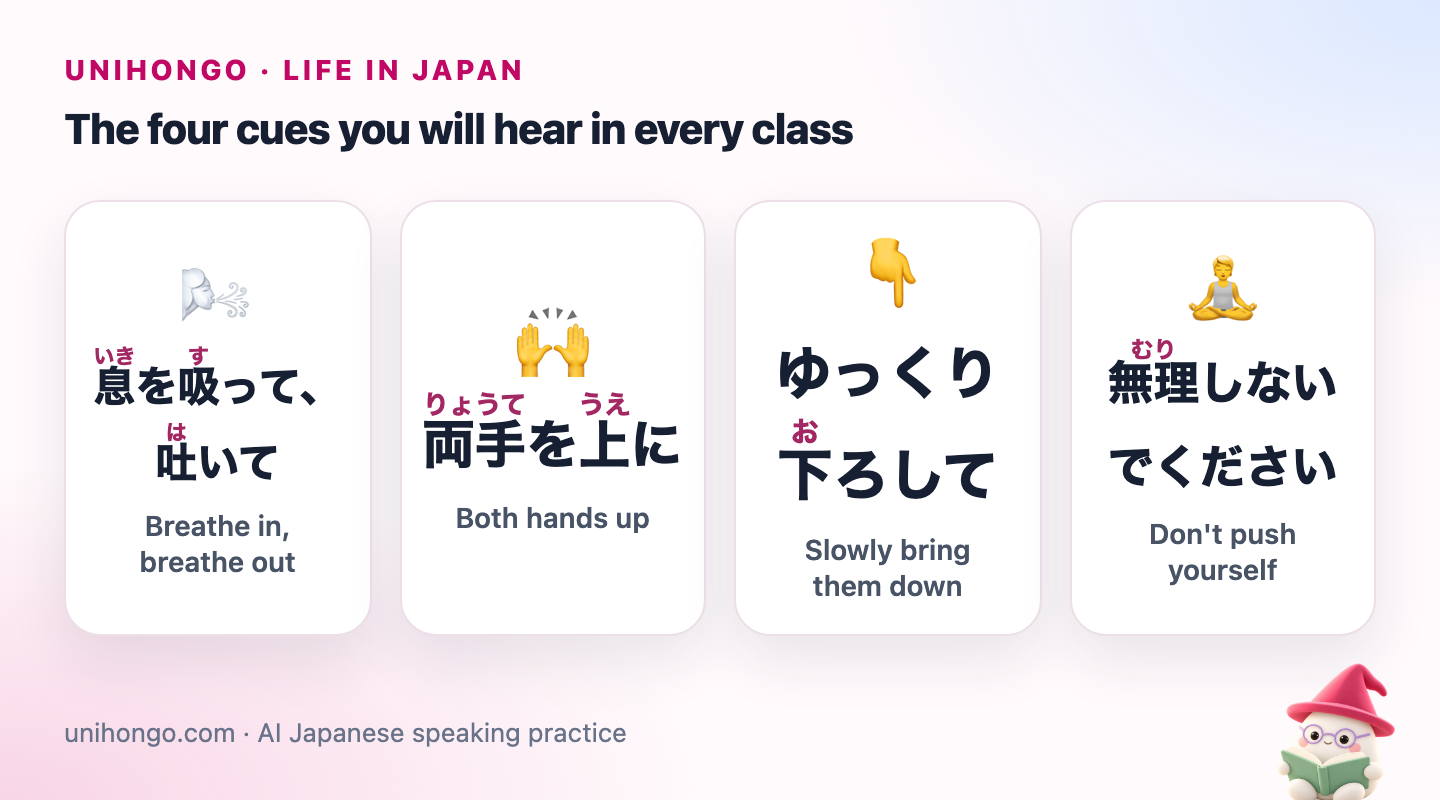
Yoga teachers in Japan rarely say full polite sentences while the class is moving. They use the bare te-form of a verb, which works as a soft, friendly instruction: sutte (breathe in), haite (breathe out), agete (raise), oroshite (lower). Grammar books teach the te-form plus kudasai as a polite request. In class the kudasai is usually dropped, because a long sentence would break the rhythm of the breath. It is not rude; it sounds calm and personal.
Direction words are often said without any verb at all. Ryōte o ue ni is literally both hands to up: the verb is understood from what everyone is doing. Listen for the particle ni, which marks where something goes, and for o, which marks what moves.
| Japanese | Romaji | Meaning |
|---|---|---|
| 息を吸って、吐いて | Iki o sutte, haite. | Breathe in, breathe out |
| 両手を上に | Ryōte o ue ni. | Both hands up |
| ゆっくり下ろして | Yukkuri oroshite. | Slowly bring them down |
| 無理しないでください | Muri shinaide kudasai. | Don't push yourself |
| 鼻から吸って、口から吐きます。 | Hana kara sutte, kuchi kara hakimasu. | In through the nose, out through the mouth. |
| もう一度、深く吸って。 | Mō ichido, fukaku sutte. | Once more, breathe in deeply. |
| そのまま、三呼吸キープします。 | Sono mama, san-kokyū kīpu shimasu. | Stay there and hold for three breaths. |
Body parts and directions the teacher uses
You do not need a full anatomy list. These are the body words that come up again and again in a typical class. Notice that koshi covers the lower back and hips together; it is the word to use if your lower back hurts. Ashi means both leg and foot, and the teacher will point or say ashi no ura (the sole) when they mean the foot only.
| Japanese | Romaji | Meaning |
|---|---|---|
| 肩 | kata | shoulders |
| 背中 | senaka | back |
| 腰 | koshi | lower back and hips |
| 膝 | hiza | knees |
| 足の裏 | ashi no ura | soles of the feet |
| おへそ | oheso | belly button |
| 右足を一歩前に出します。 | Migiashi o ippo mae ni dashimasu. | Step your right foot one step forward. |
| 背中をまっすぐ伸ばして。 | Senaka o massugu nobashite. | Stretch your back straight. |
| 肩の力を抜いてください。 | Kata no chikara o nuite kudasai. | Relax your shoulders. |
| 膝を軽く曲げて。 | Hiza o karuku magete. | Bend your knees slightly. |
| おへそを天井に向けて。 | Oheso o tenjō ni mukete. | Turn your belly button to the ceiling. |
Migi (right) and hidari (left) are where most learners get lost, because by the time you have translated, the class has moved on. A useful trick is to watch which side the teacher's body is turning to, while your ears catch the body part. Also listen for mae (front), ushiro (back), ue (up) and shita (down).
How instructions are phrased, and what each form feels like
Teachers mix four sentence shapes. Once you can tell them apart, you can also tell whether you are being given an instruction, an invitation or a description of what the class is about to do.
| Form | Example in romaji | What it means in class |
|---|---|---|
| Bare te-form | Sutte, haite | A soft cue during movement; the most common form |
| Te-form + kudasai | Nobashite kudasai | A clear polite request, often while explaining |
| Volitional -mashō | Yasumimashō | Let's do it together; often for rests |
| Plain -masu | Ashi o hirakimasu | Describes the next step, as if narrating |
| Negative -naide | Muri shinaide | Don't do it; a caution, said kindly |
Do not copy the bare te-form when you speak to the teacher. It is fine for them to give cues, but if you ask them for something, use the full polite form: mō ichido misete kudasai, please show me once more.
Pose names in katakana and Japanese
Studios vary. Some use katakana versions of the English names, some use Japanese descriptions that end in no pōzu, and a few use Sanskrit names written in katakana. Most teachers say the name and then describe the movement anyway, so you only need to recognise the name, not produce it.
| Japanese | Romaji | Meaning |
|---|---|---|
| ダウンドッグ | daun doggu | downward-facing dog |
| 下を向いた犬のポーズ | shita o muita inu no pōzu | downward-facing dog (Japanese description) |
| 木のポーズ | ki no pōzu | tree pose |
| 戦士のポーズ | senshi no pōzu | warrior pose |
| 猫のポーズ | neko no pōzu | cat pose |
| 子どものポーズ | kodomo no pōzu | child's pose |
| シャバーサナ | shabāsana | final relaxation, lying on your back |
Telling the teacher about an injury
Say it before class, at the front desk or when the teacher walks round to greet people. Use the n desu form. Koshi ga itai desu simply states a fact, while koshi ga itai n desu explains a situation the listener should know about, which is exactly the feeling you want. Adding a short request after it makes the conversation easy for the teacher.
| Japanese | Romaji | Meaning |
|---|---|---|
| 腰が痛いんです。 | Koshi ga itai n desu. | My lower back hurts. |
| 膝をけがしているんです。 | Hiza o kega shite iru n desu. | I have a knee injury. |
| 体がかたいんです。 | Karada ga katai n desu. | I'm not very flexible. |
| 代わりのポーズはありますか。 | Kawari no pōzu wa arimasu ka. | Is there an alternative pose? |
| つらいときは休んでもいいですか。 | Tsurai toki wa yasunde mo ii desu ka. | May I rest when it gets hard? |
| 先生:できる範囲で大丈夫ですよ。 | Sensei: Dekiru han'i de daijōbu desu yo. | Teacher: Just do what you can. |
Karada ga katai, literally my body is hard, is the everyday way to say you are stiff or not flexible. People say it with a laugh, and it is a natural opener for small talk after class.
Booking a trial lesson and arriving
Most studios offer a taiken ressun (体験レッスン), a trial lesson for first-timers. At reception you will usually fill in a form, be shown the changing room and be asked whether you need to borrow a mat. Hot yoga studios, very popular in Japan, will also remind you to bring water and a towel.
| Japanese | Romaji | Meaning |
|---|---|---|
| 体験レッスンを受けたいんですが。 | Taiken ressun o uketai n desu ga. | I'd like to take a trial lesson. |
| ヨガは初めてです。 | Yoga wa hajimete desu. | It's my first time doing yoga. |
| マットを借りられますか。 | Matto o kariraremasu ka. | Can I borrow a mat? |
| 更衣室はどこですか。 | Kōishitsu wa doko desu ka. | Where is the changing room? |
| 日本語がまだ苦手なので、見ながらやります。 | Nihongo ga mada nigate na node, minagara yarimasu. | My Japanese isn't strong yet, so I'll follow by watching. |
Scenario: following along, then chatting afterwards
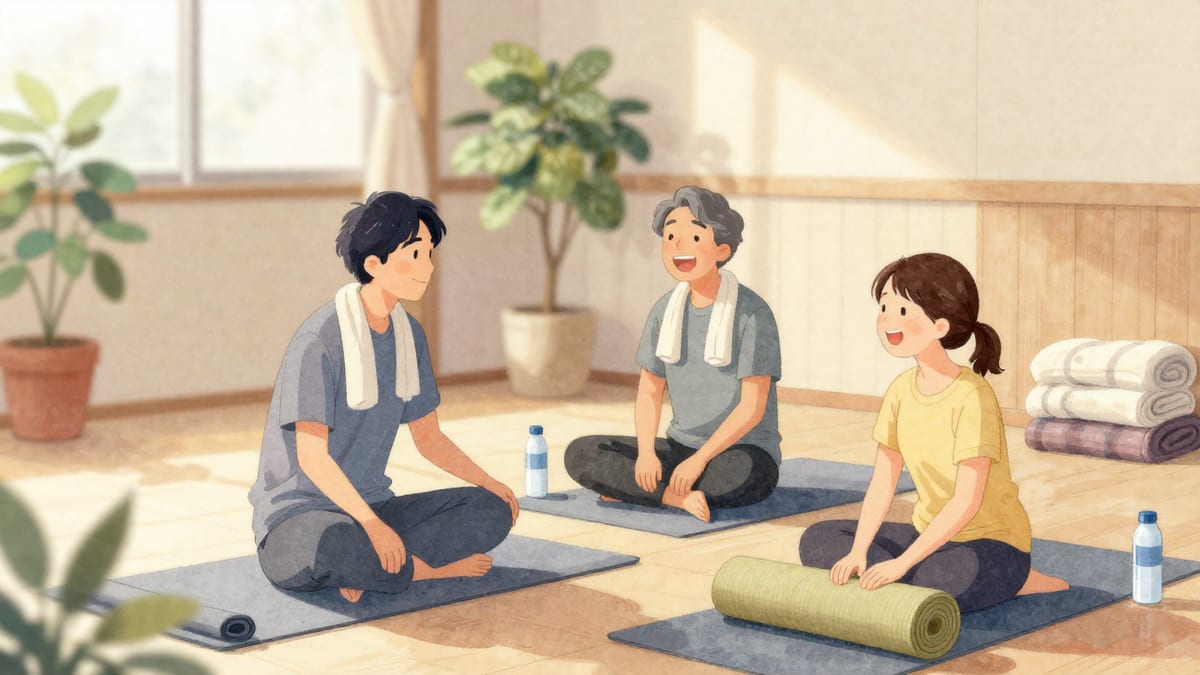
Imagine a Saturday morning trial lesson. You catch most of the cues, miss a few lefts and rights, and spend one pose resting in child's pose. At the end, the teacher thanks everyone and comes over to ask how it went. A classmate rolls up her mat next to you. This short exchange is where a one-off lesson turns into a regular class and, sometimes, a new acquaintance.
| Japanese | Romaji | Meaning |
|---|---|---|
| 先生:お疲れさまでした。どうでしたか。 | Sensei: Otsukaresama deshita. Dō deshita ka. | Teacher: Well done. How was it? |
| あなた:気持ちよかったです。 | Anata: Kimochi yokatta desu. | You: It felt great. |
| あなた:でも、ついていくのが大変でした。 | Anata: Demo, tsuite iku no ga taihen deshita. | You: But keeping up was hard. |
| 先生:最初はみんなそうですよ。 | Sensei: Saisho wa minna sō desu yo. | Teacher: Everyone finds that at first. |
| クラスメート:私も体がかたくて。 | Kurasumēto: Watashi mo karada ga katakute. | Classmate: I'm stiff too. |
| あなた:また来週も来ます。 | Anata: Mata raishū mo kimasu. | You: I'll come again next week. |
Kimochi yokatta desu is the natural way to say you enjoyed the class; it means it felt good. Tanoshikatta (it was fun) is also fine, but kimochi ii is the word for that loose, relaxed feeling after stretching.
Common learner mistakes
- Saying itai desu without n desu. It is understandable, but itai n desu sounds like you are explaining your situation, which is what the teacher needs.
- Answering a cue out loud. Cues are not questions; you just move. Hai is not needed after every instruction.
- Mixing up ashi and koshi. If your hips or lower back hurt, say koshi; if your leg or foot hurts, say ashi.
- Using the bare te-form to the teacher. Mō ichido misete is too blunt from a student; add kudasai.
- Being afraid to rest. Muri shinaide is meant seriously, and resting quietly is good etiquette, not failure.