

Why English stress does not transfer
English is a stress-timed language. Some syllables are long, loud and high; the rest are squeezed to fit between them. Japanese is mora-timed. Each mora, a short syllable or a lone n or a doubled consonant, takes about the same time, and the rhythm is even. When an English speaker brings stress into Japanese, the stressed mora gets longer and the neighbours get shorter, and the even rhythm collapses.
That collapse is not merely a matter of accent. Japanese listeners use timing to find word boundaries and to hear long vowels and doubled consonants. If you stress the ka in kakimasu, to write, and lengthen it, they may hear kākimasu, which is not a word, or lose the boundary between the verb and the particle before it. If you stress the first syllable of obasan, aunt, and stretch it, it becomes obāsan, grandmother. Stress in Japanese is not decoration; it changes meaning.
Pitch is the other casualty. Every Japanese word has a place where the pitch drops, or none. Raising the pitch of a stressed mora can move that drop, and moving the drop can turn hashi, chopsticks, into hashi, bridge. The tools below let you emphasise without touching timing or accent.
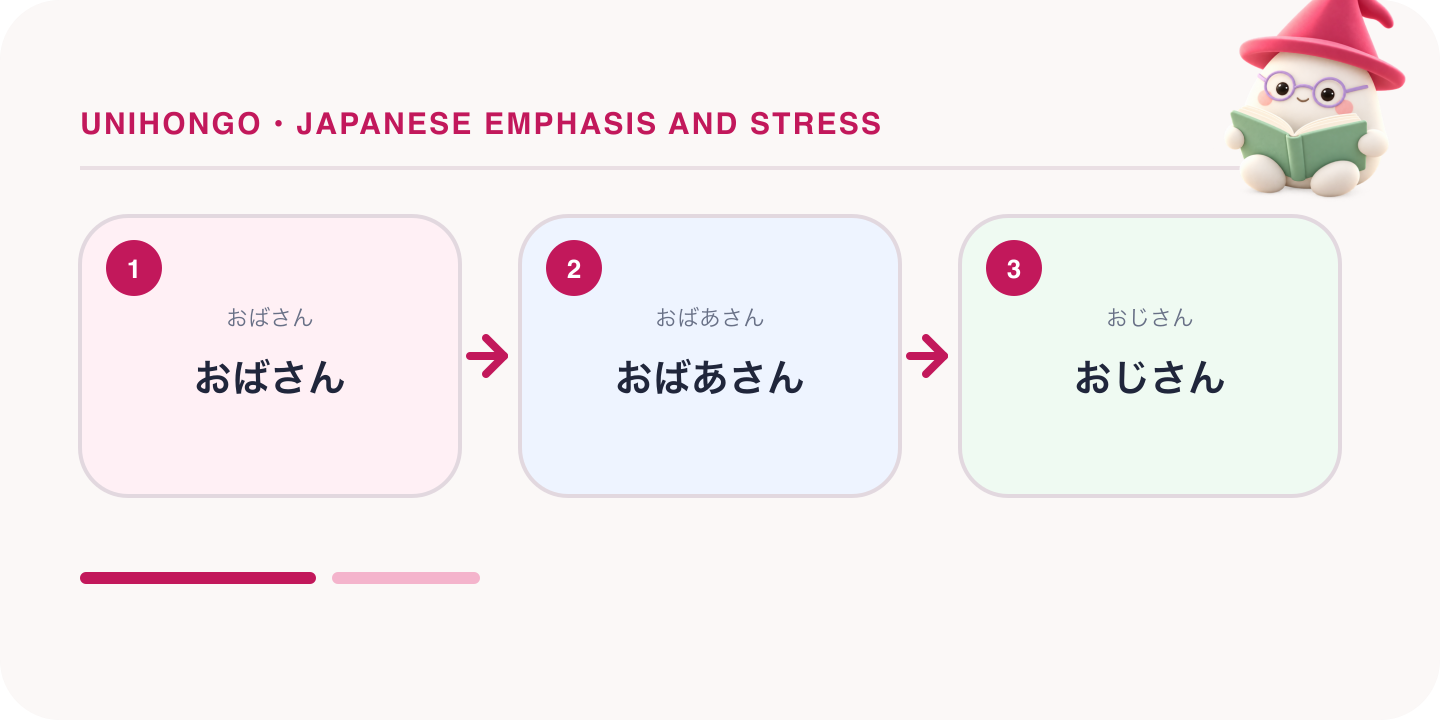
| Japanese | Romaji | Meaning |
|---|---|---|
| おばさんとおばあさん。 | Obasan to obāsan. | An aunt and a grandmother. |
| おじさんとおじいさん。 | Ojisan to ojīsan. | An uncle and a grandfather. |
| 来てください。 | Kite kudasai. | Please come. |
| 切ってください。 | Kitte kudasai. | Please cut it. |
| ここに書きます。 | Koko ni kakimasu. | I'll write it here. |
Emphasis by lengthening and pausing
The first Japanese tool is time, used carefully. To make a word stand out, speakers stretch it, but they stretch it in a way that does not create a new long vowel. The most common trick is to lengthen the sentence-final vowel or particle: sugoi becomes sugōi, and yo becomes yō. Another is to lengthen a consonant with a small tsu: sugoi becomes suggoi, and totemo becomes tottemo. Both are recognisable as emphatic because they happen in places where a long sound would not make another word.
The second tool is the pause. Japanese speakers put a short silence before the word they want you to notice, then say it at normal speed. In a meeting, kore wa, pause, muri desu, this is, pause, impossible, lands far harder than a loud muri. The pause draws attention without changing any sound. Learners underuse this because in English a pause mid-sentence sounds like hesitation, but in Japanese it sounds deliberate.
A third option is to slow the whole phrase. Saying zettai ni chigaimasu slowly and evenly is emphatic; saying it fast with a punch on zettai is foreign.
| Japanese | Romaji | Meaning |
|---|---|---|
| すっごくおいしい。 | Suggoku oishii. | It's really delicious. |
| とっても寒いですね。 | Tottemo samui desu ne. | It's very cold, isn't it. |
| これは、無理です。 | Kore wa, muri desu. | This is, impossible. |
| ぜったいに違います。 | Zettai ni chigaimasu. | It's absolutely not the case. |
| 本当に、ありがとう。 | Hontō ni, arigatō. | Really, thank you. |
| すごーい。 | Sugōi. | Wow, amazing. |
Particles that carry emphasis
The second family of tools is grammatical. Where English changes the voice, Japanese often changes a particle. Wa marks a topic and sets it against alternatives, so kore wa oishii, with a light stress on the contrast, means this one is tasty, implying others may not be. Ga picks out the subject as new information: kore ga oishii means this is the tasty one. The difference in meaning that an English speaker would carry by stressing this is carried by the choice between wa and ga, said at ordinary volume.
Koso is the strongest single-word emphasiser. It replaces wa or ga and asserts that the word before it is precisely the right one: ima koso, now is the time; kore koso hoshikatta, this is exactly what I wanted. Mo adds also and can be emphatic in the negative: hitotsu mo nai, not even one. Sae and made push further: kodomo de sae wakaru, even a child understands.
At the end of a sentence, yo tells the listener that you are asserting something they may not know, and it adds weight to the whole statement without raising the voice. Zo and ze are rougher, masculine versions. Combining yo with a pause before the key word gives you most of the force an English speaker would get from shouting, with none of the rudeness.
| Japanese | Romaji | Meaning |
|---|---|---|
| これはおいしいです。 | Kore wa oishii desu. | This one is tasty (as opposed to others). |
| これがおいしいです。 | Kore ga oishii desu. | This is the tasty one. |
| これこそ探していたものです。 | Kore koso sagashite ita mono desu. | This is exactly what I was looking for. |
| こちらこそ、ありがとうございます。 | Kochira koso, arigatō gozaimasu. | It's I who should thank you. |
| 一つもありません。 | Hitotsu mo arimasen. | There isn't even one. |
| 子どもでさえわかります。 | Kodomo de sae wakarimasu. | Even a child understands. |
| 本当ですよ。 | Hontō desu yo. | It's true, I tell you. |
Pitch range: wider, not moved
Japanese does use pitch for emphasis, but in a specific way. The accent of each word, the place where pitch falls, stays put. What changes is the range: an emphasised phrase starts higher and falls further, so its shape is the same but drawn larger. Listen to a shop assistant say irasshaimase to an empty shop and then to a customer walking in. The second version has the same pattern, but the high part is higher and the fall is deeper.
This is the opposite of what English speakers instinctively do, which is to raise pitch on one syllable in the middle of a word. The Japanese method is to keep the pattern intact and expand it. Practise by saying a short phrase three times: first with almost no pitch movement, then normal, then with the highs pushed up and the lows pushed down, while keeping the fall in the same place. If you are unsure where the fall is, say the phrase in the flat version first and listen for where a native recording drops.
Pitch range also resets at phrase boundaries. A new phrase after a pause starts high again, which is why the pause tool and the pitch tool work so well together: pause, then start the key word at the top of your range.
| Japanese | Romaji | Meaning |
|---|---|---|
| いらっしゃいませ。 | Irasshaimase. | Welcome (to the shop). |
| ありがとうございました。 | Arigatō gozaimashita. | Thank you very much. |
| それは違います。 | Sore wa chigaimasu. | That's not right. |
| ぜひ来てください。 | Zehi kite kudasai. | Please do come. |
| やっぱりこれにします。 | Yappari kore ni shimasu. | I'll go with this one after all. |
| 絶対に、行きます。 | Zettai ni, ikimasu. | I will definitely go. |
The emphasis toolkit at a glance
The table gathers the tools in one place, with the register each one suits. When you feel the urge to stress a syllable, pick one of these instead.
| Tool | Reading | How and when to use it |
|---|---|---|
| 小さい「っ」 | chiisai tsu | Doubles a consonant: suggoi, tottemo; casual |
| 長音 | chōon | Lengthens the final vowel: sugōi, ne-e; casual to neutral |
| 間 | ma | A pause before the key word; every register |
| は | wa | Contrast with alternatives; every register |
| が | ga | Marks the answer or new information; every register |
| こそ | koso | Exactly this one; formal and written too |
| さえ | sae | Even; slightly formal |
| よ | yo | Assertion to the listener; casual to polite |
| ぜひ | zehi | By all means; requests and invitations |
| 絶対に | zettai ni | Absolutely; strong, use sparingly |
| 音域 | on-iki | Wider pitch range, same accent; every register |
In a formal setting, combine the pause, koso or wa, and a wider pitch range. Save the small tsu and the stretched vowel for friends.
Common mistakes by first language
Emphasis habits come from your first language and show up in Japanese in different ways.
- English speakers: loud, long, high stress on one syllable of the key word, which changes vowel length and accent. Fix: replace stress with a pause before the word.
- German and Dutch speakers: the same stress habit plus a strong final fall that sounds like a command. Fix: end level and use yo instead of a fall.
- Mandarin speakers: emphasis by exaggerating a tone contour on one word, which moves the Japanese accent. Fix: expand the whole phrase's range rather than one syllable's.
- Korean speakers: emphasis by lengthening the first syllable and raising volume, which creates unintended long vowels. Fix: lengthen only sentence-final vowels or particles.
- Vietnamese speakers: emphasis by clipping the key word short and loud. Fix: keep all morae equal and add a pause.
- Spanish and Italian speakers: emphasis carried by a rising and falling melody over the whole sentence. Fix: keep the melody flat and choose a particle such as koso.
- Hindi speakers: heavy stress on the verb and an added aspiration on consonants. Fix: keep consonants soft and mark the key word with wa or koso instead.
In every case, the replacement is the same: use time and grammar, not volume. Once that idea sinks in, the specific habit is easier to catch.
A self-check routine with the AI Sensei
The hardest part of this topic is noticing your own stress, because it feels natural. A listener who reports what they heard is the fastest cure. First, pick a sentence with a clear key word, such as Kore wa muri desu, and say it four ways: neutral, with a pause, with koso, and with a wider range. Ask the Sensei which version sounded most emphatic and whether any sounded angry. Second, ask the Sensei to name a word in a sentence and emphasise it yourself using only the tools above; have it tell you which word it heard as emphasised. Third, run the Win Support Before the Meeting mission or a custom role-play in which you must disagree politely but firmly, and read the corrections afterwards.
If the Sensei reports that a word sounded like a different word, you lengthened a mora that should have been short. If it reports anger, you used volume. If it could not tell which word was emphasised, add a pause and a particle. Change one tool at a time.
| Japanese | Romaji | Meaning |
|---|---|---|
| どの言葉を強調しましたか。 | Dono kotoba o kyōchō shimashita ka. | Which word did I emphasise? |
| 今のは怒って聞こえましたか。 | Ima no wa okotte kikoemashita ka. | Did that sound angry? |
| 声を大きくしないで言います。 | Koe o ōkiku shinaide iimasu. | I'll say it without raising my voice. |
| 「こそ」を使って言い直します。 | Koso o tsukatte iinaoshimasu. | I'll say it again using koso. |
| リズムが平らになっていますか。 | Rizumu ga taira ni natte imasu ka. | Is my rhythm even? |